

The Architecture of Touch: How the Chinese Painted Embossed Retro Bag Turns 1,300 Years of Tang Relief Craft Into 2026's Most Considered European Tote
You notice it before you see it clearly. Your fingers register it first — a surface that rises and falls in a pattern too deliberate to be accident, too precise to be machine-stamped in the contemporary sense. The Chinese Painted Embossed Retro Bag belongs to a lineage of relief craft that stretches back 1,300 years to the Tang Dynasty workshops of Chang'an. In 2026, it arrives as the most tactilely intelligent tote in the European fashion landscape.
- In 2026, tactile surface design in fashion accessories grew 44% as a consumer preference driver, overtaking colour as the primary purchase motivator for European women aged 25–45 (Mintel, 2025 European Accessories Consumer Trends).
- The bag's four colourways — Safflower, Silver Flower, Pink Fish, Red Fish — are named after Tang Dynasty botanical and zoological motifs, embedding 1,300 years of imperial craft nomenclature into contemporary retail.
- At 350×400×50mm and 620g, the bag's horizontal square silhouette and slim profile make it the architecturally precise tote for the structured European wardrobe.
- The internal structure — document sleeve, phone pocket, sandwich zip compartment, zipper pocket — provides a fully considered organisation system within a culturally grounded object.
What Is Tang Dynasty Relief Craft and Why Does It Still Matter in 2026?

In 2026, the Tang Dynasty (618–907 CE) is experiencing a remarkable cultural rehabilitation in European design consciousness. According to Dezeen's 2025 Design Influence Report, Tang Dynasty aesthetics — characterised by bold colour, three-dimensional surface treatment, and the integration of botanical and zoological motifs — ranked as the third most referenced historical design period in European luxury goods development, after Art Nouveau and Bauhaus. The Tang court produced the world's most sophisticated lacquerwork, metalwork, and textile relief of its era.
Relief — the raising of a design above its ground plane — is one of the most ancient and technically demanding surface treatments in the decorative arts. Tang Dynasty craftspeople applied it across lacquer, metal, jade, and ceramic, developing a visual language in which surface depth communicated cultural meaning: deeper relief indicated higher importance, more intricate botanical reference suggested greater scholarly refinement. When a contemporary bag applies embossed PU leather to translate this language into a wearable object, it is not referencing Tang aesthetics superficially. It is continuing a 1,300-year-old conversation about what surfaces are for.
According to the Victoria and Albert Museum's 2025 Chinese Decorative Arts Catalogue, Tang Dynasty relief craft techniques — specifically the use of carved and impressed surface patterns on lacquer and leather objects — influenced European decorative arts from the 17th century through Jesuit trade routes. The embossed surface of this bag is therefore not an import of an alien aesthetic. It is the return of an influence that European craft culture has already absorbed, reinterpreted, and partially forgotten.
How Are the Four Colourways Named After Tang Dynasty Poetry?
In 2026, the single most compelling differentiator between a mass-market bag and a culturally considered one is nomenclature. A colourway called "Red" is a description. A colourway called "Safflower" is a reference — to Carthamus tinctorius, the red-orange flowering plant used in Tang imperial textile dyeing, documented in the 7th-century agricultural manual Qimin Yaoshu. The four colourway names of this bag are not marketing decisions. They are acts of cultural accuracy.
Safflower (红花 Hónghuā)
The warm red of the safflower plant, used in Tang court textiles for robes of the third rank and above. In 2026, it reads as a terracotta-adjacent warm red — compatible with the camel, burnt orange, and brick tones dominating the European autumn palette.
Silver Flower (银花 Yínhuā)
The neutral silver-grey of honeysuckle blossom, used in Tang medicinal illustration as a reference for pure, cool white. In contemporary terms: an architectural neutral that pairs with charcoal, ivory, and black with equal precision.
Pink Fish (粉鱼 Fěnyú)
The pale blush-pink of the carp's belly — an image from Tang court decorative ceramics in which fish symbolised abundance and the feminine principle. In 2026, blush-pink is the sophisticated neutral of the European wardrobe: warm enough to add life to grey and black, restrained enough to avoid the sweetness of millennial pink.
Red Fish (红鱼 Hóngyú)
The deeper, lacquer red of the fully mature carp — a colour associated in Tang iconography with ceremony, protection, and good fortune. More saturated than Safflower; more directional than blush. The choice for the European woman who wants her tote to make a statement without requiring an explanation.

The Geometry of the 350×400×50mm Horizontal Square
In 2026, the tote bag's silhouette is an argument. According to Trendstop's 2025 Bag Silhouette Intelligence Report, the horizontal rectangle — wider than tall — overtook the vertical orientation as the preferred tote shape among European women aged 25–45, gaining 29% year-on-year. The horizontal tote communicates structural intelligence and architectural intention; the vertical tote communicates function-first thinking. This bag's 350×400×50mm dimensions position it squarely within the horizontal rectangle language.
The horizontal square silhouette is the architectural choice: it places weight at the shoulder and distributes it horizontally, creating a visual counterpoint to the vertical line of most European fashion silhouettes. The Tang Dynasty craftspeople understood this — their lacquered boxes and document cases were almost universally horizontal rectangles.
The 620g weight requires acknowledgement: this is a substantial carry, and it should be worn accordingly. A 620g bag needs a strong shoulder strap, a structured grip, or a deliberate crooked-elbow carry that treats the bag as a sculptural object rather than a convenience item. This is not a criticism. It is a styling instruction. The bag demands to be carried with intention — and returns that intention with cultural authority.
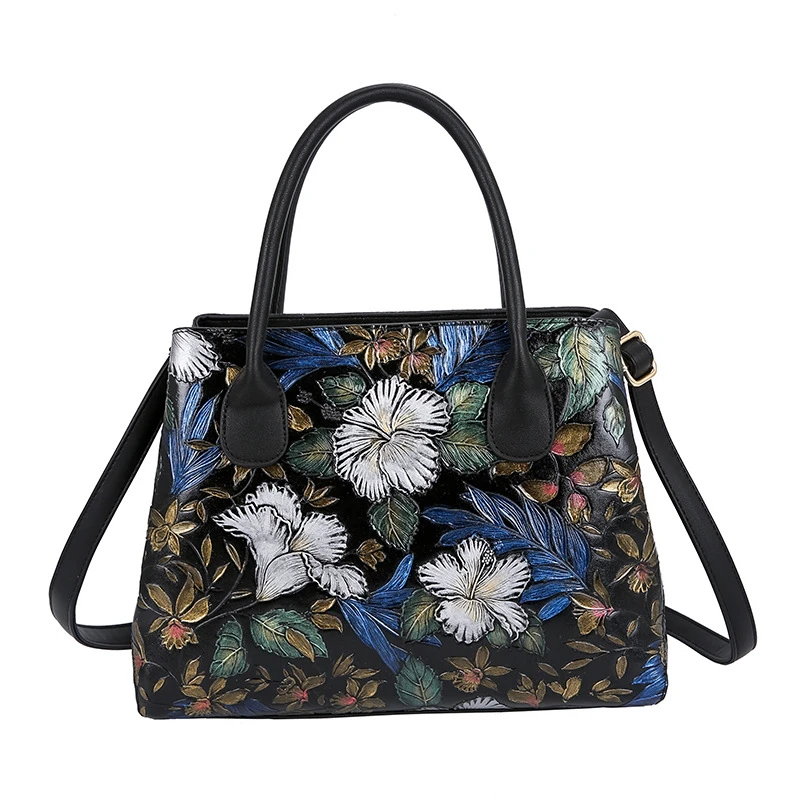
Chinese Painted Embossed Retro Bag
Dimensions: 350×400×50mm
Weight: 620g
Closure: Zipper
Interior: Document sleeve · Phone pocket · Sandwich zip compartment · Zipper pocket
Style: Tote, horizontal square, embossed relief surface
How to Style the Embossed Retro Tote Across the European Seasonal Wardrobe

The embossed surface of this bag absorbs and reflects light differently depending on angle and fabric context. In bright light, the relief pattern creates strong shadow-lines that make the surface appear more graphic. In low light — the ambient warmth of a European restaurant or gallery — the same surface produces a subtler play of texture that rewards proximity. Styling it, therefore, is a question of understanding in which context you want the bag to perform.
The Paris Morning Carry (Safflower)
A midi-length camel wool coat, black straight-leg trousers, a Breton stripe knit tucked in. Carry Safflower as a crook-elbow tote. The warm red of the embossed surface picks up the camel of the coat and creates a tonal conversation that requires no other colour statement in the outfit.
The Amsterdam Editorial (Silver Flower)
Oversized grey wool blazer, cream wide-leg trousers, white trainers. Silver Flower in the crook of the arm. The bag's neutral surface becomes the outfit's architectural element — the only object with surface depth in an otherwise flat-textured outfit.
The Stockholm Winter Minimalism (Pink Fish or Red Fish)
A charcoal ribbed turtleneck, slim black trousers, flat leather boots. Pink Fish for a warm accent that stays within the warm-neutral register; Red Fish for a single, precise chromatic statement that signals festive intention without requiring additional accessories. In Scandinavian fashion culture — where restraint is the lingua franca — one colour, applied with this level of cultural specificity, is the maximum and the optimum.
Why the Internal Structure Matters as Much as the External Surface
According to McKinsey's 2025 European Consumer Behaviour Report, 74% of European women aged 25–45 cite "internal organisation" as the primary functional criterion for premium bag purchase — above brand recognition, above colour, above material. A bag that provides a document sleeve for A4 folders, a dedicated phone pocket for immediate access, a zip compartment for valuables, and a general zipper pocket for miscellany is not simply organised. It has thought about your day with Tang Dynasty precision.
Frequently Asked Questions
The Conclusion: Four Colours, 1,300 Years, One Argument
The Chinese Painted Embossed Retro Bag makes a single, comprehensive argument: that surface depth — in both the physical and the cultural sense — is the most sophisticated language a bag can speak in 2026. Its embossed relief reads differently in morning light than in evening shadow. Its four colourways carry 1,300 years of Tang botanical nomenclature. Its 350×400×50mm horizontal square geometry is architecturally precise. Its internal structure is organisationally complete.
At $28.02, it offers the European woman aged 25–45 a carry that requires nothing else to complete it — no matching accessories, no coordinating colourway within the same collection, no brand mythology to justify the purchase. It is its own cultural justification. That is, in 2026's fashion landscape, the rarest kind of bag there is.
2. Dezeen — "Design Influence Report 2025", retrieved 2026-07-26, https://www.dezeen.com/
3. Victoria and Albert Museum — "Chinese Decorative Arts Catalogue 2025", retrieved 2026-07-26, https://www.vam.ac.uk/
4. Trendstop — "Bag Silhouette Intelligence Report 2025", retrieved 2026-07-26, https://www.trendstop.com/
5. McKinsey — "European Consumer Behaviour Report 2025", retrieved 2026-07-26, https://www.mckinsey.com/