

The Season That Lives in Four Colours: How the Big Flower Ethnic Crossbody Bag Turns 2,000 Years of Miao Da Hua Botanical Intelligence Into 2026's Most Chromatically Liberated European Everyday Carry
There is a particular kind of joy that does not negotiate with the season. It does not wait for spring to wear red, nor for autumn to accept green. It carries its own climate. In the embroidery traditions of the Miao and Dong peoples of southern China — particularly in the craft of dà huā, or "big flower" embroidery — this chromatic sovereignty has been understood for over two thousand years. You do not dress for the season. You carry the season you are already in.
The Big Flower Ethnic Crossbody Bag brings this philosophy into 2026 with remarkable directness. At 33×16.5×9.5cm, it fits against the body with the compact assurance of something that has always belonged there. In Red, Black, Green, or Blue — four chromatic positions representing four distinct temperaments — it asks the European woman aged 25–45 not which colour suits the outfit, but which colour suits the day.
- Miao dà huā (big flower) embroidery is a UNESCO-recognised intangible cultural heritage with 2,000+ years of continuous tradition in southern China's Guizhou and Yunnan provinces.
- The dumpling (jiǎozi) silhouette is a deliberate cultural form: the geometry of nourishment, fullness, and the domestic wisdom of bringing enough.
- At 180g, the bag is the lightest carry in its category — a structural achievement enabled by Nylon's extraordinary strength-to-weight ratio.
- Four chromatic positions — Red, Black, Green, Blue — represent the four cardinal directions of Miao cosmological colour mapping.
What Is Da Hua? The 2,000-Year Tradition Behind the Pattern
In the mountain villages of Guizhou province in southern China, women of the Miao and Dong ethnic communities have for more than two millennia maintained one of the world's most sophisticated textile embroidery traditions. Dà huā — literally "big flower" — refers not merely to the scale of the floral motifs, but to a specific visual grammar: oversized botanical forms, compressed and stylised, that carry complex cosmological meanings within their geometry.
Each flower in the dà huā tradition is a map. It records the seasons, the cardinal directions, the agricultural cycles of the community. Red flowers reference the south and the fire season. Green flowers reference the east and new growth. Blue references the west and water. Black grounds the composition in the north, the void, the root. This is not decorative symbolism. It is an encoding of knowledge so complete that traditional Miao scholars called the embroidery wú zì shū — "the book without characters." The pattern is the text.
The Dumpling Silhouette: When Form Is Also Philosophy
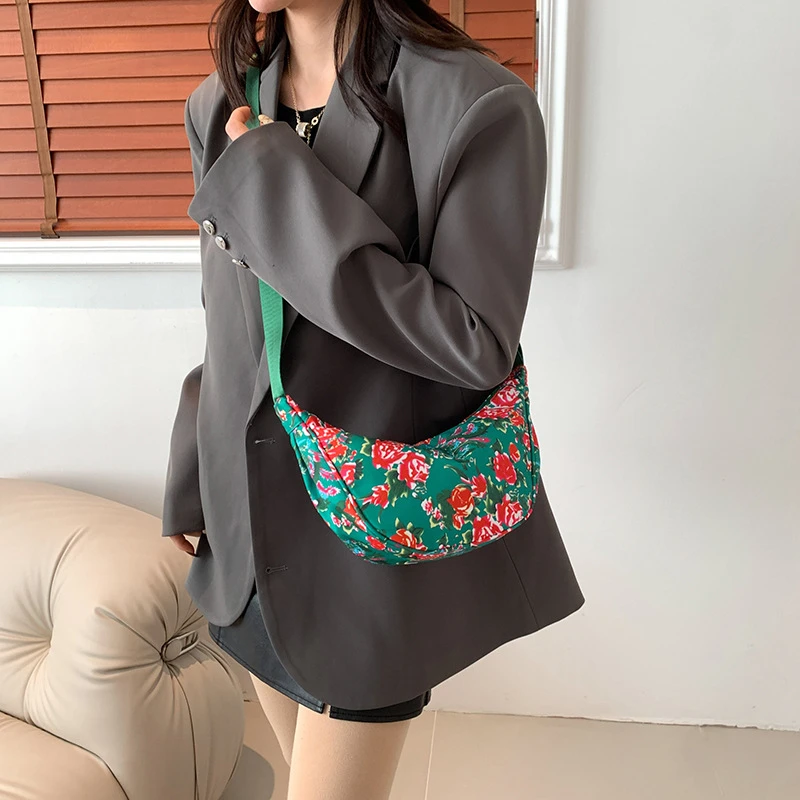
The bag's shape is described as jiǎozi xíng — dumpling-shaped. This is not a casual comparison. The jiǎozi (dumpling) holds a central position in Chinese cultural philosophy as the form of abundance: a vessel that seals nourishment within a yielding exterior, that brings enough without excess, that is complete in itself.
In practical terms, the dumpling silhouette creates a bag body that is round-bottomed, slightly inflated at the centre, and tapered at the edges. This gives the Big Flower Crossbody its characteristic fullness — the sense that it is satisfied, complete, carrying exactly what it needs. At 33×16.5×9.5cm, it sits precisely at the crossbody sweet spot: wide enough to carry a phone, wallet, keys, and earbuds; compact enough to move freely through a crowded European city afternoon without catching on doorways, turnstiles, or other bodies.
The Nylon construction is essential to this silhouette's success. Nylon — first developed in the 1930s and progressively refined into one of the most versatile structural textiles available — offers the tensile strength to maintain the dumpling shape under load, the lightness to allow the embroidery to read without the weight of the underlying material competing for attention, and the chromatic receptivity to carry the saturated dà huā colours at full intensity without fading or bleeding under the friction of daily carry.
Four Positions: Which Colour Is Today?
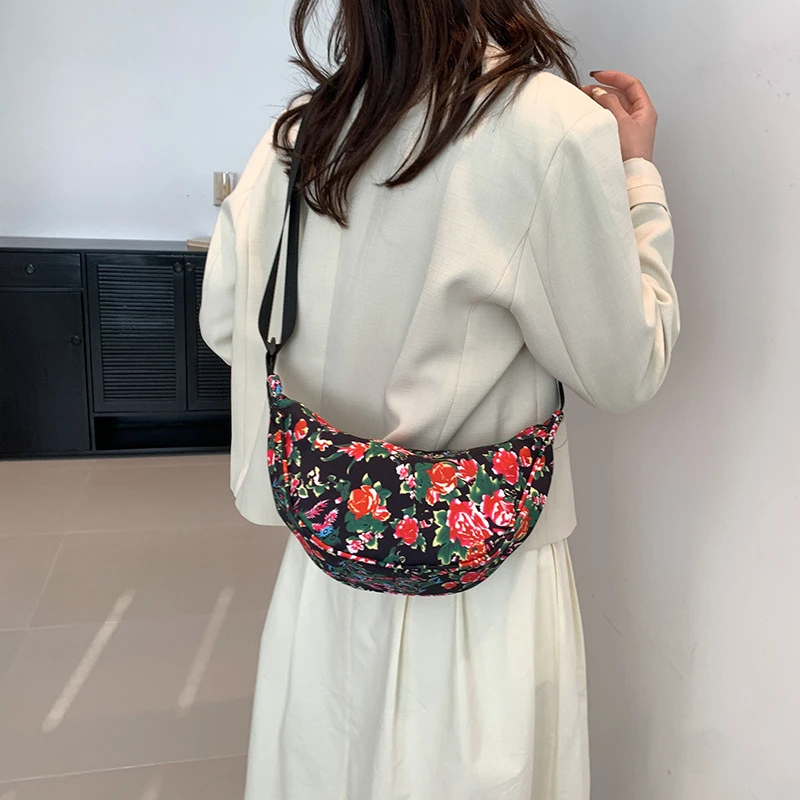
The four chromatic positions of the Big Flower Crossbody are not interchangeable. Each carries a distinct temperamental register, and the experienced carrier learns to read the day before selecting the colour.
Red — The South, The Fire, The Declaration
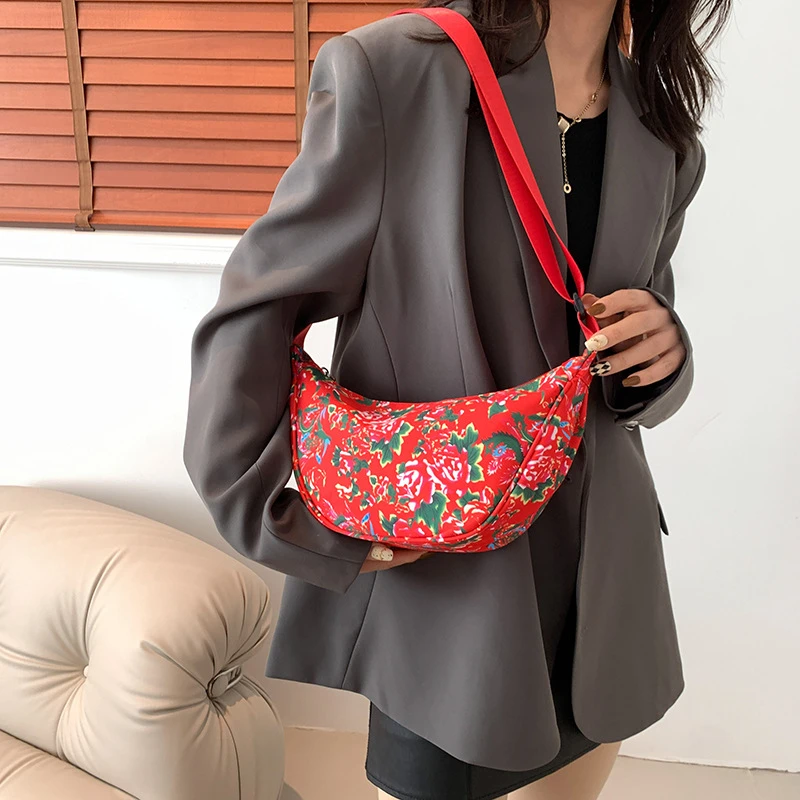
Red in Miao cosmology references the south: the direction of the sun at its highest, the season of maximum growth, the moment of full expression. Red is the carry of the woman who has already decided. It pairs with black denim, white cotton, and the kind of minimalist separates that create the conditions for colour to do its full work.
Black — The North, The Root, The Absolute
Black grounds the Miao cosmological map in the north: the direction of depth, permanence, the origin before the story begins. The Black Big Flower Crossbody is the carry of the woman who needs to be everywhere and everywhere the same. The embroidery reads as tonal texture at distance, exploding into full chromatic complexity at close range.
Green — The East, The New Growth, The Beginning
Green in Miao tradition references the east: the direction of dawn, new growth, the agricultural beginning. Green is the carry of the woman who is in the middle of something. It pairs with terracotta, rust, mustard, and the warm-toned neutrals that define 2026's most resolved European palette.
Blue — The West, The Water, The Passage
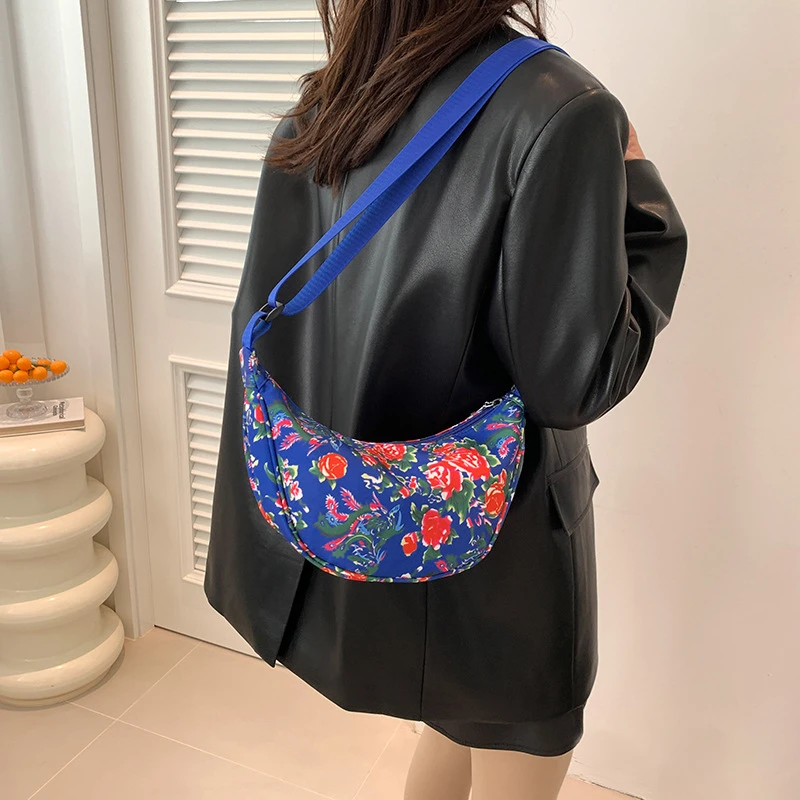
Blue references the west in Miao cosmology: the direction of water, transition, the passage between states. Blue is the carry of the woman in motion — the one between cities, between meetings, between versions of herself. It pairs with white linen, navy denim, and the kind of mid-toned separates that resolve rather than anchor.
180 Grams: The Ethics of Lightness
The weight specification deserves extended attention. 180g is a remarkable achievement for a bag of this visual complexity. The dà huā embroidery — dense, saturated, technically intricate — adds visible weight to the eye before the bag is lifted. The actual experience of lifting it is invariably a surprise: it is lighter than it looks, lighter than it promises, lighter than feels warranted given the craft density visible on its surface.
This is the Nylon advantage, and it is not merely functional. It is a statement about priority. The bag prioritises the embroidery — the cultural content, the visual argument — over the structure that carries it. The structure is present but transparent. The embroidery is foregrounded. This is the correct hierarchy for a bag whose meaning lives in its surface, not its architecture.
For the European woman who already carries too much — phone, laptop, book, water, everything the day requires — the 180g bag is an act of mercy. It arrives without adding to the load. It resolves the carry question without contributing to the carry problem.
How to Style the Big Flower Crossbody in 2026
The dà huā embroidery pattern creates specific styling logic. The pattern is bold enough to serve as the primary visual element of any outfit. This means the bag works best against tonal simplicity: when the bag is the statement, the garments become the ground.
Red Against the Minimal
Red Big Flower Crossbody against an all-white or cream cotton outfit: the bag carries the entire chromatic argument. This is the European summer move — maximum visual impact from a single accessory decision. Add a straw hat and flat sandals and the outfit is complete, resolved, and cultural without effort.
Green Against the Warm Neutral
Green against camel, rust, or terracotta creates the autumn resolution. The green reads as a botanical intrusion into the warm-toned outfit — deliberate, correct, and very 2026. Ankle boots, wide-leg trousers, a loose roll-neck: the bag is the one thing that does not follow the palette.
Black Against Everything
The Black version is the crossbody for the woman who does not want to think about it. Black resolves against every outfit, every season, every occasion. The embroidery on the Black version reads at close range as intricate texture. At distance, it reads as a carry decision. Both readings are correct.
Blue Against White
Blue and white is one of the oldest pairing traditions in both European and Chinese decorative arts. The Blue Big Flower Crossbody against a white shirt, white jeans, or a white cotton dress retrieves this tradition without referencing it directly. The result is fresh, considered, and quietly cross-cultural in the best possible sense.
Frequently Asked Questions
What is Miao da hua embroidery and why does it matter to fashion?
Miao dà huā (big flower) embroidery is a 2,000-year-old textile tradition from the Miao and Dong ethnic communities of Guizhou and Yunnan provinces in southern China. Recognised by UNESCO as an intangible cultural heritage, it uses oversized botanical forms to encode cosmological, seasonal, and directional knowledge. In fashion terms, it presents European consumers with genuinely rare decorative intelligence — a surface vocabulary that was never merely decorative.
Why is Nylon the right material for this type of bag?
Nylon offers an exceptional strength-to-weight ratio — approximately 3–4 times stronger than cotton at equivalent weight — making it ideal for a bag where lightweight carry is as important as structural integrity. Its chromatic receptivity allows the saturated dà huā colours to read at full intensity without fading. It also resists moisture, abrasion, and the general wear of daily European city use with considerable durability.
What is the dumpling (jiǎozi) silhouette and does it affect functionality?
The jiǎozi silhouette — round-bottomed, slightly inflated at centre, tapered at the edges — is a form borrowed from Chinese culinary culture, where the dumpling represents abundance and completeness. Functionally, it creates a bag that holds its shape under load, distributes weight evenly across the base, and maintains a compact crossbody profile. The rounded base also means contents settle naturally rather than jamming into corners.
How do I choose between the four colour options?
The four colours represent distinct chromatic temperaments mapped to Miao cosmological traditions: Red (south, fire, maximum expression), Black (north, permanence, tonal versatility), Green (east, new growth, warm-palette complement), Blue (west, water, transition and movement). In practical European wardrobe terms: Black for all-season versatility, Red for impact carry, Green for warm-tone outfits, Blue for cool-tone and white combinations.
Is $9.74 a fair price for this level of craft and cultural content?
At $9.74, the Big Flower Ethnic Crossbody Bag occupies an extraordinary value position: a bag carrying 2,000 years of UNESCO-recognised cultural heritage in its embroidery pattern, weighing 180g, in four genuine chromatic options, at a price point that makes daily rotation through all four colours genuinely accessible. The value is not despite the price — it is structurally embedded in the design decision to bring this craft tradition into democratic reach.
Conclusion: The Big Flower Ethnic Crossbody Bag is not the bag you buy when you have run out of ideas. It is the bag you reach for when you have already decided who you are today and want an object that confirms it at $9.74 and 180 grams. Four colours. Four temperaments. 2,000 years of Miao botanical intelligence arriving at the European hip in the most democratically accessible form it has ever taken. Carry the season you are already in.
1. Miao People and Cultural Heritage — Textile traditions and da hua embroidery, retrieved 2026-10-09, https://en.wikipedia.org/wiki/Miao_people
2. UNESCO Intangible Cultural Heritage — Chinese embroidery traditions, https://ich.unesco.org/en/RL/skills-for-making-silk-01153