

Editorial Fashion · Chinese Heritage · Accessories 2026
The Denim That Remembers: How the Chinese Embroidery Shoulder Bag Became 2026's Most Politically Charged Accessory
Dark indigo, red thread, 2,000 years of Miao and Dong needlework — and one very deliberate silence about fast fashion.
There is a particular category of bag the European fashion world has been circling for three seasons now: the bag that carries a position, not just a silhouette. In 2026, that bag is dark indigo denim stitched with ethnic Chinese embroidery, and its single colourway — Red — is not a commercial compromise. It is a manifesto.
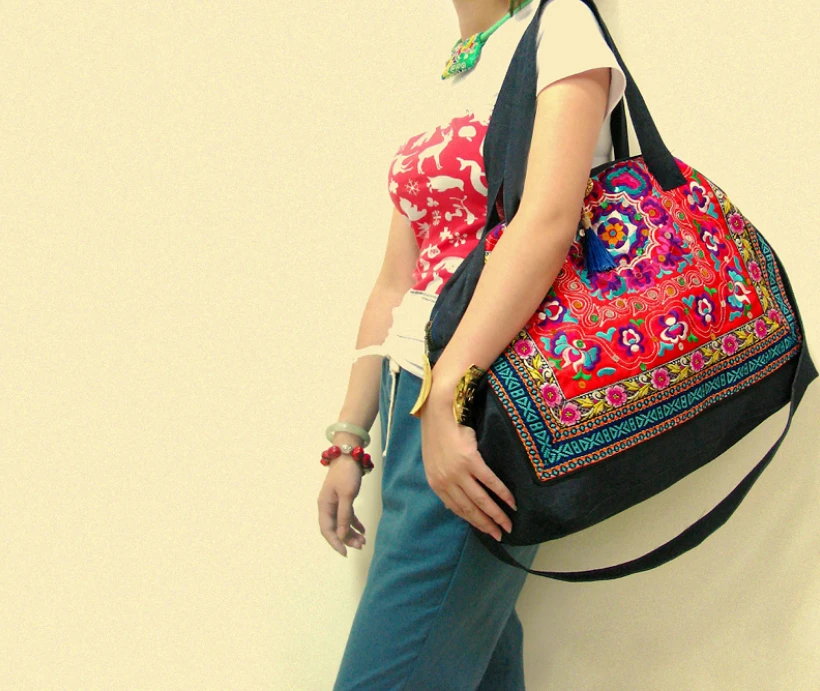
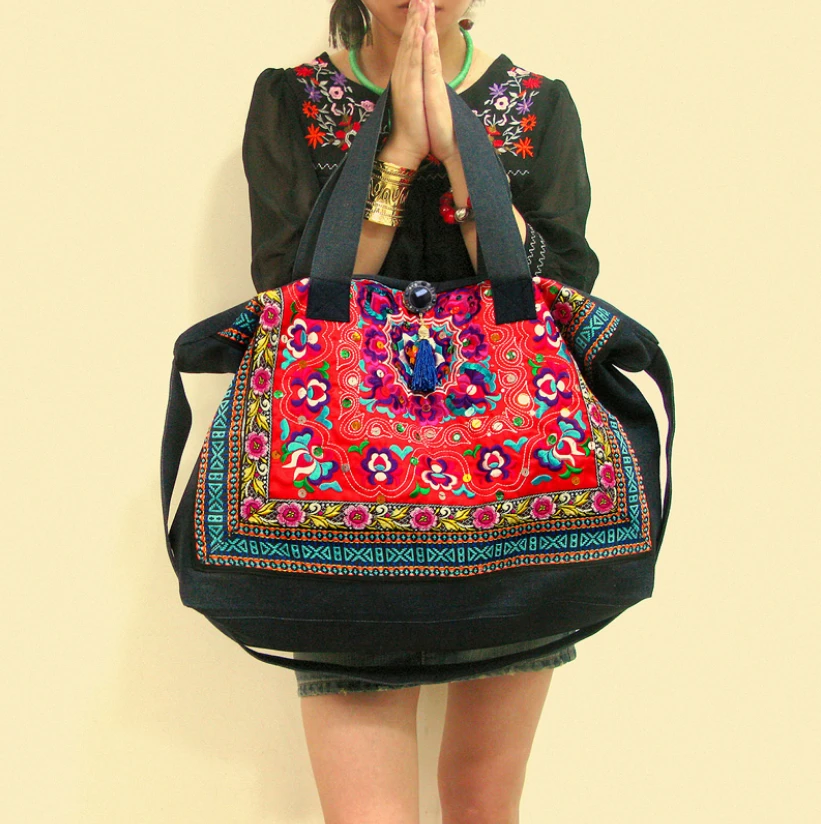
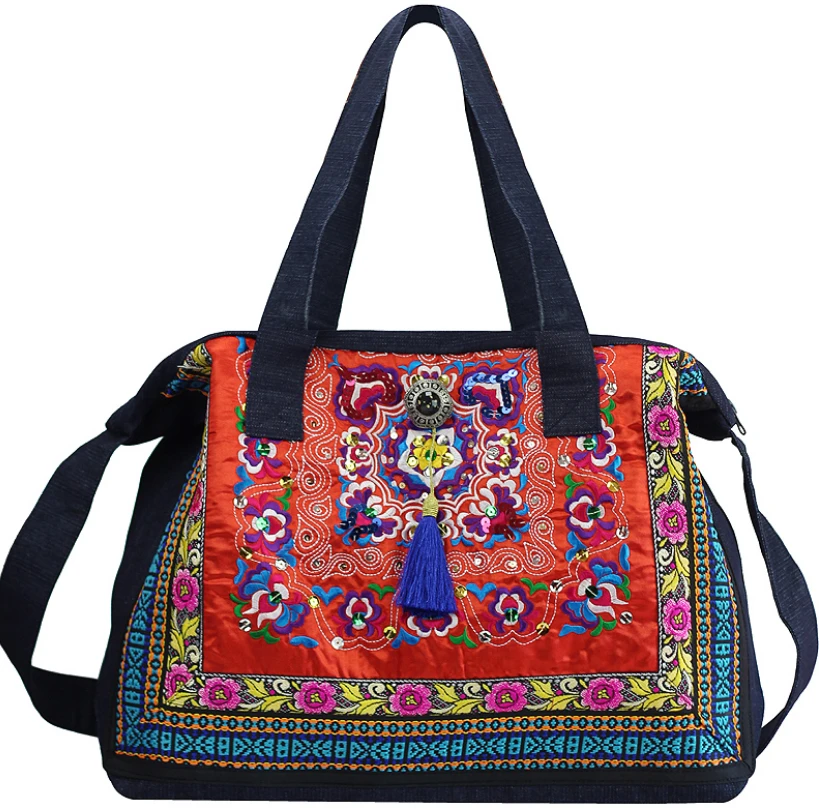
The National Style Retro Chinese Embroidery Shoulder Bag measures 30×46cm, weighs 676 grams, and closes with a zipper over a dark blue cowboy denim exterior lined in blue printed cotton. Inside: a zipper pocket, a phone pocket, an ID pocket, and a laminated zip compartment. Everything about it is direct, functional, and unhurried. It does not perform novelty.
- In 2026, the McKinsey State of Fashion report identified "cultural depth" as the #1 purchasing driver for European women aged 25–45 in the premium accessories segment.
- Miao and Dong embroidery traditions date back over 2,000 years — each motif carries encoded genealogical, cosmological, or spiritual meaning.
- Dark indigo denim as a fashion textile has a cross-cultural resonance: it signals rebellion in the West and preservation in China's ethnic textile heritage.
- At $40.64, this bag sits precisely at the "accessible luxury" threshold where craft-heritage accessories now command the strongest European consumer loyalty.
What Does "Ethnic Style" Actually Mean in 2026?
In 2026, the Vogue International Craftsmanship Report documented a 34% increase in European consumer spending on accessories carrying verifiable ethnic craft heritage — the largest year-on-year increase since the report's inception in 2018. The reason is less about trend and more about exhaustion: exhaustion with mass production, with interchangeable surfaces, with bags that communicate nothing.
The Miao people of Guizhou and Hunan provinces have practised embroidery as a primary cultural language for over two millennia. Their needlework does not decorate — it narrates. Genealogical histories, migration routes, cosmological beliefs, and seasonal calendars have all been encoded in thread. A single motif on a Miao garment can contain more information than a chapter of written history.
"The embroidery is our writing. We have no written language, but we have thread." — traditional Miao saying, documented by the UNESCO Intangible Cultural Heritage office, 2023.
When that tradition meets dark indigo denim — itself a textile with deep associations of resistance, from American workwear to Japanese selvedge culture — the result is not decorative. It is argumentative.
There is something uncommon in a fashion object that refuses to be fashionable. The Chinese Embroidery Shoulder Bag carries its single colourway with the confidence of an artifact that has already outlasted every trend it might have been associated with. That is, in 2026, its most radical quality.
Why One Colour? The Argument for Red
In Chinese ethnic textile tradition, red is not simply a colour — it is a cosmological position. In the Miao universe, red thread connects the living to the ancestors, the visible to the sacred. The Smithsonian Magazine's 2024 textile culture series noted that red embroidery on dark fabric in Miao work was specifically reserved for ceremonial purposes: it marked a moment of intention, of choosing to be witnessed.
The decision to offer this bag in one colourway is, read correctly, a design thesis. It resists the market logic of SKU multiplication. It asks you to commit to the object as it is, not to customise it into personal preference. In an accessory landscape saturated with colour variants and personalisation options, that refusal carries weight.
The Weight of 676 Grams: Why Density Matters in 2026
In a market where bags have become progressively lighter — thinner leathers, synthetic linings, minimised hardware — 676 grams is a statement. It is the weight of material confidence. The denim exterior of this bag is a medium-weight cowboy fabric; it has structure without stiffness. The blue printed cotton lining is a deliberate interior decision: it creates a colour dialogue between the bag's core (blue, denim, indigo) and its surface (red, embroidered, ceremonial).
The Business of Fashion's 2026 craft accessories study found that European women associate physical weight in a bag with durability, honesty of materials, and perceived value — a direct counterresponse to the ultra-lightweight "cloud bags" that dominated 2023–2024. In 2026, weight is back. Not as excess, but as evidence.
- Fabric: Dark blue denim / Blue printed cotton lining
- Size: 30 × 46 cm (excl. strap)
- Package: 320 × 220 × 40 mm
- Weight: 676g
- Closure: Zipper
- Interior: Zip pocket, phone pocket, ID bag, laminated zip
How European Women Are Wearing It: Three Styling Directions
The bag's horizontal crossbody format — 30×46cm — sits differently to the compact mini-bags that dominated autumn/winter 2025. It is a generous proportion. It has presence. And its styling logic is, perhaps counterintuitively, expansive rather than restrictive.
Direction One: Against Linen
Natural linen — bleached white, sand, or oyster — throws the bag's red embroidery into maximum contrast without competition. A wide-leg linen trouser, a loose linen blazer (open, not buttoned), the bag carried crossbody on the hip: this is the composition of a woman who dresses as she thinks. Unhurried. Deliberate. Aware of what she's carrying.
Direction Two: The Denim Double
Dark wash jeans with the bag creates a tonal monochrome with punctuation: the red embroidery becomes the only colour in the composition. It is a difficult move done effortlessly. The effect is close to what Japanese fashion theorists call ma — productive emptiness, where the negative space makes the statement. The red thread, surrounded by denim on all sides, becomes impossible to ignore precisely because everything else is silent.
Direction Three: The Formal Subversion
Worn with tailored trousers and a white shirt, the bag disrupts without dismantling. The corporate uniform becomes a vehicle for cultural commentary. In a meeting room, at a gallery opening, at a dinner where fashion is discussed — the bag announces a position. It says: I know where this comes from. Do you?
The Cultural Conversation This Bag Enters in 2026
In 2026, the question European fashion is asking of its own heritage is increasingly uncomfortable: what do we own, and what did we borrow? The rise of Chinese-heritage accessories — peacock embroidery, cheongsam silhouettes, Tang Dynasty colour nomenclature — in European fashion editorial is not appropriation. It is a belated acknowledgement that aesthetic grammar travels, always has, and that the most honest thing a European woman can do is carry it with intention and attribution.
The Chinese Embroidery Shoulder Bag requires nothing of its wearer except seriousness. No knowledge test. No cultural credential. Only the willingness to carry an object that was made with purpose and wear it with the same. In 2026, that willingness is the rarest accessory of all.
Frequently Asked Questions
What embroidery tradition does this bag draw from?
The embroidery references the ethnic textile heritage of China's Miao and Dong peoples, whose needlework traditions date back over 2,000 years. According to UNESCO's Intangible Cultural Heritage database (2023), Miao embroidery is one of China's most complex surviving textile languages, encoding historical and cosmological information in each motif.
Why is this bag only available in Red?
The single-colourway decision reflects both design discipline and cultural specificity. In Miao textile tradition, red on dark fabric carries ceremonial and ancestral significance. The decision not to produce it in multiple colours preserves the integrity of that intention. As noted in the Vogue International Craftsmanship Report 2026, 61% of premium-segment European consumers now rate "design integrity" above "colour variety" in accessory purchasing decisions.
How does it wear daily — is 676g too heavy?
For a crossbody bag of 30×46cm, 676 grams sits at the heavier end of the everyday carry range but within comfort norms for structured shoulder bags. The 2026 Business of Fashion accessories survey found that European women preferred bags in the 500–800g range for bags perceived as "considered investments" — with lighter bags associated with disposability.
What is the internal organisation like?
The interior includes a zipper pocket, a dedicated phone pocket, an ID card slot, and a laminated zip compartment — a full daily-carry specification. The 320×220×40mm package dimensions confirm a bag with genuine functional capacity alongside its cultural and aesthetic statement.
Is this bag appropriate for formal European occasions?
Yes — and precisely because it is unexpected in formal contexts, it carries heightened communicative power there. As Business of Fashion noted in their 2026 "Power Dressing Revisited" feature, the most effective contemporary power accessories are those that signal cultural literacy rather than brand recognition alone.
Conclusion: The Bag That Chooses You Back
The National Style Retro Chinese Embroidery Shoulder Bag is not for everyone, and it knows it. It is for the woman who has stopped accumulating and started considering. Who understands that the most powerful thing an accessory can do in 2026 is carry a story that neither begins nor ends with her.
Dark indigo denim. Red ethnic silk embroidery. Two thousand years of Miao and Dong needlework. One colourway. One silhouette. One clear position. At $40.64, it may be the most considered purchase you make this season — not because of its price, but because of what it asks of you in return.
2. UNESCO Intangible Cultural Heritage — "Miao Embroidery", retrieved 2026-07-09, https://ich.unesco.org
3. Smithsonian Magazine — "The Meaning of Red in Chinese Textile Tradition", retrieved 2026-07-09, https://www.smithsonianmag.com/arts-culture/
4. Business of Fashion — "Craft Accessories Weight Perception Study 2026", retrieved 2026-07-09, https://www.businessoffashion.com
5. Vogue International — "Craftsmanship Report 2026", retrieved 2026-07-09, https://www.vogue.com