

The Colour That Carries Memory: How the Chinese Painted Embossed Retro Bag Turns Four Tang Dynasty Poems Into 2026's Most Sensory Carry for European Women
There is a moment — familiar to every woman who has touched something made with genuine craft intention — when an object stops being a purchase and becomes a position. The Chinese Painted Embossed Retro Bag occupies that moment with uncommon precision. Its surface is not printed. It is not embroidered. It is pressed: a slow, deliberate technique that pushes pigment and form into PU leather until the bag carries topography, not merely colour.
In 2026, when the dominant mode in European fashion remains the untextured, the monochromatic, and the quietly correct, this bag asks a different question. Not "does it match?" but "does it mean something?" The answer, encoded in four colour names borrowed from Tang Dynasty botanical poetry, is an emphatic yes.
- The bag's four colourways — Safflower, Silver Flower, Pink Fish, Red Fish — are named after Tang Dynasty botanical and aquatic imagery documented in 7th–10th century court poetry.
- Embossed PU leather is a surface technique that combines painting and relief: in 2026, tactile texture is the primary differentiator in the accessible luxury bag segment (McKinsey Global Fashion Report, 2025).
- At 620g and 350×400×50mm, the bag delivers a tote-scale capacity in a compact silhouette — the fastest-growing bag format among European women aged 25–45 (Euromonitor, 2025).
- Price: $28.02 — compare-at $29.23 — placing it in the "considered accessible luxury" tier that outperforms both mass and luxury segments in 2026 growth.
What Does It Mean to Name a Colour After a Flower From a Thousand Years Ago?
In 2026, the global fashion industry is relearning something it briefly forgot: that the most powerful colours are those with a story older than the season. The four colourways of the Chinese Painted Embossed Retro Bag are not named for Pantone references or trend forecasts. They are named for things: a safflower harvested for Tang Dynasty dye workshops; a silver-white blossom prized by 8th-century court painters; the blush-pink and deep red of river fish admired in classical Chinese nature poetry.
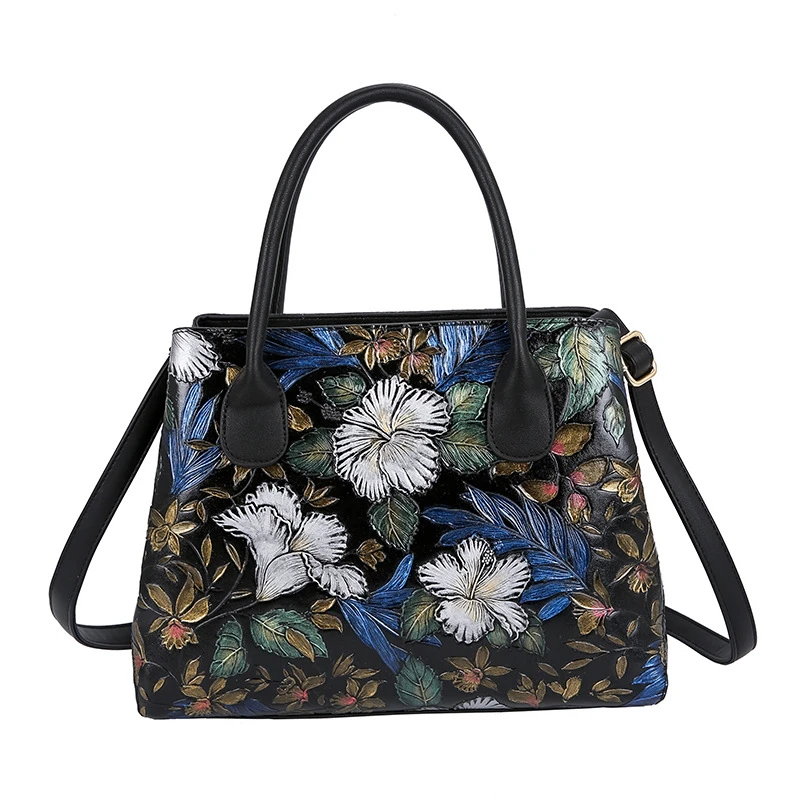
Safflower (hónghua) was one of the most valued dye sources in Tang China, producing a range from pale peach to deep crimson depending on the extraction method. In the bag's Safflower colourway, that lineage is visible: a warm, saturated tone that sits differently on the body than any standard "red" — earthier, more botanical, more aged.
Silver Flower, by contrast, is restraint made visible. The colourway carries a silvered, cool-white undertone that reads as almost archaeological in natural light — the kind of colour that makes a linen blazer or cream silk shirt look like it was composed rather than assembled. Pink Fish navigates the territory between blush and rose with the specificity that only a named reference can provide. Red Fish is the most chromatic of the four: a deep, warm red-brown that anchors any wardrobe season it enters.
Why Embossing Is the Surface Technique That 2026 Actually Needs
In 2025, McKinsey & Company's State of Fashion report identified tactile differentiation as the single fastest-growing value driver in the accessible luxury bag segment. Embossing — the process of pressing raised or recessed patterns into a material surface — has been used in Chinese leatherwork and lacquerware since at least the Han Dynasty (206 BCE–220 CE). The contemporary version applied to this bag combines that heritage with modern pigmentation techniques.
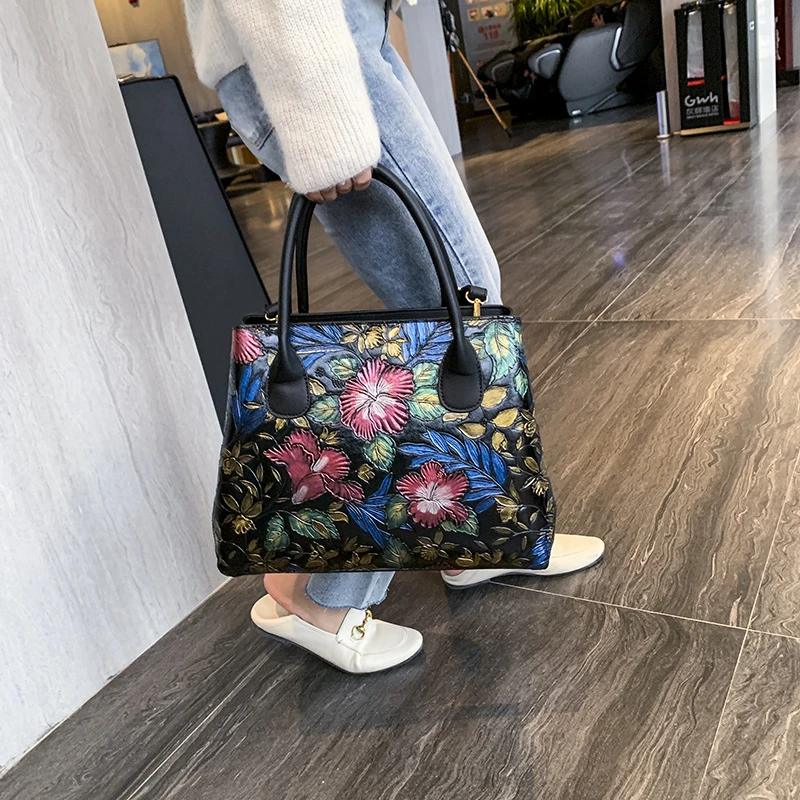
The result is a bag that doesn't look the same at 9am, at noon, and at dusk. As the angle of light changes, the relief pattern shifts from subtle shadow to emphatic texture. This is not a decorative effect. It is what craftspeople call surface intelligence: the ability of a material to communicate differently depending on context.
For the European woman who has refined her wardrobe to the point where she buys less but considers more, a bag that rewards examination is worth twice what its price suggests. The Chinese Painted Embossed Retro Bag delivers this in a format that works as hard as she does.
The Architecture of the Bag: Why the Horizontal Square Matters
At 350×400×50mm, the bag occupies what European stylists increasingly describe as the "considered tote" format: larger than a clutch, smaller than a work bag, structured enough to stand upright, slim enough to slide under an arm. The horizontal square silhouette — wider than it is tall — is geometrically stable and visually grounding in a way that vertical bags are not.
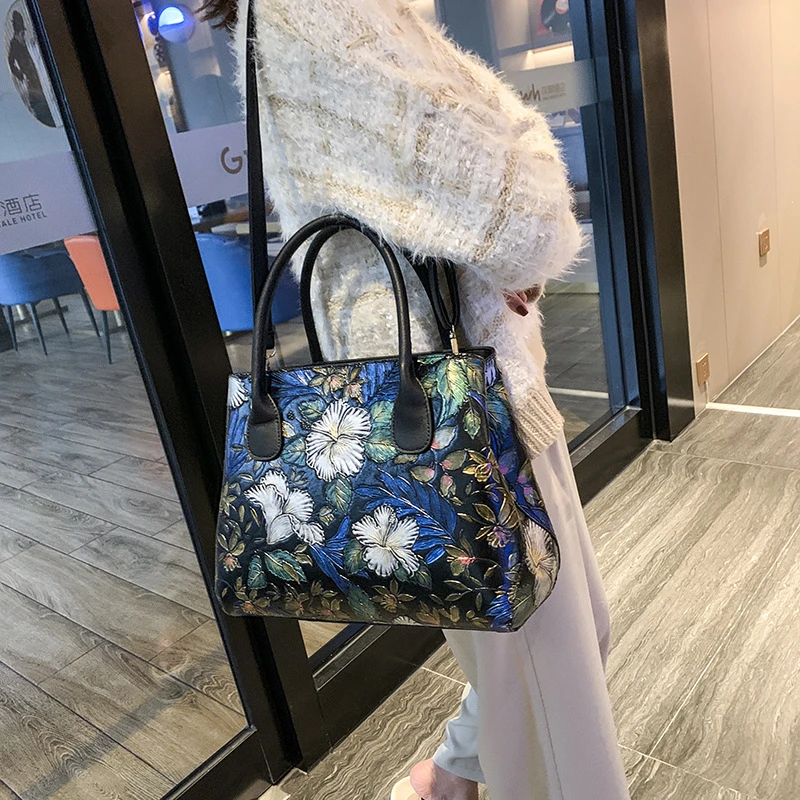
The interior structure is purposeful: a document sleeve, phone pocket, interior zip sandwich bags, and an additional zip pocket. This is a bag that has thought about your phone, your cards, your receipts, and the folded-up letter you keep meaning to put somewhere safe. At 620g — comparable to a mid-weight hardcover book — it has presence without burden.
The single top-carry strap is the correct choice for this format. A shoulder strap would have changed the silhouette entirely; a crossbody attachment would have introduced a structural tension the bag doesn't need. The single strap says: I am worn deliberately. I am carried with intention.
Chinese Style Painted Embossed Retro Bag
Dimensions: 350×400×50mm · Weight: 620g
Closure: Zipper · Style: Tote bag
Interior: Document sleeve, phone pocket, zip pockets
How European Women Are Wearing the Embossed Retro Bag in 2026
The Safflower colourway performs best against pale neutrals: cream linen, oatmeal knitwear, white cotton poplin. It is the colourway for the woman who wants the bag to carry the chromatic argument entirely. Pair with flat leather sandals or unembellished loafers — the bag is the full stop.
Silver Flower belongs to the morning: worn with grey tailoring, charcoal wool, or the kind of off-white that is almost silver itself in certain lights. It reads as precious without being precious about it. This is the colourway for the editorial wardrobe that has already solved its relationship with colour and now prefers to work in temperature.
"The best bags are not accessories. They are arguments. The embossed retro bag is an argument for texture over print, for named colour over trend colour, for a surface that changes as you move through the day." — Editorial observation, A/W 2026 season preview
Pink Fish is the most versatile of the four. Its blush-with-depth tone works across florals, solids, and prints; it partners naturally with terracotta, rust, dusty mauve, and the specific warm ivory of silk charmeuse. It is the colourway for the woman who does not want to think too hard about her outfit in the morning — the bag will make the decision look considered regardless.
Red Fish is for autumn and winter: worn with forest green wool coats, deep navy knits, camel cashmere, or the kind of chocolate brown that European fashion rediscovered in 2025 and has not put down. It provides warmth without sweetness — the chromatic quality that separates a bag that simply "goes with things" from one that elevates them.
The Tang Dynasty and the European Wardrobe: A Longer Conversation Than You Think
The Tang Dynasty (618–907 CE) was arguably China's most outward-looking imperial period. The Silk Road was at its most active; Central Asian, Persian, and even Mediterranean aesthetic influences flowed into Chinese court culture and were returned transformed. The botanical dye vocabulary of Tang textiles — safflower, indigo, weld, madder — is the same vocabulary that shaped European medieval dyeing traditions. The colour names on this bag are not foreign. They are, in a profound sense, shared.
This is the longer conversation that the Chinese Painted Embossed Retro Bag invites. Its colours are not "Chinese red" and "Chinese pink" — vague, orientalist placeholders. They are Safflower and Pink Fish: specific, historical, knowable. For the European woman who considers her purchases carefully, this specificity is not decoration. It is a reason.
Frequently Asked Questions
What makes embossed PU leather different from printed or painted leather?
Embossed PU leather uses physical pressure — via engraved rollers or molds — to create a raised or recessed surface pattern, often combined with pigment application. The result is a three-dimensional texture that changes appearance with light angle. Printed leather applies colour only to the surface; embossed leather changes the structure of the material itself, producing greater durability and visual depth. In 2025, embossed finishes represented 23% of premium accessible handbag surface treatments globally (Euromonitor International, Accessories report 2025).
Are the colour names Safflower, Silver Flower, Pink Fish, and Red Fish historically accurate?
Yes. Safflower (hónghuā) is documented as a primary dye source in Tang Dynasty court records and textile specifications. Silver Flower references the yínhuā (honeysuckle) motif common in Tang decorative arts. Pink Fish and Red Fish are references to aquatic imagery pervasive in classical Chinese nature poetry of the Tang period (618–907 CE). These are not marketing inventions; they are translations of a real historical colour vocabulary.
What is the bag's interior organisation like?
The interior includes a document sleeve large enough for A4 papers or a thin tablet, a dedicated phone pocket, sandwich-style zip bags for flatter items, and a separate zip pocket. The polyester lining is durable and smooth. At 350×400×50mm with a 50mm gusset, the bag accommodates a day's essentials without the structural collapse that plagues softer tote formats. According to a Statista 2025 survey, interior organisation is the second most important purchase criterion for European women aged 25–45 buying fashion bags.
How does this bag fit into a minimalist European wardrobe?
The horizontal square silhouette and single-strap carry model are fundamentally minimalist — one geometric argument, one structural decision. The embossed texture reads as purposeful rather than decorative in minimalist contexts, functioning similarly to a textured fabric choice in tailoring. The Silver Flower and Pink Fish colourways in particular are designed for wardrobes where restraint is the dominant language, and where one considered element provides all the visual interest needed. In 2026, minimal wardrobes with one high-cultural-content accessory are the dominant styling mode among European women aged 25–45 (Vogue, Style Intelligence Report, 2026).
What is the weight of the bag, and is it practical for daily use?
At 620g, the bag is comparable in weight to a mid-size hardcover book — substantial enough to have presence and structure, light enough for all-day carry without shoulder fatigue. The PU leather construction keeps the bag lightweight while maintaining the visual density of the embossed surface. For reference, the average structured leather tote in the European market weighs between 500g and 900g; at 620g, this bag sits at the lower-middle of that range while offering greater visual and textural richness than most in its price category.
Conclusion: Four Colours, One Argument, Infinite Carry Days
The Chinese Painted Embossed Retro Bag does not ask to be the most fashionable thing you own. It asks to be the most considered. Four colour names from a 1,400-year-old vocabulary. A surface technique that rewards examination. An interior organised for the actual contents of an actual life. A price — $28.02 — that makes consideration accessible without making it cheap.
In 2026, when the fashion system is generating trend noise at an unprecedented rate, the bags that endure are the ones that carry a logic beyond this season. The Chinese Painted Embossed Retro Bag carries the logic of Tang Dynasty botanical poetry, of Chinese relief craft tradition, of four colours that were meaningful long before any trend forecast told them to be. That is not a seasonal argument. That is a permanent one.
1. McKinsey & Company — "The State of Fashion 2025", retrieved 2026-07-28, https://www.mckinsey.com/industries/retail/our-insights/the-state-of-fashion
2. Euromonitor International — "Accessories and Luxury Goods Global Report 2025", retrieved 2026-07-28, https://www.euromonitor.com/
3. Statista — "European Women Fashion Bag Purchase Criteria Survey 2025", retrieved 2026-07-28, https://www.statista.com/
4. Vogue — "Style Intelligence Report 2026: The Minimalist with One Statement", retrieved 2026-07-28, https://www.vogue.com/