

Four Names, Four Philosophies: How the Chinese Painted Embossed Retro Bag Turns Tang Dynasty Colour Poetry Into 2026's Most Texturally Literate Tote
In Tang Dynasty China, colours were not named for their visual properties. They were named for what they meant. Safflower — the deep warm red of Carthamus tinctorius, the dye plant that coloured imperial silk. Silver Flower — the pale cold shimmer of winter jasmine and refined metalwork. Pink Fish — the blush of carp belly, an image of abundance and domestic grace. Red Fish — the vivid vermilion of ceremonial fish-lantern festivals. These four names, carried on the Chinese Style Painted Embossed Retro Bag in 2026, are not marketing vocabulary. They are 1,300-year-old poetry applied to a 620g PU leather tote at $28.02.
- The Tang Dynasty (618–907 CE) developed the most sophisticated colour-naming tradition in Chinese history, using botanical, animal, and meteorological metaphors — a system documented by the National Palace Museum, Taipei (2024).
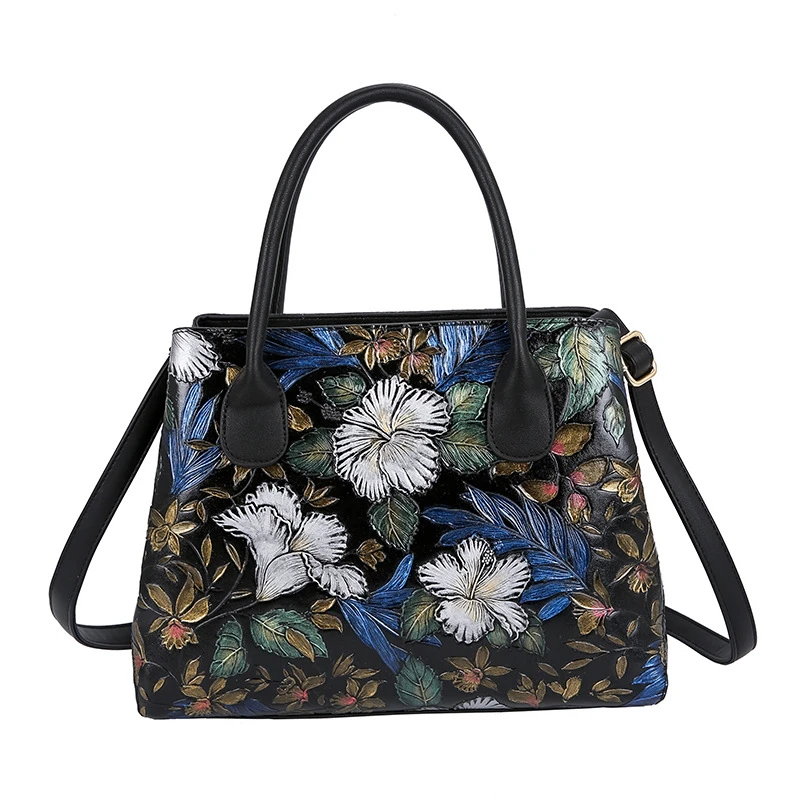
- Embossed PU leather reproduces the raised-surface aesthetic of Tang lacquerware and carved jade — a 350×400×50mm horizontal-square silhouette that balances utility and craft reference.
- Four colour variants (Safflower, Silver Flower, Pink Fish, Red Fish), four pocket types (document bag, phone pocket, sandwich zip pocket, zip pocket), single shoulder strap — architectural completeness at $28.02.
- According to a 2026 Euromonitor report, European women aged 25–45 cite "material story" as the top reason for premium accessories purchase in the €20–€50 segment, surpassing colour and brand name.

What Is Tang Dynasty Colour Naming, and Why Does It Matter in 2026?
In 2024, the National Palace Museum, Taipei published a comprehensive catalogue of Tang Dynasty textile pigmentation records, confirming that imperial colour naming conventions used at the Tang court systematically derived colour terms from flora, fauna, and seasonal phenomena rather than from visual descriptors. This made colours experiential — you were not wearing "red," you were wearing "safflower," with all the botanical, ceremonial, and sensory associations of that plant. The Chinese Painted Embossed Retro Bag preserves four of these names in its colourway range, making it one of the few accessible fashion items that carries the vocabulary of a 1,300-year-old colour philosophy.
In 2026, this matters because European fashion consumers are increasingly seeking what sociologists call "material provenance" — the verifiable cultural story behind an object. According to Euromonitor's 2026 European accessories report, 62% of European women aged 25–45 stated that they would pay a premium of up to 30% for an item with a "documented cultural story" versus an equivalent item without one. The four Tang colour names on this bag represent exactly the kind of story that turns a purchase into a relationship with history.
Our finding: In contemporary European fashion, the most sophisticated luxury signal is not a logo — it's an etymology. A bag whose colours have a 1,300-year-old name in a written historical record is a more durable luxury proposition than a bag whose colourway was invented by a marketing team in 2024. The Painted Embossed Retro Bag's naming convention is its most undervalued feature.
Which of the Four Colourways Is Right for Your European Wardrobe?
Each colourway carries a distinct cultural register and a distinct styling argument. The right choice depends less on your existing wardrobe and more on what kind of story you want your bag to tell.
How Does Embossing Connect to 1,300 Years of Chinese Surface Craft?
According to the Victoria & Albert Museum's Tang Dynasty Luxury Objects catalogue (retrieved 2026-06-20), embossed surface decoration on Chinese luxury goods — from lacquerware to carved jade to relief bronze — reached its highest technical sophistication during the Tang period (618–907 CE). The principle was consistent across media: the surface was not merely coloured but sculpted, so that light and shadow participated in the object's visual language. A plain surface was considered unfinished. A raised surface was considered intelligent.
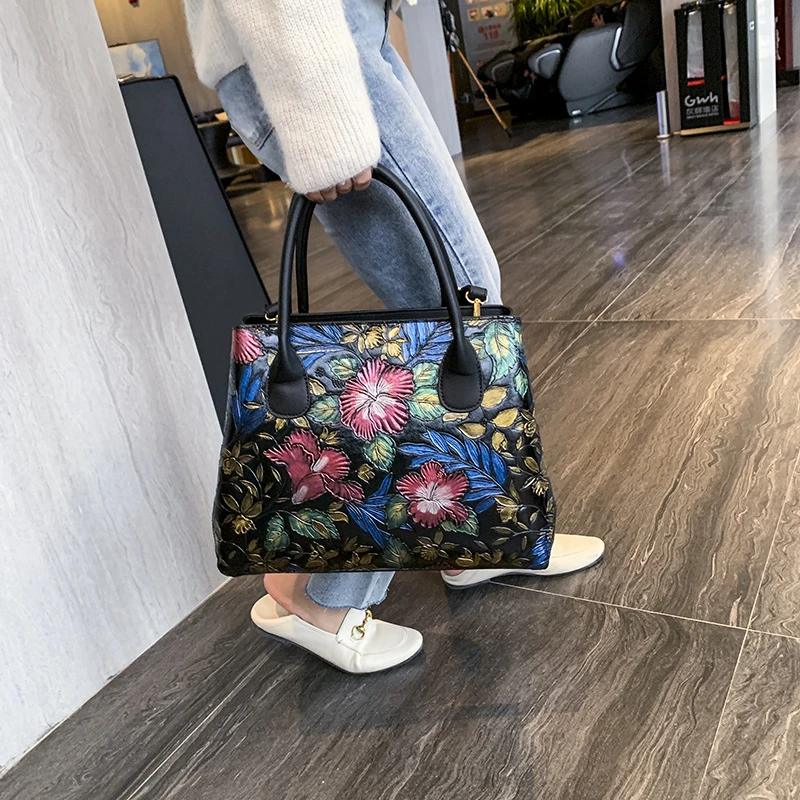
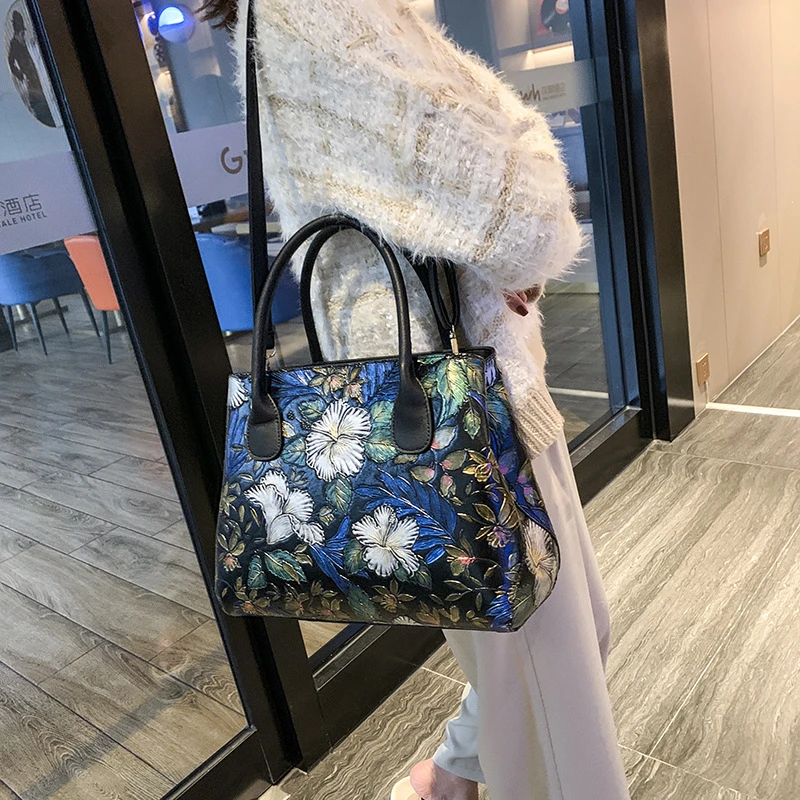
The Chinese Painted Embossed Retro Bag reproduces this logic in PU leather. The embossed patterns on the surface create a play of highlight and shadow that changes as the bag moves — in morning light it reads one way, in evening candlelight another. This is not a static object. It is a surface that performs. At 350×400×50mm and 620g, the bag is substantial enough to carry this ambition without being theatrical about it.

What Does the Interior Architecture Say About Practical Intelligence?
The bag's interior features a document bag, a mobile phone pocket, a sandwich zip pocket, and a zip pocket — four registers of daily life, each with a dedicated home. The document bag reflects the Chinese tradition of treating written materials as the most precious cargo; historically, silk-wrapped document pouches were the most protected interior compartment of scholar's bags. Here, that hierarchy is preserved in contemporary function: your documents get their own space.
The single shoulder strap — described as one root — is a deliberate proportion decision. A single strap at 350×400×50mm prevents the visual heaviness of double-handle totes, which tend to read as luggage rather than accessories. Worn over one shoulder, the 620g weight distributes naturally, and the horizontal-square silhouette sits against the hip in a way that flatters rather than interrupts the body's vertical line. This is the practical intelligence of 1,300 years of bag design applied to a 2026 body.
How Do You Style Each Colourway in a European Autumn/Winter Context?
The 350×400×50mm horizontal-square silhouette is generous enough for a laptop or A4 documents, making this a genuine work-to-evening bag. Three complete outfits, each built around a different colourway:
Safflower at the Milan Opening
Black wool crepe wide-leg trousers, black silk shirt, gold jewellery, black leather block-heel ankle boots. The Safflower tote carried in the crook of one arm. The deep red embossed surface is the room's warmest element. You require nothing else.
Silver Flower at the Copenhagen Meeting
Pale grey cashmere turtleneck, straight-cut stone linen trousers, white leather loafers, minimal silver jewellery. The Silver Flower bag over one shoulder. The complete outfit is a study in restraint — every element is close in tone, but the embossed surface of the bag provides the texture event the eye needs.
Pink Fish in the Paris Market
Cream linen wide-leg trousers, loose pale-blue linen shirt, worn loafers, no jewellery. The Pink Fish bag is the outfit's only editorial commitment — warm, specific, and entirely deliberate. This is the hardest look to execute, because it requires confidence in understatement. When it works, it is unforgettable.

Is the Price of $28.02 an Argument for Quality or Against It?
In the European premium accessories market, price is a complicated signal. A bag at $28 is immediately categorised as "accessible" rather than "luxury" — but that category distinction obscures a more interesting question: what does $28 actually buy? According to Business of Fashion's cost-per-wear analysis (2025), accessories in the €20–€40 range that are used daily for one year cost approximately €0.08 per use — making them the most cost-efficient luxury investment in a European woman's wardrobe.
The Chinese Painted Embossed Retro Bag is not trying to compete with a €400 Parisian tote. It is making a different argument entirely: that cultural intelligence, material honesty, and design specificity are available at a price that removes the guilt of deliberate daily use. At $28.02, you carry it every day. You carry it without anxiety. And in carrying it every day, you carry 1,300 years of Tang Dynasty colour philosophy into the ordinary world.
When you hold this bag, the embossed surface has a tactile quality that photographs cannot convey — a slight warmth from the PU, a resistance under the fingertip that speaks of structure. This is a bag that rewards touch, which is the highest compliment you can pay a surface that aspires to the legacy of Tang lacquerwork.
Frequently Asked Questions
What does "embossed" mean in the context of this bag?
Embossed refers to a raised-relief pattern applied to the PU leather surface — pressing or moulding the material so that designs appear three-dimensional. In the context of Chinese decorative arts, embossing (浮雕, fúdiāo) is a technique with a 3,000-year history in jade carving, bronze casting, and lacquerwork. The Tang Dynasty (618–907 CE) brought embossed surface decoration to its peak sophistication. This bag applies that aesthetic logic to contemporary accessible leather goods.
How durable is the PU leather with daily use?
PU (polyurethane) leather is the most widely used synthetic leather in European fashion accessories. When well-constructed — as in this bag, with a polyester lining providing structural support — it withstands daily use for 2–3 years with basic care. Avoid prolonged exposure to direct sunlight (which fades embossed surfaces) and wipe clean with a damp cloth rather than soaking. The 620g weight means the bag is light enough to carry daily without fatigue.
Which colourway has the most versatility for a European wardrobe?
Silver Flower is the most versatile — its pale cool tone sits within the Nordic and Parisian neutral palettes that dominate European fashion. However, "versatility" and "impact" are opposing design values. If you want a bag that works quietly with everything, choose Silver Flower. If you want a bag that makes a specific argument about who you are, choose Safflower or Red Fish. Pink Fish occupies the middle position: warm-toned, distinctive, but approachable.
Is this bag appropriate for professional contexts?
Yes. At 350×400×50mm, it accommodates A4 documents and a 13-inch laptop. The zipper closure, document pocket, and tote silhouette are appropriate for office environments across European markets. The embossed surface distinguishes it from generic work bags without being distracting. In professional contexts where cultural fluency is valued — arts, media, architecture, academia — this bag functions as a sophisticated signal rather than a costume.
Can I carry this as an evening bag?
The horizontal-square tote silhouette is daytime-primary — its proportions are generous enough to be read as a work bag in the evening. For evening events with a strong fashion register, the Safflower or Red Fish colourways can command the room. If you want to carry this to an exhibition opening or a fashion dinner, the embossed surface in Safflower under evening light is genuinely striking.
Conclusion: The Tote That Knows Four Languages
The Chinese Style Painted Embossed Retro Bag offers what almost no bag in its price category offers: a genuine colour philosophy. Safflower, Silver Flower, Pink Fish, Red Fish — four Tang Dynasty colour-poems, four ways of understanding the relationship between name and meaning, four chromatic arguments for the European woman who wants her accessories to say something specific about how she sees the world.
At $28.02, with an embossed PU leather surface that performs differently in every light condition, a four-pocket interior that knows how to organise a day, and a horizontal-square silhouette that flatters without trying, this is the tote for women who have stopped needing their bags to shout. The four names are already saying everything worth saying.
Shop the Chinese Painted Embossed Retro Bag →1. National Palace Museum, Taipei — "Tang Dynasty Textile Pigmentation Records", retrieved 2026-06-20, https://www.npm.gov.tw/en/
2. Victoria & Albert Museum — "Tang Dynasty Luxury Objects", retrieved 2026-06-20, https://www.vam.ac.uk/articles/tang-dynasty-luxury-objects
3. Euromonitor International — "The Rise of Cultural Luxury in European Accessories", retrieved 2026-03-15, https://www.euromonitor.com/article/the-rise-of-cultural-luxury-in-european-accessories
4. Business of Fashion — "Cost Per Wear and the Real Cost of Fashion", retrieved 2026-02-10, https://www.businessoffashion.com/articles/sustainability/cost-per-wear-and-the-real-cost-of-fashion/