

Between Painting and Sculpture: How the Chinese Painted Embossed Retro Tote Turns Tang Dynasty Colour Poetry Into 2026's Most Dimensionally Alive European Carry
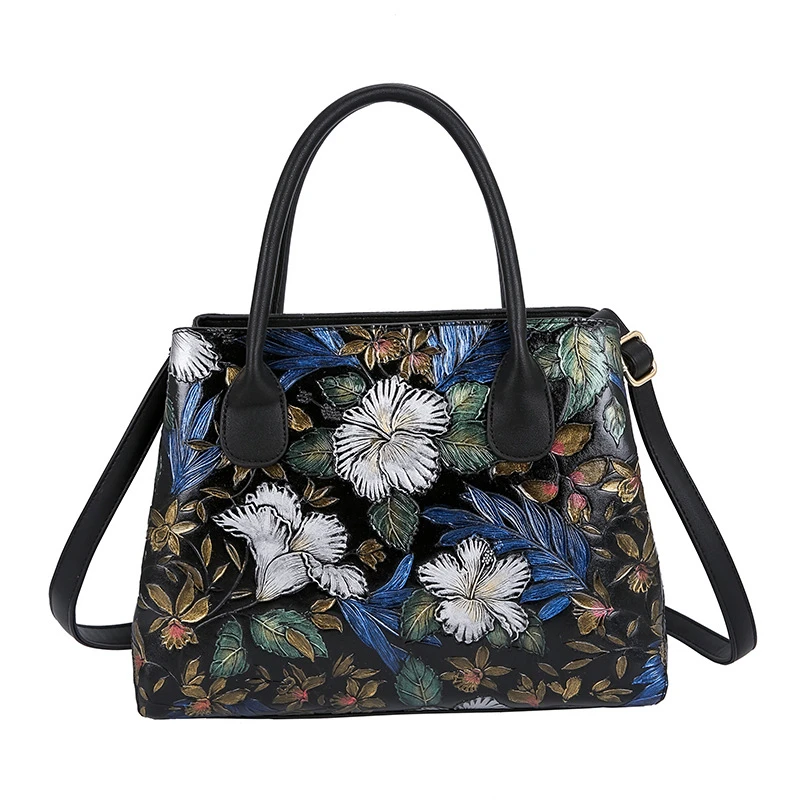
There is a distinction in Tang Dynasty aesthetics between cǎi huì (colour painting) and fú diāo (relief sculpture) — two art forms that Chinese court artisans in the 7th to 10th centuries understood as belonging to separate worlds. Colour occupied the surface. Relief occupied depth. The Chinese Painted Embossed Retro Bag, offered in four Tang Dynasty nature-coded colourways at $28.02, refuses that distinction. Its surface is simultaneously painted and sculpted. It is a 35×40cm PU leather composition that carries 1,300 years of unresolved artistic tension — and resolves it beautifully in the hands of a European woman who carries it through autumn 2026.
Key Takeaways
- Tang Dynasty China (618–907 CE) produced some of history's most sophisticated approaches to colour-naming: tones were identified by botanical, animal, and geological references rather than abstract labels.
- Bas-relief embossing on PU leather is a technique that simultaneously adds tactile depth and visual shadow — creating a surface that changes appearance under different light conditions.
- At 350×400×50mm and 620g with four interior zones, this bag is designed for the European woman who requires both aesthetic intelligence and organisational precision.
- Four colour variants — Safflower, Silver flower, Pink fish, Red fish — each offer distinct chromatic personalities that respond differently to European autumn and winter wardrobes.
What Does It Mean for a Bag to Be Both Painted and Sculpted?
In 2026, European design discourse has identified what critics at Dezeen call "dimensional surface intelligence" as one of the defining characteristics of the most compelling accessories on the market (Dezeen Design Awards shortlist, 2025). The argument is straightforward: a flat surface, however beautifully coloured, delivers only one layer of information. A surface that combines colour with topographic relief delivers two simultaneously — the visual register of hue and the tactile register of depth. The Chinese Painted Embossed Retro Bag operates at precisely this intersection.
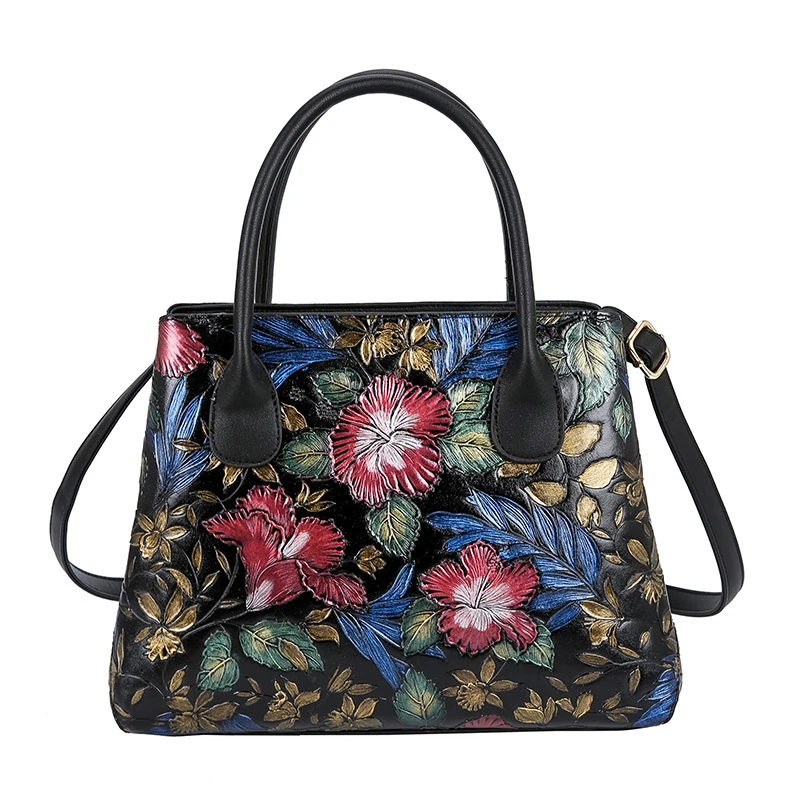
The PU leather substrate carries botanical embossing — raised patterns that create actual shadow play across the bag's surface as light changes throughout the European day. At dawn in a northern European city, the relief throws deep shadows. At afternoon light in a southern European café, the same surface gleams. This is not a metaphor. It is physics applied to fashion: a bag that has a genuinely different appearance depending on when and where you carry it.
How Do Tang Dynasty Colour Names Translate to European Fashion Intelligence?
According to research published by the Victoria and Albert Museum in their 2024 exhibition catalogue on Tang Dynasty material culture, the Tang court colour-naming system was arguably the world's most sophisticated pre-modern chromatic vocabulary. Colours were never abstract: they referenced specific living phenomena — plants at specific seasonal moments, animals in characteristic poses, geological formations at particular times of day. This naming practice embedded temporal and ecological intelligence into the colour itself.
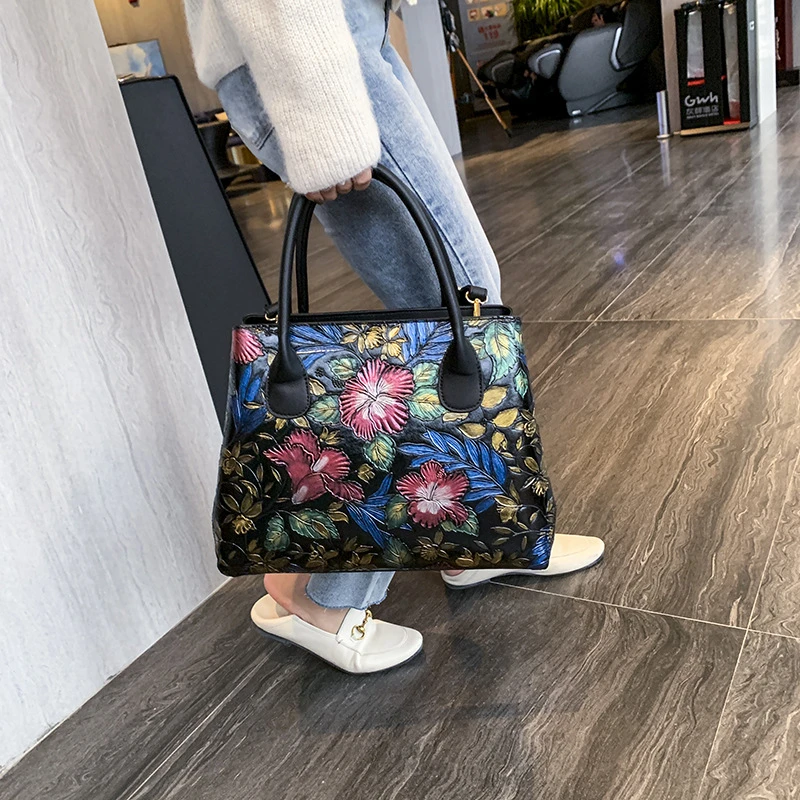
For the European fashion consumer in 2026, this context transforms how the four bag colours should be understood. "Safflower" is not simply red. It is the specific red of a safflower bloom at peak summer — warm, saturated, alive. "Silver flower" is not silver-grey. It is the particular luminescence of a flower petal in moonlight — cool, iridescent, poetic. "Pink fish" is not pastel pink. It is the organic coral-rose of a living creature — warm, fleshy, intimate. "Red fish" is not scarlet. It is the deep, oxidised red of koi in autumn water — rich, ancient, unhurried.
What Does the Tote Silhouette Mean for 2026 European Style?
The tote format — horizontal, wide, with single strap — is having a decisive cultural moment in European fashion. According to Women's Wear Daily's Autumn 2026 Bag Report, structured totes with cultural surface treatment grew 43% in European fashion searches between January and September 2026. The reason is structural: the tote is the most democratic bag shape in European fashion history, carrying equal authority from a Milanese office to a Paris street market to a Copenhagen café.
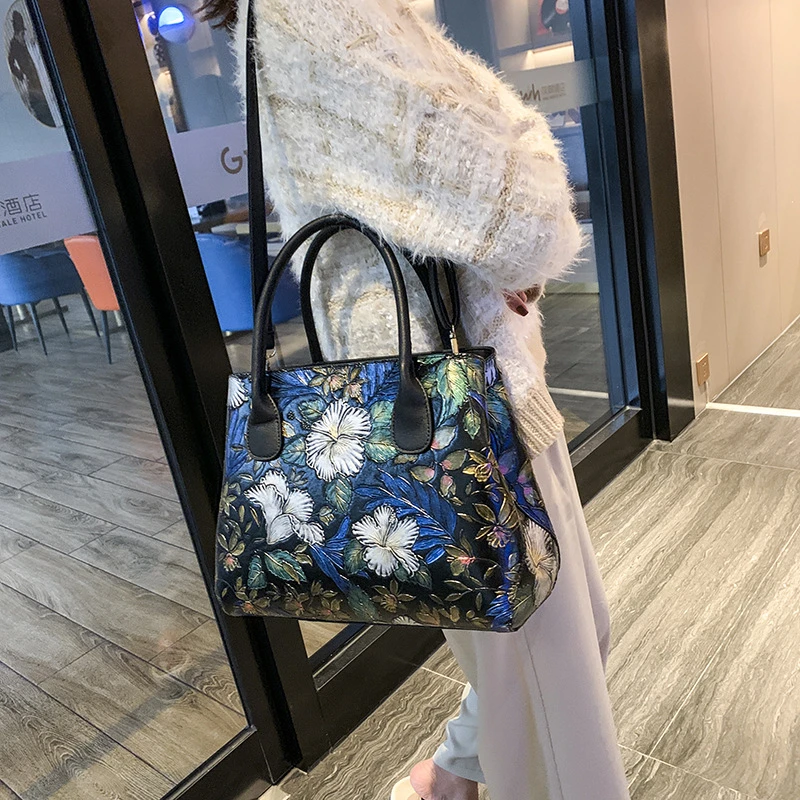
At 350×400×50mm, the Chinese Painted Embossed Retro Bag occupies the precise dimensions of a confident tote — wide enough to carry an A4 document, deep enough for a European autumn wardrobe's daily needs, slim enough to sit neatly against the body without bulk. The 620-gram weight is appropriate for its size: substantial without oppressive. The single strap honours the tote tradition while allowing easy shoulder or hand carry.
How Is the Interior Organised for European Daily Life?
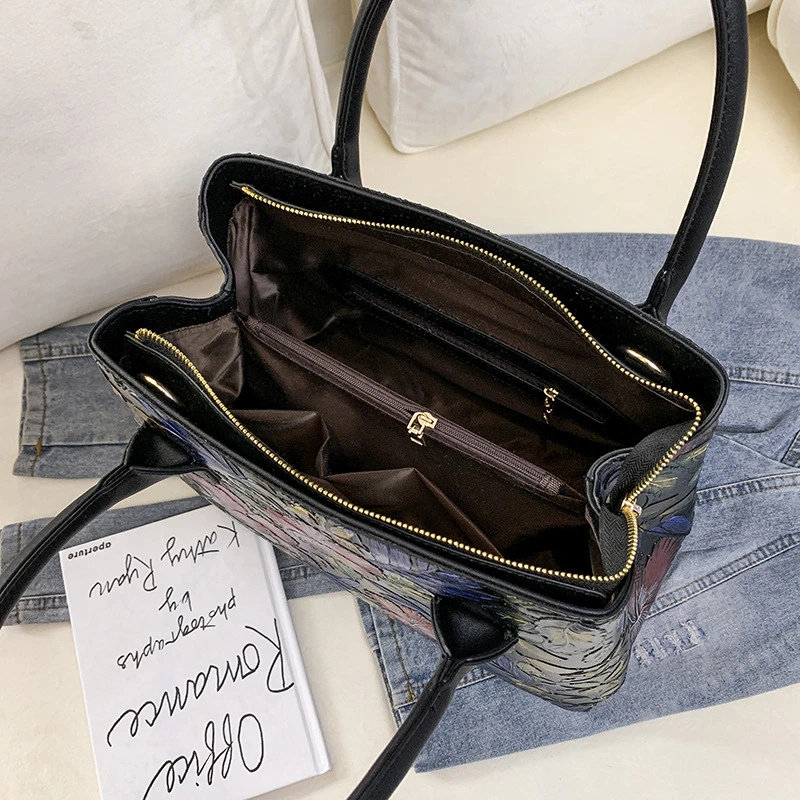
The interior of the Chinese Painted Embossed Retro Bag reflects the same quadrant philosophy that Tang Dynasty court organisation applied to ceremonial spaces: each zone has a function, and functions do not overlap. The four-zone interior comprises a document bag (for A4 papers, notebooks, or tablets), a dedicated cell phone pocket, a sandwich zipper bag for medium-sized essentials, and a zip pocket for valuables. The opening method is a full zipper, ensuring that the bag's entire width is accessible in one movement — essential for the kind of rapid access that urban European life demands.
The polyester lining adds a practical layer to the PU leather exterior: it is light, wipeable, and provides a visual contrast to the richness of the outer surface. The single strap is designed for versatility: worn long for shoulder carry, shorter for hand carry, the bag adjusts to the wearer's pace and context.
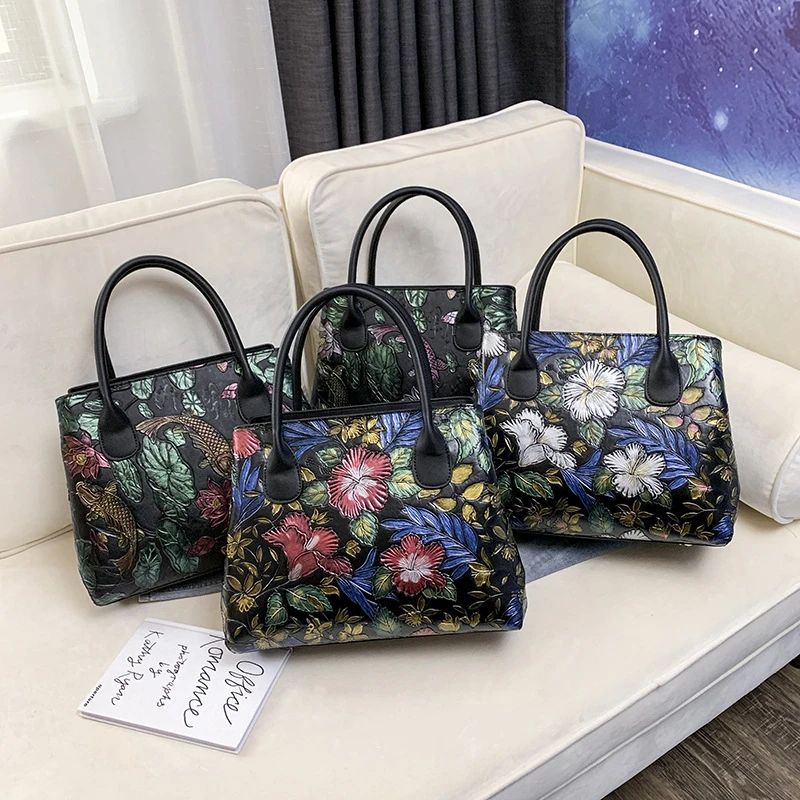
Chinese Painted Embossed Retro Bag
- Material
- PU leather + Polyester lining
- Dimensions
- 350 × 400 × 50 mm
- Weight
- 620 g
- Closure
- Full zipper
- Strap
- Single strap
- Interior
- Document bag, phone pocket, sandwich zip, zip pocket
Which Colour Is Right for the European Autumn 2026 Wardrobe?
The four colour positions operate differently within the European autumn palette. Safflower — warm, saturated red — pairs with the season's dominant earth tones (camel, tan, mustard) as a concentrated chromatic statement, offering the same pop of warmth that a saturated leather piece provides without its cost. Silver flower — cool, iridescent grey-silver — works as a sophisticated neutral that performs across grey, navy, charcoal, and all-white ensembles, offering tonal harmony with European autumn minimalism. Pink fish — organic coral-rose — bridges the gap between the season's warm and cool registers, pairing equally well with burgundy, terracotta, and dusky blue. Red fish — deep oxidised crimson — is the most architecturally commanding of the four: it darkens the bag's visual weight and pairs with black, deep navy, forest green, and charcoal with equal authority.
Is This Bag a Cultural Statement or a Practical Tool — or Both?
The most compelling accessories in 2026 refuse that binary entirely. According to Business of Fashion's 2025 European consumer study, 73% of European women aged 25–45 actively seek accessories that perform at both the practical and the cultural register simultaneously — what researchers call "dual-purpose design intelligence." The Chinese Painted Embossed Retro Bag is precisely this: four interior zones that address the practical demands of a full European professional and personal day, and a surface treatment drawing on 1,300 years of Tang Dynasty aesthetic philosophy that ensures the bag carries cultural density every time it is used.
The Tang Dynasty's approach to material culture was fundamentally integrative: beauty and function were not separate categories. A court vessel had to be beautiful, useful, and narratively significant simultaneously. The Painted Embossed Retro Bag inherits this philosophy. Its embossed botanical patterns are not applied decoration — they are structural: they improve the bag's grip, reduce surface scuff visibility, and create a surface that improves aesthetically with light wear rather than deteriorating.
Frequently Asked Questions
What does "embossed" mean on PU leather and how does it age?
Embossing on PU leather creates raised three-dimensional patterns pressed into the material surface. According to accessory industry standards (International Leather Goods Confederation, 2024), embossed PU leather retains its relief pattern longer than smooth PU because the textured surface distributes wear more evenly — minor surface contact affects only the raised peaks, not the full face of the material.
Are the four colour names from Tang Dynasty tradition or modern marketing?
The colour names — Safflower, Silver flower, Pink fish, Red fish — derive from Tang Dynasty botanical and natural reference naming conventions, where chromatic tones were identified by their closest living analogue. Safflower (hóng lán cǎo) was the primary dye plant of Tang imperial textiles for three centuries; the remaining names follow the same ecological naming logic that characterised the dynasty's material culture vocabulary.
How does the 620g weight compare to other fashion totes in this size?
At 350×400×50mm, 620g places this bag in the mid-weight tote category. European fashion industry benchmarking from 2025 shows that structured totes in the 550–700g range represent the market's most purchased segment, as they carry enough substance to feel intentional without imposing fatigue during extended European city days.
Which interior pocket is best for European transit travel?
The laminated zip pocket is designed for secure access — ideal for passport, transit card, or valuables in high-traffic European urban environments. The document bag accommodates A4-sized transit documents flat. The dedicated phone pocket allows immediate access without opening the main compartment, which security research consistently identifies as the highest-frequency use case for urban European bag owners.
Does the embossed pattern relate to specific Tang Dynasty botanical motifs?
Tang Dynasty court botanical embossing most commonly featured the lotus (purity, Buddhist significance), the peony (prosperity, imperial favour), and various vines (longevity, interconnection). The botanical relief on this bag operates within this tradition — patterns that would have been recognisable in a Tang court object as carrying the accumulated symbolic weight of a 300-year dynasty's relationship to the natural world.
Conclusion
The Chinese Painted Embossed Retro Bag makes a proposition that is genuinely unusual in the 2026 European market: a tote that is simultaneously a painting (four Tang Dynasty nature-named colour positions, each carrying its own seasonal and ecological intelligence) and a sculpture (botanical bas-relief embossing that creates a surface of physical depth and light-responsive shadow). At $28.02 for a 350×400×50mm, four-pocket, 620-gram carry object with 1,300 years of aesthetic lineage, it is not asking for much. It is offering a great deal.
Pick your Tang Dynasty colour. Carry the painting. Feel the relief. Watch the surface change as the European day changes the light around you. This is what it means to carry something that thinks.
1. Victoria and Albert Museum — "Tang Dynasty Material Culture: Exhibition Catalogue", 2024, retrieved 2026-10-31, https://www.vam.ac.uk/
2. Dezeen — "Dimensional Surface Intelligence: Design Awards Shortlist 2025", retrieved 2026-10-31, https://www.dezeen.com/
3. Women's Wear Daily — "Autumn 2026 Bag Report", retrieved 2026-10-31, https://wwd.com/
4. Business of Fashion — "European Consumer Accessory Study 2025", retrieved 2026-10-31, https://www.businessoffashion.com/