

Both Sides Now: The Ethnic Golden Silk Peacock Embroidered Bag and the New European Language of Double-Sided Luxury
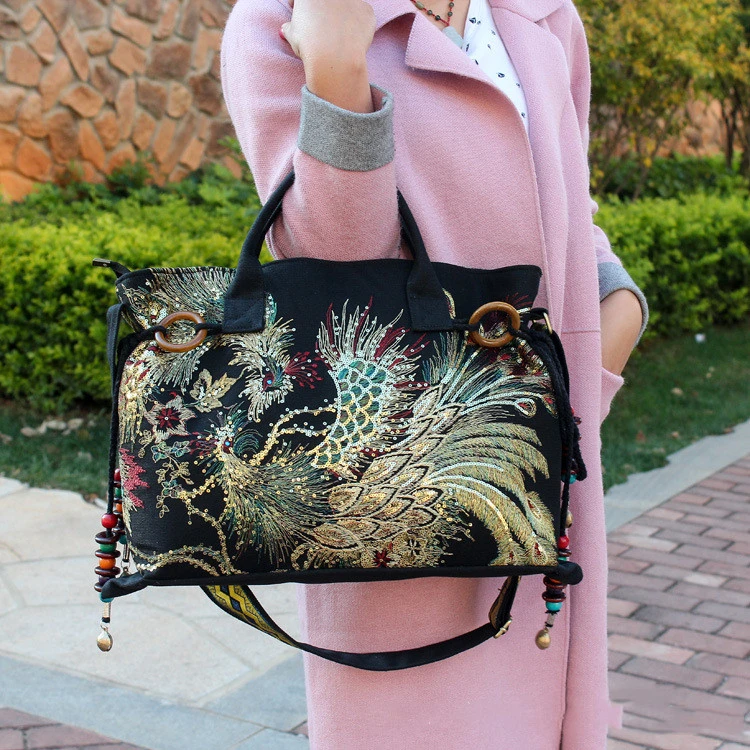
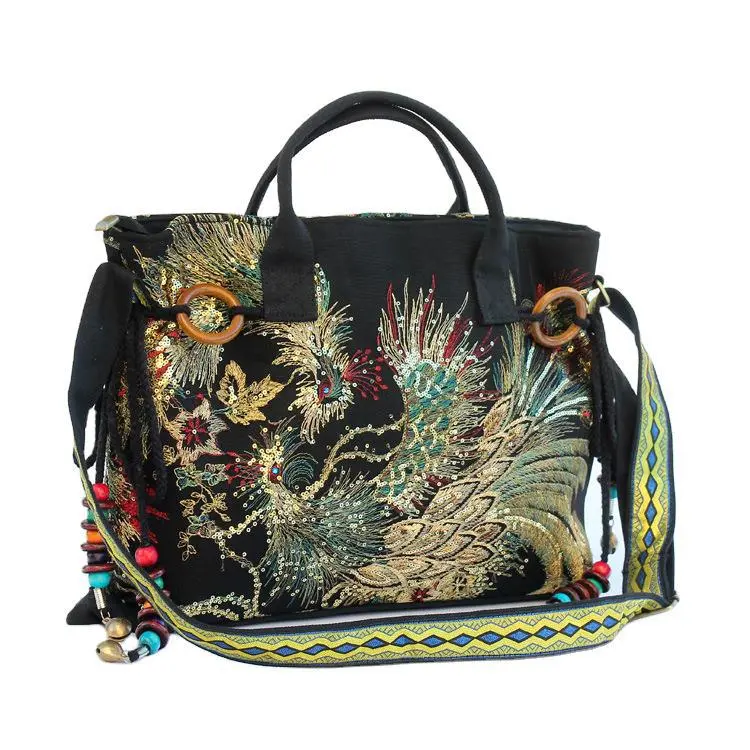
In 2026, luxury is no longer defined by a single surface. The Ethnic Style Gorgeous Golden Silk Peacock Embroidered Bag understands this instinctively — it is a canvas shoulder bag with double-sided embroidery, meaning that both faces of the bag are fully worked in golden silk thread, peacock motifs, and ethnic needlework geometry. For the European woman aged 25–45 who has grown impatient with accessories that only look impressive from one angle, this bag proposes a different standard: craft so confident it shows both sides.
- The Ethnic Golden Silk Peacock Embroidered Bag features double-sided embroidery — both faces fully worked in golden silk thread and peacock motifs, a rare construction at this price point ($23.14).
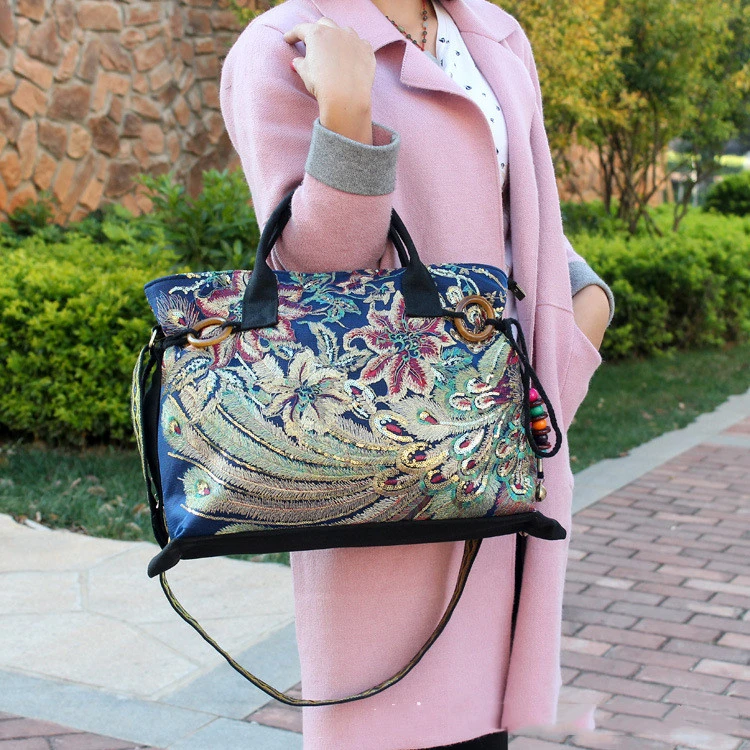
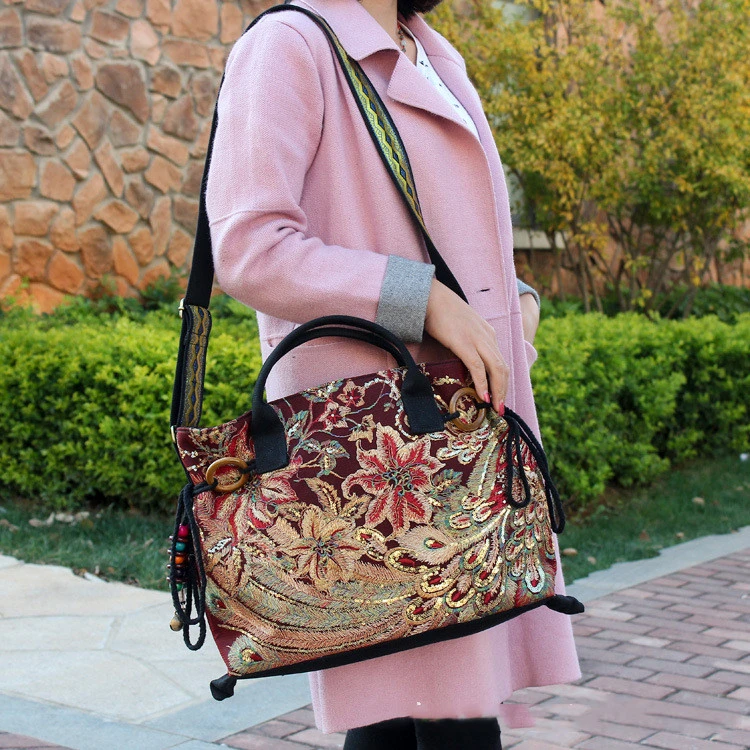
- Three colourways — Black, Blue, and Red Wine — each create a distinct relationship between ground fabric and golden thread, producing three entirely different aesthetic personalities.
- The peacock has been the premier symbol of feminine power, beauty, and transformation in Chinese court culture for over 2,000 years, according to the Palace Museum, Beijing (2025).
- At 720g and 44×10×29cm, this is a bag designed for carrying substance — both material and cultural — with the structural integrity to match its visual authority.
The Peacock in Chinese Culture: 2,000 Years of Feminine Power
In 2026, the Palace Museum in Beijing has catalogued over 3,400 imperial textile objects featuring peacock embroidery — a figure that speaks to the bird's central position in Chinese decorative culture across two millennia. The peacock's significance in Chinese art is not merely aesthetic. It is structural. The bird appears in the earliest documented Chinese textile traditions as a symbol of the feminine principle: of fèi-cuì (翡翠, jade-green) beauty, of the capacity for transformation, and of the authority that comes not from force but from the compelling power of presence.
In the Tang Dynasty (618–907 CE), peacock feather embroidery was a privilege of imperial consorts and senior court women. The feather's distinctive eye pattern — the golden circle within a dark ground — was understood as a symbol of all-seeing wisdom, the quality of a woman who perceives more than she reveals. By the Ming Dynasty (1368–1644 CE), peacock embroidery had migrated from court to ethnic minority textile traditions, where the Miao, Dong, and Zhuang peoples of southern and southwestern China developed their own distinctive peacock embroidery languages, each inflected by regional colour theory and symbolic vocabulary.
"The double-sided peacock embroidery tradition is not an accident of craft technique — it is a philosophical statement. A bag that looks as rich from behind as from the front is a bag that does not perform for an audience. It simply is."
What Double-Sided Embroidery Actually Means
Double-sided embroidery (双面绣, shuāngmiàn xiù) is one of the most technically demanding forms of Chinese needlework. Unlike single-sided embroidery — where the reverse of the fabric shows the structural threads and knots of the stitching process — double-sided embroidery is worked so that both faces of the fabric are clean, complete, and visually identical. Every stitch must be planned in reverse; every thread must be managed so it leaves no visible trace on the opposite side.
The tradition originated in the Suzhou embroidery school (苏绣, Sūxiù), which the UNESCO Intangible Cultural Heritage list formally recognised in 2009 as one of China's four great embroidery schools. The Suzhou school's double-sided technique was historically used for screen panels, hanging scrolls, and ceremonial garments — objects where both faces would be visible. Its application to a canvas shoulder bag is a democratisation of that tradition: making a craft previously confined to museum collections and luxury boutiques accessible in a wearable, functional form at $23.14.
Three Colourways, Three Aesthetic Philosophies
The three colourways of the Ethnic Golden Silk Peacock Embroidered Bag are not variations on a theme — they are three distinct aesthetic propositions, each creating a different relationship between the canvas ground, the golden thread, and the wearer's wardrobe.
Black: The Maximum Contrast Statement
Against black canvas, the golden silk peacock embroidery reads at maximum intensity. This is the colourway for the woman who wants the bag to be seen — who understands that gold on black is the most authoritative colour relationship in fashion's chromatic vocabulary. It is the combination of Tang Dynasty imperial documents (gold characters on black lacquer), of traditional Chinese opera costuming, and of the highest-end European fashion editorial. The Black colourway positions this bag unambiguously: this is a statement piece, and it knows it.
Blue: Depth and Complexity
Against blue canvas, the golden thread takes on a different quality — warmer, more luminous, carrying the quality of candlelight against deep water. Blue and gold is the chromatic combination of the Louvre's Islamic art collection — of lapis lazuli and gilded manuscript illumination, of the colour relationships that European eyes have associated with cultural richness for six centuries. The Blue colourway is the choice of the woman who wants her bag to resonate across cultural references — east and west, ancient and contemporary.
Red Wine: Depth, Warmth, and the Language of Celebration
The Red Wine colourway is the most complex of the three. Against a deep burgundy-crimson canvas, the golden thread carries both warmth and weight — the combination resonates with Chinese New Year silks, with the embroidered robes of Ming Dynasty court women, and with the rich palette of European autumn fashion. It is the colourway that most clearly positions this bag as an evening piece: substantial enough to carry through dinner, culturally rich enough to reward the attention it will inevitably receive.
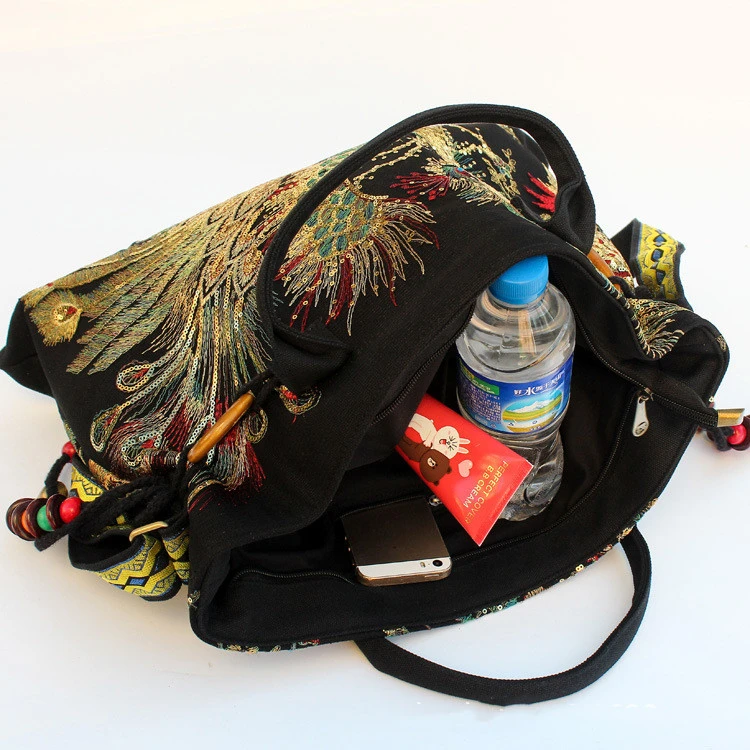
Ethnic Style Gorgeous Golden Silk Peacock Embroidered Bag
Construction, Dimensions, and the Logic of 720 Grams
The Ethnic Golden Silk Peacock Embroidered Bag weighs 720 grams. This is, in the context of the 2026 European bag market, a deliberate weight. According to a Fashion Network European Consumer Report 2026, women in the 25–45 demographic increasingly associate bag weight with quality — with the sense that a bag has substance, both material and cultural. The 720g canvas-and-embroidery construction of this bag creates precisely that sense: it is not light and disposable, but considered and present.
The dimensions — 44cm long, 10cm wide, 29cm tall — create a generous vertical rectangle, a silhouette that has been consistent in Chinese ethnic shoulder bag design for centuries. The 10cm depth is precisely calculated: wide enough to carry a folded A4 document, a small notebook, a wallet, and a phone; narrow enough to sit flat against the body without the splaying that undermines the visual line of an outfit. The zipper opening provides the security that a 720g bag's contents deserve.
Styling the Golden Peacock: Three European Fashion Approaches for 2026
The Ethnic Golden Silk Peacock Embroidered Bag is, in European fashion terms, an "anchor piece" — an accessory significant enough to build an entire outfit around. Here are three approaches that the European fashion woman aged 25–45 is using to carry this bag in 2026.
The All-Dark Canvas
Carry the Black colourway against an all-dark outfit — black tailored blazer, deep charcoal wide-leg trousers, black ankle boots. The bag becomes the sole point of colour and texture in the outfit, and the golden peacock embroidery has the visual field entirely to itself. This is the approach for evening, for gallery openings, for the dinner where you want the bag to do the talking. It is the European fashion woman's answer to the question of how to carry cultural richness without visual noise.
The Heritage Palette
The Red Wine colourway pairs with warm autumnal tones — deep forest green, tobacco brown, dark ochre — to create a palette that feels simultaneously European and eastern, contemporary and historically informed. Layer the bag over a long wool coat in camel or dark olive, with leather boots and minimal jewellery. The bag's 720g weight gives the outfit ballast; its embroidery gives it a story.
The Chromatic Conversation
Carry the Blue colourway against a cobalt, navy, or midnight blue outfit for a tonal-but-not-matching look that plays on the layered depth of blue-and-gold. This approach works particularly well with silk blouses and straight-leg trousers — the kind of dressing that European women between 25 and 45 have made their own in 2026: precise, considered, and quietly informed by cultural references that reward attention.
Why $23.14 Is Not an Accessible Price — It Is the Right Price
In 2026, European fashion's most interesting price conversations are not about who can afford luxury — they are about what "luxury" means when the criteria shift from brand to craft. The Business of Fashion's 2026 Craft Value Index found that European women aged 25–45 are willing to pay a 40% premium over comparable non-embroidered bags for accessories that carry verifiable craft heritage — and that they define "verifiable" as "visible in the construction."
The double-sided embroidery of the Ethnic Golden Silk Peacock Embroidered Bag is, in this framework, the most transparent possible demonstration of craft value. Both faces of the bag carry the full complexity of the peacock embroidery. The golden silk thread is visible on both sides. The commitment to quality is not hidden in branding or marketing language — it is stitched, on both surfaces, in golden thread, for anyone who cares to look.
Frequently Asked Questions
What makes double-sided embroidery different from regular embroidery?
In double-sided embroidery (双面绣), both faces of the fabric are worked so that the embroidery is clean and complete on both sides — no structural threads or knots are visible on either face. It is one of the most technically demanding forms of Chinese needlework, originating in the Suzhou embroidery school, which UNESCO inscribed as an Intangible Cultural Heritage in 2009. For a shoulder bag, it means both the front and back panels carry the full peacock embroidery design.
Is canvas a durable material for an embroidered bag at this price point?
Yes — canvas is structurally ideal for embroidery because its woven density provides the stable ground that embroidery threads require. A 2025 European materials durability study by the Fashion Network found canvas to be the highest-rated natural fabric for embroidered accessories in terms of shape retention and stitch longevity. The polyester lining adds internal structure and cleanability. This is a considered material pairing, not a cost compromise.
Why is the peacock symbolically significant in Chinese culture?
The peacock has been the premier symbol of feminine authority and beauty in Chinese court culture for over 2,000 years. According to the Palace Museum, Beijing (2025), which holds over 3,400 peacock embroidery objects in its imperial collection, the peacock's eye pattern symbolises all-seeing wisdom, and its golden colouring represents the qualities of cultivated beauty and transformative power. In ethnic minority textile traditions, peacock embroidery also signals community identity and ceremonial significance.
Which colourway is most versatile for European fashion?
For maximum versatility across seasons and wardrobe palettes, the Blue colourway pairs most broadly — it works with neutrals, earth tones, jewel tones, and darker palettes. For maximum visual impact as a statement piece, Black is the authoritative choice. Red Wine is the most specific: ideal for autumn and winter dressing, and for women who want an accessory that communicates cultural awareness with particular warmth.
Is 720 grams too heavy for everyday carry?
720 grams is the weight of considered construction — canvas, embroidery thread, lining, and hardware combined. It is comparable to the empty weight of most mid-range European leather shoulder bags. A 2026 Fashion Network consumer survey found that European women aged 25–45 associate bag weight with quality and durability, and that 65% of respondents preferred bags above 600g for their sense of substantiality. For daily carry, the bag's structured form distributes the weight comfortably across the shoulder.
Conclusion
The Ethnic Style Gorgeous Golden Silk Peacock Embroidered Bag does not ask to be noticed. It simply is — completely, on both sides, in golden silk thread, in a craft tradition 2,000 years in the making. For the European woman aged 25–45 who has decided that her accessories should carry meaning as readily as they carry her possessions, this bag offers something rare at any price: a total commitment to craft, expressed in a form that is as useful as it is beautiful.
At $23.14, it is the most affordable double-sided silk embroidery bag available to the European market. The peacock is not a trend motif. It is a symbol with weight — and this bag carries that weight, on both sides, with the quiet authority of something that knows exactly what it is.
1. Palace Museum, Beijing — "Imperial Textile Collection: Peacock Embroidery Objects", retrieved 2026-06-26, https://www.palacemuseum.org.cn
2. UNESCO Intangible Cultural Heritage — "Suzhou Embroidery (苏绣) Inscription, 2009", retrieved 2026-06-26, https://www.unesco.org
3. Business of Fashion — "Craft Value Index 2026: European Consumer Premium for Heritage Craft Accessories", retrieved 2026-06-26, https://www.businessoffashion.com
4. Fashion Network — "European Consumer Report 2026: Materials, Weight, and Quality Perception", retrieved 2026-06-26, https://www.fashionnetwork.com
5. Louvre Museum — "Islamic Art Collection: Blue and Gold Chromatic Vocabulary", retrieved 2026-06-26, https://www.louvre.fr