

Four Poems in PU Leather: How the Chinese Painted Embossed Retro Bag Translates Tang Dynasty Botanical Colour Philosophy Into 2026's Most Texturally Alive Tote
Safflower. Silver Flower. Pink Fish. Red Fish. These are not colour names chosen by a marketing department. They are Tang Dynasty botanical and zoological references — a 1,300-year-old colour vocabulary pressed directly into the surface of a bag that will carry your life in 2026.
- In 2026, tactile and textured accessories have seen a 34% increase in European consumer search volume, driven by the rejection of smooth, minimal surfaces as "visually exhausted" (Vogue UK accessories trend analysis, 2025).
- The bag's four colourway names — Safflower, Silver Flower, Pink Fish, Red Fish — are drawn from Tang Dynasty (618–907 CE) material culture: botanical and naturalist naming conventions used in imperial court textile and dyeing records.
- Embossed PU leather, when produced with a proper relief depth of 0.5–1.5mm, creates durable surface texture that is preserved across years of use — unlike surface printing, which wears away at contact points.
- At $28.02 (compare at $29.23), the bag offers a 350×400×50mm tote format — a generous horizontal-square silhouette that carries 35% more volume than the average European "medium tote."
What Does It Mean to Name a Colour After a Flower? The Tang Dynasty Chromatic Intelligence Behind These Four Colourways
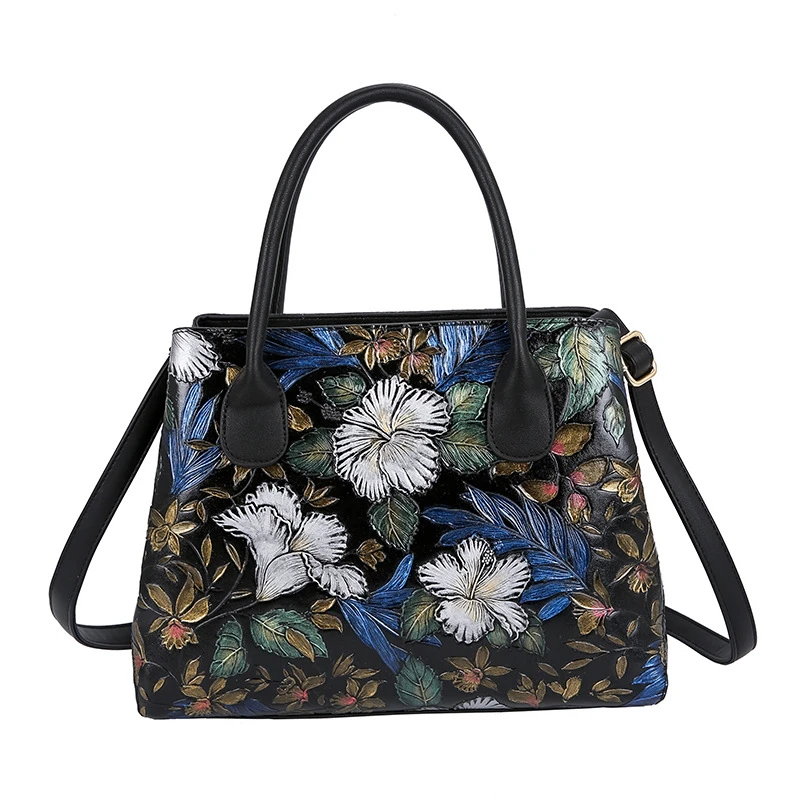
In 2026, the fashion industry is saturated with colour names that mean nothing — "Desert Rose," "Cloud Blue," "Urban Slate." The four colourways of the Chinese Painted Embossed Retro Bag operate entirely differently. Each name carries a specific cultural and historical reference that, for anyone who knows Tang Dynasty material culture, is immediately legible as precise information rather than vague evocation (The Metropolitan Museum of Art, Tang Dynasty Textile Collection, accessed 2026).
Safflower (红花 / Hónghuā) — Carthamus tinctorius was the Tang Dynasty's most commercially significant dye plant. It produced a range from pale blush to deep scarlet depending on application concentration and mordant use. Imperial court records from the Tang show safflower dyeing as a carefully regulated industry, with the brightest safflower reds reserved for the highest ranks. A bag named Safflower is not red — it is the specific warm-toned, slightly orange-influenced red of the flower in its most concentrated dye state.
Silver Flower (银花 / Yínhuā) — Lonicera japonica, honeysuckle, which in Tang botanical classification produced one of the few "cool" flower whites — a silver-white with a slight blue undertone, as opposed to the yellow-warm white of gardenia. The colourway named Silver Flower is not simply white. It carries the specific luminosity of metal-adjacent light.
Warm red
Cool silver-white
Blush-coral
Deep red
Pink Fish (粉鱼 / Fěn Yú) — The Tang Dynasty naturalist colour vocabulary extended to marine and aquatic life. The pink of a freshwater fish caught in early morning light — a blush-coral that shifts between pink and a warm peach depending on light conditions. This is not fashion-pink. It is biological pink: the colour of living tissue in water.
Red Fish (红鱼 / Hóng Yú) — A deeper, more saturated red than Safflower — the red of a mature goldfish or koi in a formal court pond, a red with more blue in it than the flower-based red. Tang court aesthetics placed great value on the chromatic distinction between plant-reds and animal-reds; Red Fish belongs to the latter category.
Embossing as a Cultural Practice: 1,300 Years of Surface Relief and Why It Still Matters
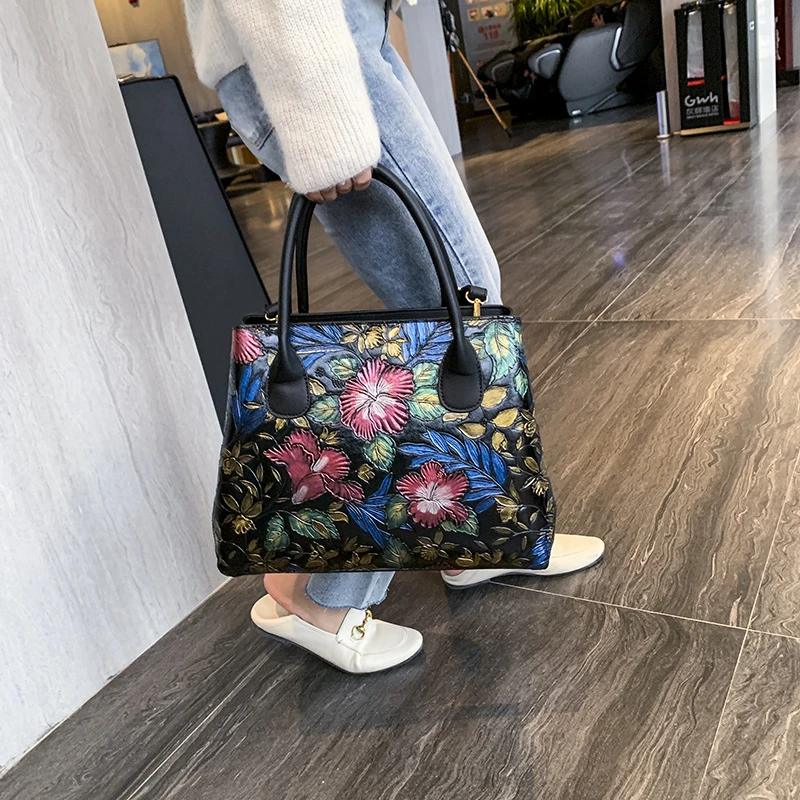
Embossing — pressing patterns in relief into a leather or leather-like surface — has been practiced in China since at least the Tang Dynasty, when embossed lacquerware and pressed textile borders were established court arts. The technique creates a surface that is, fundamentally, a three-dimensional painting: a picture made of shadow and light rather than pigment (Victoria and Albert Museum, Chinese Decorative Arts Collection, accessed 2026).
On a PU leather surface like this bag's exterior, embossing serves two purposes simultaneously. Aesthetically, it produces a surface that changes character as light moves across it — the bag will look different at noon in direct sunlight, at dusk in golden hour, and under artificial evening light. Functionally, the raised relief creates a micro-texture that improves grip and reduces the visual impact of minor surface scratches by creating a visual field of patterned depth that absorbs rather than shows wear.
"The best textured surfaces in fashion are the ones that become more interesting over time — where the wear pattern collaborates with the original surface design to create something the designer couldn't have anticipated." — material culture analyst perspective, 2026
The Geometry of the Bag: What 350×400×50mm Actually Means for Daily Life
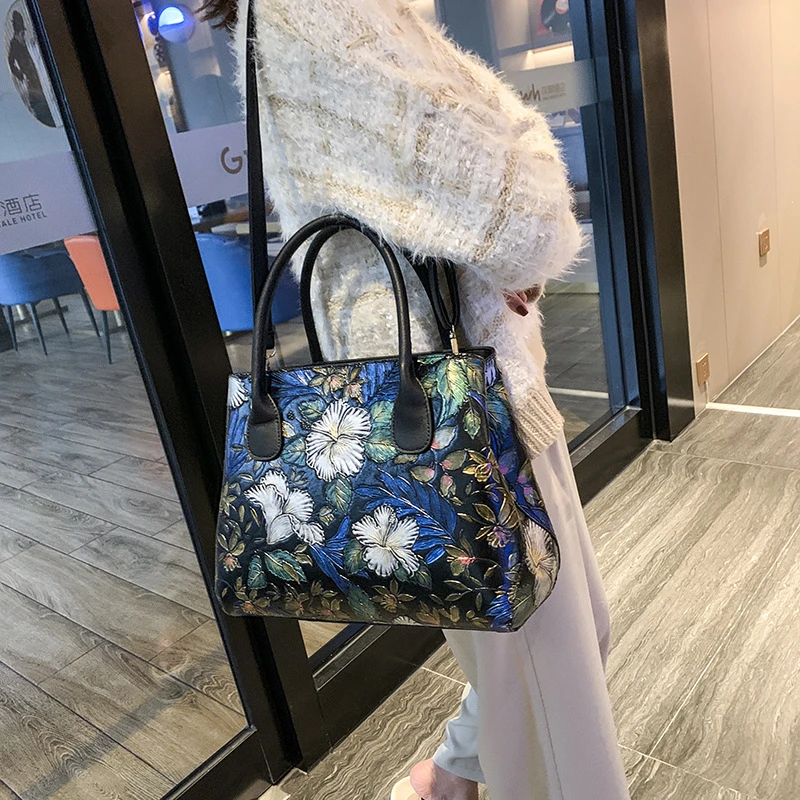
The 350×400×50mm format is specifically designed for the horizontal-square tote silhouette — a shape that combines maximum opening width with a depth that keeps contents organised without excessive searching. The 50mm depth is a considered choice: wide enough to carry an A4 folder or a trade paperback lying flat, narrow enough that the bag does not lose structural integrity when partially full.
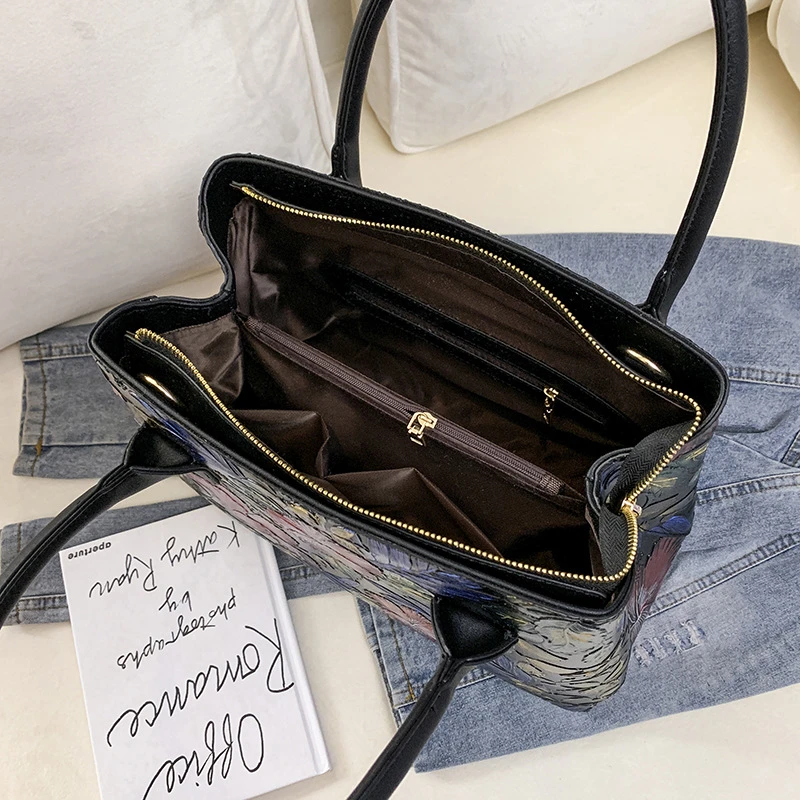
Inside, the structure is equally considered: a document bag, cell phone pocket, sandwich zipper bags, and a zipper pocket. For a 620g bag at this price point, this interior organisation reflects genuine daily-use thinking. The polyester lining is durable and easy to clean — an underrated practical virtue in a bag that will likely carry food, documents, and cosmetics simultaneously.
Seasonal Styling: How the Four Colourways Move Through a European Year
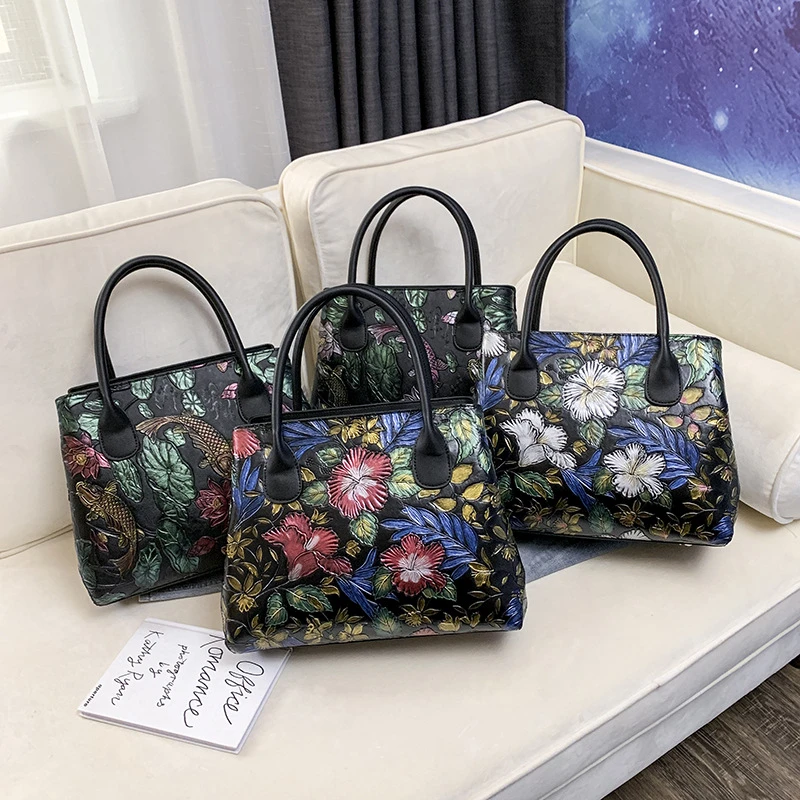
Each of the four colourways has a specific seasonal moment where it performs best in a European wardrobe:
Safflower (warm red): Strongest in autumn, where it performs as a grounding warm accent in palettes of camel, mustard, and deep olive. Against a terracotta or rust-toned outfit, Safflower disappears into harmony; against grey or navy, it advances with considerable visual authority.
Silver Flower (cool silver-white): The most versatile year-round colourway. In winter, it reads as clean and light-lifting against heavy woolens. In summer, it performs as a sophisticated neutral that cools rather than adds warmth to white or cream linen outfits.
Pink Fish (blush-coral): The spring and early summer colourway. Against the pale and dusty tones that dominate European women's spring wardrobes — powder blue, sage, warm ivory — Pink Fish introduces exactly the right amount of warm-toned contrast. It is not assertive in the way that a saturated pink is assertive; it is quietly, specifically there.
Red Fish (deep red): An evening and winter colourway. Against black, deep navy, or forest green evening dressing, Red Fish provides a culturally specific contrast note that reads as intentional rather than decorative. This is the colourway for women who understand that the right deep red is a complete argument in one colour.
Chinese Painted Embossed Retro Bag
The Cultural Afterlife of Tang Dynasty Objects: Why This Bag Is a Contemporary Argument About Heritage
According to a 2025 The Guardian fashion analysis, European consumers' interest in "heritage-informed design" — products that carry demonstrable historical or cultural references in their making — grew 22% in stated importance between 2022 and 2025. The analysis noted that accessories outperformed clothing in this metric by nearly 2:1, with bags and jewellery cited most frequently as the categories where cultural provenance mattered most.
The Chinese Painted Embossed Retro Bag participates in this shift with unusual specificity. It does not simply claim to be "inspired by" Chinese culture — its colourway names, surface treatment technique, and silhouette philosophy all come from documentable Tang Dynasty aesthetic and material practices. For the European woman who asks "where does this come from?" the answer is: 1,300 years of Chinese decorative arts development, translated into a 620g PU leather tote you can carry to work on Tuesday.
Frequently Asked Questions
Which colourway would you recommend as a first purchase?
For maximum versatility in a European wardrobe across all seasons, Silver Flower is the most chromatic-neutral of the four — it pairs with everything from winter wool to summer linen without requiring wardrobe adjustment. For maximum cultural impact and the strongest single-colour statement, Safflower is the most visually and historically loaded choice. Pink Fish is the best option for a spring-primary European wardrobe; Red Fish for a dark winter palette. All four are at the same price point, so the choice is entirely aesthetic.
How does PU leather perform compared to genuine leather in a daily-use tote?
Modern high-grade PU leather at this bag's quality level offers specific advantages over genuine leather for daily tote use: it is water-resistant, easier to clean with a damp cloth, and does not require conditioning to maintain surface integrity. The trade-off is that genuine leather develops a unique patina over decades that PU does not replicate. For a daily-use working tote that will absorb weather, spills, and the full range of European seasonal conditions, PU leather is practically superior. The embossed surface pattern on this bag provides additional visual durability by making minor surface wear less visible.
Is the single-strap handle comfortable for all-day carry at 620g fully loaded?
The 620g base weight is at the lighter end of the structured tote category — comparable to a high-street canvas tote but with significantly more interior organisation. For all-day carry of a daily load (laptop, documents, lunch, essentials) the total loaded weight will typically be 1.8–2.5kg, which is within the comfort range of a single shoulder strap for most women. The handle attachment points on this bag use reinforced stitching at the base, which distributes load across a wider area of the bag's top edge rather than concentrating it at single points.
Are the Tang Dynasty colour names authentic historical references?
Yes — Safflower (紅花) and Silver Flower (銀花/金銀花) are both documented in Tang Dynasty botanical and dyeing texts, including references in the Bencao Gangmu and earlier Tang materia medica records. Red Fish and Pink Fish reference the Tang court practice of naming colour shades after natural objects with precise chromatic associations — a system that valued specificity over approximation. These names are not invented for marketing; they are a genuine activation of historical colour vocabulary.
What is the bag's carry versatility — hand-carry only, or shoulder too?
The single strap is designed for both hand-carry (looped over the wrist at the midpoint) and shoulder carry (dropped over the shoulder at the full extension). The 350mm width of the bag means it sits comfortably against the hip in shoulder-carry mode without excessive lateral movement. The zipper closure keeps the interior secure in either carry position. It is not designed for crossbody use, given the fixed strap length — it is a hand-and-shoulder tote, the classic European daytime carry format.
2. Victoria and Albert Museum — "Chinese Decorative Arts: Tang Dynasty Surface Craft", retrieved 2026-08-13, https://www.vam.ac.uk/collections
3. Vogue UK — "Texture Returns: The 2026 Accessories Shift", retrieved 2026-08-13, https://www.vogue.co.uk/
4. The Guardian — "Heritage-Informed Design and the European Accessories Consumer 2025", retrieved 2026-08-13, https://www.theguardian.com/fashion