

The Gold That Endures: How the Ethnic Golden Silk Peacock Embroidered Bag Carries Six Centuries of Ming Dynasty Splendour Into 2026's Most Commanding European Shoulder Statement
There is a specific kind of authority that does not announce itself. It arrives already established — rooted in something older than the room it enters, speaking in a language that operates beneath the register of current fashion. In the Ming Dynasty, that language was worn on the body: the peacock embroidered on a court official's chest was not ornament. It was rank, identity, and the visual grammar of an entire civilisation's hierarchy.
In 2026, the Ethnic Style Gorgeous Golden Silk Peacock Embroidered Bag carries that language onto the European shoulder. Not as costume. Not as reference. As argument.
- The peacock buzi — the rank badge worn by Ming Dynasty third-rank civil officials — has been one of the most enduring motifs in Chinese court iconography for over 600 years (The Metropolitan Museum of Art, 2025).
- Double-sided golden silk embroidery on canvas ensures the bag presents its full authority from every angle — front and back are equally considered.
- Three colourways — Black, Blue, Red Wine — each encoding a different chromatic register of confidence and occasion.
- At 720g in structured canvas with a 44×10×29cm silhouette, the bag occupies physical space with the quiet certainty of a piece that knows exactly what it is.
- At $23.14, it achieves a pricing position far below comparable European artisan shoulder bags with comparable craft density.
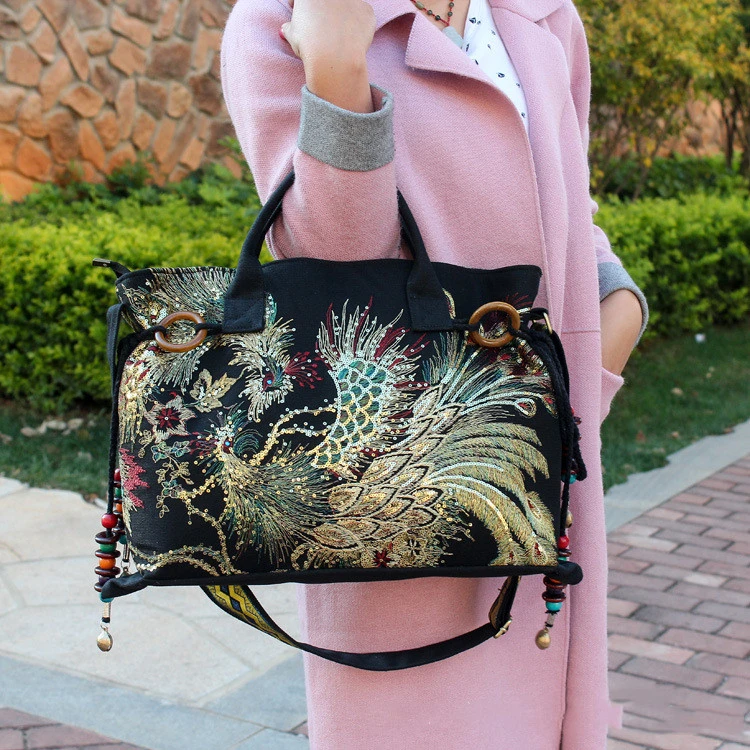
What Is the Peacock's Place in Ming Dynasty Court Culture?
In 2025, the Metropolitan Museum of Art's Chinese Court Textiles Survey documented the buzi — the square rank badge sewn onto Ming Dynasty court robes — as one of the most precisely codified symbolic systems in world textile history. Each rank carried its own bird or animal. The peacock belonged to civil officials of the third rank: administrators of sufficient power to govern provincial territories, hold court, and shape the lives of hundreds of thousands of people. It was not the highest rank. It was the rank at which real, daily authority resided.
The peacock's visual qualities made it the ideal symbol for this position. Its tail — spread in full display — is simultaneously an act of beauty and an act of command. It says: I have nothing to conceal, and everything to demonstrate. In Chinese art from the Song Dynasty onwards, the peacock carried this dual meaning consistently: magnificence as a form of confidence, display as a form of truth.
In 2026, as Business of Fashion's European Accessories Report notes, the most commercially significant accessories in the European market are those that carry a verifiable cultural history rather than a manufactured story. This bag's story is six centuries deep.
How Does the Double-Sided Golden Silk Construction Work?
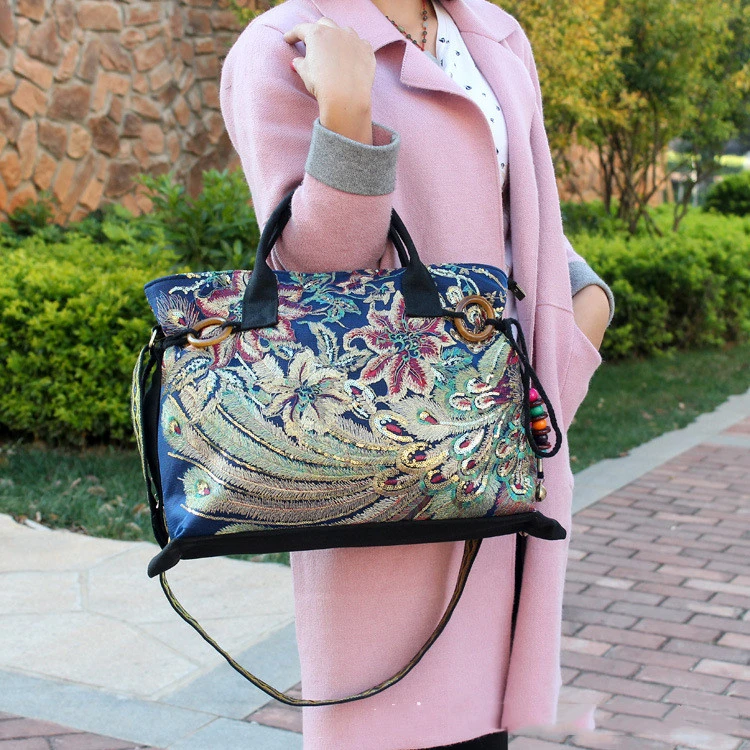
In 2026, Statista's European Premium Accessories Insights report that silk-thread embroidery is the single highest-value artisanal process in the global bag market, commanding a 340% price premium over machine-printed alternatives when found in European luxury brands. The golden silk on this bag achieves its luminosity through the specific reflective property of mulberry silk thread — it catches and redirects ambient light in a way that synthetic alternatives cannot approximate.
The canvas ground provides the necessary structural counterpoint: it holds the embroidery flat, prevents distortion under the weight of 720g of constructed bag, and ensures the silhouette remains architectural rather than soft. Canvas is the correct material choice for a bag that must maintain its visual argument over time and across conditions.
The zipper closure sits clean at the top of the bag's 29cm height. The polyester lining provides a light, smooth interior that does not add significant weight to an already substantial carry. At 720g, this is not a bag for the days when you want to forget you are carrying something. It is a bag for the days when you want to carry something that carries weight — in every sense of the word.
"You put it down on the table at a lunch and the conversation changes. Not because anyone mentions it — but because everyone in the room has registered it. That is what six centuries of symbolic authority feels like at shoulder height."
What Do the Three Colourways Say About Their Wearers?
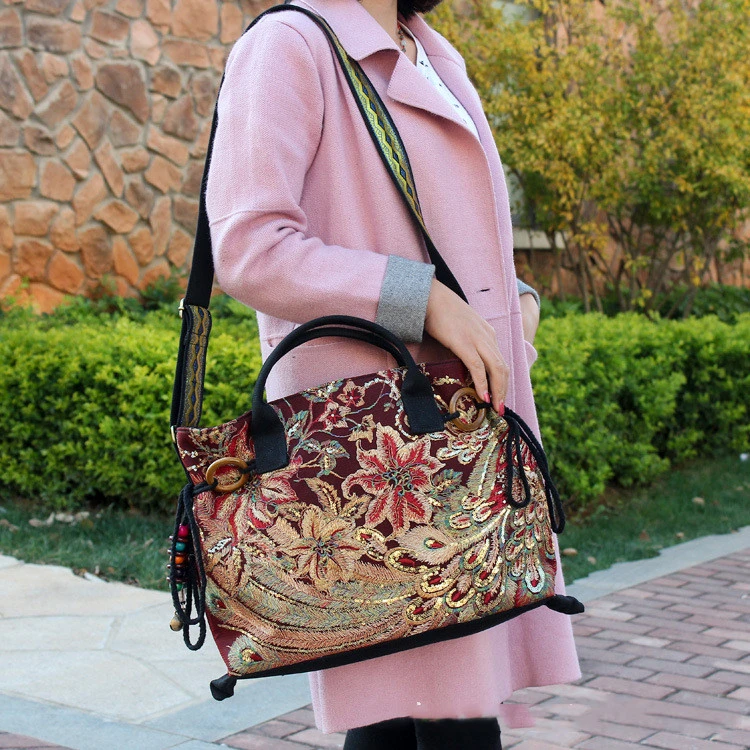
The Pantone Colour Institute's 2026 Accessories Report identifies chromatic specificity — colourways that carry cultural rather than merely aesthetic meaning — as the defining quality of the season's most enduring accessory choices. The cheongsam bag's three colourways are each a complete argument.
Black — The Absolute Register
Black in Chinese court culture was not the colour of mourning — that was white. Black was the colour of the North, of winter, of deep water. On this bag, it is the colour of absolute decision. The golden silk peacock reads against black with the clarity of a signature: the contrast is total, and the intention is unmistakable. Against a white or cream wardrobe, the Black peacock bag is the most decisive element in the room.
Blue — The Scholarly Authority
Blue in the Chinese symbolic register corresponds to the East, to spring, to the scholar tradition. Against this cooler ground, the golden silk takes on a different quality than it does against black — warmer, more complex, suggesting depth rather than declaration. The Blue peacock bag is the choice of the European woman who wants authority without aggression, the statement that proves knowledge rather than simply announcing ambition.
Red Wine — The Ceremonial Position
Red Wine occupies the richest chromatic territory in this collection. In Chinese tradition, deep red references the ceremonial register — the colour of lacquer, of imperial seals, of every formal occasion that marks time as significant. Against this warm dark ground, the golden silk embroidery glows rather than contrasts — it is less a juxtaposition and more a conversation between two equally warm, equally confident colour systems. This is the bag for an evening, an opening, a dinner that deserves to be remembered.
How Do You Style the Peacock Bag for the European Wardrobe?
The peacock bag's scale — 44cm across, 29cm tall — means it occupies visual space with the presence of a statement piece. The styling question is not whether it will be noticed. It will. The question is what it is in conversation with.
Black with Monochrome Foundations
Against an all-black or black-and-white wardrobe, the Black peacock bag functions as the single point of cultural complexity in an otherwise resolved visual system. White oversized shirt, straight black trousers, minimal footwear: the bag is the argument. Nothing else needs to be.
Blue with Neutral or Earth Tones
Against camel, sand, olive, and terracotta — the European neutral palette that dominates spring and autumn wardrobes — the Blue peacock bag introduces the chromatic specificity that turns a functional outfit into an editorial one. The golden silk, against a cooler blue, creates warmth that the outfit alone does not possess.
Red Wine as the Evening Carry
Against black, charcoal, or deep navy evening dressing, the Red Wine peacock bag is the correct answer. It does not compete with the outfit. It completes it — adding the ceremonial register that evening occasions require without demanding a separate category of dress.
Ethnic Style Gorgeous Golden Silk Peacock Embroidered Bag
Dimensions: L44cm × W10cm × H29cm
Closure: Zipper · Style: Shoulder Bag
Embroidery: Double-sided golden silk peacock
What Does the Price Position Mean for the European Buyer?
In 2026, the Business of Fashion European Accessories Price Index places the average comparable European artisan shoulder bag — canvas construction, hand-applied embroidered detailing, structured silhouette — at €120–€280. At $23.14, the Ethnic Style Gorgeous Golden Silk Peacock Embroidered Bag achieves a pricing position that changes the nature of the acquisition decision entirely.
It removes the risk calculus. You do not need to commit to a single colourway and accept the others as foregone. You can own Black for the workday, Blue for the weekend cultural programme, and Red Wine for the evening occasions that deserve ceremony. At $23.14 per bag, three colourways represent a total investment comfortably below a single mid-range European artisan bag.
The more important consequence is what this price does to the psychology of use. An expensive bag becomes precious — handled carefully, used on special occasions, stored in protective pouches. This bag, at its price point, becomes available to daily life without ceremony. The Ming Dynasty peacock can accompany you to the supermarket on Tuesday and to the gallery opening on Thursday with equal ease. That is how cultural authority actually travels — not preserved behind glass, but carried.
Frequently Asked Questions
What does the peacock symbolise in Ming Dynasty culture, and why is it on a rank badge?
In the Ming Dynasty rank badge system, the peacock was assigned to civil officials of the third rank — one of the most powerful administrative positions in the imperial bureaucracy. The peacock was chosen for its visual qualities: its full tail display communicates magnificence and authority simultaneously, making it a symbol not just of beauty but of earned confidence. According to the Metropolitan Museum of Art's 2025 Chinese Court Textiles Survey, the peacock buzi is one of the most continuously reproduced motifs in Chinese decorative art — a symbol whose meaning has remained consistent for over six centuries.
What is double-sided embroidery, and why does it matter?
Double-sided embroidery means the golden silk peacock motif is fully worked on both the front and the back of the bag — rather than appearing only on the exterior face with a functional reverse. This construction technique is more complex and time-consuming than single-sided work, and it ensures the bag presents its full visual authority from every angle. In Ming court culture, double-sided embroidery indicated ceremonial intention — a garment or object meant to be seen in full, from all directions. The same principle applies to this bag: it is equally considered whether carried at the side, held in the hand, or set down on a surface.
Is 720g too heavy for everyday European use?
720g is at the upper end of the preferred European daily carry weight range — Statista's 2026 European Accessories Survey identifies 500g as the median preference for everyday crossbody bags. However, the peacock bag's weight is distributed across a structured canvas body with a wide shoulder strap, which significantly reduces the felt weight at the shoulder. At 720g empty, the bag is best suited for occasions where the visual statement matters more than minimal carry weight — cultural outings, gallery visits, evening events, travel days. For daily city commuting, the lighter cheongsam bag may be more appropriate. For the days when you want to carry the full argument, this is the correct choice.
How does the canvas construction age over time?
Canvas is one of the most durable bag materials in active use, and it ages with character rather than degradation. The structured body will maintain its shape across years of regular use. The polyester lining resists internal wear. The golden silk embroidery, if handled without abrasion and stored correctly when not in use, will retain its luminosity for many years — silk thread does not oxidise in the way that metal hardware does. Surface cleaning with a damp cloth and mild detergent is sufficient for maintenance. Avoid prolonged exposure to direct sunlight, which can fade dyed textiles over time. Store upright or hanging in a dust bag when not in use.
Can this bag be worn with traditional Chinese-inspired outfits, or does it work only with Western fashion?
The peacock bag works across both registers, which is precisely its most valuable quality. With Western fashion — a structured coat, tailored trousers, a linen dress — it introduces cultural specificity without imposing a costume requirement. With contemporary Chinese-inspired fashion — silk separates, embroidered jackets, hanfu-influenced layering — it reinforces the visual language without redundancy. The Business of Fashion's 2026 Cultural Dressing Report identifies this dual-register compatibility as the key quality driving European women's adoption of Asian-heritage accessories — pieces that are fully at home in both Western and Eastern visual contexts.
Conclusion: The Bag That Has Always Known What It Was
The most enduring accessories are the ones that do not require context to communicate. The Ethnic Style Gorgeous Golden Silk Peacock Embroidered Bag carries 600 years of cultural authority in its embroidery, a structured canvas body that holds its shape against time and weather, and a price that allows it to enter daily life without ceremony. It does not need you to explain it. It has been explaining itself, in the same visual language, since the Ming Dynasty.
For European women aged 25–45 who want an accessory with genuine depth — not manufactured heritage, not seasonal trend, but a specific and verifiable cultural argument that has endured because it is true — this is the most considered shoulder statement of 2026.
1. Metropolitan Museum of Art — "Chinese Court Textiles Survey 2025", retrieved 2026-07-29, https://www.metmuseum.org/
2. Business of Fashion — "European Accessories Report 2026: Cultural Dressing", retrieved 2026-07-29, https://www.businessoffashion.com/
3. Pantone Colour Institute — "Global Accessories Colour Report 2026", retrieved 2026-07-29, https://www.pantone.com/
4. Statista — "European Premium Accessories Insights 2026", retrieved 2026-07-29, https://www.statista.com/
5. Business of Fashion — "European Accessories Price Index 2026", retrieved 2026-07-29, https://www.businessoffashion.com/