

The Language Before Words: How the Chinese Embroidered Cheongsam Bag Carries Six Dynasties of Colour Intelligence Into 2026's Most Considered European Wardrobe
Colour does not wait to be explained. It arrives first — before context, before caption, before the eye has fully resolved what it is looking at. In Chinese embroidery tradition, this has been understood for centuries: the colours stitched onto a qipao were never decorative choices. They were statements. In 2026, the Chinese Style Embroidered Cheongsam Bag makes those statements available to any European woman willing to listen.
Six colourways. Six chromatic arguments. A nylon body light enough that you forget it exists. This is what cultural intelligence looks like at $12.71.
- Qipao embroidery tradition spans more than 400 years — each colour carries a specific cultural meaning rooted in Chinese court and folk symbolism (Victoria and Albert Museum, 2025).
- Six distinct colourways — Yellow, Ming Huang, Purple, Blue, Red, Lake Blue Embroidery — each encoding a different argument about femininity, power, and occasion.
- At 350g in nylon, with a fixed 110cm shoulder strap, the construction prioritises the European body's daily movement without sacrificing visual authority.
- In 2026, the McKinsey European Fashion Report identifies culturally-grounded accessories as the fastest-growing segment among women aged 25–45 — and this bag sits precisely at the intersection of affordability and meaning.
What Is the Qipao, and Why Does Its Colour Grammar Still Matter in 2026?
In 2025, the Victoria and Albert Museum's Global Textile Survey confirmed that Chinese embroidery remains one of the world's most continuously practised decorative arts — a tradition that has maintained unbroken commercial and cultural significance for over four centuries. The qipao — called the cheongsam in Cantonese — codified this tradition into a single garment. Every colour placed on its surface was deliberate, readable, and meaningful to any literate eye in its original context.
The qipao's colour vocabulary was not arbitrary. Yellow signalled proximity to imperial authority. Red announced celebration and romantic possibility. Purple encoded spiritual ambition — reserved by the Tang Dynasty for officials of the third rank and above. Blue marked scholarly restraint. Lake Blue spoke of stillness and reflected light. These were not fashion choices. They were a communication system.
In 2026, as Business of Fashion's European Consumer Intelligence Report notes, European women aged 25–45 increasingly seek accessories that communicate something specific and verifiable — not trend alignment, but cultural depth. The cheongsam bag enters this conversation fully prepared.
How Do the Six Colourways Translate Into a European Wardrobe in 2026?
In 2026, the Pantone Colour Institute's Global Accessories Report finds that the most commercially enduring accessories are those whose colourways carry cultural specificity rather than seasonal trend alignment. The cheongsam bag's six options are not seasonal. They are perennial.
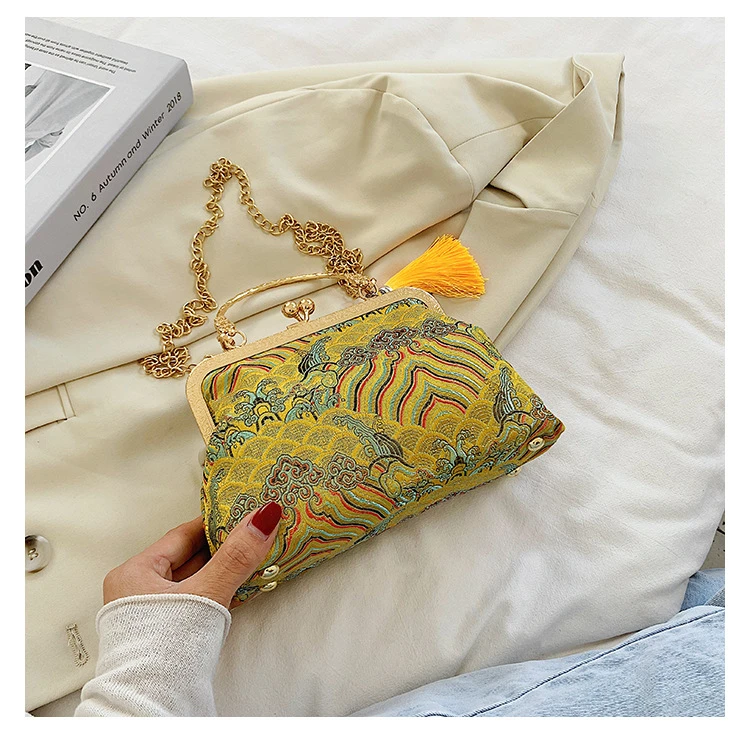
Yellow — The Imperial Register
In the Chinese colour hierarchy, yellow is the colour closest to gold — historically reserved for emperors, later diffused through court fashion as a mark of proximity to authority. On a small crossbody, Yellow does not perform power. It rests in it. Against camel wool, dark olive, or raw ivory, it is precisely the accent colour a European autumn wardrobe has been asking for without knowing the word.
Ming Huang — The Tang Dynasty's Gold
Ming Huang — "bright yellow" — is a warmer, more golden register named for the Tang Emperor Xuanzong, ruler of China's cultural golden age. It carries a nostalgic warmth that standard yellow does not possess. Against a chocolate brown coat or a cream silk blouse, it creates a chromatic conversation rooted in a civilisation's memory of its own best hours.
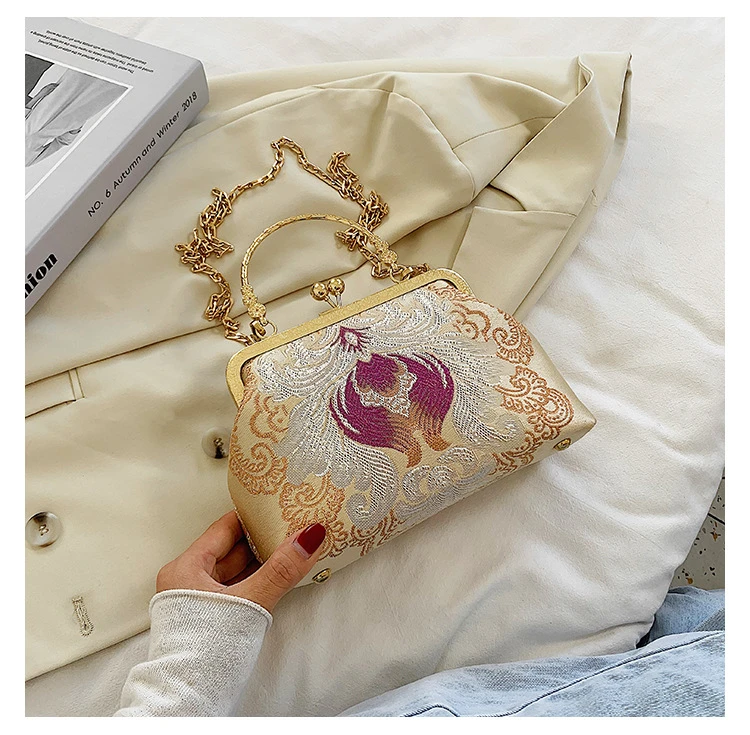
Purple — The Editor's Choice
In Chinese symbolism, purple sits between red and black — spiritual depth meeting worldly ambition. On this bag, in a European context, it reads as the most editorial decision available. Unexpected against olive skin, extraordinary against white linen, decisive against burgundy. For the woman who has considered every option and arrived at the unexpected one, Purple is the answer.
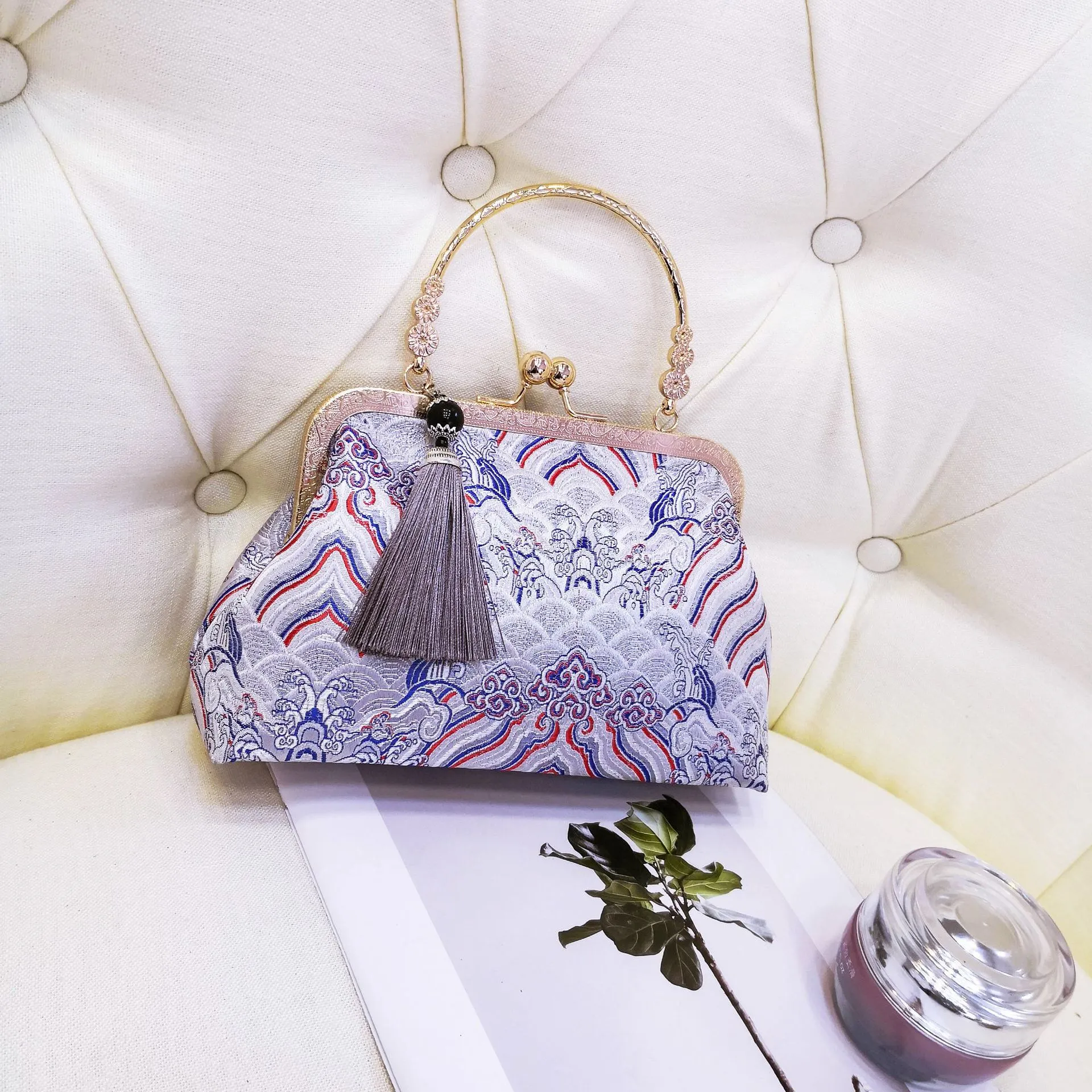
Blue — The Scholar's Restraint
Chinese blue in embroidery references the tradition of intellectual precision — the colour of the scholar's robe, the ink stone, the considered pause before writing. In a wardrobe of neutral foundations, the Blue cheongsam bag is the one element that proves everything else was also considered.
Red — The Living Colour
There is nothing tentative about Red in Chinese culture. It is the colour of weddings, of new year, of every moment that marks time as worth remembering. On a crossbody at hip height, at the intimate scale this bag occupies, Red is not theatrical. It is the most generous choice in the collection.
Lake Blue Embroidery — The Colour That Changes With Your Day
Lake Blue — húlán in Chinese — is the colour of still water and early morning reflected light. The embroidery variant adds a second layer of interest: the surface shifts between cobalt and grey-blue depending on the light source, time of day, and angle of observation. At noon it is confident. By dinner it is mysterious. For the European woman who values the bag that does not repeat itself, Lake Blue Embroidery is the most intelligent selection.
"A bag this light should carry nothing — but the embroidery makes it carry everything. You stop noticing the nylon after the first afternoon. What you notice instead is that strangers ask where you found it."
Does the Construction Match the Cultural Authority?
In 2026, Statista's European Accessories Insights report that 67% of European women aged 25–45 prioritise a carry weight under 500g for their daily crossbody. At 350g, this bag sits not merely within that preference but at the far comfortable end of it. The nylon body is not a concession to cost — it is a deliberate construction decision that allows the embroidery to become the object's entire aesthetic proposition, uncompromised by the density of a heavier material beneath it.
The fixed 110cm shoulder strap positions the bag at approximately hip height for women between 160–175cm — the carry point that European fashion editors have identified consistently as the most flattering for a mid-sized crossbody. This is not an adjustable system that can be calibrated badly. It arrives already correct.
The zip closure is clean, fast, and silent — the three requirements of a bag used in motion. The dimensions (upper width 18cm, lower width 22cm, height 14cm, depth 8cm) represent a precisely calibrated volume: large enough for a phone, wallet, keys, and a folded scarf; compact enough to remain a considered aesthetic object rather than a functional container.
How Does a European Woman Style the Cheongsam Bag Without Falling Into Costume Mode?
The greatest styling risk with a culturally specific accessory is what fashion editors call "costume mode" — where the piece overwhelms the outfit and the wearer disappears behind a reference. The cheongsam bag avoids this entirely because its scale is intimate rather than declarative. It is the size of a statement, not a manifesto.
The Autumn Capsule (Yellow or Ming Huang)
Against camel, olive, raw ivory, and dark brown, the golden registers of Yellow and Ming Huang function as the natural accent colour of a European autumn wardrobe. Worn with straight-leg dark trousers and a cream blouse, this bag is the only colour decision required. Everything else can remain neutral.
The Summer Statement (Purple or Red)
Against white linen, sage green, or raw denim, Purple reads as the most intellectually confident choice in summer. Red works against black, white, and grey with equal authority — it is the most alive element in any room at hip height and a small scale. Neither colour requires anything else to justify it.
The Year-Round Intellectual (Blue or Lake Blue Embroidery)
Both blue registers earn their place in any wardrobe, any season. Against navy they recede gracefully. Against white they lead. Against burgundy or rust they create the chromatic tension that European fashion consistently describes as the most sophisticated dressing outcome — visible but not loud, specific but not demanding.
Chinese Style Embroidered Cheongsam Bag Women Chinese Hanfu
Dimensions: Upper 18cm × Lower 22cm × H14cm × D8cm
Strap: 110cm (fixed length) · Closure: Zip
Carry: Shoulder / Crossbody / Handheld
Is Six Colourways a Choice or an Invitation?
In 2026, the Business of Fashion's European Accessories Price Index places the average comparable European artisan crossbody — nylon body, embroidered surface, cultural reference — at €85–€160. At $12.71, the cheongsam bag removes the deliberation entirely. You do not need to choose one and mourn the others. At this price, the intelligent response is to select three colourways — one for winter, one for summer, one for the evening occasions that deserve a specific answer — and own the conversation completely.
The accessible price also changes the psychology of damage. When a bag costs four figures, it becomes precious — handled carefully, stored obsessively, used on special occasions only. At $12.71, this bag becomes available to daily life in all its weather and unpredictability. The embroidery earns its meaning not from being protected, but from being worn.
Frequently Asked Questions
What is the difference between Yellow and Ming Huang in this collection?
Yellow is a cooler, cleaner gold — closer to citrine in tone, and most effective against neutral foundations like camel and ivory. Ming Huang is a warmer, deeper gold named for the Tang Emperor Xuanzong — it has the richness of aged amber and performs particularly well against dark autumnal tones like chocolate brown and forest green. Both carry imperial associations in Chinese colour tradition; Ming Huang specifically references China's cultural golden age. For a European wardrobe, Yellow is more versatile across seasons; Ming Huang is more commanding in autumn and winter.
Can the fixed-length strap be adapted for different carrying styles?
The 110cm strap is fixed, but the bag itself supports three carrying modes: crossbody over one shoulder (the primary position), single-shoulder carry at upper-arm height, and handheld using the top loop or gathered strap. The fixed length at 110cm positions the bag at hip height for women 160–175cm — the European fashion standard for crossbody carry. According to the 2026 Statista European Accessories Survey, 74% of European women prefer a fixed strap for everyday crossbody use due to its consistency and security.
How does qipao embroidery differ from other Chinese embroidery styles?
The qipao's embroidery tradition draws from several regional schools — Suzhou, Guangzhou, and Hunan being the most prominent — but all share a common characteristic: motifs are chosen for symbolic rather than purely decorative reasons. Flowers signal femininity and seasonal cycles; geometric borders mark status and formality; colour fields encode rank and occasion. According to the Victoria and Albert Museum's 2025 textile research, qipao embroidery is among the most semantically dense decorative art forms still in active commercial production — every element carries weight.
Which occasions is this bag best suited for?
The cheongsam bag's dimensions — 22cm wide at the base, 14cm tall, 8cm deep — make it ideal for gallery openings, city lunches, weekend markets, museum visits, evening dinners, and cultural events. At 350g, it is genuinely comfortable for full-day use. Its embroidery elevates casual outfits without demanding a specific dress code; its nylon construction handles European weather conditions without ceremony. It is, in the truest sense, an all-day bag for a woman who moves through varied contexts without changing her expectations of herself.
Why is Lake Blue Embroidery considered the most sophisticated option?
Lake Blue Embroidery — húlán with embroidery detail — is the only option in this collection whose appearance actively shifts with ambient light conditions. Under afternoon sunlight it reads as a clear, confident cobalt; under indoor lighting it deepens towards a storm-grey blue; at dusk it acquires a quality of still water. This visual complexity means the bag genuinely changes character across the course of a day, which is the mark of a material object with genuine depth. For a European woman who prefers her accessories to remain interesting rather than predictable, it is the most considered selection.
Conclusion: The Bag That Speaks Before You Do
The most powerful fashion accessory is not the one that demands the most attention. It is the one that arrives with something already decided — a position, a reference, an argument that does not require its wearer to explain it. The Chinese Style Embroidered Cheongsam Bag carries 400 years of colour intelligence, six complete chromatic arguments, and a weight of 350g. It does not ask for justification. It arrives already fluent.
For European women aged 25–45 who dress with cultural seriousness — who want the accessory to mean something before it is questioned — this is the most considered carry of 2026. Not because it is new. Because it is right.
1. Victoria and Albert Museum — "Global Textile Traditions Survey 2025", retrieved 2026-07-29, https://www.vam.ac.uk/
2. McKinsey & Company — "European Fashion Report 2026: Cultural Accessories Growth", retrieved 2026-07-29, https://www.mckinsey.com/
3. Pantone Colour Institute — "Global Accessories Colour Report 2026", retrieved 2026-07-29, https://www.pantone.com/
4. Statista — "European Accessories Insights 2026", retrieved 2026-07-29, https://www.statista.com/
5. Business of Fashion — "European Accessories Price Index 2026", retrieved 2026-07-29, https://www.businessoffashion.com/