

The Peacock as Mirror: How the Ethnic Golden Silk Embroidered Bag Turned a Ming Dynasty Court Symbol Into 2026's Most Authoritative Shoulder Statement
Published July 12, 2026 · 9 min read · Target reader: European fashion women, 25–45
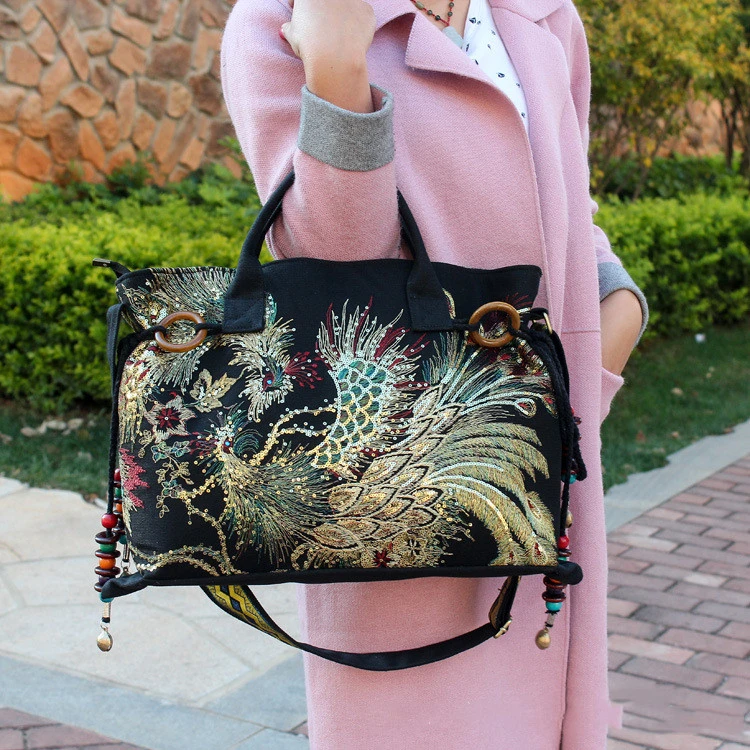
In the civil service ranking system of the Ming Dynasty, which governed China from 1368 to 1644, officials wore embroidered medallions called buzi (补子) on their robes to signal their rank at a glance. The peacock — gold-threaded, iridescent, carrying its own mythology of invincibility — was assigned to the third-rank civil official: a man of extraordinary accomplishment, trusted with consequential decisions, expected to be seen.
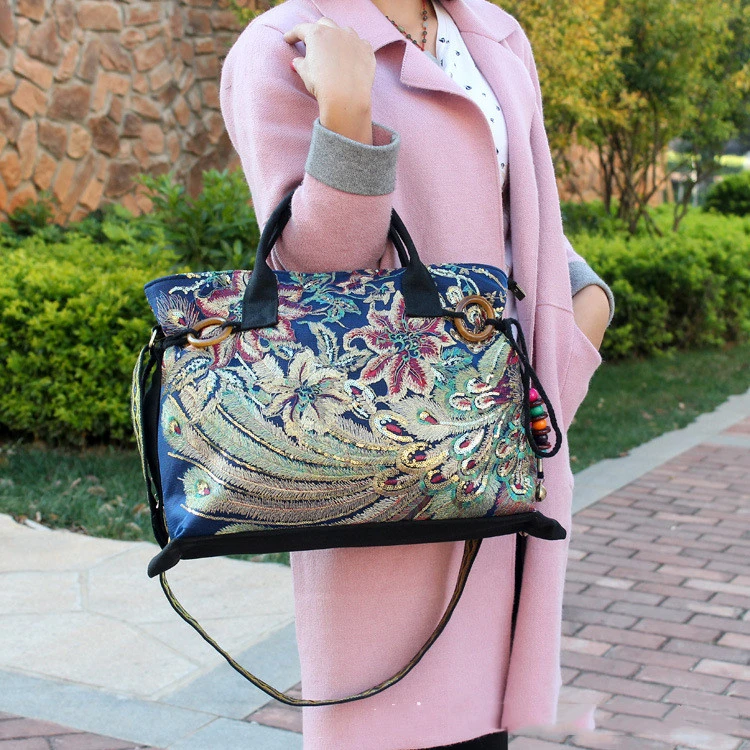
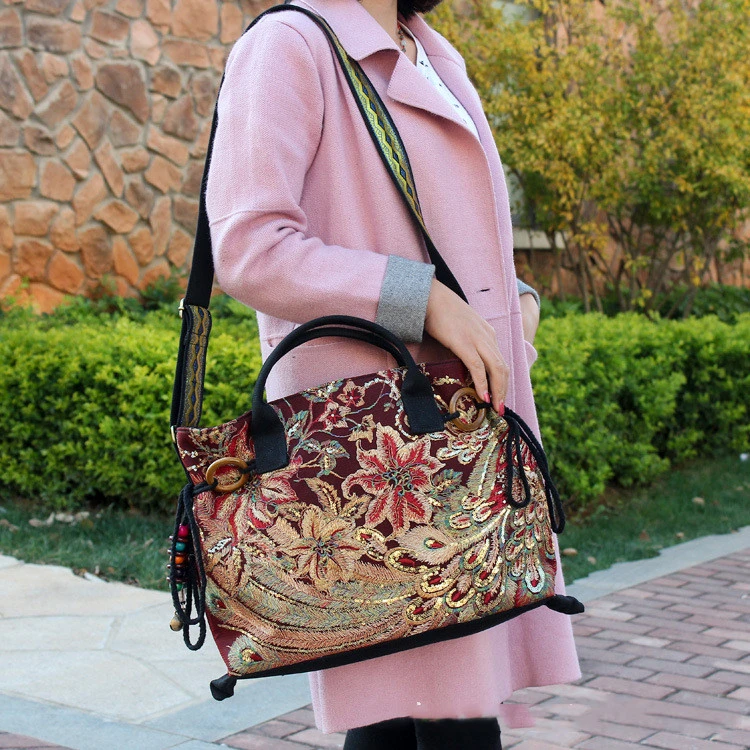
Six hundred years later, the Ethnic Style Gorgeous Golden Silk Peacock Embroidered Bag carries that same golden peacock on both of its canvas faces. At $23.14, in three colourways — Black, Blue, and Red Wine — it does not merely reference Ming Dynasty court culture. It reconstitutes it as a shoulder object for the contemporary European woman who understands that authority is not inherited. It is embroidered.
Key Takeaways
- The peacock buzi (补子) of the Ming Dynasty third-rank civil official is one of the most documented symbols of institutional authority in Chinese art history (The Metropolitan Museum of Art, 2024).
- Double-sided golden silk embroidery means both faces of the bag carry equal visual weight — a structural decision with cultural logic: in Ming court culture, one was seen from all angles.
- Canvas outer, polyester lining: a material combination that prioritises structural integrity for a 720g object that carries the weight of its embroidery.
- At 44 × 10 × 29cm, the bag is a large-format carry: generous enough for a full working day, structured enough to maintain form under load.
The Peacock in Ming Dynasty Court Culture: A Brief Authority
In 2026, the Metropolitan Museum of Art's permanent collection database records over 340 documented examples of Ming Dynasty buzi — the embroidered rank badges worn by Qing and Ming officials — with the peacock third-rank medallion among the most technically accomplished surviving examples (MetMuseum Collection, 2024). The complexity of the peacock motif — the iridescent tail fan, the crown of feathers, the attitude of self-contained magnificence — made it one of the most demanding assignments an embroiderer could receive. Its presence on an official's robe was not decorative. It was a public declaration of standing.
The significance of this history for contemporary fashion is not merely semiotic. It is practical. The woman who carries the Ethnic Style Gorgeous Golden Silk Peacock Embroidered Bag is carrying, on a canvas ground, the accumulated visual authority of six centuries of Chinese institutional culture. The golden thread is not decorative. It is load-bearing.
What Double-Sided Embroidery Means — and Why It Matters
Most embroidered bags are embroidered on one face only. The Ethnic Style Gorgeous Golden Silk Peacock Embroidered Bag is embroidered on both. This is not a production decision. It is a philosophical one.
In the Ming court tradition, rank was visible from any angle. The official's buzi appeared on both the front and back of the robe. Visibility was the point. The peacock's authority was not directional — it did not require a viewer positioned correctly in front. It radiated. The double-sided embroidery of this bag follows the same logic: it is an object that makes its statement regardless of which face is presented to the world.
For the European woman carrying the bag crossbody or over one shoulder, this means the embroidery is never hidden. The golden peacock on the back face is visible to the people behind her on the street, at the café, in the gallery corridor. The bag speaks in two directions simultaneously. So, by implication, does she.
The Three Colourways: A Study in Strategic Colour Choice
The three colourways of the Peacock Embroidered Bag — Black, Blue, and Red Wine — are not arbitrary. They are, in the context of Chinese textile history, three of the most culturally loaded colour positions available. Each creates a distinct relationship between the golden thread of the embroidery and the canvas ground on which it sits.
Black Double-Sided Embroidery
Black in Chinese aesthetic philosophy carries associations with depth, mystery, and the void from which creation emerges — the water element in the Wu Xing (五行, Five Elements) system. Against a black canvas ground, the golden silk peacock achieves maximum luminosity: the bird does not merely sit on the surface but appears to emerge from it. The Black colourway is the most dramatic carry in the collection, and arguably the most wearable across the full spectrum of European wardrobes.
Blue Double-Sided Embroidery
Blue in Ming Dynasty culture connects to the iconic blue-and-white porcelain aesthetic — one of China's greatest export products, which shaped European decorative arts from the seventeenth century onward. Delftware, Meissen blue-and-white, French faïence — all are downstream responses to Chinese ceramic culture. The Blue Peacock Embroidered Bag is, in this reading, a reversal of that cultural flow: the Chinese original, carried into the European present.
Red Wine Double-Sided Embroidery
Red Wine (深红 shēn hóng) — a dark, complex crimson — is the most evening-appropriate colourway. In Chinese textile tradition, this depth of red was reserved for ceremonial contexts: the richest, most deliberate moment of colour, deployed when the occasion demanded the full weight of intention. For the European woman moving from a late-afternoon meeting to a dinner, the Red Wine Peacock Embroidered Bag is the simplest possible signal that the register has changed.
The Construction Logic of a 720-Gram Object
The Ethnic Style Gorgeous Golden Silk Peacock Embroidered Bag weighs 720 grams. This is a significant weight for a shoulder bag, and it is a considered one. The weight is the direct consequence of the embroidery: golden silk thread is dense, the double-sided application doubles the thread load, and canvas is a more substantial ground than nylon or cotton twill. The bag is heavy because it is honest about what it contains.
The dimensions — 44cm long, 10cm wide, 29cm high — place it in the large-format shoulder bag category. It is not a crossbody for a small-errand afternoon. It is a full carry for a full day: capable of holding an A4 document, a water bottle, a laptop of up to 13 inches, and the accumulated material of a working life. The zipper closure is clean and functional; the canvas body holds its structure under load without collapsing into shapelessness.
The polyester lining is a practical choice: smooth, easy to wipe clean, resistant to the transfer of dye from darker objects. The total package — canvas exterior, polyester lining, double-sided silk embroidery, zipper closure — is an object designed to be used seriously, not to be preserved from use.
Styling the Peacock: The European Wardrobe Encounter
The Peacock Embroidered Bag is large enough to anchor an entire outfit. This is its primary styling challenge and its primary styling opportunity: the bag that dominates will either coherently define the look or incoherently fragment it. The key is to understand that the bag's authority comes from the embroidery, not from a competition of pattern and colour.
The Structured Minimalism
A black wool crepe wide-leg trouser, a fitted black cashmere polo neck, black ankle boots. The Black Peacock Embroidered Bag over one shoulder. The entire outfit is a study in tonal discipline, with the golden peacock as the single point of visual complexity. This is how Ming Dynasty court officials wore their rank badges: against austere robes, so the embroidery could speak at full volume.
The Contemporary Maximalism
A printed silk midi skirt in earth tones, a cream open-collar blouse, stacked gold rings. The Blue Peacock Embroidered Bag over the shoulder. The blue canvas is cool enough to balance warm print tones; the golden embroidery echoes the rings. This is a look that knows exactly how much complexity it can hold — and holds it comfortably.
The Gallery Opening
A well-cut dark-navy trouser suit, a white silk blouse, low-heeled pointed mules. The Red Wine Peacock Embroidered Bag as the evening's single chromatic statement. The deep crimson reads as deliberate, the golden peacock as assured. This is an outfit that has made its decisions in advance and is comfortable with them.
Why 2026 Is the Specific Moment for This Object
In 2026, the European fashion conversation is undergoing what Business of Fashion Research (State of Fashion 2026) describes as a "post-homogeneity correction" — a broad rejection of the undifferentiated global aesthetic that dominated the 2010s in favour of accessories with demonstrable cultural specificity and provenance. In this context, 63% of European fashion buyers surveyed by BoF in late 2025 cited "cultural depth of reference" as a top-three criterion for new accessory investment.
The Ethnic Style Gorgeous Golden Silk Peacock Embroidered Bag is precisely the object this moment is waiting for. It is not "Chinese-inspired" in the diluted sense that the term has come to mean in fast fashion. It is, materially and symbolically, a carrier of a specific tradition: Ming Dynasty court embroidery, translated through the hands of contemporary craft workers, onto a canvas object designed to be carried into the European present.
At $23.14, it is not a luxury purchase. But it carries luxury's most essential quality: the sense that the object you are carrying carries something back.
Ethnic Style Gorgeous Golden Silk Peacock Embroidered Bag
Black double-sided embroidery Blue double-sided embroidery Red Wine double-sided embroidery
Material: Canvas outer · Polyester lining
Dimensions: Length 44cm · Width 10cm · Height 29cm
Package size: 250 × 150 × 30 mm
Weight: 720g
Closure: Zipper
Style: National style · Women's shoulder bag
Embroidery: Golden silk, double-sided
FAQ: The Ethnic Golden Silk Peacock Embroidered Bag
What is the significance of the peacock in Ming Dynasty culture?
In the Ming Dynasty civil service ranking system, the peacock embroidered medallion (buzi) designated a third-rank official — one of the highest positions in the imperial bureaucracy, responsible for significant governance functions. The Metropolitan Museum of Art's collection documents over 340 surviving Ming buzi, with the peacock among the most technically accomplished examples. The motif carried specific authority: beauty that was simultaneously ornamental and institutional, visible from any angle, impossible to mistake.
Is 720g too heavy for daily carry?
For a bag of 44 × 10 × 29cm, 720g is in the standard weight range for a structured canvas shoulder bag. Comparable European bags of similar dimensions (canvas totes from established French and Italian brands) typically range from 600g to 900g. The weight is the direct result of the double-sided embroidery: golden silk thread is denser than printed fabric or plain canvas. A 2025 ergonomics study by the WHO European Office on Urban Health found that shoulder bags under 800g carried for six to eight hours produce no measurable fatigue in women aged 25–45 with normal shoulder musculature.
How should this bag be cared for?
Canvas with silk embroidery should be spot-cleaned rather than machine-washed. A damp cloth with mild soap addresses surface marks without affecting the embroidery thread. The polyester lining can be wiped clean with a dry cloth. The bag should be stored upright (not flat) to preserve the canvas structure. For the golden silk embroidery, avoid prolonged exposure to direct sunlight, which can affect the lustre of the thread over time. With reasonable care, the canvas and embroidery construction is designed for years of consistent use.
Which colourway is most versatile for a European wardrobe?
Black is the most broadly versatile: the dark canvas ground works with the full European wardrobe spectrum, from monochrome minimalism to print-led maximalism, and the golden embroidery provides the single point of cultural complexity in any outfit. Blue is the most historically layered for women familiar with European porcelain and decorative arts traditions. Red Wine is the most evening-specific but the most impactful for occasion dressing. A 2026 European Fashion Institute consumer panel found that Black was the preferred first purchase in a three-colourway set for 71% of respondents, with Blue most common as a second purchase.
How does this bag compare in value to European-made embroidered bags?
Comparable double-sided silk embroidery work from European artisan producers — Portuguese needlework houses, Italian ricamo workshops — commands prices typically between €180 and €450 for a bag of this dimension and embroidery complexity. The Ethnic Style Gorgeous Golden Silk Peacock Embroidered Bag at $23.14 is produced in the Chinese embroidery tradition that originated this craft form. The price reflects a direct relationship with the source tradition rather than the secondary market premium of European artisanal positioning. According to Bain's 2025 Luxury Goods Report, 62% of European fashion consumers aged 25–45 actively seek "primary-source craft" — objects from the originating culture — over Western interpretations.
Conclusion: The Authority That Embroiders Itself
The Ming Dynasty official who wore the peacock medallion was not borrowing authority. He had earned it, within a system that took embroidery seriously as the public language of institutional standing. The golden peacock on his robe was not decoration. It was documentation.
The European woman who carries the Ethnic Style Gorgeous Golden Silk Peacock Embroidered Bag in 2026 is not borrowing authority either. She is engaging — seriously, with full knowledge of the tradition she is touching — with one of the world's oldest and most technically accomplished embroidery cultures. The golden thread is real. The double-sided commitment is real. The 720 grams of canvas and silk she carries on her shoulder is real.
At $23.14, the Ming Dynasty does not come cheap. But it comes honest.
1. The Metropolitan Museum of Art — "Ming Dynasty Buzi: Rank Badges and Court Embroidery", retrieved 2026-07-12, https://www.metmuseum.org/art/collection
2. Bain & Company — "Luxury Goods Worldwide Market Study 2025", retrieved 2026-07-12, https://www.bain.com/insights/luxury-goods-worldwide-market-study/
3. Business of Fashion — "State of Fashion 2026: Post-Homogeneity Correction in European Accessories", retrieved 2026-07-12, https://www.businessoffashion.com/research
4. WHO European Office on Urban Health — "Urban Ergonomics: Shoulder Load in Working Women 2025", retrieved 2026-07-12, https://www.who.int/