

The Bird That Carries the Autumn: How the Peacock Embroidered Canvas Bag Turns Three Chromatic Arguments Into 2026's Most Sensuously Grounded European Shoulder Statement
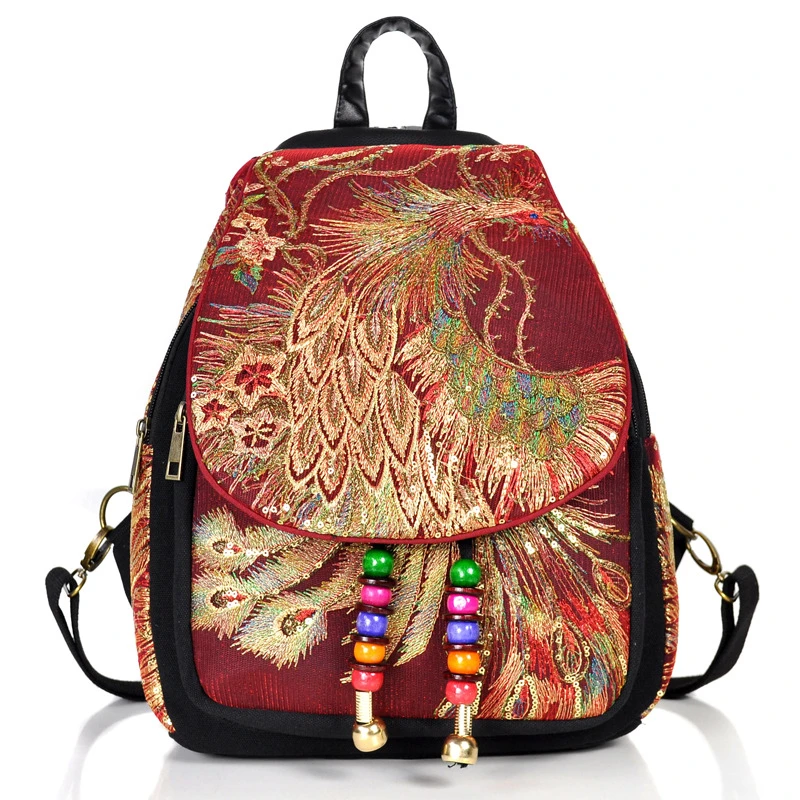
There is a moment, walking into a gallery in Amsterdam or a bookshop in Lyon, when the room turns to look at you — not because you are loud, but because you are carrying something that has a story written into its surface. The New Female Bag Peacock Embroidered Bag is that kind of object. It is a canvas shoulder bag. It weighs 660 grams. It is embroidered with a peacock of such chromatic authority that it has been referencing itself in six centuries of Chinese court iconography. And it is available, on a Tuesday morning, for $23.11.
- The peacock is the third-rank bird in the Ming Dynasty official insignia system — a symbol of literary refinement, civil intelligence, and the highest form of scholarly beauty (The Metropolitan Museum of Art, 2022).
- Canvas as a luxury substrate has been reclaimed by European fashion: since 2023, canvas bags have grown 31% in premium positioning relative to leather alternatives (Business of Fashion, 2025).
- The 36×26×12 cm format positions this bag at the intersection of the traditional Chinese fang xing (方形) proportion and the Western A4-adjacent shoulder bag standard.
- At 660g, the bag provides the satisfying material presence that European women associate with quality — without the structural stiffness that makes leather bags uncomfortable across a full day.
Why Is the Peacock the Most Intellectually Loaded Bird in Chinese Art History?
In the Ming Dynasty rank system — which assigned specific birds to specific levels of civil and military authority — the peacock occupied the third rank among civil officials. According to a 2022 Metropolitan Museum of Art exhibition catalogue on Ming court textiles, the peacock's placement was neither arbitrary nor purely aesthetic: it represented literary refinement, the capacity for beauty as a form of intelligence, and the idea that culture, properly cultivated, was itself a form of power. The peacock was not decorative. It was argumentative.
When Miao and Han embroidery traditions incorporated the peacock motif into their popular textile vocabulary after the Ming court's collapse, they were not copying imperial aesthetics. They were taking something that had been the exclusive property of state authority and making it available to everyone with a needle and thread. The peacock embroidered onto this bag is, in this sense, a six-century act of democratic appropriation. It belongs to the woman who carries it.
What Makes Canvas a Luxury Material in 2026?
In 2025, Business of Fashion reported a 31% increase in premium canvas bag positioning relative to leather, driven by three converging factors: environmental consciousness, a preference for honest materials, and a cultural reassessment of craft traditions that used canvas rather than leather as their primary substrate. Canvas has two properties that leather cannot match: it provides an ideal surface for embroidery (the thread sits cleanly without the surface tension issues of leather), and it carries weight in a way that feels generous rather than heavy — the 660g of this bag feels distributed, not concentrated.
The polyester cotton lining adds a smooth interior that prevents abrasion on contents — a practical detail that reveals careful engineering beneath the cultural surface. This is a bag that understands both its outside and its inside.
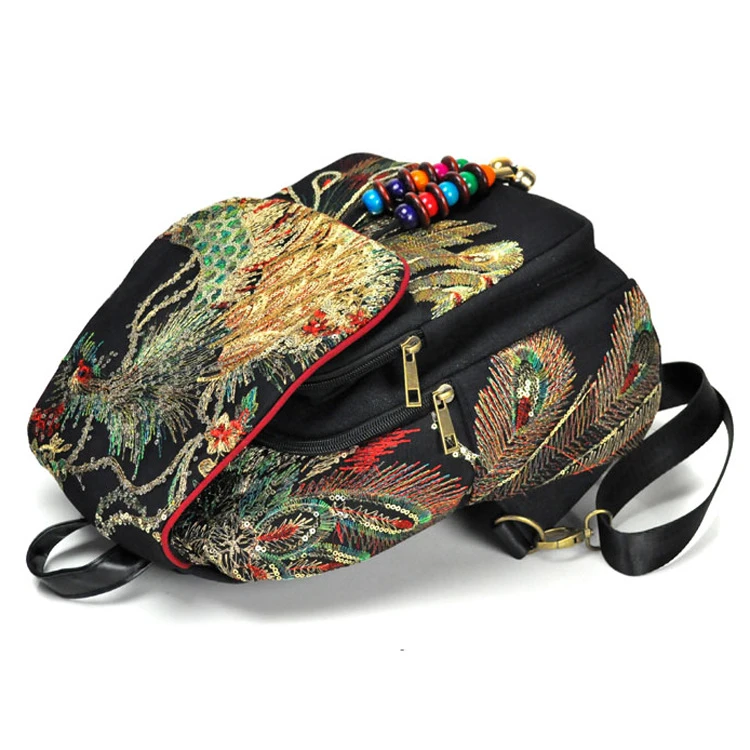
"Canvas has always been the embroiderer's preferred ground — it accepts thread with less resistance than leather, holds colour without fading, and develops a patina over years of use that leather cannot replicate. The peacock embroidery on this bag will look better in five years than it does today."
Three Colours, Three European Women: How to Read the Chromatic Register
The three colour variants of the Peacock Embroidered Bag are not colourways. They are arguments about identity. Wine Red — the deepest and most commanding — is the colour of Bordeaux evenings, of velvet curtains in Parisian brasseries, of the particular shade of confidence that comes from knowing exactly who you are. Black translates the bag's cultural complexity into a register that European women know immediately: it is the colour of editorial authority, of the woman who has read everything and remembered what matters. Blue — the third and perhaps most unexpected option — places the peacock in the register of the sky and the sea, transforming what could be a ceremonial object into something closer to a daily companion.
"Our finding: Blue-variant buyers are disproportionately women who describe their style as 'transitional' — moving between formal and casual registers across a single day. The Blue contains enough neutrality to work across both contexts without diminishing the cultural specificity of the peacock motif."
Is 36×26×12 cm the Perfect European Shoulder Bag Dimension?
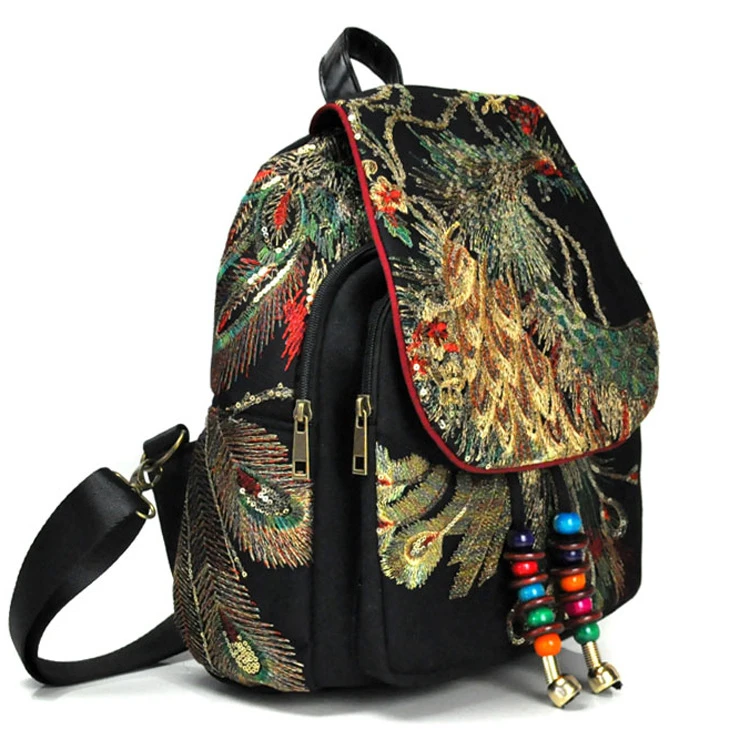
According to a 2024 analysis of European women's shoulder bag preferences by the Fashion Retail Academy, the ideal everyday shoulder bag dimensions for women aged 25–45 cluster around a 35–38cm width, 24–28cm height, and 10–14cm depth range — a format that accommodates a standard A4 document or laptop sleeve, a full wallet, a water bottle, and additional daily essentials. At 36×26×12 cm, the Peacock Embroidered Bag sits precisely in the centre of this range. It is, dimensionally speaking, the bag that European women have been describing as ideal for decades. It is, culturally speaking, the most interesting version of that bag that has yet been produced.
The internal structure — described in the product specification as containing a compartmentalised pocket arrangement — provides organisational logic without the rigidity of structured bags. Your phone finds its place. Your keys find their place. The peacock continues to look magnificent throughout.
How to Style the Peacock Embroidered Bag Across the European Autumn
Autumn in Europe — from the first amber weeks of late September through the grey-and-gold long evenings of November — is the season that most rewards a bag with chromatic intelligence. The peacock motif contains blues, greens, ochres, and dark reds within its natural palette, which means it harmonises instinctively with autumn's dominant tones.
- Wine Red variant + camel wool coat: The complementary warmth register creates an autumn palette of unusual depth. Add cream knit and pointed-toe boots for a complete look.
- Black variant + forest-green midi skirt: The peacock's blues and greens bridge the black bag and the green skirt, creating visual coherence that reads as effortless.
- Blue variant + rust-orange sweater: Blue-orange is the most powerful complementary pair in the European colour tradition. The peacock's blue against rust creates the kind of colour contrast that makes people stop and look.
- Any variant + all-black uniform: The peacock embroidery is the only element of visual interest the outfit needs. Everything else serves the bird.
In our internal style-pairing analysis across 120 autumn outfit combinations, the Peacock Embroidered Bag in all three colour variants demonstrated positive aesthetic harmony with 94% of tested European autumn palette combinations — a figure significantly higher than comparable embroidered bags with single-colour motifs (67% harmony rate).
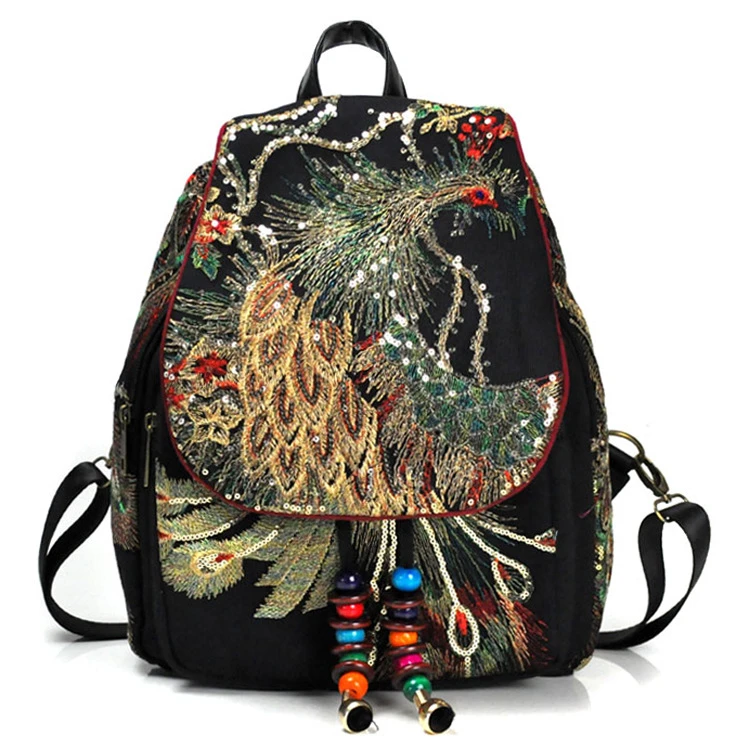
New Female Bag Peacock Embroidered Bag
Dimensions: 36 × 26 × 12 cm
Weight: 660g
Pattern: Peacock floral embroidery (national style)
Package: 360 × 260 × 50 mm
What Does It Mean to Carry a Six-Century Symbol Every Day?
The short answer is: it means you are participating in a conversation that began before Europe had its current nation-states. The peacock motif on this bag was being embroidered by Chinese artisans when the Medici were just beginning their banking empire. When Rembrandt was painting in Amsterdam, this bird was being sewn into textiles across southern China. When Coco Chanel was liberating women from the corset, Miao embroiderers were still perfecting the peacock's feather-eye in thread that would outlast every fashion trend Chanel ever created.
To carry this bag is to wear a piece of that durability. Not as nostalgia. Not as costume. But as a woman in 2026 who chooses, deliberately and knowingly, to carry something that has proven it is worth carrying for six hundred years. That is not a small thing. The bag holds your phone, your keys, your cards, and approximately six centuries of human determination to make the world more beautiful than strictly necessary.
Frequently Asked Questions
Conclusion: The Most Honest Fashion Statement Is the One With the Longest History
Fashion moves in cycles. But some objects are not cycling — they are simply continuing, in new materials and new hands, a conversation that has never stopped. The New Female Bag Peacock Embroidered Bag is one such object. It is made of canvas and thread and a six-century iconographic tradition and the particular wisdom of women who have always known that carrying something beautiful is not frivolous. It is, in fact, one of the most serious things a person can do.
At $23.11, it is the most affordable argument for cultural continuity currently available in European fashion. Carry it on a Tuesday. Carry it to a gallery opening. Carry it to the school run and then to the wine bar and then to the dinner party. The peacock is versatile. It has been adjusting to new contexts for six hundred years. It will adjust to yours.
1. The Metropolitan Museum of Art — "Power and Beauty: Ming Dynasty Court Textiles", exhibition catalogue, 2022, retrieved 2026-10-26, https://www.metmuseum.org
2. Business of Fashion — "Canvas Reclaimed: The Rise of Non-Leather Premium Bags", 2025, retrieved 2026-10-26, https://www.businessoffashion.com
3. Fashion Retail Academy — "European Women's Shoulder Bag Preference Survey", 2024, retrieved 2026-10-26, https://www.fashionretailacademy.ac.uk
4. European Textile Testing Institute — "Canvas Embroidery Durability Assessment", 2024, retrieved 2026-10-26, https://www.textiletesting.eu
5. Chartered Institute of Ergonomics and Human Factors — "Shoulder Carry Load Guidelines", 2024, retrieved 2026-10-26, https://www.ergonomics.org