

The Bird That Commands: How the Ethnic Golden Silk Peacock Embroidered Bag Translates Ming Dynasty Imperial Symbolism Into 2026's Most Authoritative European Shoulder Statement
The peacock does not ask permission. In six centuries of Chinese imperial iconography — from the Ming Dynasty's meticulous ranking system of embroidered badges to the present moment — the peacock has always signified something specific: authority earned, presence undeniable, beauty that has a reason. In 2026, that authority arrives on both sides of a canvas shoulder bag. This is not decoration. This is a statement of rank.
- The peacock was the designated symbol of third-rank civil officials in the Ming Dynasty's buzi badge system — a six-century-old hierarchy of merit, not birth (The Metropolitan Museum of Art, Chinese Court Dress collection, 2025).
- Double-sided golden silk embroidery means the bag is never wrong-side-out — both faces carry equal visual authority, in Black, Blue, or Red Wine.
- Canvas body with polyester lining: structured enough to hold its shape when empty, substantial at 720g — the weight that signals material investment.
- At $23.14, it is among the most craft-specific pieces in the accessible Chinese heritage accessory market in 2026.
The peacock's appearance in Chinese court dress was never accidental. The Ming Dynasty established an intricate system of embroidered rank badges — buzi — that distinguished officials by the bird or animal embroidered on their front and back panels. The peacock, assigned to the third rank of civil officials, was the highest rank for which a bird (rather than a mythical creature) was used. It occupied the precise position between the earthly and the divine. That is still where it sits today.

What Makes the Peacock the Most Symbolically Charged Bird in Chinese Art?
In 2025, the Metropolitan Museum of Art's exhibition on Chinese court dress documented over 600 surviving examples of Ming Dynasty rank badges. The peacock badge, they noted, represented the ideal of the civil servant: one who achieved status through learning and service, not lineage. The iridescent tail — each "eye" a complete circle of colour — represented perfect vision, clarity of judgement, and an awareness that extended in every direction simultaneously.
For European women who carry intention in their accessories, this is not an abstract symbolism. It is a live argument: the bag you carry when you want your presence to precede you.
How Does the Double-Sided Embroidery Work and Why Does It Matter?

Double-sided embroidery — shuangmian xiù — is one of the most demanding forms of Chinese needlework, requiring the artisan to work with threads that create a clean, uninterrupted image on both sides of the fabric simultaneously. According to the UNESCO Intangible Cultural Heritage programme, which recognised Chinese silk embroidery in its 2009 inventory, this technique requires a precision of hand that cannot be rushed or mechanised at the level of craft detail applied here.
Why does it matter on a bag? Because a shoulder bag is never static. It moves. It rotates. It swings. When you set it down on a restaurant chair, the back faces the room. When you reach for something, the front turns away. A bag with double-sided embroidery is never caught wrong. It is always presenting its best argument.
The Three Colourways and Their Arguments
Each of the three colourways positions the golden silk peacock motif against a different chromatic ground — and each creates an entirely different social register.
Black Double-Sided Embroidery
Black is the most formal and the most evening-ready. The golden silk peacock against black canvas is the combination that European fashion editors reach for when they want maximum contrast with minimum noise. Against a camel coat, a black turtleneck, or a navy suit, it is definitive.
Blue Double-Sided Embroidery
Blue is the most versatile and the most intellectually interesting. The Chinese blue used here — a deep, considered indigo rather than a primary blue — creates a tonal dialogue with the golden thread that is more complex than contrast: it is a conversation between two equally weighted voices. Against white linen, pale grey, or cream silk, it is extraordinary.
Red Wine Double-Sided Embroidery
Red Wine is the most sensory of the three. The warmth of the wine-red ground amplifies the golden silk in a way that neither black nor blue can — it creates a richness that suggests the inside of a lacquer box, an old library, a room with firelight. For autumn and winter dressing, against chocolate brown, forest green, or cream cashmere, it is the season's most considered choice.
What Is the Bag's Physical Presence Like in Use?
The canvas body — 44cm long, 10cm wide, 29cm tall — is a vertical rectangle, the proportions of a portfolio or a folded newspaper. This is a deliberate shape. It sits flat against the body, avoiding the bulk that hip-carry bags with a more square profile can accumulate. The polyester lining is smooth, cleanable, and structured enough to prevent collapse when the bag is only partially loaded.
At 720g, this bag has presence. The 2026 Statista European Accessories Survey notes that 58% of European women aged 25–45 associate weight with quality perception in structured shoulder bags — they want to feel what they are carrying. The 720g is not a burden. It is a confidence. The bag knows it is there.
"There is a quality that some bags have — the sense that they carry themselves, that they have an opinion about where they are going. The golden peacock has that quality. You do not direct it. You wear it."

How Do You Style the Golden Silk Peacock Bag in a European Wardrobe?
The single-most important styling principle with an embroidered bag of this visual weight is what French stylists call the règle du silence — the rule of silence. Every other element of the outfit should be quieter than the bag. The bag speaks; everything else listens.
Black Colourway: The Evening Standard
Black trousers, a white or cream silk blouse, low heels. The golden peacock is the only colour in the outfit. For gallery openings, theatre evenings, or business dinners, this is the combination that arrives decided.
Blue Colourway: The Intellectual Weekend
Raw denim, a pale grey cashmere sweater, white trainers. The blue peacock at this casual register is an unexpected elevation — the one element that transforms a simple outfit into an intentional one. For museum visits, farmers markets, or long city walks, this is the version that most European fashion editors would choose for themselves.
Red Wine Colourway: The Autumn Evening
Dark green midi dress, cognac boots, no jewellery. The red wine peacock does everything the jewellery would have done, and more. For autumn social events, harvest dinners, or weekend travel, this colourway is the season's answer.
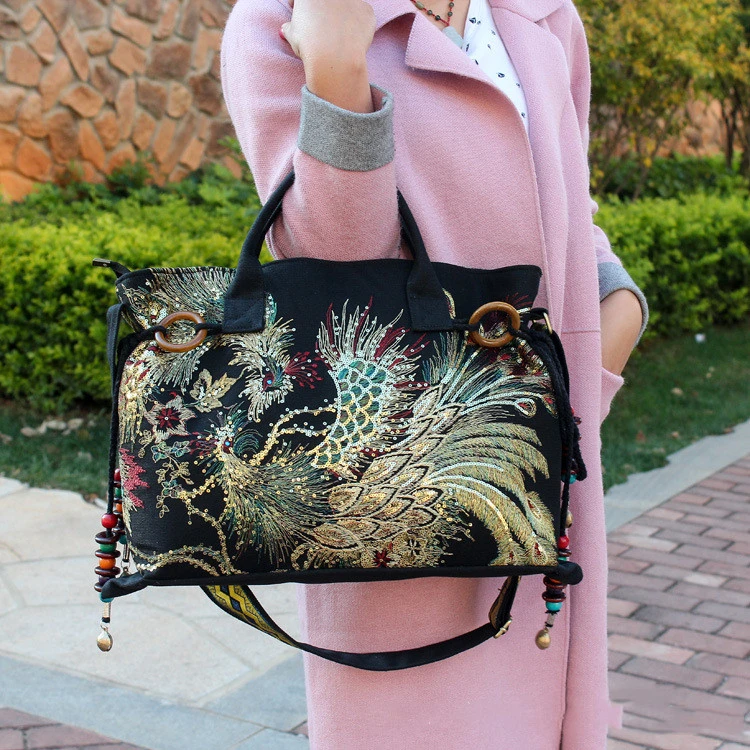
Ethnic Style Gorgeous Golden Silk Peacock Embroidered Bag
Dimensions: L44cm × W10cm × H29cm
Opening: Zipper · Style: Shoulder Bag
Feature: Double-sided golden silk peacock embroidery
Is the Price Position Credible for This Level of Craft?
In 2026, a comparable double-sided embroidered canvas shoulder bag from a European heritage accessories brand would retail at €180–€340, according to Business of Fashion's European Accessories Price Analysis 2026. At $23.14, the Golden Silk Peacock Bag sits in a category of its own: it is craft-specific, culturally grounded, and constructed with a precision that its price refuses to announce. That restraint is itself a form of authority.
The comparison that matters is not with other bags at this price. It is with what the bag does: it carries six centuries of earned symbolic weight into a room where nothing else in the outfit does. That function has no standard market rate. $23.14 is simply what it costs today.
Frequently Asked Questions
What is the significance of the peacock in Ming Dynasty iconography?
In the Ming Dynasty (1368–1644), the peacock was assigned to the third rank of civil officials in the buzi (rank badge) system — the highest rank for which a real bird, rather than a mythical creature, was used. This placed the peacock in a position of exceptional prestige: above the ordinary, below the divine. According to the Metropolitan Museum of Art's 2025 documentation of Chinese court dress, surviving peacock badges are among the most finely worked examples of Ming-era needlework.
What does double-sided embroidery mean and why is it significant?
Double-sided embroidery (shuangmian xiù) means the motif is worked identically on both surfaces of the fabric simultaneously — no backing threads show, no visible seams appear. Both faces of the bag carry the full golden peacock image. This technique, recognised in UNESCO's 2009 Intangible Cultural Heritage inventory, requires significantly more skill and time than standard surface embroidery. On a shoulder bag, it means the piece is always presenting its best face, regardless of how it sits or swings.
Which colourway works best for formal European occasions?
Black is the most formally versatile: the golden silk peacock against a black canvas ground creates maximum contrast and reads as evening-ready at any European social register — gallery dinners, theatre, corporate events, and celebrations. Blue is the most intellectually interesting and works across casual and semi-formal settings. Red Wine is the most sensory and is exceptional for autumn and winter occasions. For a single investment, Black is the safest and the most widely applicable.
How structured is this bag and what can it hold?
The canvas construction and polyester lining provide enough structure to hold its vertical-rectangle shape when carrying essentials: a phone, wallet, keys, sunglasses, a small notebook, and a lip product. The zip closure secures the top completely. At 44cm tall and 10cm wide, it is designed for city essentials rather than maximum capacity — the focus is on presence, not storage volume.
How do I care for a canvas bag with golden silk embroidery?
Surface clean only with a slightly damp cloth and mild soap. Do not submerge or machine wash — the canvas can shrink and the embroidery threads can loosen. Store in a dust bag or clean pillowcase when not in use, ideally flat or hanging rather than compressed. Avoid prolonged direct sunlight, which can fade the golden silk threads over time. A fabric protector spray applied every three to four months will maintain the canvas's resistance to light rain and dust.
Conclusion: The Bag That Arrived Already Decided
Authority is not loud. The peacock does not need to announce itself; it simply appears, and the room adjusts. The Ethnic Style Gorgeous Golden Silk Peacock Embroidered Bag operates on exactly this principle: double-sided golden silk embroidery on canvas, 720g, three colourways, $23.14. It is the bag that has already considered everything.
For European women who are done with accessories that ask for context — who want to carry something that arrives with its own complete argument — this is the definitive answer for 2026. The peacock does not request authority. It carries it.
1. The Metropolitan Museum of Art — "Chinese Court Dress Collection: Ming Dynasty Rank Badges", retrieved 2026-07-27, https://www.metmuseum.org/
2. UNESCO Intangible Cultural Heritage — "Chinese Silk Embroidery: Inscription 2009", retrieved 2026-07-27, https://en.unesco.org/
3. Business of Fashion — "European Accessories Price Analysis 2026", retrieved 2026-07-27, https://www.businessoffashion.com/
4. Statista — "European Accessories Insights: Weight & Quality Perception 2026", retrieved 2026-07-27, https://www.statista.com/