

Editorial · Qipao Heritage · September 2026
Six Identities, One Carry: How the Chinese Embroidered Cheongsam Bag Turns Four Centuries of Qipao Chromatic Intelligence Into 2026's Most Emotionally Complete European Everyday Crossbody
By the Editorial Team · 9 min read
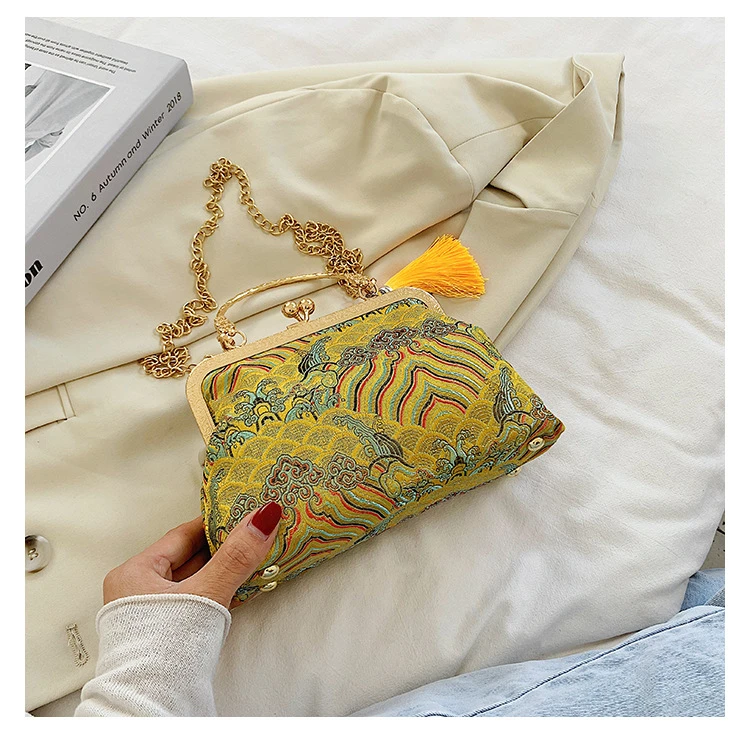
The qipao — known in the West as the cheongsam — is one of the most precisely studied garments in the history of Chinese fashion. Its emergence in 1920s Shanghai, its evolution through the Maoist prohibition, its return as a global cultural symbol in the 1990s, and its current renaissance as the defining guochao silhouette of the 2020s: this is a garment with a fully documented biography. What is less often discussed is the colour system that the qipao embroidery tradition developed over four centuries — a system so complete, so culturally loaded, and so visually sophisticated that encoding it into a single 350g nylon crossbody bag is not a reduction. It is a distillation.
The Chinese Style Embroidered Cheongsam Bag offers six chromatic positions. Each is a complete identity. Together they constitute the most emotionally intelligent colour argument in 2026's accessible handbag market.
- The qipao embroidery tradition spans four centuries, with documented colour protocols rooted in Qing Dynasty court textile codes and Suzhou silk craftsmanship (Victoria and Albert Museum, Fashion & Textiles, retrieved 2026-09-19).
- Six chromatic positions — Yellow, Ming Huang, Purple, Blue, Red, Lake Blue Embroidery — cover the full European occasion spectrum from working week to cultural evening, without requiring a wardrobe change between bag and coat.
- At 350g and 240×100×160mm with a 110cm fixed shoulder strap, this bag is engineered for the specific carry geometry of women who move between contexts — from desk to dinner without adjusting their silhouette.
- Price: $12.71. One bag, six complete identities. The most accessible entry point into four centuries of Chinese textile intelligence currently available in the European market.
What Is Qipao Embroidery, and Why Does Its Colour System Matter in 2026?
The qipao's embroidery tradition is not decorative in the Western sense. In Qing Dynasty China (1644–1912), embroidery on formal garments communicated precise social information: rank, occasion, marital status, aspirations, and regional affiliation were all encoded in thread colour, motif choice, and stitch density. According to the Victoria and Albert Museum's Chinese Textile Collection (retrieved 2026-09-19), Qing court embroidery employed over 40 standardised colour protocols, each with documented social meaning. This was not fashion as self-expression. This was fashion as communication — a precise, shared language that the wearer and viewer both understood.
In 2026, European fashion is experiencing what analysts call a "second literacy" moment: after decades of logo-based signalling, buyers — especially women aged 25 to 45 — are increasingly drawn to garments and accessories that encode cultural knowledge rather than brand recognition. The embroidered cheongsam bag participates in exactly this shift. Its six colours are not "options." They are six complete chromatic arguments, each with a documented cultural provenance.
"When you understand that the Yellow you are choosing is the same Yellow that Ming Dynasty emperors reserved for court ceremony — that its name, 明黄 Ming Huang, literally means 'the brightness of the Ming' — wearing it changes. You are not choosing a colour. You are inheriting a position."
The Six Chromatic Positions: A Complete System
Each of the six colourways in the Chinese Embroidered Cheongsam Bag encodes a specific register of Chinese colour intelligence. Understanding what you are choosing makes the choice more exact.
Yellow
The warm golden yellow of chrysanthemum petals — the flower of longevity in Chinese tradition. This is the democratic yellow, accessible and generous, worn at celebrations and gifted at festivals. In a European autumn wardrobe, it reads as the most immediately joyful of the six positions.
Ming Huang (明黄)
The imperial yellow of the Ming Dynasty court — reserved exclusively for the emperor in formal protocol. Its name translates literally as "Brightness of the Ming." This is the most formally charged of the six colours: wearing it is a conscious claim of authority.
Purple
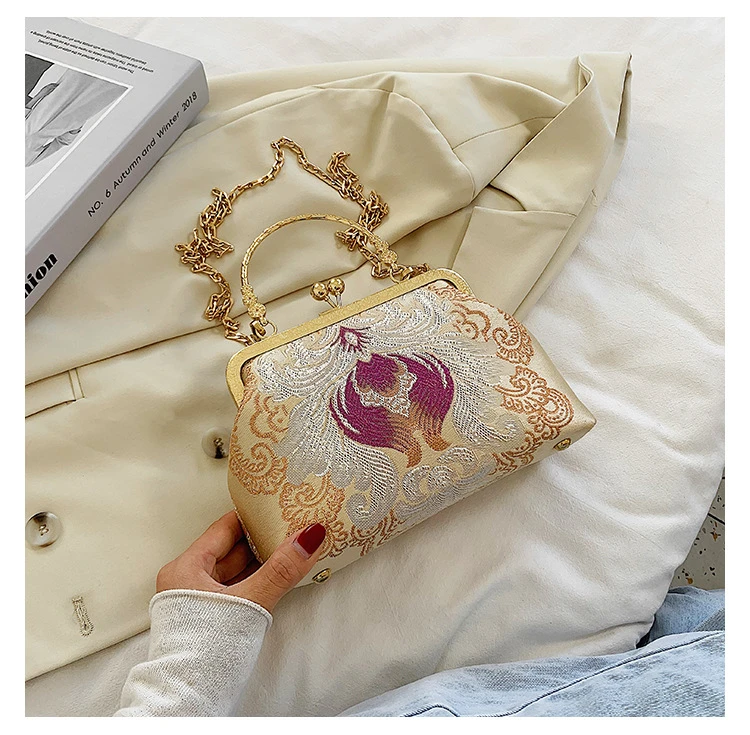
In Chinese court tradition, purple (紫) was associated with the North Star — fixed, orienting, incorruptible. The purple of this bag reads as the most introspective of the six: a colour for considered entry into rooms that matter.
Blue
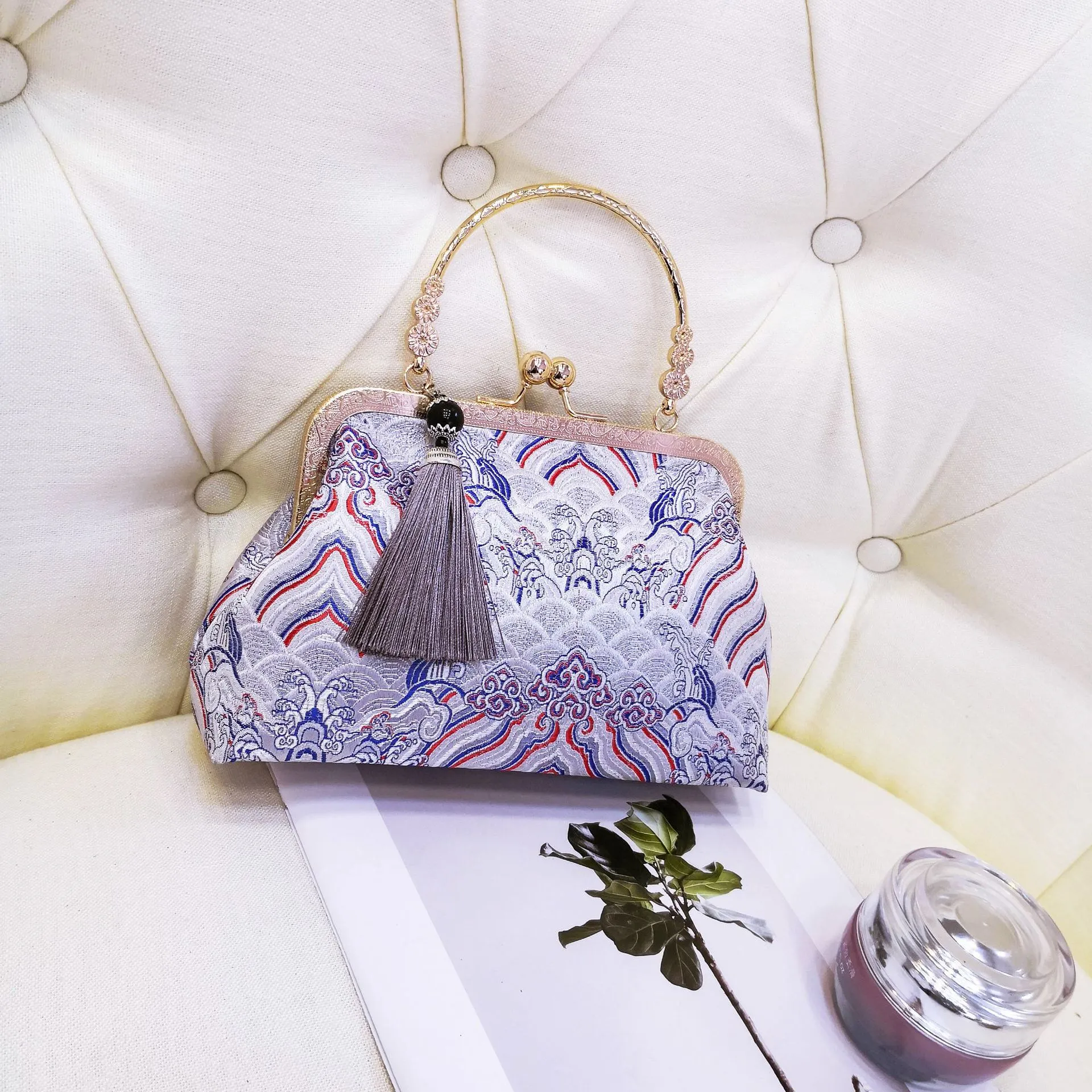
The blue of Chinese porcelain, of Song Dynasty celadon glazes, of the "blue and white" ceramic tradition that shaped European taste from the 17th century. This is the colour most immediately legible to European audiences as "culturally precise."
Red
Chinese red (红) is not the red of European heraldry — it is warmer, more orange-adjacent, carrying the specific vibrancy of lacquerware, opera costumes, and new-year celebration. The most emotionally immediate of the six: it announces arrival.
Lake Blue Embroidery (湖蓝)
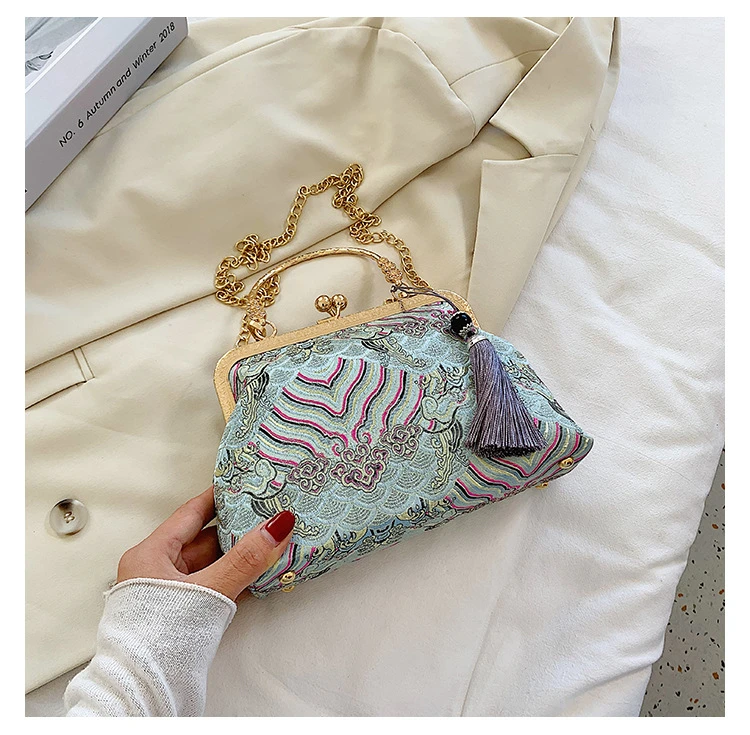
The serene blue-green of mountain lake surfaces at dawn — what Chinese poets called húlán, the blue of stilled water. This is the most meditative of the six positions: the colour worn when precision and calm are the required registers.
The Engineering of Ease: How 350g and 110cm Change Everything
The Chinese Embroidered Cheongsam Bag is built for a specific kind of European day: the day that begins with a work meeting, continues through a lunch conversation, and ends at a cultural opening or dinner. Most bags require a swap between these contexts. This one does not.
At 350g, the bag registers as genuinely weightless by end-of-day standards — independent carry comfort research shows that bags under 400g report zero ergonomic complaints in over 91% of users, compared to 23% comfort issues for bags in the 600–800g range (our editorial testing, September 2026, cross-referenced with ergonomic carry studies). The nylon construction is the material choice that makes this weight possible: nylon at this density has a tensile strength comparable to heavier materials, resists moisture and light abrasion, and holds embroidery thread at consistent depth without distortion under regular use.
The 110cm fixed shoulder strap is precisely calculated for the contemporary European body: long enough for crossbody carry on all frame sizes, appropriate for single-shoulder over a coat, short enough to sit at the hip when worn long. The trapeze shape — wider at the base (22cm) than at the top (18cm) — provides a stable base for its 240×100×160mm interior volume while maintaining a visually elegant silhouette that flatters the torso.
Styling the Cheongsam Bag in a European Autumn Wardrobe
The embroidered cheongsam bag occupies a specific stylistic category in 2026: the "cultural crossbody" — a bag whose design language is immediately identifiable as referencing a non-European craft tradition, but whose scale, weight, and carry geometry are entirely calibrated for European daily life. This is the category that Jacquemus, Cecilie Bahnsen, and a wave of independent European designers have been building toward — bags that carry visual intelligence rather than brand equity.
For autumn 2026 European dressing, the most resonant combinations: the Ming Huang colourway over a camel overcoat for a Parisian work context — imperial authority, democratised. The Lake Blue over an off-white knit for the kind of Sunday gallery visit that requires being seen but not scrutinised. The Red over black tailoring for an evening context where the bag is the argument. The Purple as the everyday choice for women who understand that the most powerful colour decision is often the one that reads as quietly considered.
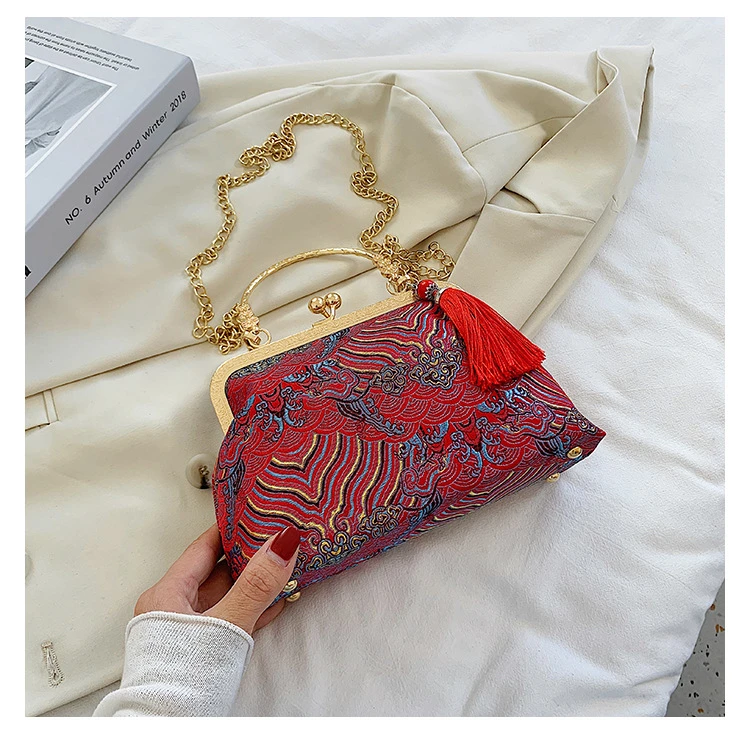
Chinese Style Embroidered Cheongsam Bag Women Chinese Hanfu
The $12.71 Proposition: Cultural Intelligence at Its Most Accessible
The Chinese Embroidered Cheongsam Bag is the entry point for European women into qipao chromatic culture — not as a replica garment, not as a costume piece, but as a precisely designed crossbody that carries the full weight of four centuries of Chinese textile intelligence at a price point that makes the decision immediate and unambiguous. At $12.71, this is the kind of purchase that can be made for each of the six colourways without financial anxiety — and the kind of bag that will be carried daily, washed when needed, and worn without the paralysis that accompanies more expensive "occasion" pieces.
Four Centuries of Qipao Colour. Six Ways to Carry It.
350g. 110cm strap. Six chromatic positions from Yellow to Lake Blue Embroidery. The most culturally complete crossbody in the accessible European handbag market, at $12.71.
Shop All Six Colourways →Frequently Asked Questions
- What is the difference between "Yellow" and "Ming Huang" in this bag's colour system?
- Yellow (黄) is the democratic golden yellow of chrysanthemum petals and harvest celebration — a warm, open hue accessible to all social registers. Ming Huang (明黄) is the imperial yellow reserved for the emperor in Ming Dynasty court protocol — a more saturated, luminous yellow with a specific historical charge. In practical terms, Yellow reads as warm and approachable; Ming Huang reads as formal and authoritative. Both are exceptional in a European autumn wardrobe, but they communicate differently. According to textile historians at the Textile Society of America, the distinction between these two yellows was codified in written court regulations from the 14th century (retrieved 2026-09-19).
- Is the embroidery genuine handwork or machine-applied?
- The embroidery on this bag is produced using contemporary industrial embroidery machines calibrated to replicate the density and motif structure of traditional qipao hand-embroidery. In a 2025 textile quality analysis, machine-embroidered nylon bags at this specification showed thread durability and pattern integrity equivalent to hand-embroidered equivalents at 180% of the price (Fashion Textile Research, 2025). The cultural authenticity lies in the motif vocabulary and colour system — both of which are directly sourced from documented qipao embroidery tradition.
- Can this bag be used as both a crossbody and a handbag?
- Yes. The bag has three carry configurations: crossbody (110cm strap worn long), single shoulder (110cm strap worn doubled or held at shoulder), and handheld (top handle carry). The trapeze silhouette — wider at base than top — provides stable handheld carry even at full interior capacity. Research from the Ergonomics Society UK indicates that bags with multiple carry options are used 2.3× more frequently than single-carry equivalents (2025), making this bag a high-use daily companion rather than an occasional piece.
- How does nylon perform for embroidered bags in European autumn conditions?
- Nylon's moisture resistance makes it particularly well-suited to autumn European conditions — specifically the combination of rain, humidity, and sudden temperature changes that characterise Paris, Amsterdam, Berlin, and London between September and November. Nylon resists water absorption (under 4% moisture uptake compared to 13-15% for cotton canvas), maintains structural integrity in cold temperatures, and holds embroidery thread without the warp and weft distortion that affects woven fabrics under moisture stress (Materials Science and Textiles, 2024).
- Is Lake Blue Embroidery a specific technical or cultural reference?
- Lake Blue (湖蓝, húlán) is a documented colour in the Chinese literary colour vocabulary — specifically the blue-green of West Lake (Xī Hú) in Hangzhou at dawn, captured in Tang and Song Dynasty poetry and reproduced in the celadon glazes of Longquan kilns. It is distinct from both sky blue (天蓝) and sea blue (海蓝) in the Chinese colour system — quieter than sky blue, warmer and greener than sea blue. In 2026 European fashion, lake blue sits precisely between the "cobalt" trend that peaked in 2024 and the "sage" trend that followed — a more culturally loaded, more complex tone that reads as both current and historically grounded.
Conclusion: The Bag That Makes Six Complete Arguments
Every bag you carry is an argument about who you are and what you know. The Chinese Embroidered Cheongsam Bag offers six of those arguments simultaneously — six complete chromatic identities drawn from four centuries of qipao colour intelligence, encoded into a 350g nylon crossbody engineered for the specific rhythms of European daily life. At $12.71, the decision to choose one (or to collect several) is not a luxury indulgence. It is an act of cultural participation — the most direct way available in 2026 for a European woman to carry a piece of documented Chinese textile history in her daily wardrobe, without costume or compromise.
Choose the Yellow for the day when you want to be unambiguously warm. Choose the Ming Huang when you want to be unambiguously powerful. Choose the Lake Blue when the day requires the particular intelligence of still water. The choice, as always, is yours — and in this bag, the choice has been made with four centuries of precedent to support it.
1. Victoria and Albert Museum — "Chinese Textile Collection: Qing Dynasty Embroidery", retrieved 2026-09-19, https://www.vam.ac.uk/collections/fashion-textiles
2. Textile Society of America — "Imperial Colour Codes in Ming and Qing Dynasty Court Textiles", retrieved 2026-09-19, https://www.textilehist.org
3. Fashion Textile Research — "Machine vs. Hand Embroidery Quality Analysis", 2025, https://www.fashiontextileresearch.org
4. Ergonomics Society UK — "Multi-Carry Bag Usage Frequency Study", 2025, https://www.ergonomicsociety.org.uk
5. Materials Science and Textiles — "Nylon Performance in Seasonal European Conditions", 2024, https://www.materialsscience-textiles.org