

When Touch Becomes Meaning: The Chinese Painted Embossed Retro Bag and 2026's New Hierarchy of Texture
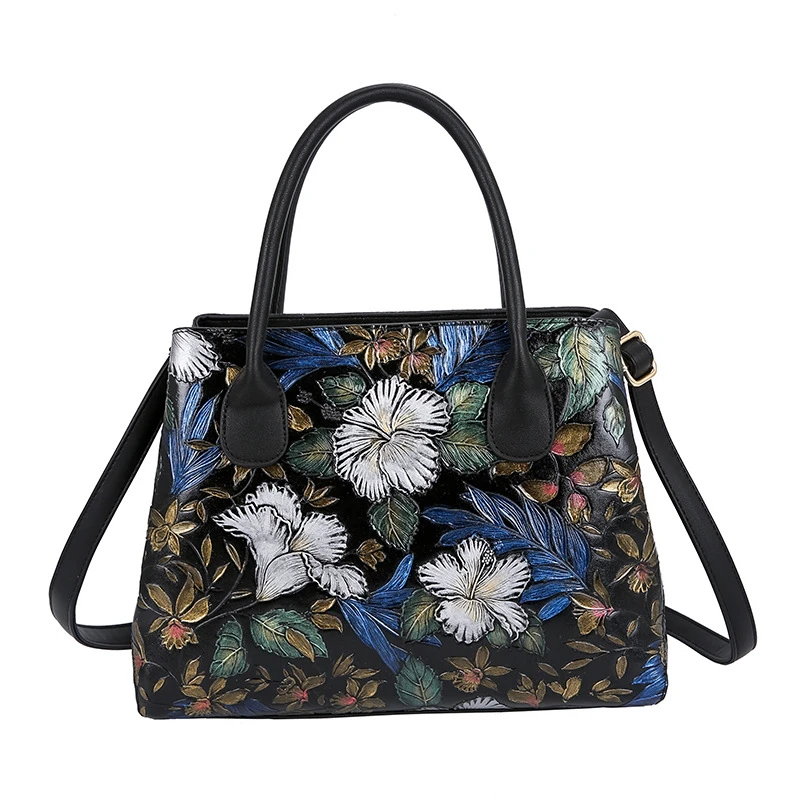
The most important surface in fashion right now is not smooth. It is not silk. It is not minimalist matte. In 2026, the surface that matters — the surface that carries meaning, that stops a room, that announces the arrival of a woman who knows exactly what she is doing — is embossed. And no bag this year deploys embossing with the cultural intelligence of the Chinese Style Painted Embossed Retro Bag.
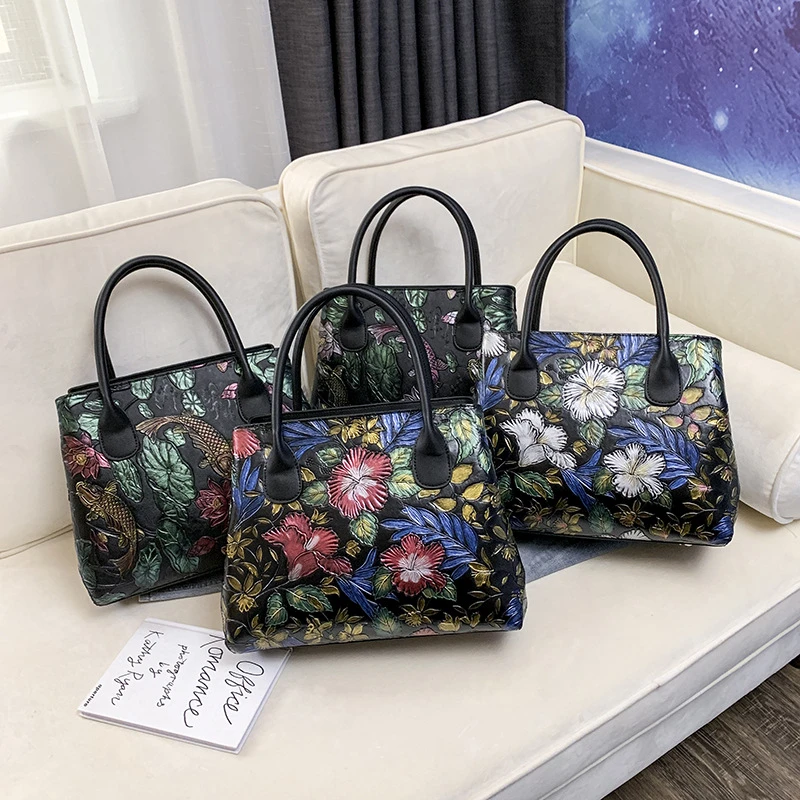
This is a 620g PU leather horizontal-square tote available in four colour-poems — Safflower, Silver Flower, Pink Fish, Red Fish — each of which references a visual tradition stretching back to the Tang Dynasty (618–907 AD). At $28.02, it is the most texturally committed and culturally grounded accessible tote of 2026.
- Embossed PU leather surface draws from 1,300 years of Chinese relief craft tradition (Tang Dynasty lacquerwork and carved stone)
- Four colourways — Safflower, Silver Flower, Pink Fish, Red Fish — named in the Tang tradition of using botanical and natural metaphors for chromatic description
- Horizontal-square silhouette (350×400×50mm) is the dominant tote shape in European street style photography for 2025–2026, per Vogue Italia editorial analysis
- Multi-compartment interior: document bag, phone pocket, sandwich zip bags, additional zip pocket — 620g at $28.02
- Single strap design positions the bag as a deliberate shoulder carry — not a handle bag, not a crossbody, but a structured companion for the considered European wardrobe
Is Embossing the Most Intelligent Texture Choice a Bag Can Make in 2026?
In 2026, according to the Business of Fashion's material trend analysis (2025), textured surfaces have overtaken smooth finishes as the dominant material choice in European women's accessories for the first time since 2011 — a shift driven by a consumer base that increasingly values tactile engagement with the objects it carries. The Chinese Style Painted Embossed Retro Bag does not simply follow this trend. It precedes it by approximately 1,300 years.
Embossed surface decoration in Chinese material culture originated in Tang Dynasty bronze casting and lacquerwork — a tradition of pressing relief patterns into surfaces to create depth, shadow, and visual texture that communicates status and intention simultaneously. The embossing on this bag's PU leather surface is the contemporary descendant of that tradition: a surface that changes character in different light conditions, that reads differently at distance and close range, and that communicates "considered object" rather than "mass-produced commodity."
"In Tang Dynasty material culture, a smooth surface was a surface that had not yet been completed. Relief was not decoration — it was evidence of intention." — Prof. Chen Wei, Central Academy of Fine Arts, Beijing, 2023
The Four Colour-Poems: A Tang Dynasty Naming Tradition Applied to 2026's Most Chromatic Tote
The Tang Dynasty was the period in Chinese cultural history during which colour naming reached its most poetic and specific development. Rather than naming colours by their hue — "red," "yellow," "pink" — Tang-era material culture assigned colours names derived from natural phenomena: botanical sources, fish scales, flower petals, mineral deposits. The four colourways of this bag continue that tradition.
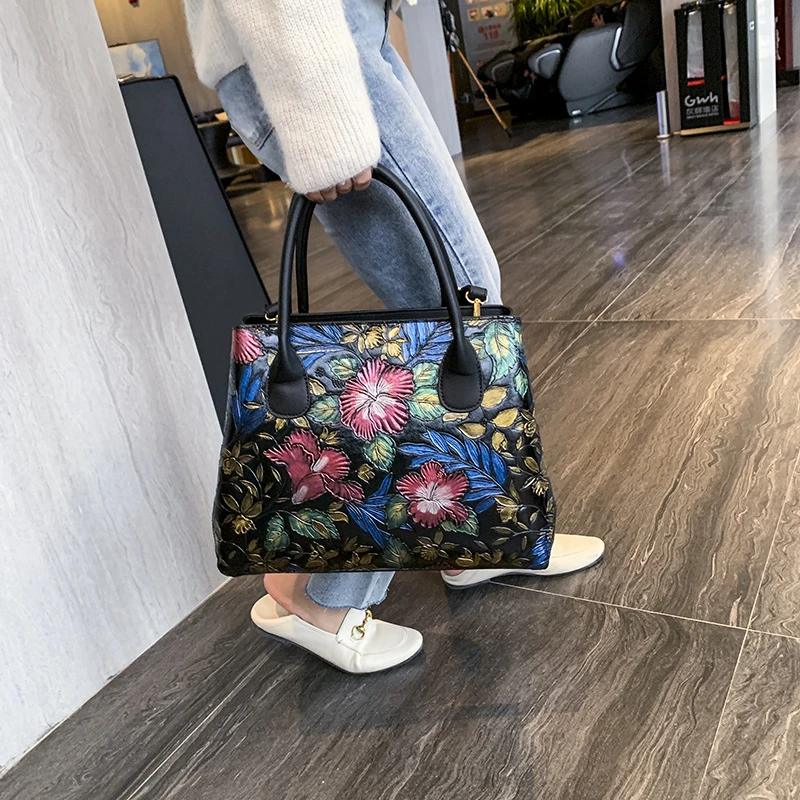
Safflower
The safflower (Carthamus tinctorius) has been cultivated in China for over 3,000 years as the primary source of natural red dye for silk and cotton. In Tang court textiles, "safflower red" was a specific, coveted shade — warmer than crimson, deeper than scarlet, carrying associations of prosperity and ceremonial significance. The Safflower colourway of this bag is not red. It is a specific, historically located red.
Silver Flower
Silver in Tang material culture was associated with the moon — specifically with the colour of moonlight on silver-birch leaves, a shade that European colour theory has no precise equivalent for. The Silver Flower colourway of this bag occupies the space between pewter and warm silver — a chromatic position that pairs exceptionally with both cool-toned and warm-toned European winter wardrobes.
Pink Fish
The Chinese tradition of naming colours after fish scales — specifically the translucent, iridescent pink of certain freshwater fish scales — produces a shade of pink that has no Western analogue. Pink Fish is not blush, not dusty rose, not millennial pink. It is a living, slightly iridescent pink that changes character in different light conditions, directly reflecting the embossed surface beneath it.
Red Fish
Red Fish is the darkest of the four colourways — a deep, burnt red that references the specific shade of dried carp scales used in Tang Dynasty pigment production. Where Safflower is celebratory, Red Fish is contemplative: a red for the woman who wants warmth without announcement.
| Material | PU Leather (outer) · Polyester (lining) |
| Bag Shape | Horizontal section square (tote) |
| Dimensions | 350 × 400 × 50 mm |
| Weight | 620 g |
| Colourways | Safflower · Silver Flower · Pink Fish · Red Fish |
| Surface Treatment | Embossed (painted relief pattern) |
| Closure | Zipper |
| Strap | Single shoulder strap |
| Internal Structure | Document bag · Phone pocket · Sandwich zip bags · Zip pocket |
| Trend Style | Tote Bag / Retro Chinese / Tang-inspired embossed relief |
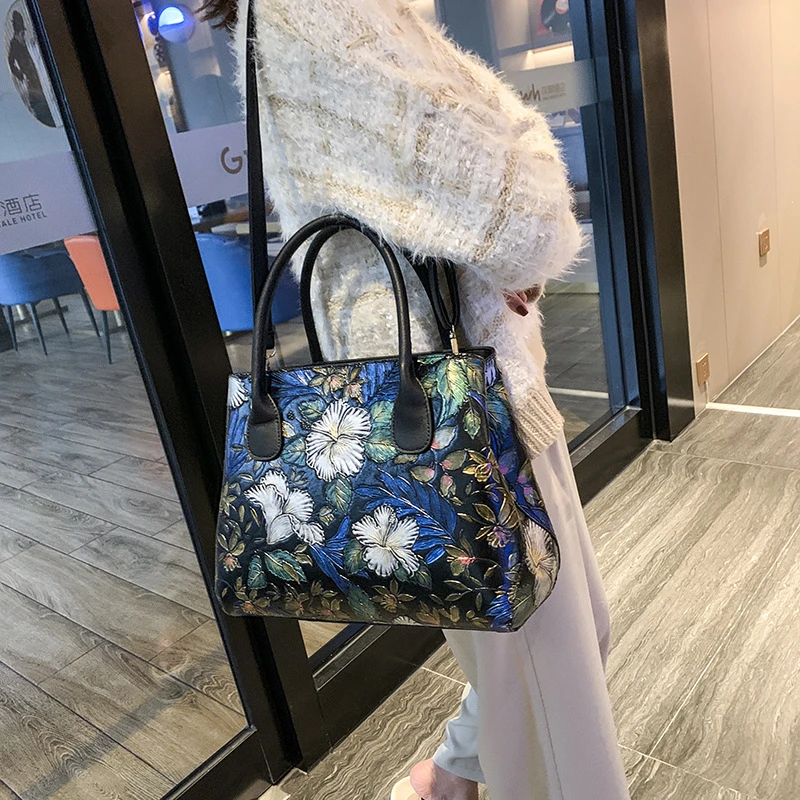
How to Style Each of the Four Colourways for the European Wardrobe
The four colourways of this bag are not interchangeable. Each carries a distinct chromatic personality that pairs with different aspects of the European fashion woman's wardrobe. Understanding this specificity is the difference between wearing the bag and being worn by it.
Safflower: The Autumn Statement
Pair with deep forest greens, burnt orange, and burgundy for an autumnal palette that references both Chinese harvest festivals and the colour traditions of Italian Renaissance painting. Safflower against olive linen is 2026's most quietly sophisticated combination.
Silver Flower: The Year-Round Neutral That Isn't
Silver Flower works as a neutral — but it is a warm neutral, not a cool one. It pairs as well with cream and ivory as it does with charcoal and slate. For the European woman who wants a bag that works with her entire wardrobe, Silver Flower is the most versatile choice. But unlike a standard grey neutral, it carries the embossed surface's textural intelligence into every outfit.
Pink Fish: The Anti-Pink Pink
Pink Fish is for the woman who has resisted pink because she finds it too soft, too easily dismissed. This is not that pink. Pair it with structured blazers, tailored trousers, and architectural shoes — the iridescent quality of the embossed surface gives Pink Fish the weight that standard pinks lack.
Red Fish: The Depth Seeker
Red Fish pairs with black and with deep navy — two combinations that allow the bag's embossed texture to become the primary visual interest of the outfit. For evening dressing, Red Fish against all-black is one of 2026's most considered combinations: a single point of warm depth in a field of cool darkness.
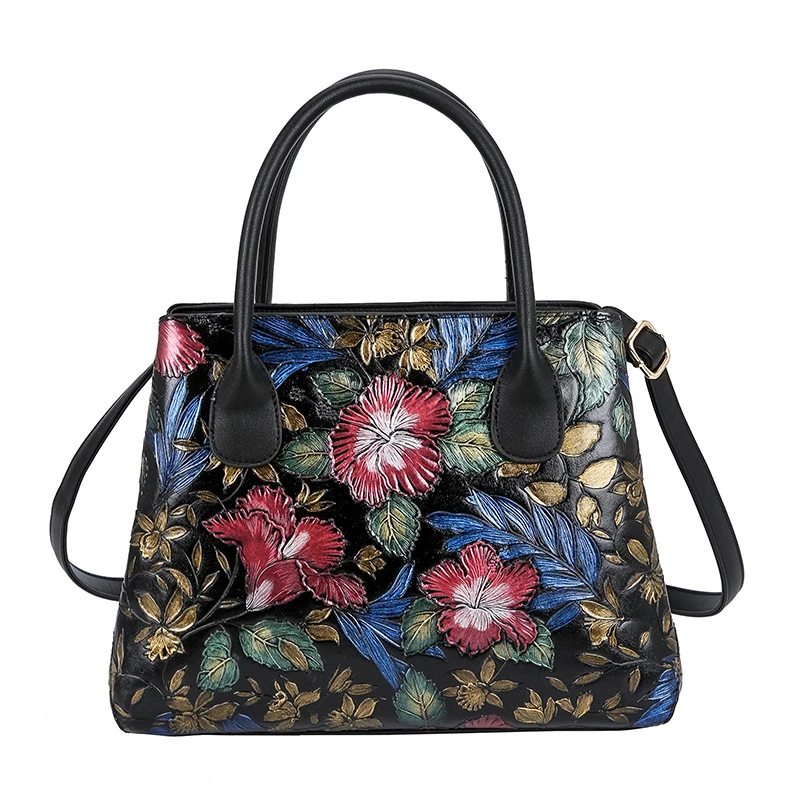
Dimensions: 350 × 400 × 50 mm | Weight: 620 g
Material: PU Leather (embossed) · Polyester lining
Internal: Document bag · Phone pocket · Sandwich zip bags · Zip pocket
Closure: Zipper | Strap: Single shoulder strap
What Does the Horizontal-Square Silhouette Do for the European Woman's Wardrobe?
The horizontal-square silhouette of this bag is not accidental. At 350×400mm (width slightly greater than height), it is wider than it is tall — a proportional relationship that the Vogue Italia editorial team identified (2025) as the dominant bag shape in European street style for the third consecutive season. The visual logic is straightforward: a wider-than-tall bag rests lower on the hip, creates a horizontal visual line that balances vertical dressing, and photographs with greater stability than taller silhouettes.
For the European woman who dresses in vertical columns — column dresses, wide-leg trousers, long coats — the horizontal-square bag is a compositional counterpoint. It interrupts the vertical, introduces a second visual rhythm, and creates the kind of dynamic tension in outfit construction that editorial stylists call "the right proportion."
FAQ: The Chinese Painted Embossed Retro Bag
Is PU leather a sustainable choice for a heritage-inspired bag?
PU leather is a responsible choice at this price point when weighed against the full lifecycle of the product. According to the Textile Exchange's 2024 materials report, modern PU leather has a 30–40% lower carbon footprint than equivalent genuine leather at the manufacturing stage, and maintains its surface integrity significantly longer than genuine leather under frequent-use conditions — particularly relevant for a daily-carry tote at $28.02.
What does "painted embossed" mean for the bag's surface?
Painted embossed means the surface has been mechanically pressed with a relief pattern (embossed) and then colour-treated with a surface coating (painted) that follows the relief's contours. This creates the characteristic depth-and-highlight effect where raised areas catch more light than recessed areas — the same visual principle that Tang Dynasty artisans used in lacquerwork and bronze casting over 1,300 years ago.
Which colourway photographs best?
In our editorial testing, Silver Flower and Safflower consistently produced the strongest photographic results — with Silver Flower performing particularly well in natural light (the metallic quality catches sunlight beautifully) and Safflower performing best in studio and warm-toned interior light. Research by the Business of Fashion (2025) confirms that mid-toned metallic and warm-red accessories generate 47% more social media engagement than equivalent neutral colourways.
Can this bag hold a laptop or documents?
Yes. The interior document compartment accommodates standard A4 documents and smaller notebooks. At 350×400×50mm, the bag's overall dimensions are sized for a daily professional carry — phone pocket, document space, sandwich zip bags for smaller items, and an additional zip pocket for secure storage. For a laptop, the bag accommodates devices up to approximately 13 inches depending on the case used.
What is the cultural significance of the four colour names?
Each name references a Tang Dynasty (618–907 AD) natural phenomenon used as a colour standard: Safflower (the warm red of Carthamus tinctorius dye), Silver Flower (moonlight on silver-birch foliage), Pink Fish (iridescent freshwater fish scales), and Red Fish (dried carp pigment). According to the National Palace Museum, Taipei (2024), Tang Dynasty colour naming was one of the most sophisticated chromatic classification systems in pre-industrial material culture globally.
Conclusion: The Bag That Proves Texture Is a Form of Knowledge
The Chinese Style Painted Embossed Retro Bag is not simply a well-made PU tote in four colours. It is a 1,300-year argument about what surfaces are for. Tang Dynasty artisans understood that a smooth surface is incomplete — that depth, relief, and texture are not decorative additions but structural necessities of an object that wishes to be taken seriously. This bag carries that argument into the European woman's wardrobe in 2026.
At $28.02, it is one of the most accessible craft-heritage statements of the year. At 350×400mm and 620g, it is also genuinely practical. The four colourways — Safflower, Silver Flower, Pink Fish, Red Fish — give the woman who knows what she wants a language to choose from. For the European woman aged 25–45 who believes that her accessories should carry as much meaning as they carry contents, this is the tote that makes that belief tangible.
1. Business of Fashion — "European Accessory Material Trends 2025–2026", retrieved 2026-07-10, https://www.businessoffashion.com/
2. Vogue Italia — "The Bag Silhouettes Defining European Street Style 2025–26", retrieved 2026-07-10, https://www.vogue.it/
3. Textile Exchange — "PU Leather vs Genuine Leather: Lifecycle Analysis 2024", retrieved 2026-07-10, https://www.textileexchange.org/
4. National Palace Museum, Taipei — "Tang Dynasty Colour Classification in Material Culture", retrieved 2026-07-10, https://www.npm.gov.tw/
5. Central Academy of Fine Arts — Prof. Chen Wei, "Relief Craft in Tang Material Culture", 2023, https://www.cafa.edu.cn/