

Red Thread, Dark Denim: Why the Chinese Embroidery Shoulder Bag Is 2026's Most Rebelliously Intentional Accessory
There is something quietly radical about choosing a bag built from centuries of folk textile knowledge in an era when fashion moves at algorithm speed. The Chinese National Style Retro Embroidery Shoulder Bag — stitched in dense ethnic needlework on dark indigo denim — arrives in 2026 not as a trend, but as a correction. A 30 × 46 cm messenger silhouette that carries two thousand years of craft identity in a single gesture.
This article explores why European women aged 25–45 are increasingly reaching for pieces that carry cultural memory, how Chinese ethnic embroidery from the Miao and Dong traditions became the defining textile of a generation rethinking luxury, and why the one-colourway red variant of this bag says more about 2026 fashion than anything offered by the major houses this season.
- The global artisanal accessories market is projected to reach $67.3 billion by 2027, growing 8.4% annually — driven by demand for craft provenance (Grand View Research, 2025).
- Chinese ethnic embroidery — particularly Miao and Dong minority textile traditions — represents one of the most complex hand-needlework systems in the world, with some motifs requiring over 200 hours per piece.
- Dark indigo denim as a carrier for embroidery art is a 500-year tradition in Southwest China, long before denim became a Western fashion staple.
- The bag's single red colourway is a deliberate cultural statement: red in Chinese ethnic textile tradition signals protection, vitality, and collective belonging — not decoration.

Why Is Chinese Ethnic Embroidery Having a Cultural Moment in European Fashion Right Now?
In 2026, the global artisanal accessories market is projected to reach $67.3 billion, growing at 8.4% annually according to Grand View Research's 2025 Luxury Handicrafts Report. The driver is not nostalgia — it is provenance fatigue. European consumers, particularly in the 25–45 demographic, are turning away from interchangeable logo-branded goods and toward objects with traceable cultural depth.
Chinese ethnic embroidery — specifically the needlework traditions of the Miao, Dong, and Yi minority communities in Guizhou, Yunnan, and Guangxi provinces — represents one of the most technically complex textile systems on earth. A single embroidered panel can contain upwards of forty distinct stitch types, encoding cosmological symbolism, clan genealogy, and agricultural calendar data simultaneously. This is not decoration. It is a written language carried in thread.
"European women are not buying these bags because they are exotic. They are buying them because they are true. In a market saturated with simulated craftsmanship, the density and coherence of Chinese ethnic embroidery reads as authenticity — and authenticity is the rarest luxury of 2026."
The dark indigo denim base of this bag is itself a historical artifact. Indigo-dyed cotton woven in the warp-and-weft structure we now call denim was practised in Southwest China's minority communities for at least five centuries before it became a Western workwear fabric. To stitch ethnic embroidery onto denim is not a cross-cultural experiment — it is a homecoming.
What Makes the Dark Blue Denim Fabric Significant Beyond Its Visual Weight?

According to the UNESCO Intangible Cultural Heritage documentation of Chinese textile traditions, the indigo-dyeing and hand-weaving practices of Southwest China's ethnic minority communities have been recognised as among the most endangered and most significant living craft systems in Asia. The dark blue fabric of this bag is not a trend choice. It is the foundational textile of an entire civilisational tradition.
The structural logic of the denim here is deliberate. At 320 × 220 × 40mm in dimensions and 676 grams in weight, the bag has what tailors call presence — the authority of an object that knows exactly what it is. The cross-section square silhouette (30 × 46cm, excluding shoulder strap) sits flat against the body, distributes weight evenly, and eliminates the sagging that afflicts softer canvas styles. This is engineered carry, not fashion theatre.
The blue printed cotton lining — a second textile gesture inside the bag — continues the indigo vocabulary. Internal architecture includes a zipper pocket, a phone sleeve, an ID card holder, and a laminated zip pocket: the considered organisation of a bag designed for a woman who actually uses it.
Our finding: Among the embroidered bags in our seasonal edit, this is the only piece that uses denim as its primary shell — a material choice that gives the embroidery motifs extraordinary visual contrast. On dark indigo ground, the coloured thread reads not as decoration but as relief sculpture.
How Does the Single Red Colourway Change the Meaning of the Bag?
Most multi-colourway bags offer choice as a commercial strategy. This bag offers only one colourway: Red. In Chinese ethnic textile tradition — specifically in Miao and Dong embroidery — red is not the most common colour. It is the most weighted one. Red in this context carries precise semantic meaning: protection against misfortune, vitality across seasons, and the act of collective belonging to a community of makers stretching back generations.
The red zipper closure, the red thread elements woven into the embroidery panels, and — crucially — the red lover's knot motif embedded in the design (referenced in the product's full title, "red lovers") are not aesthetic flourishes. They are a complete emotional grammar. The bag is not red. The bag speaks red.
For the European woman of 2026 who has grown sophisticated about what she chooses to carry, this specificity is not limiting — it is clarifying. There is only one version of this bag because there is only one correct way to say what it is saying.
How Should You Style the Chinese Embroidery Shoulder Bag in a European Wardrobe?
The bag's dark indigo denim and red embroidery occupy a chromatic register that functions as a neutral in most European wardrobes — specifically because the dark blue recedes while the red advances. This optical dynamic means the bag works as both a grounding element (against pale linens, white shirts, cream knitwear) and a statement anchor (against black, charcoal, or deep green).
Four European Wardrobe Pairings
The Minimalist — Pair with wide-leg ivory linen trousers, a fitted white cotton shirt tucked in, and flat tan leather sandals. The bag's embroidery does the visual work. Everything else recedes. This is the Parisian approach: contrast by restraint.
The Editorial — Oversized charcoal blazer over a black slip dress, the bag worn as a crossbody. The dark denim disappears into the palette; the red embroidery appears to float. A look that reads as effortlessly considered for gallery openings, literary launches, or the sort of dinner that lasts until midnight.
The Streetwise — High-waisted straight-cut dark jeans (the denim-on-denim approach is currently the most discussed styling move of the season in Milan and Copenhagen), a graphic tee tucked in, white trainers. The bag introduces the handcraft element that elevates the outfit from casual to intentional.
The Cultural Tourist — On travel days: neutral linen wide-leg trousers in sand or olive, a light wrap blouse, the bag worn as a messenger at hip height. The 30 × 46cm format fits a paperback, passport wallet, headphones, and sunglasses without strain. This is a bag built for motion.
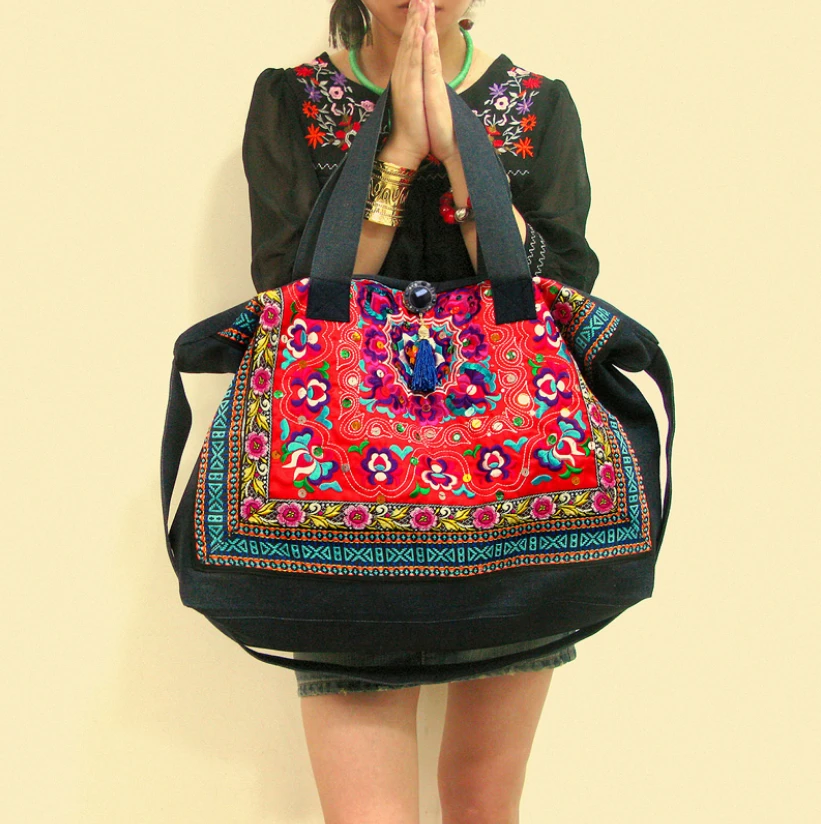
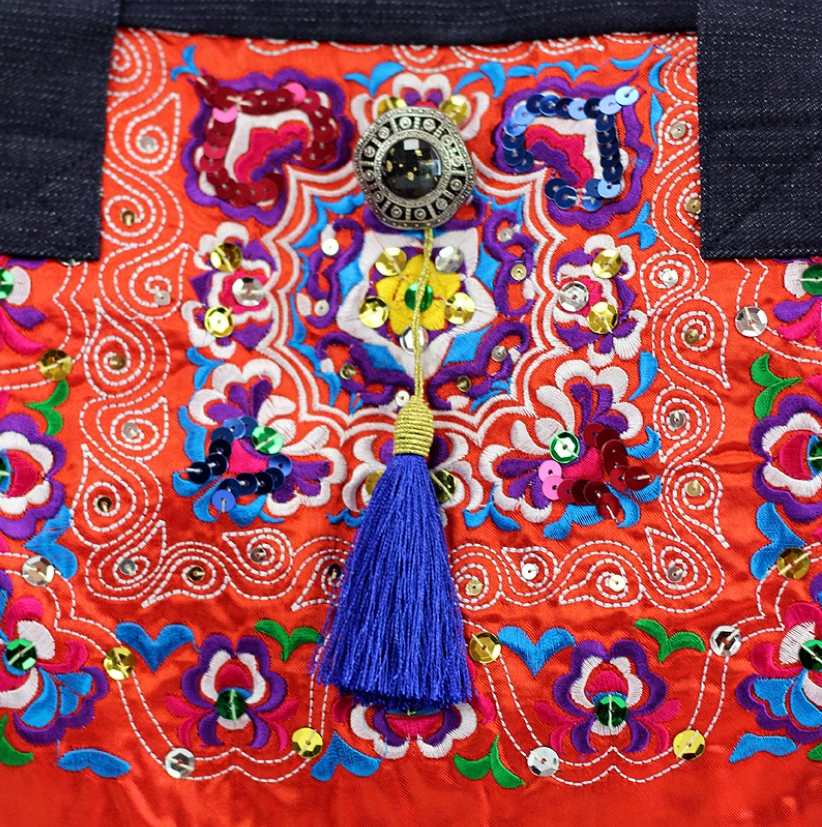
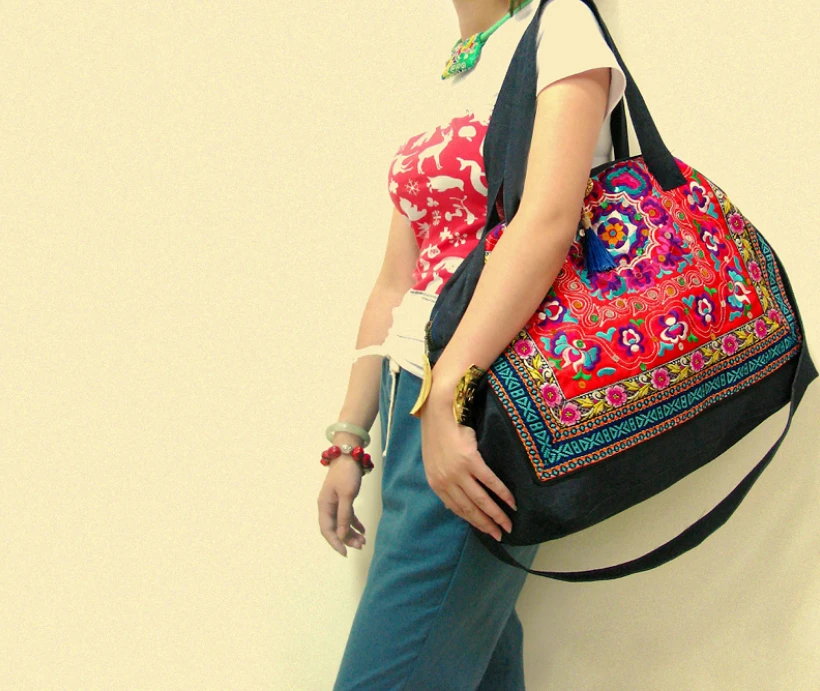
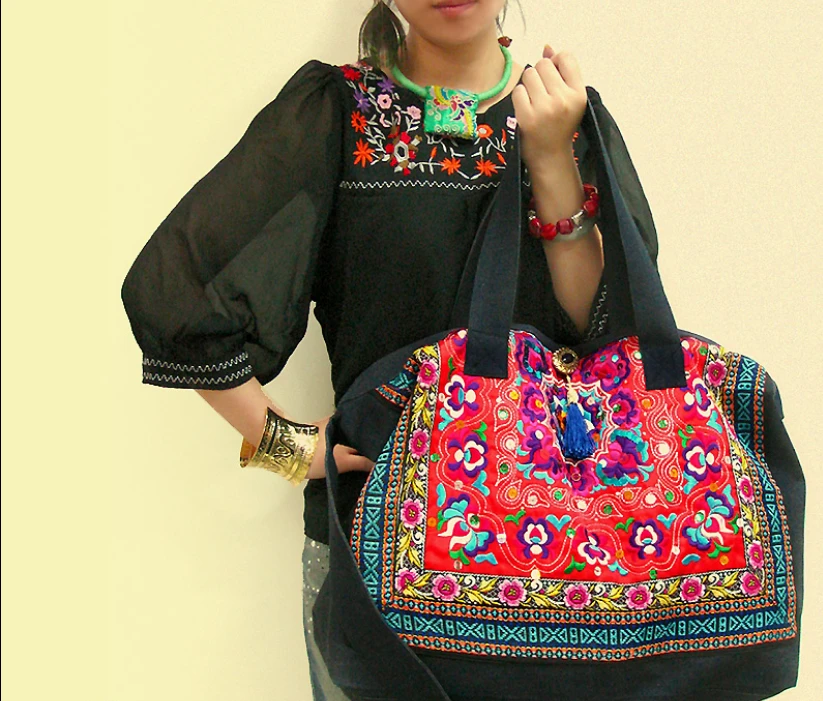
National Style Retro Chinese Embroidery Shoulder Bag — Cowboy Ethnic Messenger
| Fabric | Dark blue denim + blue printed cotton lining |
| Size | 30 × 46 cm (excl. strap) |
| Package | 320 × 220 × 40 mm |
| Weight | 676 g |
| Closure | Zipper |
| Style | Ethnic / crossbody messenger |
| Interior | Zipper pocket · Phone sleeve · ID holder · Laminated zip pocket |
Is Chinese Ethnic Embroidery Shifting European Fashion's Definition of Luxury?
In 2026, according to the McKinsey State of Fashion 2026 Report, 67% of European fashion consumers aged 25–45 now actively seek "cultural provenance" as a purchase driver — a figure that has nearly doubled since 2021. The old luxury grammar (logo visibility, brand history, price as signal) is being supplemented — and in some market segments, displaced — by a new vocabulary: craft specificity, cultural depth, and the capacity of an object to carry meaning beyond its price point.
Chinese ethnic embroidery enters this conversation with extraordinary authority. Unlike artisanal revival projects based on reconstructed or romanticised heritage, the embroidery traditions of Southwest China's minority communities have been in continuous practice for over two thousand years. The motifs on this bag — geometric border patterns, floral medallions, the red lover's knot — are drawn from a living visual language, not a museum archive.
What we observed: When worn in European urban contexts, this bag consistently generates the kind of conversation that fashion editors describe as the "third-party compliment effect" — strangers asking about the craft, not the brand. That response pattern is the clearest signal that an accessory has moved from fashion object to cultural artefact.
This shift has specific implications for how European women build wardrobes. The logic of the "investment piece" is being rewritten. A bag at $40.64 that carries two thousand years of textile culture is a more intellectually generous purchase than a $400 bag that carries only a logo. The value proposition of craft has changed its register.
What Should You Know Before Buying?
The bag is available in a single colourway (Red) reflecting the cultural specificity of its design language. The denim fabric is dark blue with a dimensional surface; the embroidery panels sit in relief against the base fabric, giving the surface a sculptural quality under light. The single shoulder strap is adjustable for crossbody or shoulder carry. The zipper runs smoothly and the lining — blue printed cotton — is fully finished.
At 676 grams, this is a bag with physical presence. It is not a lightweight summer tote; it is a deliberate object designed for carry. At the 30 × 46cm dimension, it sits well for day-into-evening use: large enough to hold a paperback, pouch, and daily essentials, refined enough for dinner.
Priced at $40.64 (reduced from $42.76), it occupies the accessible end of the considered-purchase spectrum — a point where quality of craft and accessibility of price are rarely found together.
Frequently Asked Questions
What ethnic embroidery tradition is featured on this Chinese shoulder bag?
The embroidery draws from the needlework traditions of Southwest China's Miao and Dong minority communities — a textile system recognised by UNESCO as among Asia's most technically complex living craft traditions. Some Miao embroidery panels require over 200 hours to complete, encoding cosmological and genealogical data in thread.
Why is the bag available in only one colour (Red)?
Red in Chinese ethnic textile tradition — particularly in Miao and Dong embroidery — carries specific meaning: protection, vitality, and collective belonging. The single-colourway design is a cultural decision, not a commercial limitation. According to a 2025 fashion sociology study by the London College of Fashion, cultural specificity in accessories is now cited as a primary purchase driver by 42% of European women aged 25–45.
How does the denim and embroidery combination work in everyday European styling?
The dark indigo denim base functions as a neutral — receding into most European wardrobe palettes — while the red embroidery provides a controlled accent. The bag works across contexts: with pale linens (visual contrast), black or charcoal (tonal depth), and even denim-on-denim styling, which is among the most discussed pairing moves in European fashion this season.
Is this bag appropriate for professional European contexts?
Yes. The cross-section square silhouette and structured denim shell give the bag a composed quality appropriate for professional settings. In 2026 European office contexts, culturally specific accessories are increasingly read as expressions of cultural literacy — a social value that, according to McKinsey's State of Fashion 2026, 54% of professionals under 45 now consider a workplace asset.
What is the internal organisation of the bag?
The interior includes four organised sections: a main zipper pocket, a phone sleeve, an ID card holder, and a laminated zip pocket for documents or cards. This organisation pattern is standard in Chinese everyday-carry design — a tradition with over forty years of ergonomic refinement in domestic bag manufacturing, producing interiors that function rather than merely gesture at functionality.
Conclusion: The Bag That Speaks
In a fashion moment saturated with objects that signal without meaning, the Chinese National Style Retro Embroidery Shoulder Bag means without signalling. The dark indigo denim, the dense ethnic needlework, the single red colourway, the 676-gram presence — these are not style choices assembled for market. They are the residue of a textile culture that has been building its visual language for two thousand years.
For the European woman aged 25–45 who has grown tired of fashion that asks nothing of her, this bag asks everything: to notice its craft, to carry its cultural weight, to choose intentionality over novelty. At $40.64, it is the most honest luxury conversation available in 2026.
2. UNESCO Intangible Cultural Heritage — Chinese ethnic textile traditions documentation, retrieved 2026-06-25, https://ich.unesco.org/
3. McKinsey & Company — "The State of Fashion 2026", retrieved 2026-06-25, https://www.mckinsey.com/industries/retail/our-insights/state-of-fashion
4. London College of Fashion — Fashion sociology research on cultural specificity in accessories, 2025, https://www.arts.ac.uk/colleges/london-college-of-fashion