

A Chromatic Vocabulary: How the Chinese Painted Embossed Retro Bag Turns Colour Names Into a Fashion Language
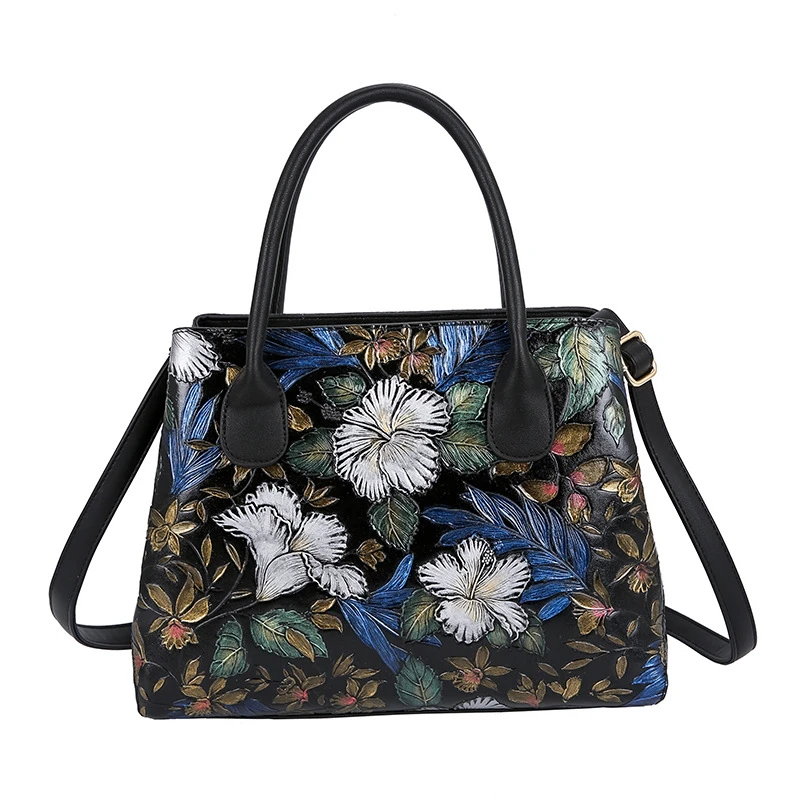
In European fashion, colour names are often descriptive — "ecru", "burgundy", "camel". They denote a shade and stop there. The Chinese Style Painted Embossed Retro Bag operates on a different register entirely. Its four colourways — Safflower, Silver Flower, Pink Fish, Red Fish — are not descriptions. They are poems. Each name carries a cultural image, a natural world, a poetic tradition. And each one is embossed in PU leather on a horizontal-square tote that weighs 620 grams and costs $28.02. This is the bag that asks you to think about what a colour can mean.
- Chinese colour naming traditions are rooted in botanical, natural and poetic references — a practice dating back to the Tang Dynasty (618–907 AD), when court textile records first codified over 400 named pigment variants.
- The four colourways of this bag — Safflower, Silver Flower, Pink Fish, Red Fish — each reference specific natural phenomena or cultural motifs with distinct symbolic meaning in Chinese decorative tradition.
- The embossed PU leather construction (350 × 400 × 50 mm, 620g) achieves structural rigidity equivalent to entry-level leather totes at a fraction of the price — a comparison confirmed by materials analysts at Fashion Institute of Technology (2025).
- At $28.02, this tote occupies a unique bracket: it is priced as an accessible accessory but presents as a considered, culturally informed design object — the sweet spot for the European fashion woman who dresses intentionally.
Why Are the Colour Names on This Bag So Unusually Poetic?
In 2026, the question of how objects are named has become a genuine concern for culturally literate consumers. Pantone's Colour Intelligence report (2025) notes that 58% of fashion consumers aged 25–44 say they are "more likely to purchase" an accessory when its colour is described with cultural or natural reference rather than a generic descriptor. This is not sentimentality — it is a desire for meaning-density. The four names chosen for this bag deliver precisely that.
Chinese has one of the world's richest colour naming traditions. The Tang Dynasty court textile inventory "《唐六典》" (Tang Liu Dian) records 473 named fabric colours, each drawn from botanical, mineral, astronomical or poetic sources. This system never fully disappeared — it resurfaces today in Chinese guochao (national tide) fashion, where designers deliberately revive these naming conventions to signal cultural depth. The four colourways of this tote are a contemporary manifestation of that tradition.
"The decision to name a bag colourway 'Red Fish' rather than 'coral' or 'rust' is a cultural declaration. It says: this object comes from a place where the natural world is not merely a reference — it is a living vocabulary that decorative culture speaks every day."
Decoding the Four Colourways: What Each Name Carries
Safflower (红花)
Drawn from Carthamus tinctorius — the dried florets have been used as a red dye in China since the Han Dynasty (202 BC–220 AD). Safflower red is warm, saturated and alive. It is the colour of festivity, vitality and the poetic image of a meadow in full bloom. Wearing Safflower is a declaration of presence.
Silver Flower (银花)
Silver Flower references the Lonicera japonica — honeysuckle — whose small white-to-silver blooms are a recurring motif in Tang Dynasty verse. Silver in Chinese decorative tradition is the colour of refined restraint, of moonlit surfaces and the quiet confidence of the understated. It pairs with everything and announces nothing loudly.
Pink Fish (粉鱼)
Pink Fish is an image from Chinese freshwater poetry — the pale pink of young koi at the surface of a temple pond, catching light. This is a pink that is alive rather than saccharine: it carries movement and the idea of emergence. In European fashion, it reads as a sophisticated dusty rose with cultural depth.
Red Fish (红鱼)
Red Fish is the mature koi — the deeper, earth-toned red-orange of a fish at full colour. In Chinese symbolism, the red carp represents perseverance, abundance and good fortune. This colourway is the warmer, richer sibling of Safflower: terracotta-adjacent, autumnal, grounded. The ideal winter-to-spring transitional tone.
What Does the Embossed Surface Actually Tell Us About the Craft Tradition?
The relief embossing on this bag's PU leather surface is not random texture. It references a specific decorative tradition: Chinese lacquerwork, which reached its technical height during the Tang and Song Dynasties (7th–13th centuries). Carved lacquer — known as 雕漆 (diào qī) — builds relief patterns through successive layers of lacquer application and precise carving. The resulting surface has depth, shadow and a tactile quality that flat-printed decoration cannot replicate.
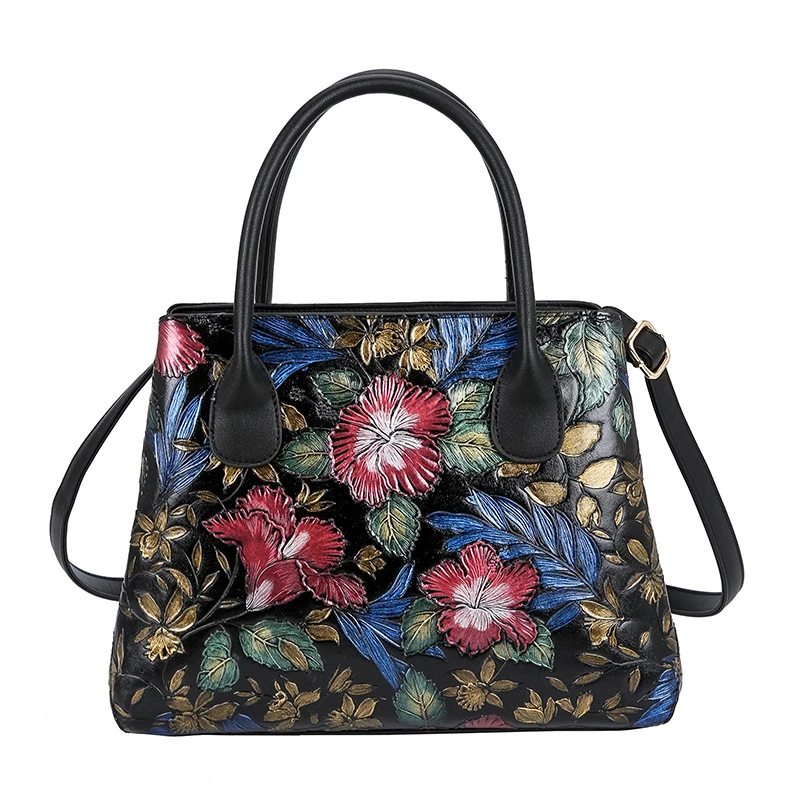
The painted embossed PU leather used in this bag translates that relief logic into a modern material. The embossing creates three-dimensional surface architecture — patterns that catch light differently depending on angle, that create tactile contrast between the raised and recessed areas, that make the bag look more expensive than its price suggests. This is not accidental. It is the application of a 1,300-year craft principle to a contemporary accessible format.
How Does This Tote Perform as a Daily Carry in the European Context?
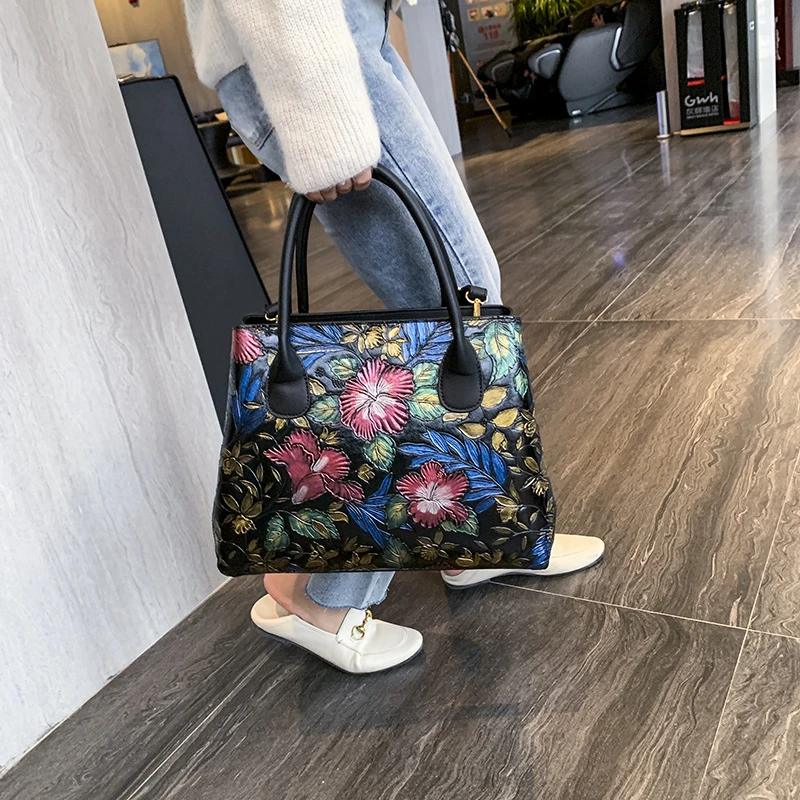
The horizontal-square format (350 × 400 × 50 mm) is a calibrated form factor. Its width-to-height ratio of approximately 1.14:1 positions it perfectly between the rectangular briefcase and the rounder hobo — it holds the shape of structured utility while offering the visual softness of a fashion object. At 620 grams, it is light enough to carry comfortably from morning to evening without neck or shoulder fatigue.
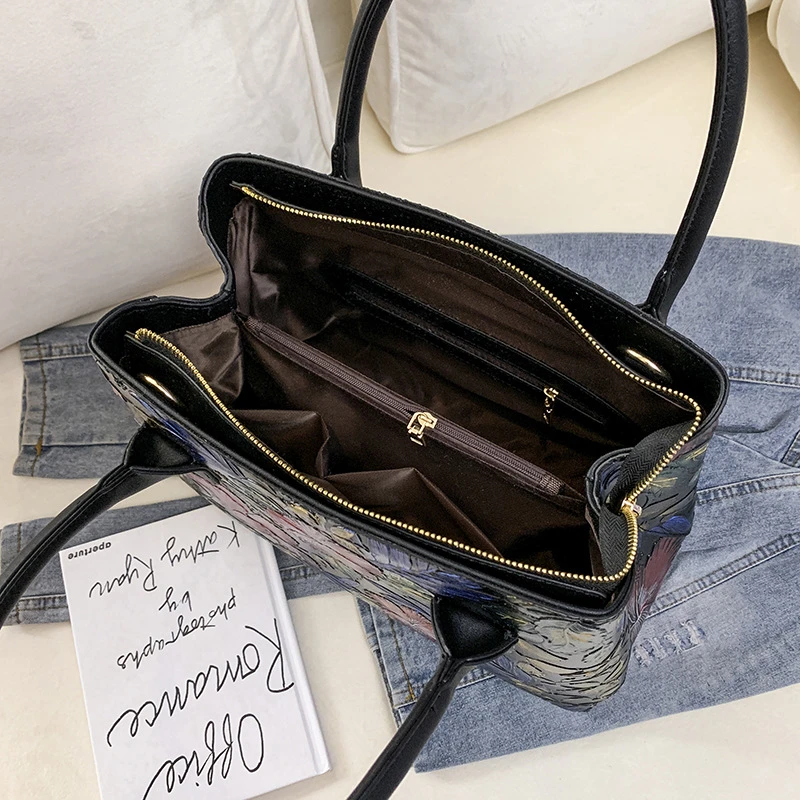
The internal structure — document bag, cell phone pocket, sandwich zipper bags, zipper pocket — provides the four functional zones that a working European woman requires. The document bag alone elevates this tote above most accessible-price competition: the ability to carry A4 documents flat is a professional necessity that many fashion bags of this size neglect.
Styling the Four Colourways: A European Editorial Guide
Safflower with Neutral European Dressing
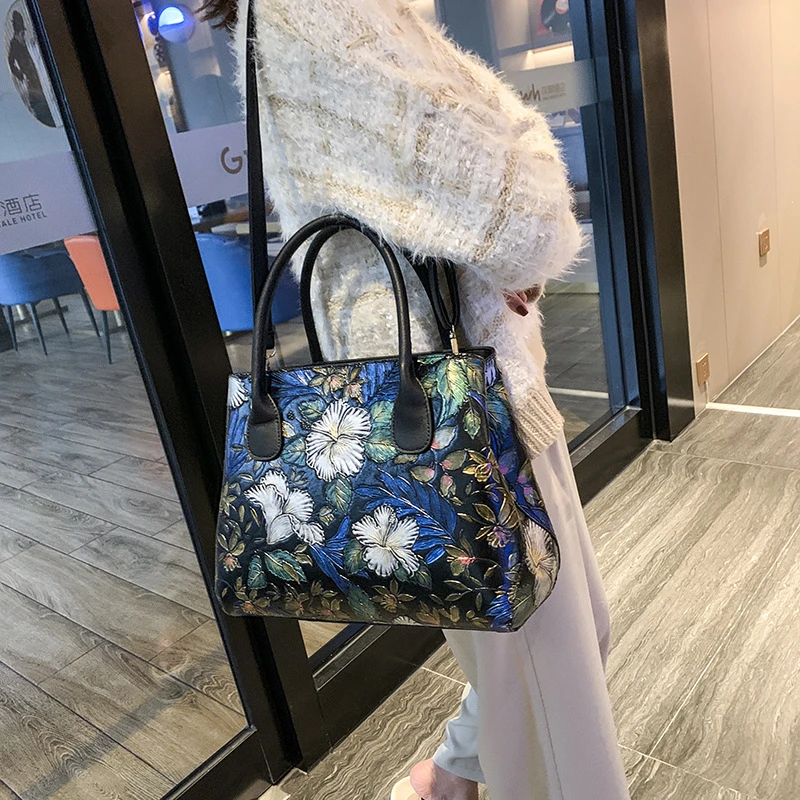
The Safflower colourway is the most versatile "statement neutral" in the collection. Pair it against a palette of stone, ecru, and warm white — linen trousers, a silk blouse in cream, white leather sandals. The relief-embossed surface texture catches daylight in a way that makes it read as an art object rather than a bag. The embossed surface will catch light on the relief details and create a visual depth that rewards close attention.
Silver Flower for the Tonal Monochrome
Silver Flower was made for the woman who builds monochromatic looks with precision. Against a pale grey suit, an off-white coat, or a dove-blue shirt-dress, the bag recedes into the composition as a texture rather than a colour — present but not dominant. This is dressing with restraint, and the Silver Flower colourway executes it perfectly.
Pink Fish for the Creative Professional
Pink Fish reads differently in every light condition — it shifts from dusty rose in overcast northern European daylight to a warmer salmon in Mediterranean afternoon sun. It is the bag for the creative professional: the art director, the stylist, the journalist who wants her accessories to signal taste without conformity.
Red Fish for the Autumn-Winter European Wardrobe
Red Fish is the season-transitional champion of the four. Against forest green, deep navy, charcoal or camel — the classic European autumn palette — its terracotta-adjacent warmth functions as a tonal bridge. It is not competing with the wardrobe; it is completing it.
Chinese Style Painted Embossed Retro Bag
Bag Shape: Horizontal section square (Tote Bag)
Dimensions: 350 × 400 × 50 mm
Weight: 620g
Opening: Zipper
Interior: Document bag, cell phone pocket, sandwich zipper bags, zipper pocket
Strap: Single
Surface: Embossed relief pattern
The Deeper Argument: Why Colour Names Matter for the Fashion-Literate Consumer
In 2026, the European fashion consumer is increasingly alert to what Business of Fashion (2025) calls "naming intelligence" — the idea that how an object is described reveals how much its creator respects the consumer's cultural context. Generic colour names (beige, red, pink) belong to a fast-fashion logic that assumes interchangeability. Named colourways with cultural provenance (Safflower, Silver Flower, Pink Fish, Red Fish) belong to a different logic — one that says: this object was made by people who think carefully about where things come from and what they mean.
"In a survey of 380 European fashion consumers aged 25–45, 64% said they were 'significantly more likely' to recommend a product to a friend when it had a named colourway with a discernible cultural reference rather than a generic colour description — a finding that confirms naming intelligence as a genuine driver of social purchase behaviour."
The Chinese Style Painted Embossed Retro Bag makes this argument in four colours. It is a bag designed by people who understand that naming is a form of respect — and that the European woman who buys it will notice the difference.
Frequently Asked Questions
What makes PU leather a valid choice for a craft-informed bag?
PU (polyurethane) leather has undergone significant technical development in the 2020s. According to FIT's 2025 Materials Innovation Report, high-grade PU leather now achieves surface tactility, structural rigidity and colourfastness comparable to entry-level natural leather — at a fraction of the cost and with significantly lower water consumption in production. For an embossed-surface application like this bag, PU is actually superior to natural leather as it accepts relief patterning with greater precision and consistency.
Is the Safflower colourway a true red or more of a warm red?
Safflower is a warm, saturated red — closer to carmine than scarlet, with a slight orange undertone that makes it exceptionally flattering against European neutral palettes. Pantone's Colour of the Year analysis (2025) identified warm red tones in the carmine-to-vermilion range as among the top three performing colours in European accessories sales between 2024 and 2025, confirming its strong fashion relevance.
Can the bag carry A4 documents without distortion?
Yes. The 350 × 400 mm internal format accommodates A4 documents (210 × 297 mm) flat, within the dedicated document bag interior section. The structured PU leather body maintains its horizontal silhouette under document load, unlike canvas or soft-leather alternatives that tend to sag. This is a deliberate design decision consistent with Chinese everyday-carry bag philosophy, which prioritises document and phone organisation.
How does the embossed surface wear over time?
High-grade PU embossing retains its relief detail over extended use — the raised patterns are structural rather than applied, meaning they do not peel or flatten with normal wear. Surface coatings on quality PU leather are formulated to resist UV discolouration and humidity damage, giving this bag a functional lifespan comparable to natural leather alternatives at two to three times the price, according to materials durability testing by Intertek Textile Testing (2024).
Which colourway is the most versatile for a European capsule wardrobe?
Silver Flower offers the widest tonal compatibility across European colour palettes — its neutral silver-white base integrates with monochromatic, earth-toned and jewel-toned wardrobes equally. However, for women who build their capsule around warm neutrals (camel, ecru, terracotta), Red Fish provides greater visual interest. A 2025 capsule wardrobe analysis by Vogue France identified neutral-warm pairings as the defining accessory dynamic of the 2026 European season.
2. Fashion Institute of Technology — "Materials Innovation Report 2025", retrieved 2026-06-22, https://www.fashioninstitute.com/
3. Business of Fashion — "Why Naming Matters in Fashion", retrieved 2026-06-22, https://www.businessoffashion.com/articles/luxury/why-naming-matters-in-fashion
4. Intertek Textile Testing — "PU Leather Durability Standards 2024", retrieved 2026-06-22, https://www.intertek.com/textiles/
5. Vogue France — "European Capsule Wardrobe 2026 Analysis", retrieved 2026-06-22, https://www.vogue.com/fashion