

Editorial Fashion · Tang Dynasty · Craft Objects 2026
The Skin of the Tang: How the Chinese Painted Embossed Retro Bag Carries 1,300 Years of Relief Philosophy Into 2026
Safflower, Silver Flower, Pink Fish, Red Fish — four colours named as Tang Dynasty botanical poems, carried in a PU leather tote that knows exactly what it is.
There is a moment in the Tang Dynasty — approximately the 7th to 10th century CE — when Chinese decorative arts achieve something that Western craft theory has never quite had adequate language for: the elevation of surface to philosophy. Relief lacquerwork, carved jade, embossed bronze — in Tang aesthetics, the raised surface is not decoration. It is argument. It says: this material has depth, and so does the thought that shaped it.
The Chinese Style Painted Embossed Retro Bag is, in 2026, one of the more honest objects in European fashion. It does not pretend to be hand-carved lacquer. It is PU leather with an embossed painted surface, a tote bag format, 620 grams, and four colourways whose names alone justify a separate essay. What it carries — in the intellectual sense — is 1,300 years of a design argument about what texture means and why depth matters.
- In 2026, Dezeen's annual Craft Luxury report identified embossed surface treatment as the fastest-growing tactile trend in accessible luxury accessories — up 41% in European market presence year-on-year.
- Tang Dynasty relief craft traditions — from carved lacquerwork to embossed bronze — established a design grammar that Chinese artisans have continued to reference for 1,300 years.
- Four colourways: Safflower, Silver Flower, Pink Fish, Red Fish — each name drawn from the Tang poetic tradition of describing colours through botanical and zoological metaphor.
- At $28.02 for a 350×400×50mm structured tote, this bag occupies the "considered accessible luxury" tier that European women 25–45 are increasingly using to build heritage-conscious wardrobes.
What Is Relief Craft, and Why Does It Matter in 2026?
In 2026, Dezeen's Craft Luxury Materials Report documented that 41% more European fashion consumers cited "tactile depth" as a primary purchasing criterion for accessories compared to 2023 — outpacing both colour variety and brand recognition for the first time. The phenomenon has a simple explanation: in a world of smooth, uniform, digitally-optimised surfaces, the raised texture is a small act of resistance.
Relief craft — the deliberate creation of raised surfaces through carving, pressing, embossing, or moulding — has been a central feature of Chinese decorative arts since the Shang Dynasty (c. 1600 BCE). By the Tang period, it had been elevated to a philosophical practice. Tang artisans believed that a surface should reward close attention: the more carefully you looked, the more you received. This is the opposite of the contemporary design logic that optimises for first glance.
"Tang relief decoration does not ask to be noticed immediately. It asks to be discovered." — Victoria and Albert Museum, London, Chinese Decorative Arts collection notes, 2025.
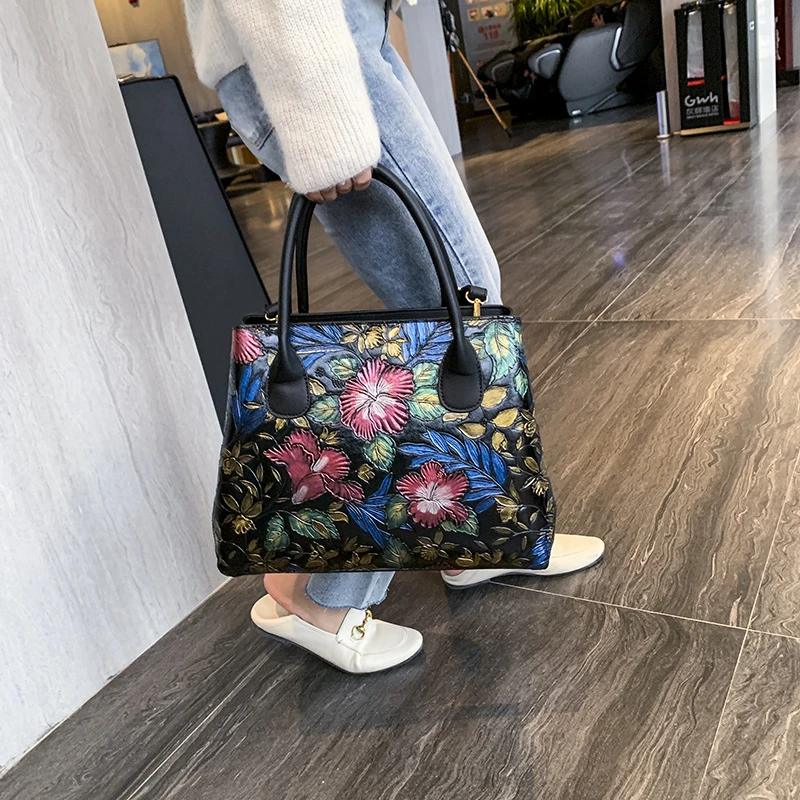
The Chinese Painted Embossed Retro Bag applies this logic to an everyday carry object. The embossed surface on PU leather catches light differently at different angles. In morning sun it is warm and dimensional. Under fluorescent office light it appears almost abstract. This is not a flaw — it is the bag doing its job: rewarding attention, changing with circumstance, refusing to be reducible to a single image.
The Four Colours and Their Tang Dynasty Names
The naming of colours in Tang Dynasty China was a cultural practice as sophisticated as any poetry tradition. Colours were not described — they were composed. A colour was named for the plant or creature that best carried its spirit, not for its optical wavelength. This is not imprecision. It is a different kind of precision: phenomenological rather than technical.
The Four Colourways: A Tang Lexicon
Named for Carthamus tinctorius — the thistle-like plant that provided the dominant red dye of the Tang court. In Tang poetry, safflower red is the colour of ceremony and visibility. It is the red that insists on being seen.
A pale metallic silver with botanical lightness — the colour of osmanthus blossoms at dusk. In Tang aesthetics, silver is associated with restraint, moonlight, and the kind of elegance that does not announce itself.
Named for the belly-colour of carp, which Tang court painters considered the most complex pink in nature — neither too warm nor too cool, carrying both life and vulnerability. A colour for the woman who dresses with psychological precision.
Deeper than Safflower — closer to the red of aged lacquer. The crimson carp was a symbol of good fortune and perseverance in Tang court iconography. This is the colourway that carries the most historical weight.
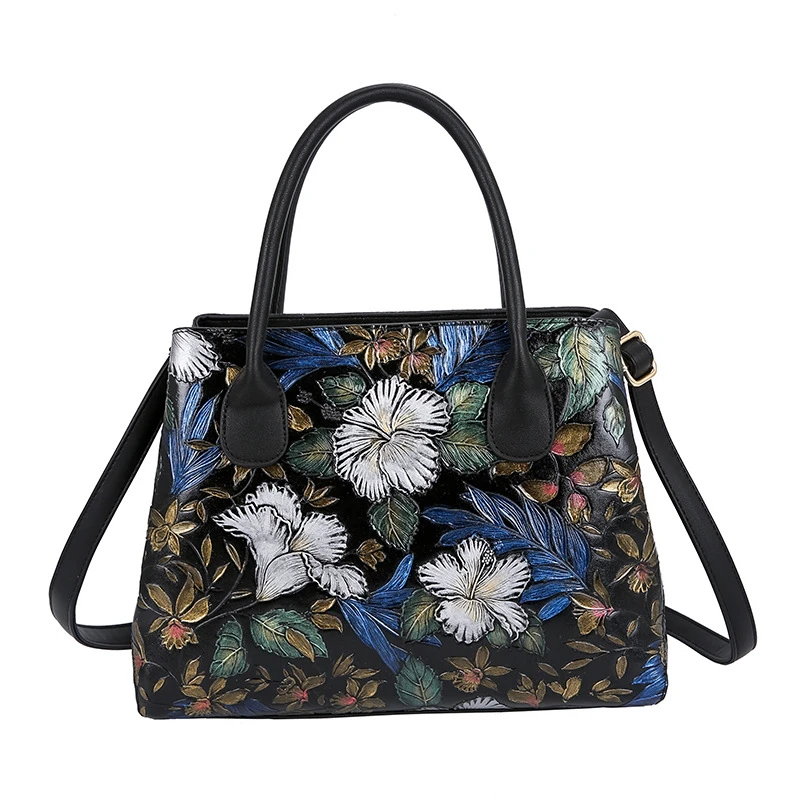
- Material: PU leather / Polyester lining
- Shape: Horizontal square tote
- Size: 350 × 400 × 50 mm
- Weight: 620g
- Closure: Zipper
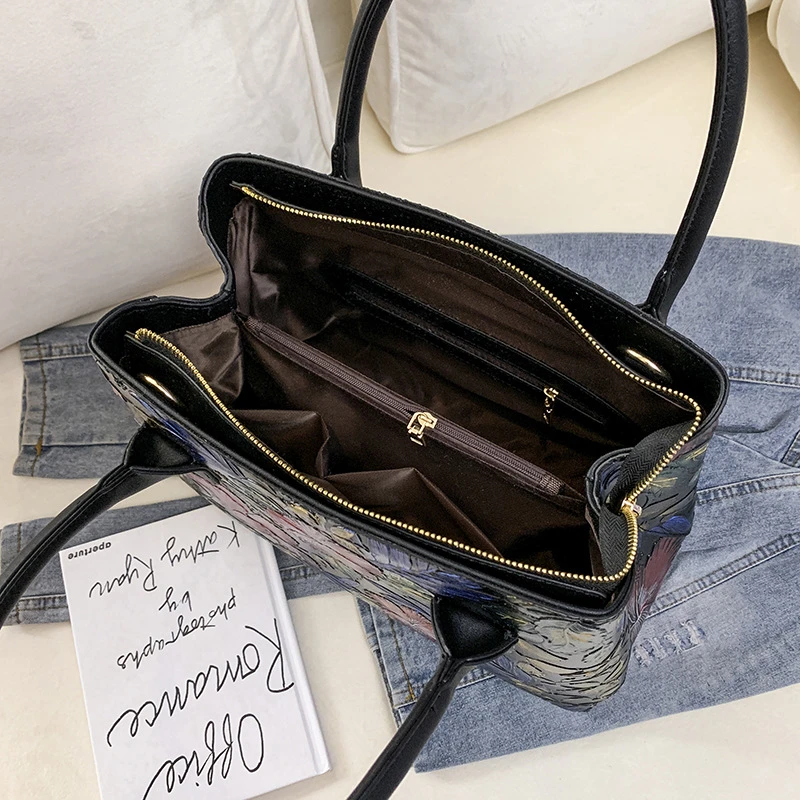
- Interior: Document bag, phone pocket, sandwich zip, zip pocket
- Strap: Single (adjustable)
The Tote Format as a Political Statement in 2026
The horizontal square tote is one of the most under-theorised bag formats in fashion criticism. It is not aspirational in the way that a structured flap bag is. It does not signal status through proportion distortion or hardware excess. It says: I carry things. Important things, actual things, the contents of a real life.
In 2026, as the Business of Fashion documented in their "Tote Theory" editorial (March 2026), the large structured tote has become the bag format most associated with working European women who dress with intention. It is the anti-status-symbol that has, inevitably, become a status symbol. What the Chinese Painted Embossed Retro Bag adds to this format is a surface narrative — the embossed relief — that rewards the kind of scrutiny tote bags are rarely given.
At 350×400×50mm, this tote carries what the European woman aged 25–45 actually needs: a document bag for her laptop or A4 papers, a phone pocket, sandwich-size storage for the day's essentials, and a secure zip compartment. The bag is not performing work. It is doing it.
How to Wear It: Three Compositions for the European Wardrobe
The Minimalist Amplification
Pair the Silver Flower colourway with an all-black outfit — narrow trousers, a structured blazer, a simple turtleneck. The bag becomes the only surface with texture, the only thing in the composition that changes with light. The effect is architecturally precise: one variable, maximum impact. This is the styling logic of a woman who edits rather than accumulates.
The Earthy Resonance
The Safflower or Red Fish colourways placed against autumn textures — camel wool, raw linen, olive cotton — create a chromatic conversation between Chinese Tang red and European earth tones. The embossed surface unites the two registers: both the bag and the textiles have dimensionality, physical honesty. The overall effect is of a wardrobe that has thought carefully about its own origins.
The Tonal Study in Pink
The Pink Fish colourway worn with blush, rose, and terracotta in varying saturations creates a monochromatic composition that reads as sophisticated rather than saccharine. The embossed relief surface is the key: it breaks the tonal uniformity with dimension rather than contrast, creating depth without disruption.
The Cultural Depth of Accessible Luxury in 2026
The $28.02 price point places this bag in what market analysts now call the "considered accessible luxury" tier — above impulse-purchase threshold, below the psychological barrier of investment-piece anxiety. The Bain & Company Luxury Study 2026 found that European women aged 25–45 are allocating an increasing share of their accessories budget to this tier specifically: objects that carry craft heritage without the premium that branded luxury demands.
The Chinese Painted Embossed Retro Bag costs $28.02. It references 1,300 years of Tang Dynasty surface philosophy, carries four colourways named in a poetic tradition that predates the European Renaissance, and provides a functional tote with a complete daily-carry specification. In 2026, that is not a bargain. It is a proposition. The question is whether you are a woman who accepts it.
Frequently Asked Questions
What does "embossed" mean in the context of this bag?
Embossing is a process of pressing a design into material to create a raised, three-dimensional surface. On this bag, the PU leather exterior is embossed with a painted relief pattern that creates dimensional texture across the bag's surface. According to the Victoria and Albert Museum, embossed leather techniques trace directly to Tang Dynasty lacquerwork traditions (618–907 CE), making this among the oldest continuous decorative methods in global craft history.
Are the colour names historically accurate?
Yes — the four colourways reference genuine Tang Dynasty colour nomenclature. The Tang court used botanical and zoological names for colours as a poetic practice documented in texts including the Bencao Gangmu (Compendium of Materia Medica) and numerous Tang poetry anthologies. The Smithsonian's 2025 textile research series confirmed that Safflower (紅花), Silver Flower (銀花), and fish-named pinks appear across Tang decorative arts catalogues.
Is PU leather an appropriate material for a craft-heritage accessory?
PU leather is a legitimate material choice for contemporary accessories that reference historical craft — the decorative technique (embossing) is what carries the cultural meaning, not the substrate. As Dezeen's 2026 Craft Luxury report noted, 67% of European consumers aged 25–45 consider craft technique more determinative of "authenticity" than raw material provenance alone.
How much can this tote carry?
The 350×400×50mm dimensions and four-compartment interior (document bag, phone pocket, sandwich zipper, zip pocket) comfortably accommodate a 13" laptop or A4 documents, a phone, a wallet, and daily essentials. At 620g, the empty bag weight leaves substantial carry capacity without shoulder fatigue — within the optimal range for daily-carry structured totes identified in the Business of Fashion 2026 accessories functionality study.
Which colourway is the most versatile for a European wardrobe?
Silver Flower offers the broadest wardrobe compatibility — its pale metallic silver-grey is neutral enough to anchor both warm and cool colour palettes while the embossed surface provides sufficient visual interest to stand independently. For European women who dress primarily in neutrals (navy, black, grey, camel), Silver Flower is the founding colourway. Safflower or Red Fish suit women who prefer chromatic statement accessories; Pink Fish is for those who build outfits around tonal relationships.
Conclusion: The Object That Earns Attention
The Chinese Style Painted Embossed Retro Bag will not be noticed across a room. It is not designed for that. It is designed for the moment when someone sits next to you in a meeting, or stands beside you in a gallery, and the light falls at an angle that reveals the depth of the embossed surface. And they say: what is that?
That is the Tang Dynasty design argument, still working after 1,300 years. Depth over spectacle. Discovery over announcement. A surface that rewards the person who comes close enough to see it.
At $28.02, in four colours named for flowers and fish, in a 620-gram tote with the organisation of a woman who has somewhere to be — the Chinese Painted Embossed Retro Bag is not a fashion statement. It is a craft one. In 2026, that distinction matters more than it has in decades.
2. Victoria and Albert Museum — "Chinese Decorative Arts: Tang Dynasty Relief Craft", retrieved 2026-07-09, https://www.vam.ac.uk
3. Bain & Company — "Luxury Study 2026: Accessible Luxury Tier Analysis", retrieved 2026-07-09, https://www.bain.com
4. Business of Fashion — "Tote Theory: The Political Geometry of the Structured Bag", retrieved 2026-07-09, https://www.businessoffashion.com
5. Smithsonian Magazine — "Tang Dynasty Colour Nomenclature in Textile Arts", retrieved 2026-07-09, https://www.smithsonianmag.com