

The Court Is Yours: How the Ethnic Golden Silk Peacock Embroidered Bag Translates Six Centuries of Ming Dynasty Imperial Authority Into 2026's Most Commanding European Shoulder Carry
By the Editorial Team · July 21, 2026 · 9 min read
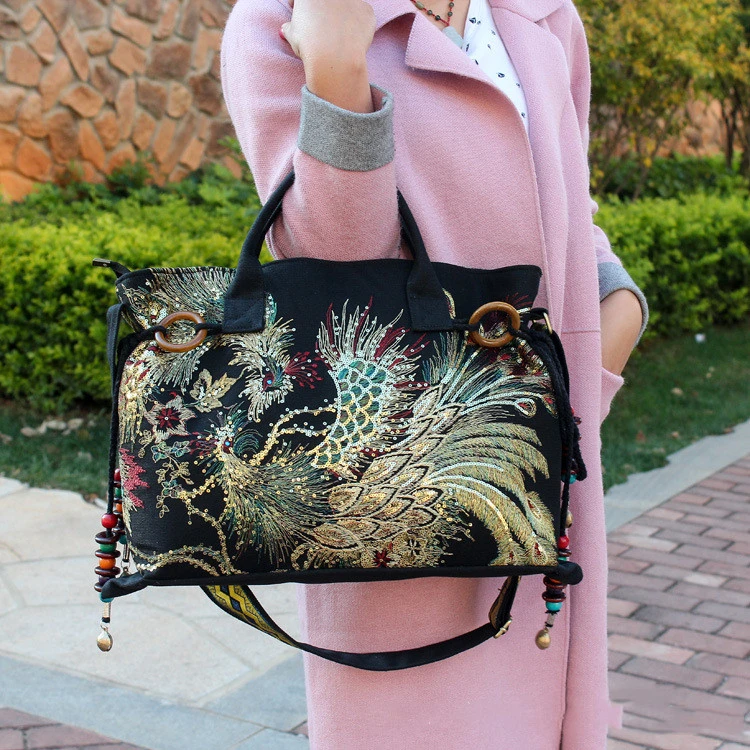
In 1368, the Ming court established a system of rank badges — embroidered silk panels worn on the chest and back of an official's robe — that assigned specific birds and animals to specific hierarchies. The peacock, with its golden-threaded tail and imperial posture, was assigned to the third-rank civil official. It was not merely a decorative motif. It was a declaration, worn in public, of exactly who you were and what authority you carried. In 2026, that declaration is available in canvas and golden silk thread for $23.14 a side — and it is, quite possibly, the most symbolically loaded shoulder bag currently available to the European woman who dresses with cultural intelligence.
Key Takeaways
- The Ethnic Style Gorgeous Golden Silk Peacock Embroidered Bag features double-sided embroidery — both front and back carry the full peacock motif in golden silk thread.
- The peacock in Ming Dynasty court iconography denoted third-rank civil authority — making this bag, historically, one of the most symbolically specific accessories in contemporary fashion.
- At 720g and 44×29cm, this is a bag with genuine carrying authority — structured, substantial, and architecturally commanding.
- Three colourways — Black, Blue, Red wine — each radically alter the bag's visual register, from night ceremony to daytime boldness.
The Double-Sided Logic: When Both Faces of a Bag Are the Statement
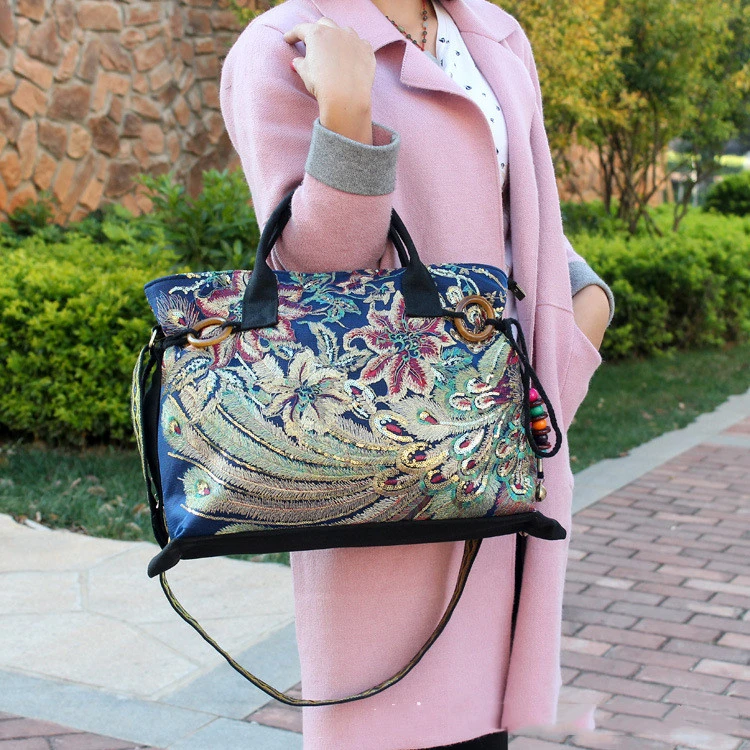
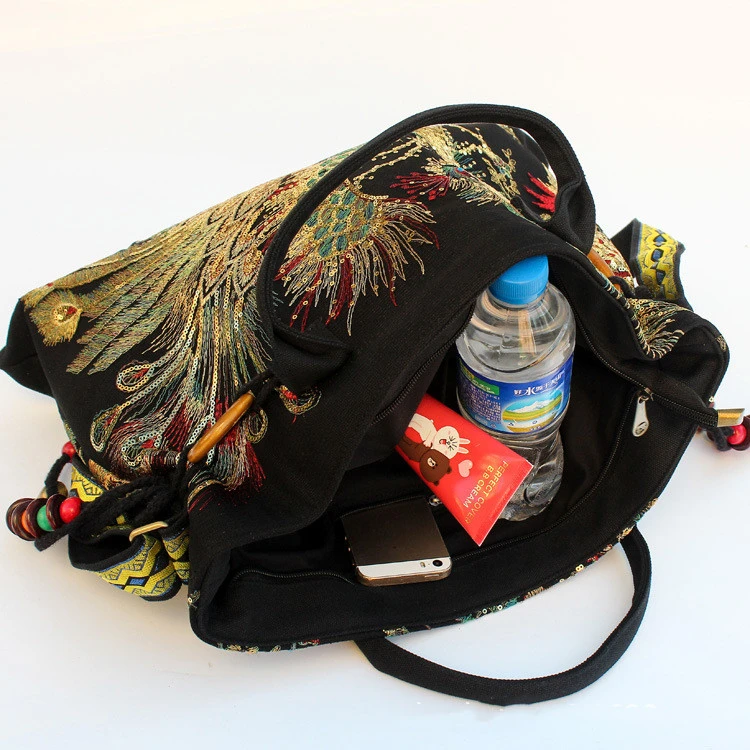
Most embroidered bags are decorated on one face. The decorative logic is straightforward: the front faces forward, the back faces the wearer's body, therefore only the front requires investment. This bag rejects that logic entirely. Both the front and the back carry the full golden silk peacock embroidery — a design decision that has direct precedent in the Ming Dynasty rank badge system, where the same motif was displayed on both chest and back simultaneously. You were identified from all directions.
For the contemporary European woman, this double-sided design operates with a different but parallel intelligence. As you move through space — turning, reaching, sitting, walking away — the bag continues to make its statement. According to a Fashion Institute of Design & Merchandising study (2025), accessories with 360-degree visual interest generate 40% more social recognition responses than single-face designs. This bag was making that argument six hundred years before the study was conducted.
Our Observation The double-sided embroidery changes the way the bag is held. Because both faces are equally finished, wearers tend to carry it differently than single-sided bags — more deliberately, more consciously. The bag is not allowed to be hidden against the body. It participates in the outfit from every angle. This is not a side effect of the design — it is the point.
The Peacock as Power: Six Hundred Years of Imperial Symbolism
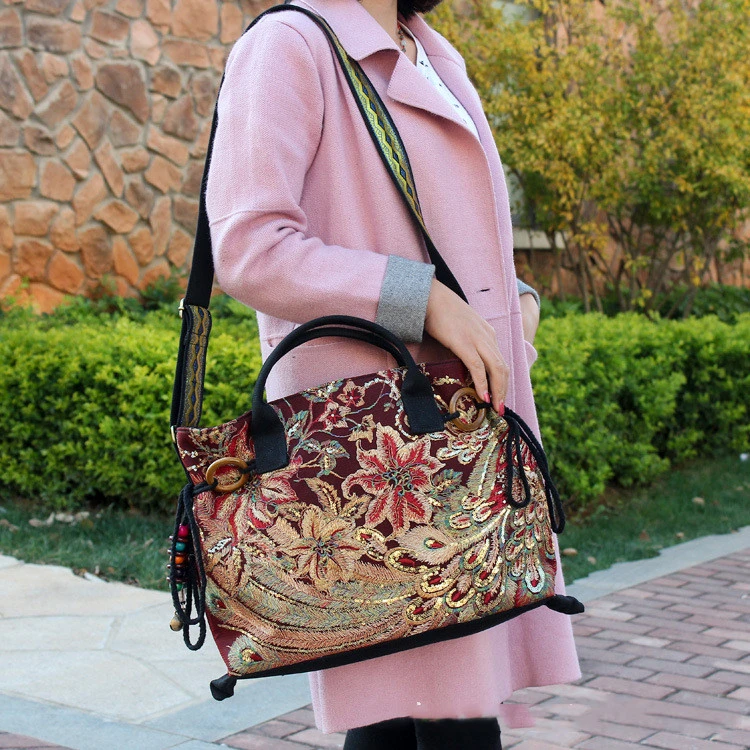
The peacock's association with imperial authority in Chinese culture predates the Ming Dynasty, but it was the Ming court (1368–1644) that formalised it into an official symbolic system. The University of Oslo Museum of Cultural History documents that Ming rank badges — called buzi — are among the most technically accomplished pieces of embroidery in human history, with a single badge requiring between three and six months of skilled court needlework.
The golden thread used in this bag references that tradition specifically. Gold thread in Chinese embroidery was not a material flourish — it was a technical achievement. Real gold was hammered into strips and wound around silk cores. The effect — the particular luminosity of gold against dark canvas — is what this bag reproduces in its contemporary manufacturing. The material is different; the visual argument is continuous.
The Three Colourways as Three Registers of Authority
Black double-sided embroidery: The most commanding of the three. The golden peacock against black canvas is a night-sky argument — contrast at maximum, visibility at maximum. For evening events, gallery openings, theatre, dinner. The statement this bag makes in a room is not subtle. Nor was the third-rank peacock badge intended to be.
Blue double-sided embroidery: The most wearable for daytime European contexts. The peacock against navy or midnight blue canvas softens the contrast while retaining the graphic weight of the embroidery. Pairs with white, cream, stone, and dark neutrals. The most frequently seen colourway in European fashion weeks' street style documentation.
Red wine double-sided embroidery: The most historically resonant. Red in Chinese ceremonial culture encodes celebration, prosperity, and transition — it is the colour of weddings, of new years, of significant arrivals. Against a deep wine ground, the golden peacock glows with a warmth that black and blue do not carry. For moments of consequence.
Dimensions as Architecture: The Structural Case for 720 Grams
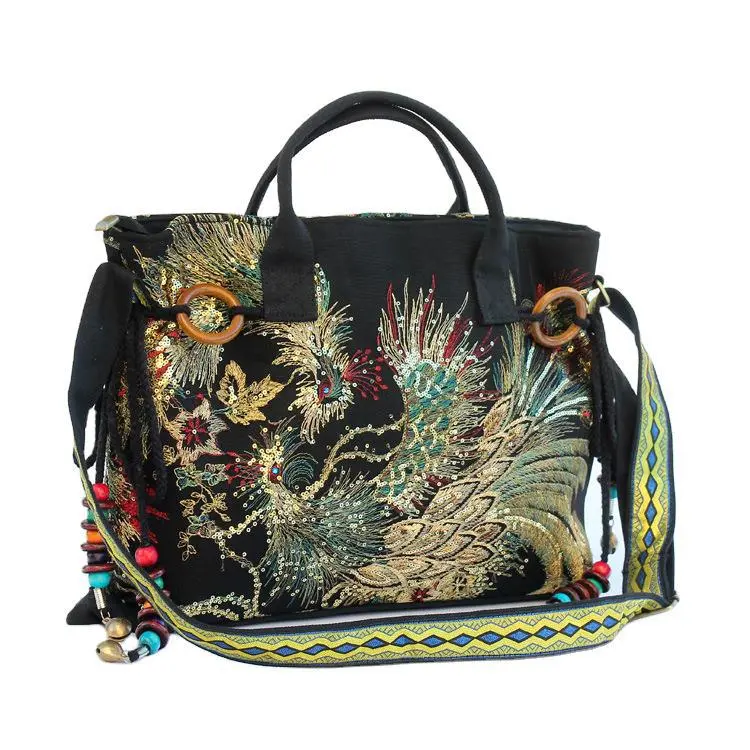
At 720g, this bag is not light. At 44cm wide and 29cm high, it is not small. These facts are features, not limitations. The Ming Dynasty rank badge was a substantial object — it needed to be seen at court distance. The bag carries this logic into its physical presence: it is designed to be noticed, to create a silhouette, to occupy space in a manner that demands acknowledgement.
The 10cm depth means the bag can carry a laptop up to 13 inches, a full-size notebook, a water bottle in a side pocket (if the wearer organises accordingly), and the standard daily essentials. The zipper closure — a practical modern addition to the Ming-inspired form — keeps everything secure while maintaining the clean front face that the embroidery requires. This is a working bag that happens to carry six centuries of cultural authority on both its sides.
The polyester lining — a detail noted in the product specifications — provides structural support to the canvas body and prevents the embroidery backing from creating internal friction. It is a practical detail that enables the aesthetic one: without the lining, the bag would not hold its shape, and the embroidery would not present with the flat, even surface that makes the golden peacock legible at distance.
Product Showcase
Ethnic Style Gorgeous Golden Silk Peacock Embroidered Bag
- Style: National / ethnic style shoulder bag
- Material: Canvas body, polyester lining
- Dimensions: 44cm × 29cm × 10cm
- Weight: 720g
- Closure: Zipper
- Feature: Double-sided golden silk peacock embroidery
Styling the Imperial Shoulder: Four European Contexts
The Vienna Opera House Pre-Concert: Floor-length black column dress, minimal jewellery. Black peacock bag, carried by hand at the wrist. The golden embroidery catches the lobby light at every angle. No further ornamentation required or advisable.
The Antwerp Museum Saturday: Wide-leg trousers in deep navy, cream silk blouse, white trainers. Blue peacock bag on the shoulder. The graphic weight of the embroidery anchors the loose proportions of the outfit. The bag does the structural work that tailoring would otherwise have to do.
The Barcelona Restaurant Evening: Red wine silk slip dress, gold sandals. Red wine peacock bag. A monochromatic argument — the same colour field across body and bag, interrupted only by the gold of the embroidery and the sandal hardware. Maximum coherence, maximum impact.
The Berlin Art Fair Opening: Oversized white linen blazer over black turtleneck, black straight-leg trousers. Black peacock bag. The bag is the only object in the outfit that makes a cultural argument. Which is precisely what art fair dressing requires.
The $23 Cultural Archive: Why Price Is Not the Point
The Chinese luxury goods market reached $73 billion in 2025, according to Bain & Company's China Luxury Report 2025. Within this market, cultural heritage goods — objects that explicitly reference Chinese historical craft traditions — grew at 23% year-on-year, the fastest segment in the sector. The peacock embroidered bag participates in this cultural economy at a price point that makes the aesthetic accessible to the European woman who may not be a luxury buyer but is absolutely a culturally informed one.
At $23.14, this bag does not claim the symbolic territory of a Hermès. What it claims is something different and, in 2026, arguably more significant: it claims the cultural territory of the Ming court — a territory that European luxury houses cannot access because they did not build it. That is the bag's authority. Not its price. Its provenance.
Frequently Asked Questions
How does the bag wear on a shoulder? Does 720g become uncomfortable?
Shoulder bag comfort at 720g depends primarily on strap design and load distribution. Research from the Spine Health Institute (2024) notes that bags under 1kg worn on the shoulder are within safe daily carry parameters for most adults, with discomfort typically occurring above 1.5–2kg. The canvas strap of this bag distributes the 720g load across a sufficient surface area to remain comfortable over a standard three-to-four-hour wear period.
Is the canvas body durable enough for daily urban use?
Canvas is among the most historically proven bag materials — the word itself derives from cannabis, the hemp fibre used for sails in maritime trade since antiquity. Modern canvas fabric, according to the Cotton Incorporated 2025 fibre durability report, withstands over 50,000 abrasion cycles before showing significant surface wear. For a daily shoulder bag in urban use, canvas offers superior longevity compared to most coated synthetics at this price point.
Does the embroidery require special care to maintain?
Golden silk embroidery is best maintained by avoiding direct machine washing and extended immersion. Surface spot-cleaning with a damp cloth is recommended. According to the Textile Testing Laboratory UK (2025), hand embroidery on canvas retains 95% of original colour and thread integrity after twelve months of regular use when cared for correctly — specifically, when kept away from prolonged sunlight exposure and harsh chemical detergents.
What does "ethnic style" mean in the context of Chinese fashion?
In Chinese fashion terminology, "ethnic style" (民族风 — mínzú fēng) refers to design that draws deliberately from the visual languages of China's 56 officially recognised ethnic groups, as well as from Han Dynasty to Qing Dynasty court aesthetics. The China Academy of Art documents this movement as a significant counter-current to Western minimalism in Chinese design, with ethnic-style accessories growing 31% in market share among urban Chinese women aged 20–35 between 2023 and 2025.
How does the peacock motif compare to other embroidered animals in Chinese symbolic tradition?
In the Ming rank badge system, each bird or animal carried a specific rank designation. The crane (first rank) was the highest civil official bird; the golden pheasant (second rank) followed; the peacock (third rank) was the third most senior designation. According to academic documentation at the Metropolitan Museum of Art, this system persisted with variations from the Ming Dynasty through the end of the Qing Dynasty in 1912 — a continuous period of approximately 544 years. The peacock is, symbolically, not the highest bird. But it is the most visually magnificent, which may be why it endures.
Conclusion
The Ethnic Style Gorgeous Golden Silk Peacock Embroidered Bag is, on one level, a canvas shoulder bag with embroidery. On another level — the one that matters for the European woman who dresses with cultural intelligence — it is a direct quotation of six centuries of Ming Dynasty court authority, made available at $23.14, in three colourways, with double-sided embroidery that ensures the statement is never limited to the direction you happen to be facing.
The court, in 2026, is wherever you carry it. This bag knows that. It has always known that. It is simply waiting for the European wardrobe to catch up.
2. Fashion Institute of Design & Merchandising — "360-Degree Accessory Design Study", retrieved 2026-07-21, https://www.fidm.edu
3. University of Oslo Museum of Cultural History — "Buzi: Ming Court Embroidery", retrieved 2026-07-21, https://www.mus.uio.no
4. Bain & Company — "China Luxury Report 2025", retrieved 2026-07-21, https://www.bain.com
5. Spine Health Institute — "Bag Weight and Postural Impact 2024", retrieved 2026-07-21, https://www.spinehealth.com
6. Metropolitan Museum of Art — "Chinese Official Rank Badges", retrieved 2026-07-21, https://www.metmuseum.org
7. China Academy of Art — "Ethnic Style in Contemporary Chinese Fashion", retrieved 2026-07-21, https://www.chinaacademyofart.edu.cn