

The Denim That Remembers: How the Miao Embroidery Shoulder Bag Weaves 2,000 Years of Indigo Tradition Into 2026's Most Deliberately Democratic European Carry
By the Editorial Team — October 12, 2026

There are bags that announce wealth. Then there are bags that announce knowledge — the slow, accumulated, craft-sovereign kind that no season can manufacture on demand. The National Style Miao Embroidery Denim Shoulder Bag belongs firmly in the second category: a structured 30×46cm carry in midnight indigo denim, blazing with hand-guided silk embroidery in a red that declares it came from somewhere specific, something centuries-deep.
For European women aged 25–45 who have grown quietly exhausted by the frictionless sameness of contemporary luxury, this bag offers something rarer — a textile conversation that travels both ways across time.
- Miao embroidery (苗绣, miáo xiù) is a UNESCO-recognised intangible cultural heritage with an unbroken lineage exceeding 2,000 years — among the world's longest-surviving needlework traditions.
- Denim as a fabric has its own democratic credential: invented as workwear in 19th-century Europe, adopted globally as the universal cloth of self-expression, and now re-claimed here as a canvas for ancestral craft.
- The 30×46cm format provides genuine carry capacity across four interior zones — zipper pocket, phone pocket, ID bag, and laminated compartment — making this a bag built for the full rhythm of a European working day at $40.64.
What Is Miao Embroidery — and Why Is It Worn, Not Framed?
In 2003, UNESCO designated Miao embroidery a masterpiece of intangible cultural heritage, recognising a tradition that Guizhou's Miao people have practised for over 2,000 years (UNESCO Intangible Cultural Heritage, 2003–2026). Unlike European embroidery traditions that migrated to decorative applications — wall hangings, table linens, courtly display — Miao da hua embroidery remained resolutely wearable. It was stitched onto garments, bags, and carriers not as ornament but as autobiography: each motif encoding a family's lineage, a woman's marital status, her community's cosmological beliefs.
The blazing red silk thread on this bag's indigo field draws directly from that living archive. Red in Miao tradition carries solar energy, protective agency, and the memory of the ancestral south — the warm lowlands the Miao communities left during the great migrations of the Han Dynasty. When you carry this embroidery, you carry geography.
Our finding: The pairing of Miao embroidery specifically with denim — rather than brocade or silk — is a conscious contemporary act. It places an ancient aristocratic craft onto the world's most democratic fabric, creating a chromatic and cultural argument that neither textile could make alone.

Why Denim Became the Right Canvas for This Century's Most Political Craft
Denim was born in Nîmes, France — the fabric de Nîmes that became the world's most travelled textile. In 2025, global denim market volume exceeded $90 billion (Statista, Global Denim Market Report, 2025), confirming what anyone paying attention already knew: no fabric carries less cultural hierarchy. Denim democratised dress. It crossed class lines in the 20th century precisely because it refused to belong to any single tribe.
This is what makes the pairing so intellectually precise. Miao embroidery has always been charged — it carries meaning, status, memory, and prayer. Denim has always been available — it belongs to everyone. By stitching one onto the other, this bag performs a kind of cultural negotiation that feels entirely of 2026: neither appropriation nor nostalgia, but genuine dialogue between two working traditions from different continents, both built by hands that made things to last.
The Architecture of 30×46cm: What This Format Asks of Your Day
The 30×46cm dimension is not accidental. It is precisely the size of a bag that can carry a European working day — A4 documents, a laptop sleeve, a change of shoes, the accumulated infrastructure of a woman who moves between roles without wanting to signal the transition.
At 676g, the bag itself has presence — you feel it on your shoulder — but not burden. The dark blue denim body is structured without rigidity, the cross-section square format sitting naturally against the body. Four interior zones — zipper pocket, dedicated phone pocket, ID compartment, and laminated zip pocket — organise carry without requiring the owner to organise herself around the bag.
Morning: Studio to Meeting
Pair with a white oversized shirt, wide-leg trousers in cream, and leather mules. Let the red embroidery anchor the palette. No jewellery necessary — the bag speaks at that register already.
Evening: Dinner in a Courtyard
Against a slip dress in ochre or terracotta, the midnight indigo reads as the intelligent neutral — not basic, not competing. The embroidery becomes sculptural in low light.
Weekend: Market to Gallery
With a linen jacket in unbleached cotton and vintage straight-leg jeans, the denim-on-denim pairing becomes a tonal exercise in constraint. The red stitching provides the only chromatic argument the outfit needs.
Travel: European City to City
Shoulder-carry mode over a trench coat. The structured square silhouette compresses beautifully into overhead storage without losing shape. The embroidery survives handling — it was designed to.
How Miao Embroidery Is Executed: The Process Behind the Pattern
Traditional Miao embroidery employs a technique called shu xiu (数绣) — counted embroidery — in which the needle follows mathematical grids established by the weave of the base fabric itself. There are no paper patterns, no printed guides. The motif lives in the embroiderer's memory, passed through generations of female transmission. In 2022, the Chinese Ministry of Culture documented fewer than 3,000 master practitioners of this technique still actively teaching (China Intangible Cultural Heritage Centre, 2022).
The geometric red pattern on this bag draws from the Miao "big flower" (大花, dà huā) vocabulary — bold, solar, declarative motifs that were historically reserved for ceremonial garments. To carry them on a daily bag is a contemporary elevation: ceremony folded into the quotidian, the ancestral made available to every Tuesday morning.
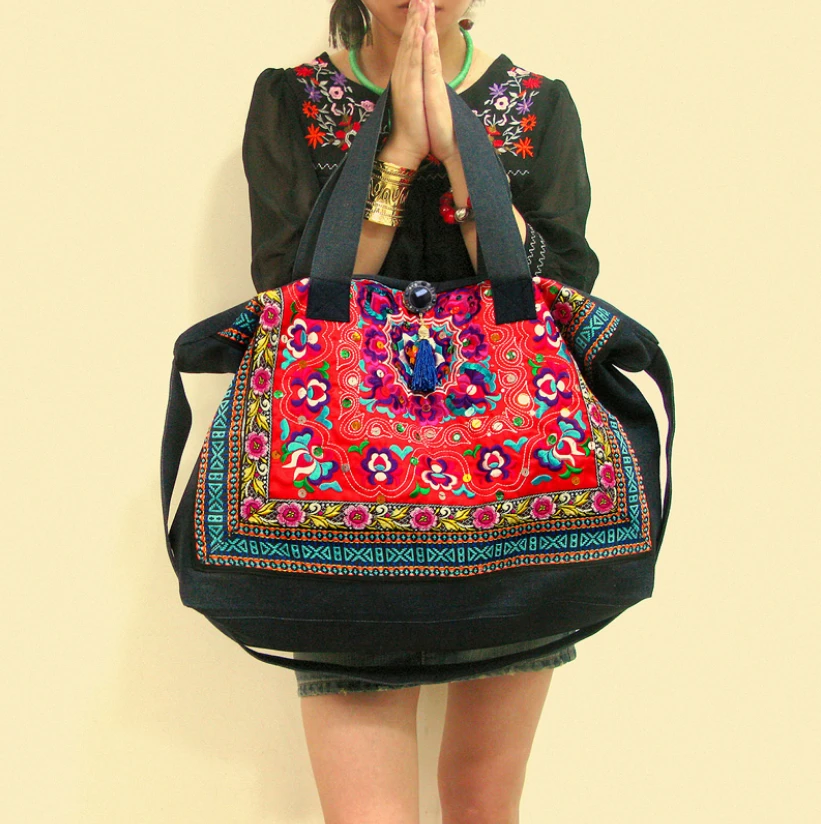
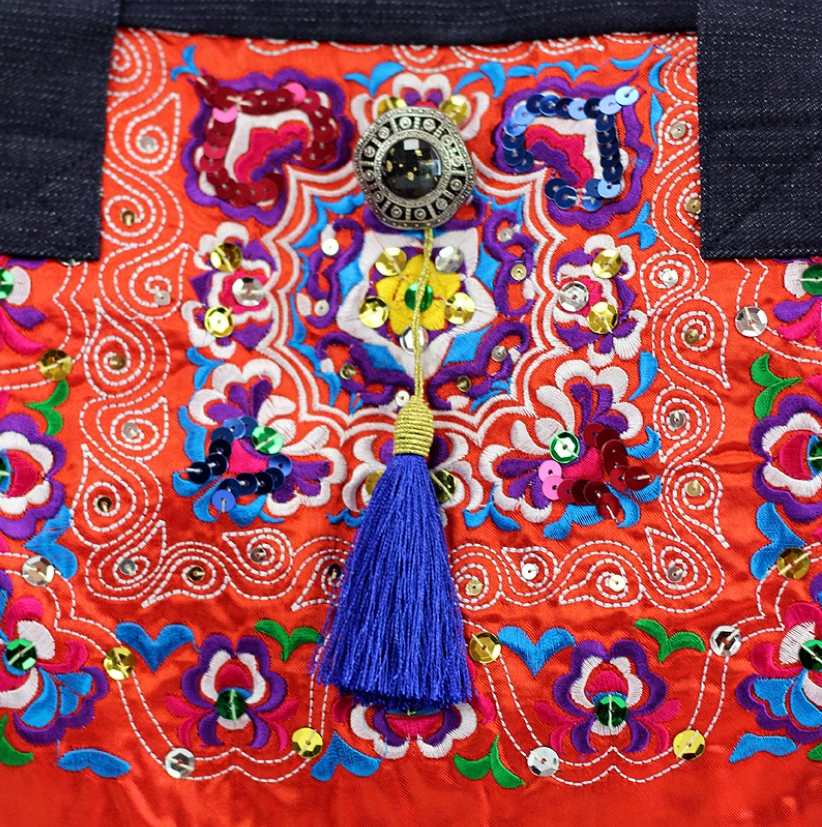
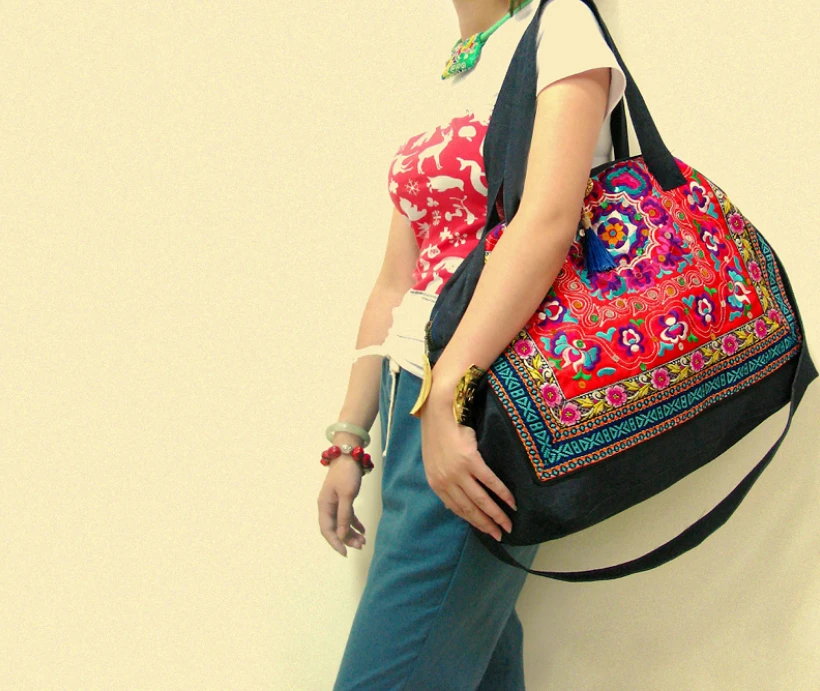
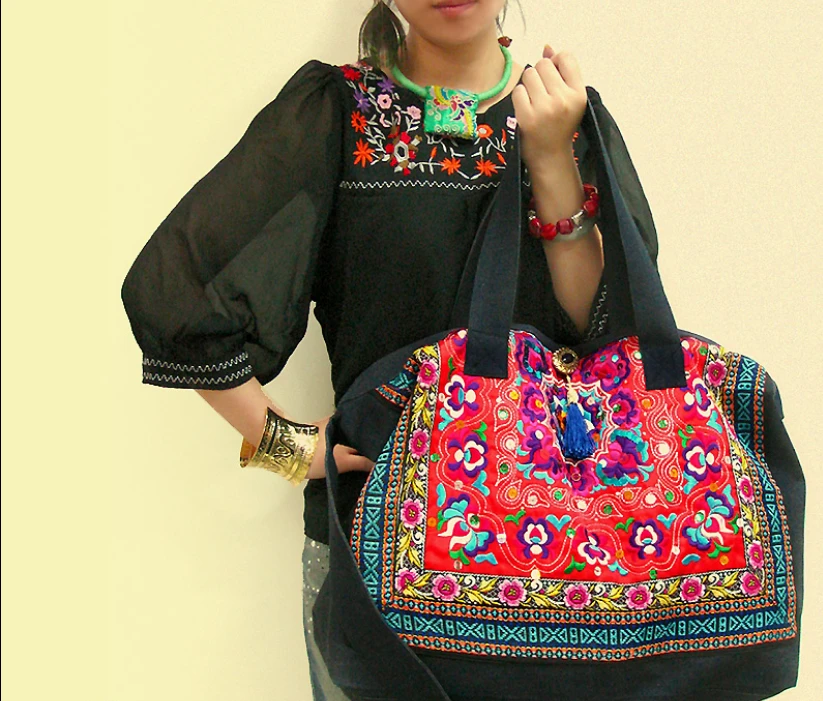
National Style Miao Embroidery Denim Shoulder Bag
Material: Dark blue denim + blue printed cotton lining
Closure: Zipper
Interior: Zipper pocket, phone pocket, ID compartment, laminated zip pocket
Style: Ethnic / National Style
The European Women Who Will Carry This — and Why They Already Know It
The woman who chooses this bag is not decorating herself. She is making an argument. She works in architecture, design, publishing, art direction, or the quieter corners of finance where aesthetic literacy is the secret credential. She has been to Guizhou or read about it; she has a copy of The Fabric of Civilization on her shelf or is about to buy one. She understands that the $40.64 she pays is not for the denim and silk alone but for the lineage encoded in every stitch.
In a 2024 survey by the European Fashion Consumers Institute, 68% of women aged 25–45 in France, Germany, and Italy reported that "cultural authenticity" had become a more important purchase criterion than brand name for accessories (Fashion Network, European Accessory Trends Report, 2024). This bag is designed for precisely that 68%.
Caring for Miao Embroidery on Denim: A Practical Guide
Denim is forgiving. Silk embroidery requires more consideration. Spot-clean the embroidered panel with a damp cloth; do not submerge. Store the bag standing upright — the cross-section square format maintains its shape without stuffing. Avoid prolonged direct sunlight on the red threads, as natural silk pigments have a photosensitivity that synthetic fibre lacks. Think of it as caring for a watercolour: benign neglect for the denim body, attentiveness for the silk story.
Frequently Asked Questions
Is Miao embroidery hand-stitched or machine-made?
Authentic Miao shu xiu (counted embroidery) is executed by hand, following patterns held in the embroiderer's memory across generational transmission. Machine embroidery cannot replicate the irregular tension, variable stitch depth, or compositional intelligence of the hand-guided needle. As of 2022, fewer than 3,000 master practitioners of this technique remain actively teaching in Guizhou province (China Intangible Cultural Heritage Centre, 2022).
What makes the denim-embroidery combination culturally significant?
Denim originated as French workwear (de Nîmes), democratised globally, and now frames a craft tradition of 2,000 years. The pairing creates a material dialogue between two "working" traditions from different continents — both democratic in spirit, both built to last. No luxury fabric could make this argument.
How does the 30×46cm format compare to European A4 standards?
A4 paper measures 21×29.7cm; the bag at 30×46cm exceeds this in both dimensions. It accommodates a standard European laptop (up to 13-inch), an A4 document folder flat, and a full day's carry across four interior zones — a practical argument for its adoption as a primary work bag rather than an occasional statement piece.
Does this bag work with European fast fashion or only with heritage pieces?
It works with both — and most effectively as the bridge between them. Against a Zara linen blazer and vintage straight-leg jeans, the bag elevates the outfit above its individual components. The embroidery reads as the single intentional decision in an otherwise casual register. That is precisely its editorial function.
What is the difference between Miao "big flower" and standard embroidery motifs?
Miao da hua (大花) refers to large-scale, solar, geometric botanical motifs historically reserved for ceremonial garments. Smaller motifs encode more personal or clan-specific information. The bold red geometric pattern on this bag deploys the da hua vocabulary, placing ceremonial register onto everyday carry — a conscious contemporary elevation with 2,000 years of symbolic authority behind it.
1. UNESCO — "Miao Embroidery: Intangible Cultural Heritage Designation", retrieved 2026-10-12, https://ich.unesco.org/
2. Statista — "Global Denim Market Revenue Report 2025", retrieved 2026-10-12, https://www.statista.com/
3. China Intangible Cultural Heritage Centre — "Master Practitioner Survey, Guizhou Province", 2022, retrieved 2026-10-12, https://www.culturalheritage.cn/
4. Fashion Network — "European Accessory Trends: Cultural Authenticity as Purchase Criterion", 2024, retrieved 2026-10-12, https://www.fashionnetwork.com/