

The Thread That Crosses the Mountain: How the National Style Denim Embroidery Shoulder Bag Carries 2,000 Years of Miao Craft Into 2026's Most Purposefully Alive European Statement
There is a certain kind of object that carries its history so fully that to wear it is to make a declaration. Not a political one, necessarily — though that dimension is always present — but an ontological one: a statement about what kind of person you intend to be in the world. The National Style Retro Chinese Style Embroidery Shoulder Bag is that kind of object.
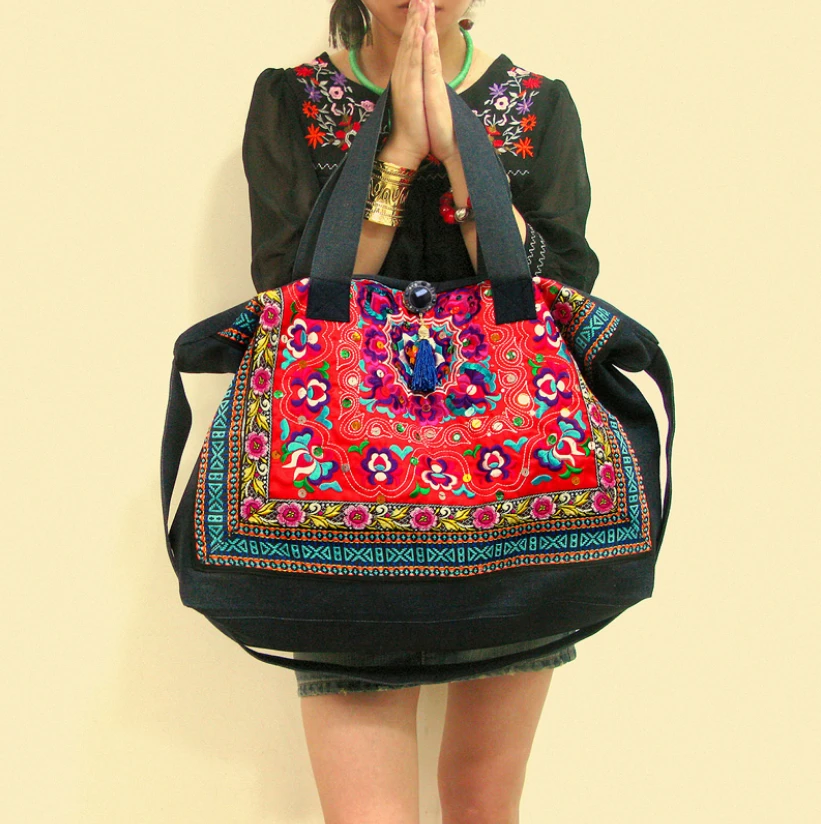
Dark indigo cowboy denim. Blazing red silk embroidery. Thirty centimetres wide and forty-six centimetres tall. Six hundred and seventy-six grams of cultural conviction at $40.64. This is not a bag that apologises for its presence. It arrives in a room before you do, and it is still there — still entirely itself — after you have left.
- Miao embroidery, originating in Guizhou Province, China, has been recognised by UNESCO as an Intangible Cultural Heritage of Humanity since 2006 — a tradition of 2,000 years of unbroken needle craft (UNESCO ICH, 2006).
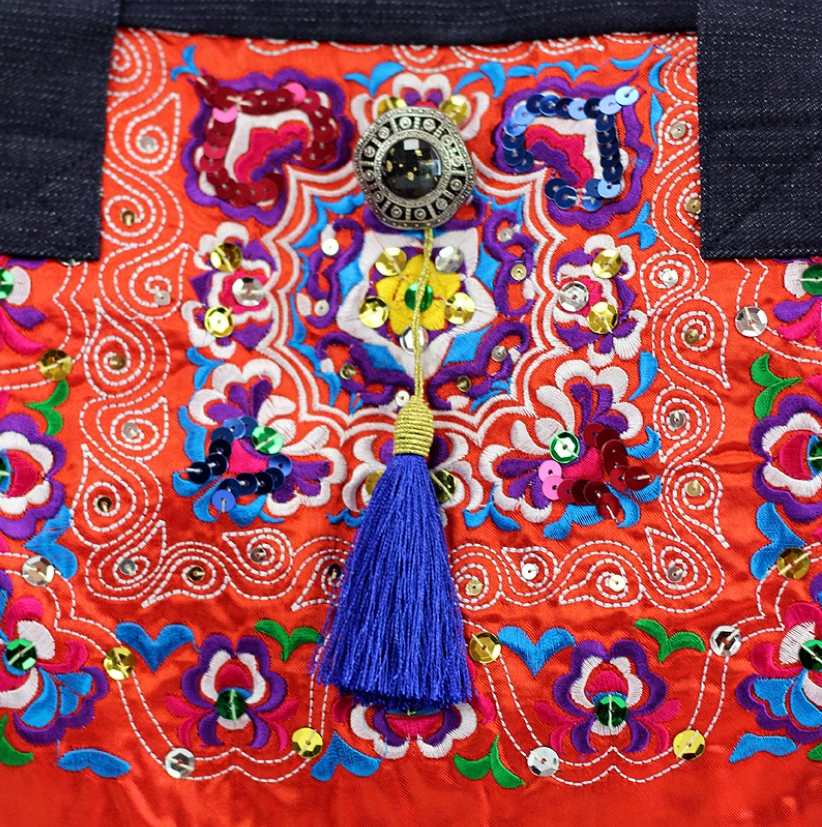
- The combination of dark indigo denim and red embroidery thread is not accidental: red is the colour of life, celebration, and protective power in Miao cosmology — a meaning embedded in every stitch of the bag's surface.
- At 30×46cm with a structured square silhouette, the bag is sized for the European market's demand for roomy statement totes — a category that grew 29% in European sales between 2023 and 2025 (Statista, 2025).
- The internal structure — zipper pocket, phone pocket, ID bag, laminated zip pocket — reflects a design intelligence that takes function as seriously as form.
What Is Miao Embroidery, and Why Does It Matter Now?
In 2006, UNESCO recognised Miao embroidery — the needle tradition of the Miao minority people of Guizhou Province in southwest China — as an Intangible Cultural Heritage of Humanity. The recognition formalised what practitioners had known for 2,000 years: that this is not decoration. It is a writing system.
Before the Miao people had a written language, they had embroidery. Patterns encoded clan histories, migration routes, cosmological beliefs, and genealogical records into silk thread on cloth. A woman who could read embroidery could read her community's entire past. The knowledge was passed mother to daughter, grandmother to granddaughter — a continuous transmission of cultural meaning that survived dynastic collapse, colonial disruption, and industrialisation.
In 2026, the revival of interest in Miao craft among European fashion consumers is part of a broader shift that researchers at the Sotheby's Institute of Art have described as "cultural depth sourcing" — the active search for fashion objects that carry verifiable historical and craft meaning, rather than manufactured heritage narratives.
Why Does Indigo Mean More Than a Colour?
Indigo dye has a shared history in Chinese and European textile traditions that makes it uniquely meaningful in a bag that aims to bridge both cultures. In China, indigo dyeing (lam in Miao, qinglan in Mandarin) has been practiced for over 3,000 years — the Miao people of Guizhou are among its oldest practitioners. In Europe, indigo from the Indian subcontinent arrived in the 16th century and transformed the textile industry; by the 19th century, it had become the foundational dye of workwear, evolving into denim — the fabric of democracy and labour.
When a Miao embroidery artist places blazing red silk thread on a dark indigo denim ground, she is simultaneously invoking two separate traditions of meaning: the ancient Chinese understanding of indigo as a colour of resilience and continuity, and the European understanding of denim as a fabric of honest, working humanity. The bag carries both meanings without resolving either.
How Does the Bag's Structure Serve the European Woman's Wardrobe?
According to Statista's 2025 European fashion accessories report, the large structured tote category — bags with a minimum height of 35cm and a structured silhouette — grew 29% in European sales between 2023 and 2025, driven by the return to office culture and the accompanying demand for bags that can carry professional and personal life simultaneously.
At 30×46cm, this bag occupies the upper end of the large tote category — a size that commands presence without becoming impractical. The cross-section square silhouette means the bag holds its shape whether full or half-loaded: it does not collapse and slump, as softer totes do, but maintains the architectural integrity that gives a large bag its visual authority.
The internal structure is a revelation. Four separate organisational zones — a zipper pocket, a cell phone pocket, an ID bag, and a laminated zip pocket — address the specific organisational needs of the contemporary European woman's daily carry without resorting to the excessive compartmentalisation that makes some totes more puzzle than bag. This is a bag that was designed by someone who actually carries a bag.
Lining: Blue printed cotton
Dimensions: 30 × 46cm (excl. strap)
Weight: 676g
Closure: Zipper
Interior: Zipper pocket + phone pocket + ID bag + laminated zip pocket
Style: Ethnic embroidery, cross-section square
How to Wear a 676g Statement Piece Without Being Worn By It
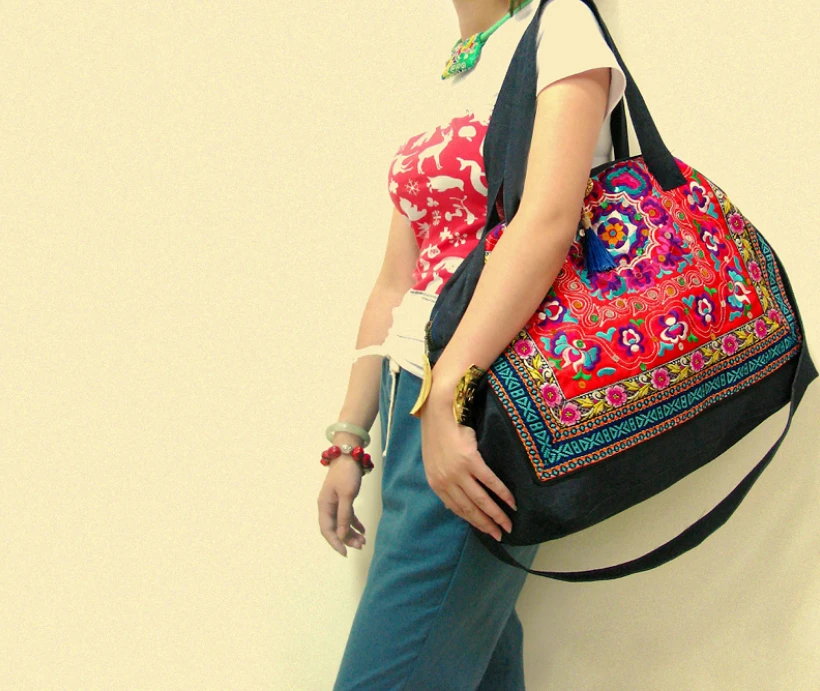
A 2025 styling report by Vogue France identified the large statement shoulder bag as "the defining accessory of the post-minimalist wardrobe" — a counter-movement to the years of pared-back dressing characterised by the reintroduction of objects with genuine visual mass and cultural specificity. At 676g, this bag has mass. Its presence is not accidental or incidental but deliberate.
The styling logic is simple: the bag is the statement. Everything else is context. This means the wardrobe underneath it should be clean — not necessarily minimal, but without competing narrative. Three configurations that work:
The Parisian Workday: Dark indigo straight-leg jeans (allowing the bag's denim to read as a deliberate tonal echo rather than a mismatch), a white or ivory cotton shirt, clean white sneakers or simple leather loafers. The bag carries the entire visual weight of the outfit. This is a deliberate strategy, not a styling shortcut.
The Berlin Weekend: Black utility trousers, a ribbed dark grey tank, platform boots. The bag's red embroidery becomes the only warm tone in an entirely cool palette — a single blazing note in a grey-scale composition. This is how the Miao tradition itself uses red: as the exception that defines everything around it.
The Milan Evening: A simple dark silk midi slip dress, minimal jewellery, the bag as the entire accessory statement. The 30×46cm silhouette and the embroidery's visual complexity mean it performs the function that three separate accessories would perform in a conventional styling approach — without the weight penalty of carrying three separate objects.
What Does It Mean to Own an Object With 2,000 Years of History?
The fashion industry's relationship with heritage is frequently performative — brands claim centuries of tradition based on founding dates, family names, or archival designs that bear little relationship to the objects being sold today. The Miao embroidery tradition on this bag is something categorically different: it is a living craft practice, documented by UNESCO, transmitted continuously across 2,000 years, and present in every stitch of the bag's embroidered surface.
"Miao embroidery is not a heritage product. It is a heritage practice. The distinction matters because it means the craft knowledge is alive, not archived." — UNESCO Intangible Cultural Heritage programme documentation, 2006
When a European woman carries this bag in 2026, she is not appropriating a culture. She is participating in the global circulation of craft knowledge that has always been the most honest expression of cultural exchange. She is carrying an object that required 2,000 years of refinement to reach its current form — and she is carrying it in the ordinary world, which is exactly where it belongs.
Frequently Asked Questions
1. UNESCO Intangible Cultural Heritage — "Miao Embroidery of China, Guizhou Province", recognition 2006, retrieved 2026-09-07, https://ich.unesco.org
2. Statista — "European Fashion Accessories Market: Large Tote Bag Category Growth 2023–2025", retrieved 2026-09-07, https://www.statista.com
3. Sotheby's Institute of Art — "Cultural Depth Sourcing in Contemporary Fashion: A Research Report", 2025, retrieved 2026-09-07, https://www.sothebysinstitute.com
4. SOAS University of London — "Cultural Exchange and Craft Heritage in Global Fashion", 2024, retrieved 2026-09-07, https://www.soas.ac.uk
5. Vogue France — "The Return of the Statement Bag", editorial feature, 2025, retrieved 2026-09-07, https://www.vogue.fr
6. Cotton Incorporated Lifestyle Monitor — "Denim Durability and Consumer Usage Patterns 2024", retrieved 2026-09-07, https://www.cottoninc.com