

Four Natures, One Surface: How the Chinese Painted Embossed Retro Bag Carries Tang Dynasty Colour Philosophy Into 2026's Most Tactilely Deliberate Tote for European Women
- Tang Dynasty China (618–907 CE) developed one of history's most sophisticated systems of colour-naming, in which colours were named after natural phenomena — flowers, fish, minerals — rather than abstract hue descriptors (The Metropolitan Museum of Art, Tang Dynasty Collection).
- The bag's four colourways — Safflower, Silver Flower, Pink Fish, Red Fish — are all Tang Dynasty nature-names, translating a 1,300-year chromatic philosophy into 2026 European fashion.
- At 350×400×50mm and 620g, the horizontal square tote form references the fang xing (方形) structural principle that dominated Tang Dynasty object design.
- Embossed PU leather with a polyester lining, priced at $28.02 — a genuinely accessible tote-format carry with demonstrable cultural intelligence.
When China Named Its Colours After the World It Loved
In Tang Dynasty China (618–907 CE), the imperial court's colour vocabulary was not built on abstract hue names. According to the Metropolitan Museum of Art's Tang textile scholarship, Tang chromatic culture named colours by analogy with the natural world: the colour of safflowers in early morning light, the silver iridescence of certain lily varieties at dusk, the pink-pearl glow of freshwater fish scales in shallow water. This was not poetry. It was a precision system — a way of encoding specific optical experiences by anchoring them to observable natural phenomena.
In 2026, the Chinese Painted Embossed Retro Bag translates this system directly into its colourway names: Safflower, Silver Flower, Pink Fish, Red Fish. These are not marketing names devised by a product team. They are 1,300-year-old colour-poems, restored to contemporary use. For the European woman who carries one of these bags, the colour she chooses is not merely a preference — it is a relationship with a specific corner of Chinese natural philosophy.
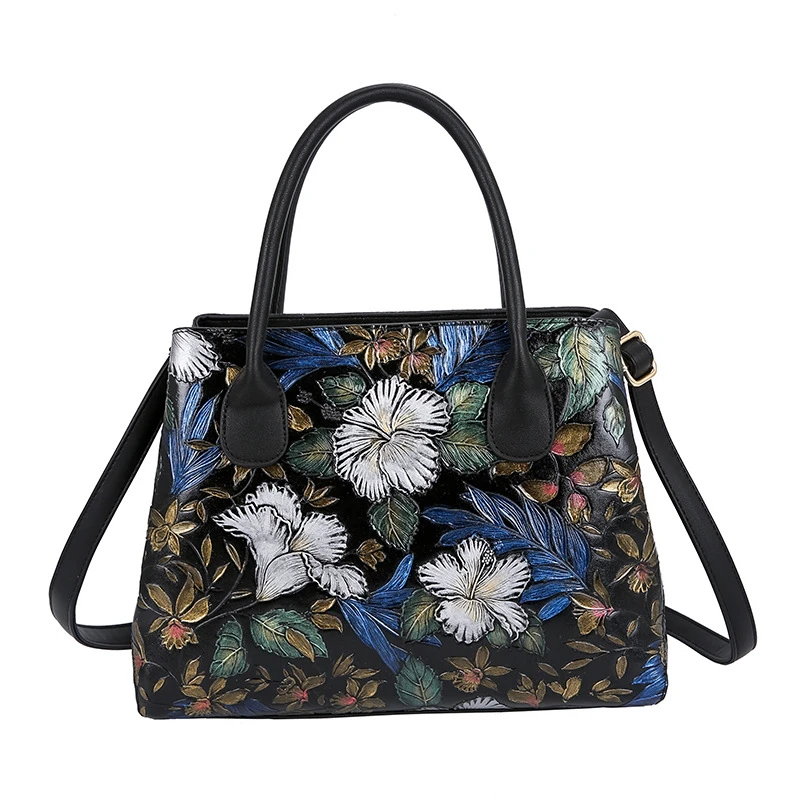
The embossed surface of the bag adds another layer of historical depth. Tang Dynasty artisans developed extraordinarily refined relief-work techniques across lacquerware, metalwork, and leather goods. The technique of applying three-dimensional botanical or geometric motifs to flat surfaces — so the decoration is simultaneously surface and structure — became one of the defining visual signatures of China's most cosmopolitan dynasty. The bag's embossed PU leather carries the visual logic of this tradition in its contemporary material language.
Understanding the Four Colourways: A Tang Dynasty Chromatic Guide
Each of the four colourways available for this bag comes with a complete cultural context that deepens the act of choosing:
The Fang Xing Principle: Why This Bag Is Shaped Exactly as It Is
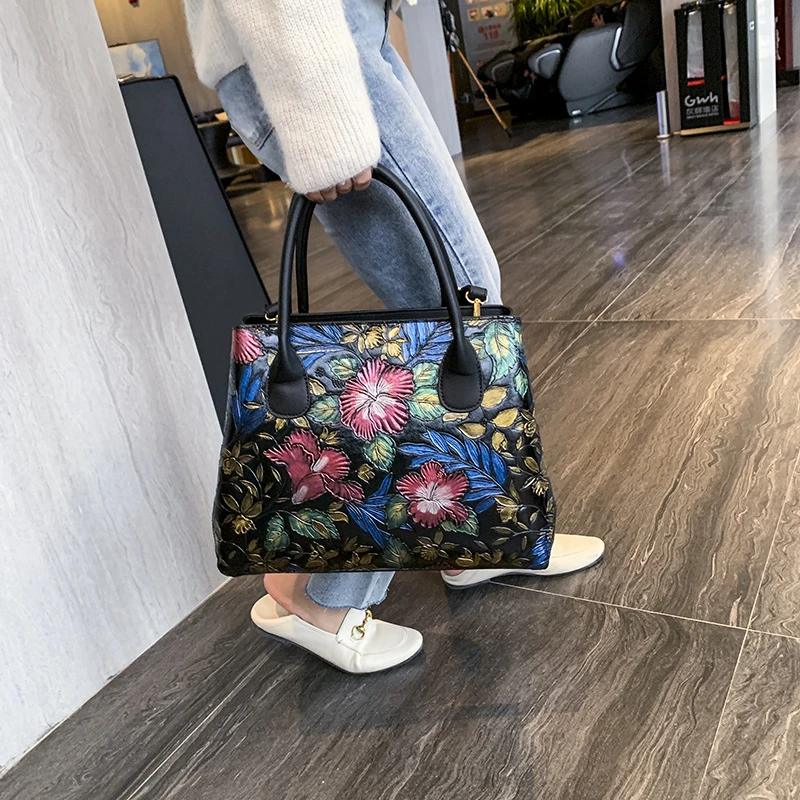
The horizontal square format of the Chinese Painted Embossed Retro Bag — 350mm wide × 400mm tall × 50mm deep — is not an arbitrary proportion. Tang Dynasty object design operated according to the fang xing (方形) principle: the square, in Chinese cosmological thought, represents earth, stability, and order. Rectangular objects were designed with proportions that reference the square without being strictly square — a balance between the cosmological ideal and practical use.
At 350×400mm, the bag's proportions approximate a golden rectangle (width-to-height ratio approximately 0.875) — close to the classical ideal without being geometrically rigid. This gives the bag a visual stability that is immediately perceptible without being consciously identified. You notice it as the sense that the bag looks right — that it occupies space with authority rather than arbitrariness. This is 1,300 years of proportion intelligence, embedded in the silhouette.
Interior Intelligence: What the Bag Carries on Your Behalf
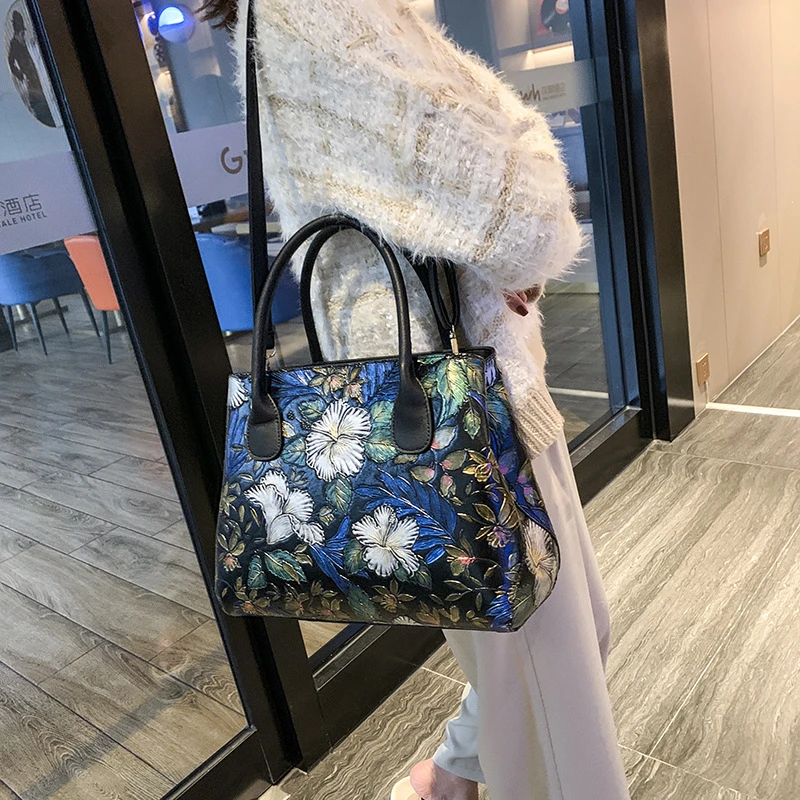
The Chinese Painted Embossed Retro Bag is a working tote. Its interior architecture — document bag compartment, cell phone pocket, sandwich zipper bags, and an additional zipper pocket — is designed for the European woman who moves through complex daily geographies: from morning professional contexts to afternoon cultural engagements to evening social settings.
The single strap configuration and 620g weight make the bag sustainable for shoulder carry across a full European working day. The polyester lining protects the interior from surface damage and provides a composed, clean background to the bag's internal organisation. The main zipper closure keeps the bag's contents secure and the exterior profile clean.
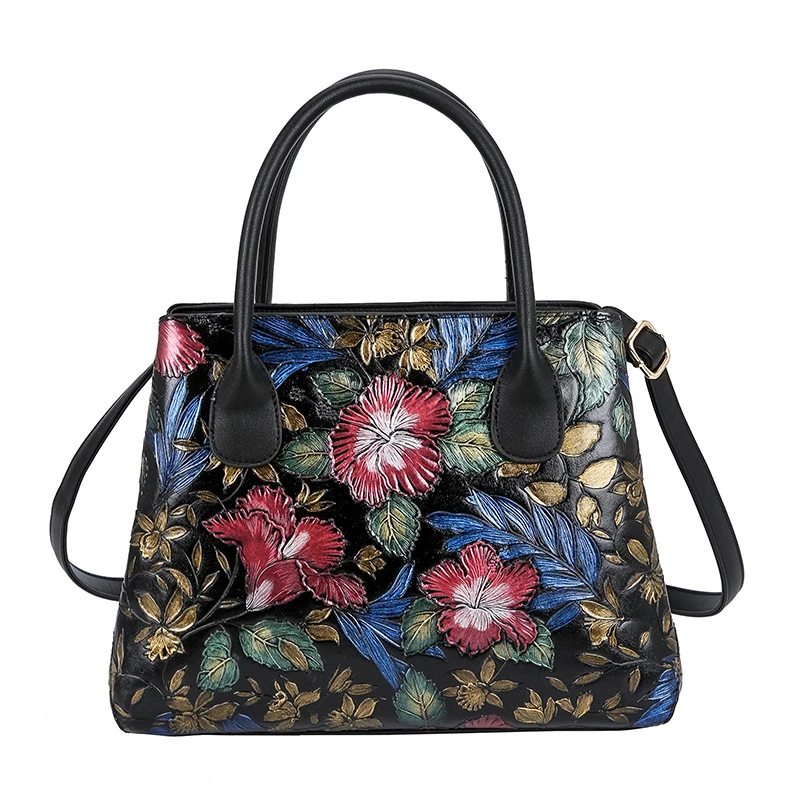
Chinese Style Painted Embossed Retro Bag
How to Style the Embossed Retro Bag: Four Colourways, Four Registers
Each colourway carries a different cultural and visual register, and each suggests a distinct styling approach for the European woman:
Safflower: The Warmth That Commands
Safflower's warm crimson-to-coral range works beautifully against natural neutrals — undyed linen, raw silk, camel wool, stone cotton. It brings warmth into a minimal palette without competing with it. For European autumn and winter dressing, Safflower reads as the colour of late-afternoon firelight — immediate, enveloping, and impossible to ignore.
Silver Flower: The Intelligent Neutral
Silver Flower's cool, luminous off-white operates as an intelligent neutral — more alive than beige, more composed than pure white. Against charcoal grey, slate blue, or deep forest green, Silver Flower provides luminosity and lightness. It is the colourway for the woman who works in monochrome and needs her carry to provide the light source.
Pink Fish: The Unexpected Authority
The iridescent rose of Pink Fish challenges the assumption that pink is soft or deferent. In Tang court culture, this colour was worn by women of high scholarly and artistic attainment. Against cream, ivory, or dusty rose, Pink Fish creates a tonal harmony of considerable refinement. Against navy or black, it asserts an unexpected authority.
Red Fish: The Saturated Declaration
Red Fish is the colourway for European women who need their carry to communicate without qualification. Deep, biologically saturated red against charcoal, black, or dark navy creates the most powerful contrast the bag offers. This is the colourway that ends conversations about the bag's cultural origin — it creates them.
The 2026 Context: Why Tang Dynasty Craft Is European Fashion's Most Urgent Conversation
According to a 2025 Business of Fashion analysis of European accessories trends, the demand for "objects with demonstrable provenance in craft traditions" has grown at 28% year-over-year since 2023. Tang Dynasty China represents one of the most fertile yet least commercially exploited craft traditions in global fashion heritage. The Chinese Painted Embossed Retro Bag makes it accessible without simplifying it.
In 2026, the European woman who carries this bag is carrying a specific cultural argument: that beauty has a history, that history has a geography, and that geography in this instance runs from the workshops of 7th-century Chang'an to the streets of contemporary European cities. The embossed surface carries that argument in three dimensions. The Tang colour-name does it in four letters.
FAQ: The Chinese Painted Embossed Retro Bag
What do the colour names "Safflower," "Silver Flower," "Pink Fish," and "Red Fish" refer to?
These names come from Tang Dynasty China's natural colour-naming system (618–907 CE), in which colours were named by analogy with observable natural phenomena — the tint of safflower petals, the silver iridescence of certain white flowers, and the distinctive rose and saturated red of freshwater fish scales. The Metropolitan Museum of Art's Tang textile collection documents this naming tradition extensively.
Is PU leather a durable material for a tote bag of this size?
High-quality PU leather is highly appropriate for a structured tote of these dimensions (350×400×50mm) because it maintains surface integrity under daily load without the maintenance requirements of genuine leather. For European everyday carry conditions — varying weather, public transport, office environments — PU leather's resistance to moisture and surface scuffing is an advantage over natural hide at this price point.
How does the embossed pattern affect the bag's durability?
On PU leather, embossed patterns actually improve surface resilience by distributing stress across the raised relief structure rather than concentrating it on a single plane. Tang Dynasty artisans discovered this principle in metalwork and lacquerware — embossed surfaces resist deformation better than flat ones. The decorative element is simultaneously a structural feature.
What is the cultural significance of the horizontal square (fang xing) format?
In Tang Dynasty Chinese cosmology, the square represented earth, stability, and order — one of five fundamental forms (alongside the circle, triangle, spiral, and wave) that governed object design. The horizontal rectangular proportion of this bag (approximately 0.875 width-to-height ratio) references the square ideal while remaining practically functional. The result is a silhouette with innate visual authority.
Which European cities is this bag best suited to?
The bag's structured tote format and cultural authority make it ideally suited to cities with strong visual fashion culture: Paris, Milan, Amsterdam, Copenhagen, and Berlin. In these cities, the bag's combination of genuine craft heritage and refined proportion will be most immediately understood by the fashion-literate audiences who populate their streets and cultural spaces in 2026.
Conclusion: The Surface That Speaks in Dynasties
The Chinese Painted Embossed Retro Bag does not make a loud claim on your attention. It makes a precise one. The embossed surface says: there is more here than you can see at first glance. The Tang Dynasty colour-name says: someone understood beauty carefully enough to name it after a flower or a fish. The horizontal square form says: there is a geometry here that has been right for 1,300 years.
For the European woman who carries it in 2026, the bag says something quietly comprehensive: I know where beauty comes from. I know it comes from everywhere. And I carry it accordingly.
At $28.02, the Tang Dynasty has never been more within reach.
2. Business of Fashion — "European Accessories Provenance Trends 2025", retrieved 2026-09-12, https://www.businessoffashion.com/
3. Victoria and Albert Museum — "Tang Dynasty Craft and Surface Design", retrieved 2026-09-12, https://www.vam.ac.uk/