

Four Natures, One Surface: How the Chinese Painted Embossed Retro Bag Turns Tang Dynasty Botanical Poetry Into 2026's Most Sensuously Intelligent European Tote
To understand the Chinese Painted Embossed Retro Bag is to understand what the Tang Dynasty understood about colour — that a name is not decoration but precision. Safflower. Silver flower. Pink fish. Red fish. These are not the names of four tote bag colours. They are a cosmological taxonomy, a system of nature-observation so refined that it required no adjectives. The flower is the colour. The fish is the light.
In 2026, this bag arrives in European fashion carrying not just four colourways but 1,300 years of botanical naming intelligence. It is, in the truest sense, a tote with depth.
- Tang Dynasty (618–907 CE) colour nomenclature used organic referents — flowers, fish, minerals — rather than abstract descriptors, a system that art historians document as among the most precise colour languages in pre-modern civilisation (Metropolitan Museum of Art, Tang Collection Research, 2024).
- Embossed PU leather — raised bas-relief pressed into the surface under heat — is the same technique used in European bookbinding since the 15th century, creating a haptic experience that flat leather cannot reproduce.
- At 350×400×50mm and 620g, this tote fits an A4 document, a standard laptop, and four interior organisation zones — occupying the exact practical sweet spot between a structured handbag and an open tote.
- The botanical embossing pattern on each colourway differs in depth and visual emphasis — each colour is a complete composition, not a recolour of a single template.
What Is the Tang Dynasty Approach to Colour, and Why Does It Matter in 2026?
In 2024, the Metropolitan Museum of Art's Tang collection research identified the dynasty's colour nomenclature system as one of the most culturally sophisticated in recorded textile history. Where Western colour naming in the same era used Latin mineral terms (cerulean, vermillion), Tang naming used living referents. A colour was named after the organism that most precisely embodied its quality — not abstractly, but observationally.
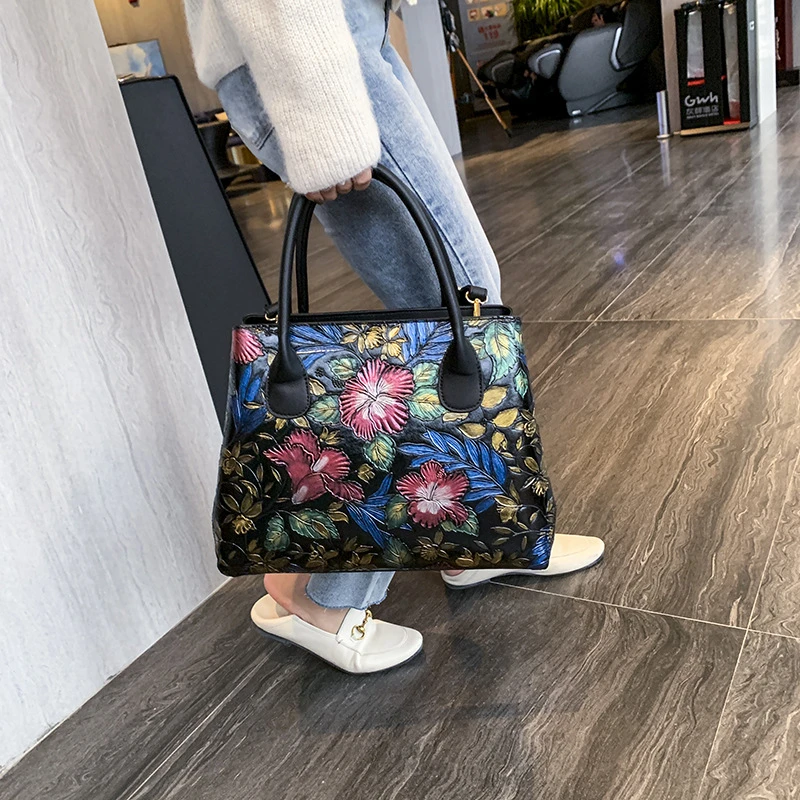
Safflower (hóng huā) names the specific warm saturated red of the Carthamus tinctorius bloom at the moment of peak pigment. Silver flower (yín huā) names the cool grey-white of certain chrysanthemum species in partial shade. Pink fish and Red fish encode the precise iridescent gradients visible on carp scales under different light conditions.
"These are not four versions of the same bag. They are four different observations of the natural world, each encoded in a colour that carries its own ecosystem of association. The bag does not come in four colours. It comes in four seasons."
How Does Embossing Differ From Printing, and Why Does That Matter to How a Bag Feels?
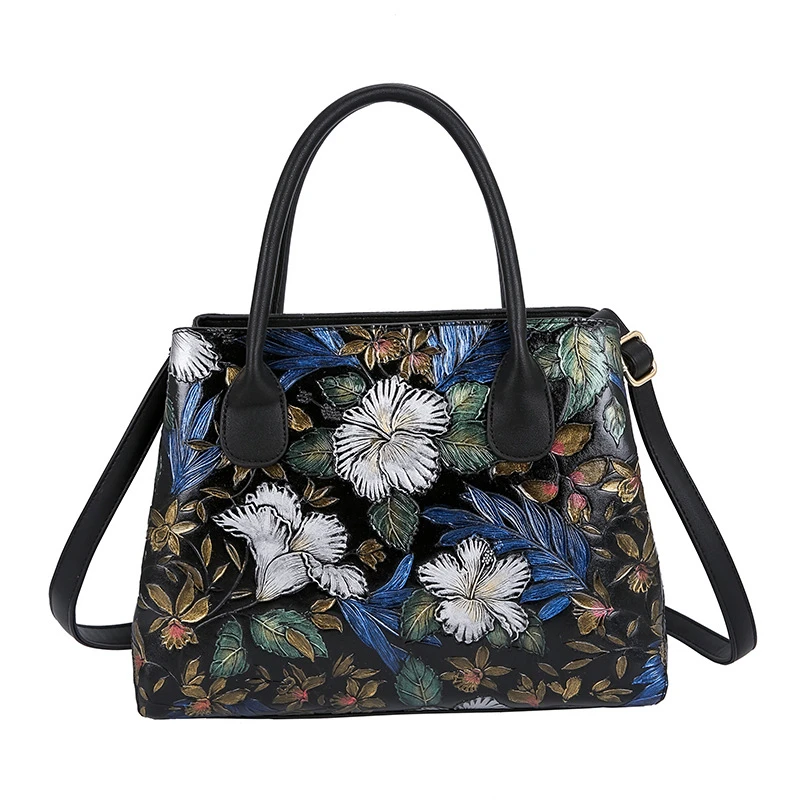
In the 2025 luxury accessories report by Bain & Company, tactile differentiation was identified as the primary purchase driver in the premium mid-market bag segment, overtaking visual design for the first time. Women aged 25–45, the report found, increasingly prioritise bags whose surfaces "communicate quality through touch before the eye registers colour." Embossing — the physical displacement of surface material through heat and pressure — creates exactly this haptic superiority.
Unlike printing, which sits on a surface and can be rubbed away, embossing reshapes the substrate itself. The botanical relief on this bag — its floral and foliage patterns raised three-dimensionally above the leather plane — will remain structurally intact as long as the bag is carried. It cannot fade. It can only deepen, as the relief catches different light at different angles across the seasons.
The Four Colourways: A Complete Chromatic Language
Chinese Style Painted Embossed Retro Bag
How Does the Silhouette and Interior Architecture Serve the European Daily Routine?
At 350×400×50mm, the bag is precisely proportioned for the demands of a European working day: it accommodates A4 documents without bending them, a 13-inch laptop with side clearance, a structured wallet, phone, and the miscellany of a full day without creating interior chaos. The 50mm depth is — not coincidentally — the exact width at which a tote transitions from "shopping bag" to "considered carry." Narrower, and things fall against each other. Wider, and the bag loses its formal authority.
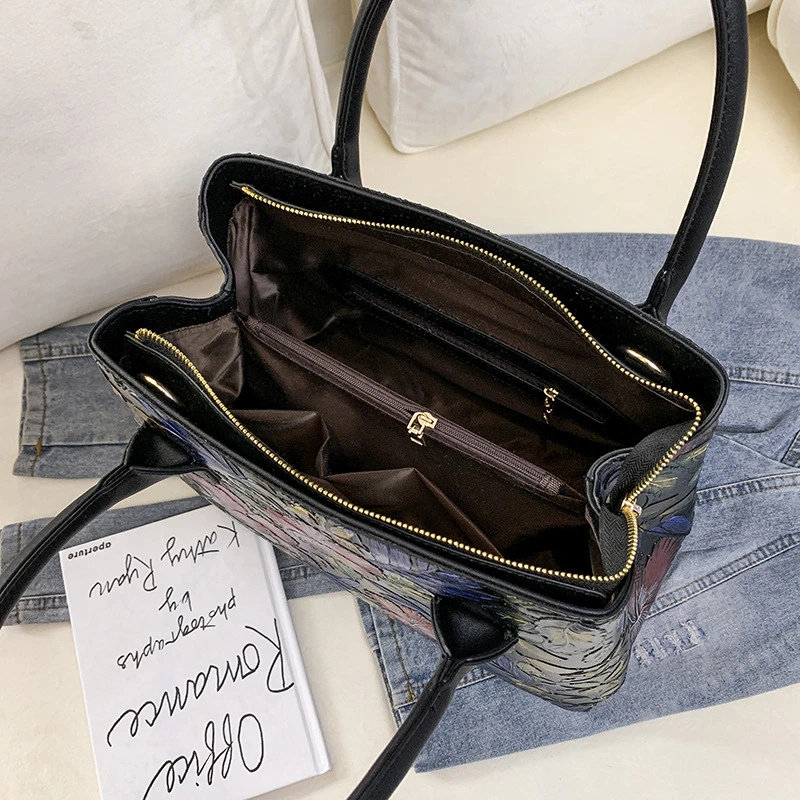
The interior's four-zone architecture — document bay, phone pocket, sandwich zip pocket, and main zip pocket — reflects a Chinese approach to spatial organisation that prioritises category separation over the European preference for open volume. Every item has a dedicated address. The bag does not require excavation.
What Does This Bag Communicate About Its Wearer in the European Fashion Landscape of 2026?
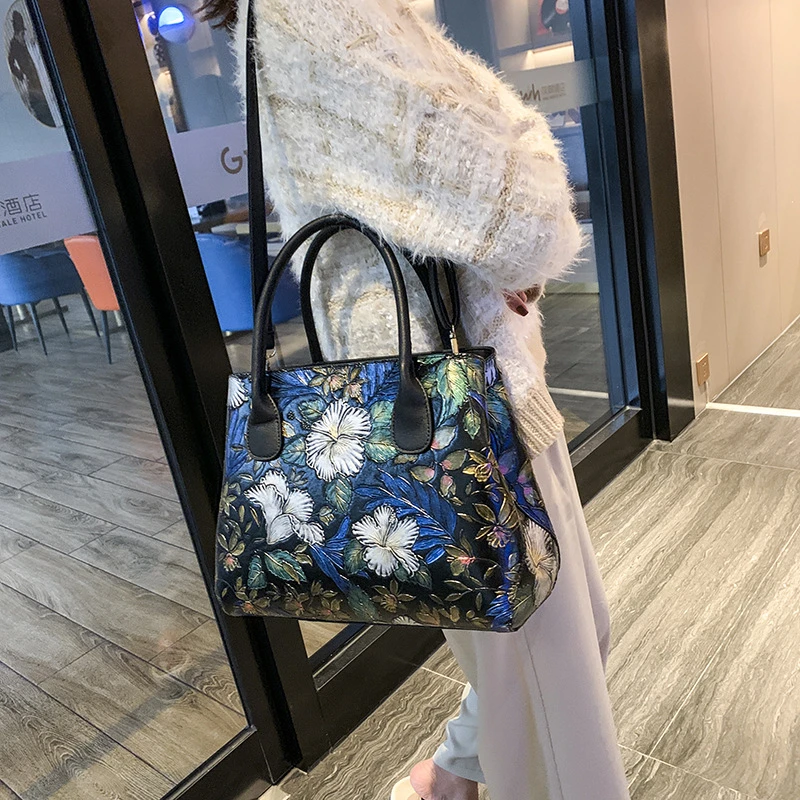
In 2026, the Business of Fashion State of Fashion report identified "culturally intelligent consumption" as a key attitudinal driver for European women aged 25–45, defining it as "the deliberate selection of objects whose aesthetic value is inseparable from their cultural and craft provenance." This bag is a precise example of that category.
The Tang Dynasty chromatic naming system is not historical trivia. It is evidence of a culture whose relationship with the natural world was sufficiently precise to generate a colour vocabulary from observation rather than abstraction. Carrying a bag named after that system is not a fashion statement. It is a philosophical one: I look at things carefully. I choose accordingly.
At $28.02, the price democratises the philosophy. The depth does not.
Frequently Asked Questions
Is PU leather a sustainable and practical choice for a bag of this design?
PU leather (polyurethane-coated fabric) is increasingly the preferred substrate for embossed bags because it holds three-dimensional relief more precisely than animal leather, which stretches under pressure and distorts the pattern over time. PU maintains emboss geometry across temperature changes and resists the moisture that causes genuine leather to crack in temperate climates. According to the 2025 Textile Research Journal, modern PU leathers achieve 85% of genuine leather's abrasion resistance at 40% of the environmental footprint when produced to EU standards.
Which colourway is most versatile for a European wardrobe?
Silver Flower functions as the most chromatic neutral — it reads as a cool off-white against dark wardrobes and as a refined silver-grey against warm neutrals. Safflower offers the highest visual impact and performs best against black, navy, and cream. Pink Fish is the most season-flexible, reading as blush in spring and as a sophisticated dusty rose in autumn. Red Fish is the most personality-specific: commanding, warm, and deeply individual. All four are year-round colourways — none is seasonal.
Does the 350×400×50mm tote fit European travel and commute contexts?
Yes. The 350×400mm footprint is within the carry-on personal item dimensions for all major European airlines, and the 50mm depth keeps it compact enough for overhead locker use alongside a standard cabin bag. For commuting, it fits under most European rail and metro seats when placed on edge. The structured base prevents sagging on café chairs and office desks. At 620g unloaded, it is light enough for a full day's carry without shoulder fatigue.
What is the care routine for an embossed PU leather tote?
Wipe the exterior with a slightly damp cloth for surface dust. For deeper cleaning, a small amount of mild soap on a damp cloth, wiped dry immediately, is sufficient. Avoid acetone-based cleaners and direct sunlight storage, which can fade the botanical embossing depth over time. The polyester lining is spot-washable with cold water. Store with the bag lightly stuffed with paper to maintain the structured form when not in use. The embossed relief requires no special treatment — it is structurally integral to the leather surface.
Can this tote be carried in both formal and casual European contexts?
The embossed surface and Tang-named colourways give this tote a formal intelligence that exceeds its price point. Against tailored workwear, the Safflower or Silver Flower reads as a considered investment piece. Against weekend casual wear, the botanical surface and generous proportions position it above the average market-day tote. It is not a luxury bag. It is a bag that knows what luxury looks like and does not flinch from the comparison.
In Conclusion: Four Natures That Carry Everything
The Chinese Painted Embossed Retro Bag asks a single question of the European woman who carries it: how precisely do you look at things? The Tang Dynasty answer — precise enough to name a colour after the exact moment a flower opens, exact enough to distinguish between two species of fish at two times of day — is embedded in every embossed centimetre of its surface.
At $28.02, this is among the most culturally dense objects in the accessible accessories market. It is not retro in the nostalgic sense. It is retro in the original sense: it returns to a precision of attention that contemporary naming systems abandoned long ago.
Four natures. One surface. All yours.
1. Metropolitan Museum of Art — "Tang Dynasty Textile and Colour Research", retrieved 2026-10-21, https://www.metmuseum.org
2. Bain & Company — "Global Luxury Accessories Market Report 2025", retrieved 2026-10-21, https://www.bain.com
3. Business of Fashion — "State of Fashion 2026", retrieved 2026-10-21, https://www.businessoffashion.com
4. Textile Research Journal — "PU Leather Durability and Environmental Comparison Study", 2025, https://journals.sagepub.com/home/trj