

The Stitch That Speaks: How the Embroidered Chinese-Style Handbag Turns Polyester Into Six Centuries of Ming Dynasty Floral Sovereignty for the European Woman
There is a category of object that refuses to be ordinary. Not because it is expensive — it isn't — but because the intelligence embedded in its surface far exceeds its price point. The Embroidered Chinese-Style Handbag belongs to this category. At 250×160×90mm and 370 grams, it carries the compact authority of something that knows exactly what it is.
- Embroidery as a courtly art form has a 3,000-year documented history in China, with Ming Dynasty (1368–1644) floral motifs representing the pinnacle of refined needlework craft (UNESCO Silk and Textiles Programme, 2024).
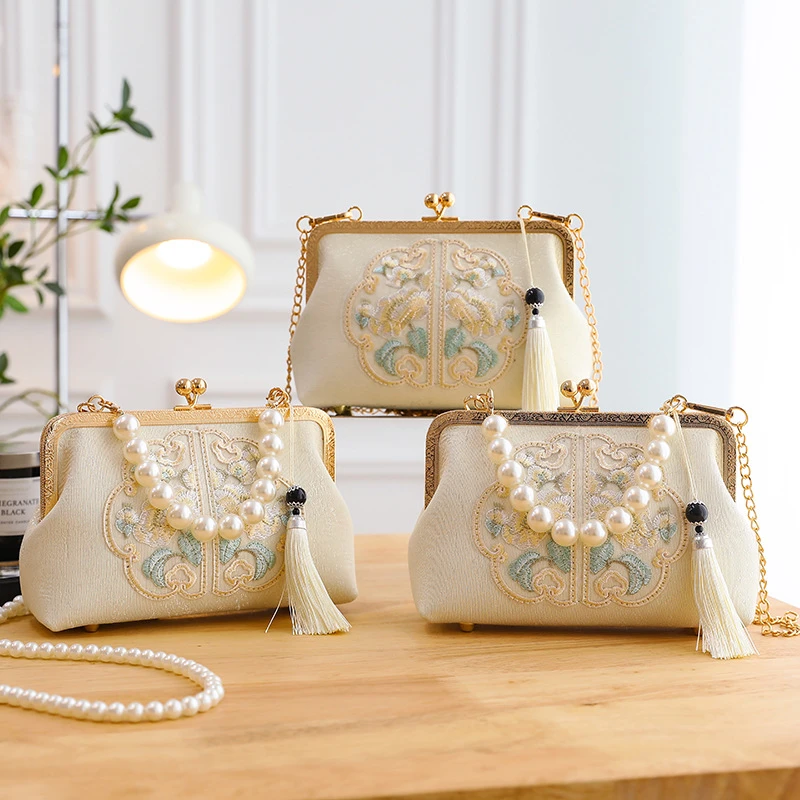
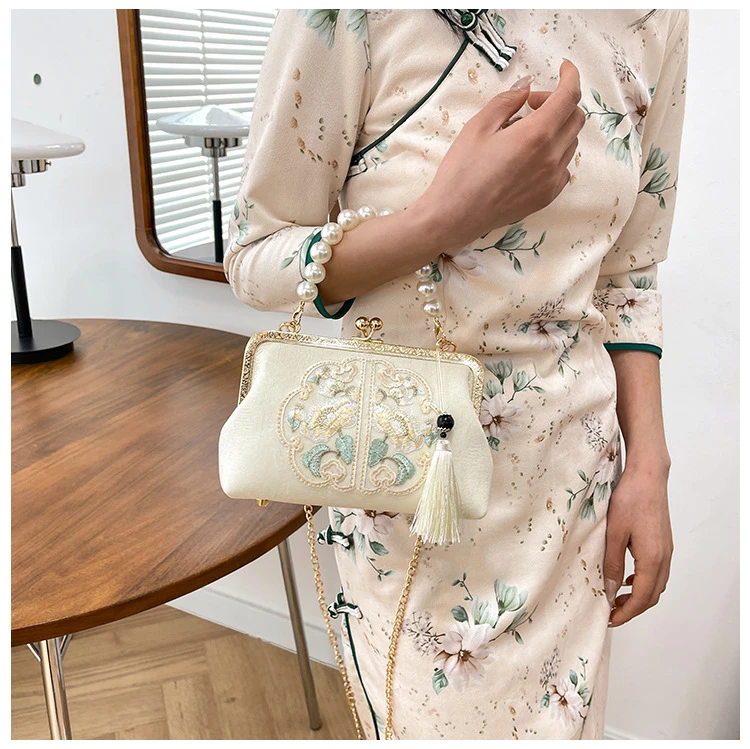
- The bag offers three distinct gold-chain configurations — Beaded Chain, Short+Long Necklace, Gold Long Chain — each producing a different silhouette and style register at the same dimensions.
- At $14.10–$15.56 depending on configuration, it delivers singular artisanal surface quality at accessible positioning.
- Polyester foundation provides superior colour-retention and shape stability compared to natural fabrics — the ideal substrate for precision embroidery.
Why Embroidery Has Always Been a Language of Power in Chinese Textile History
In 2024, UNESCO's Silk and Textiles Programme noted that Chinese embroidery traditions represent one of the world's most technically sophisticated textile arts, with regional styles — Suzhou's su xiu, Hunan's xiang xiu, Guangdong's yue xiu, Sichuan's shu xiu — each encoding distinct formal vocabularies (UNESCO, 2024). What unites them is a shared principle: the needle is a tool of declaration. Every stitch placed is a statement about the value of time, attention, and intention.
During the Ming Dynasty (1368–1644), floral embroidery on court accessories was not decorative in any casual sense. It was heraldic. The flowers chosen — peonies for prosperity and feminine authority, chrysanthemums for endurance, lotus for purity ascending from difficulty — were coded messages about the wearer's values and status. A bag was never merely a bag. It was an argument worn on the body.
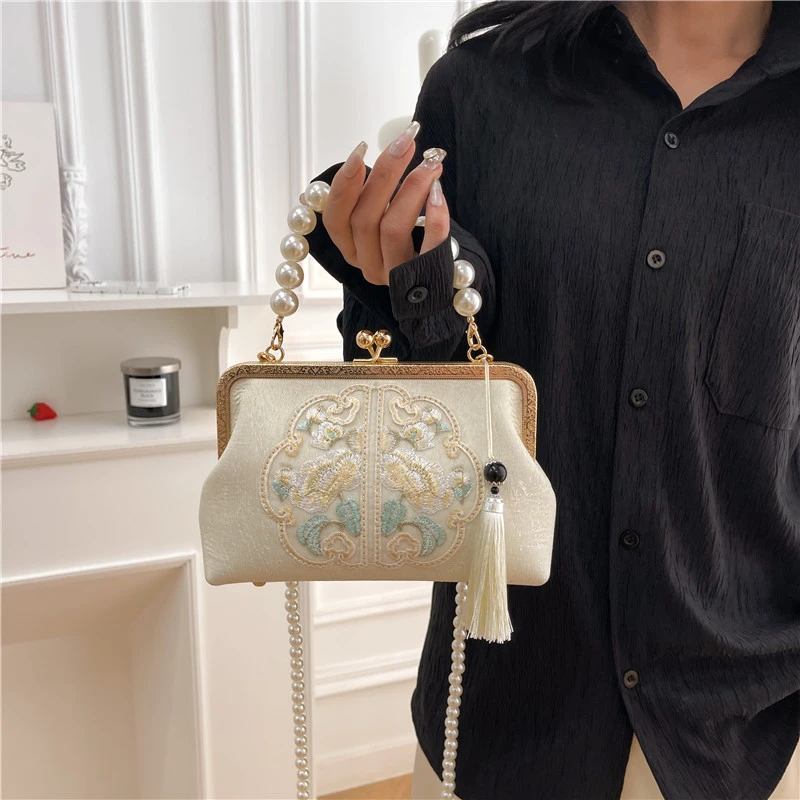
What makes Ming floral embroidery specifically compelling for the contemporary European wardrobe is its insistence on colour precision. The needlework uses gradient stitching — threads laid in graduating densities — to simulate the dimensional depth of a painted flower. The result is a surface that moves differently in light depending on angle and hour.
How Three Gold Chain Configurations Change the Same Object Entirely
The most architecturally interesting thing about this bag is not its embroidery — remarkable as that surface is — but its configuration logic. Three chain options transform the same 250×160×90mm body into three categorically distinct objects. In 2026, as European fashion increasingly rewards what could be called "wardrobe intelligence" — fewer pieces that do more — this matters enormously.
Consider what each chain option produces:
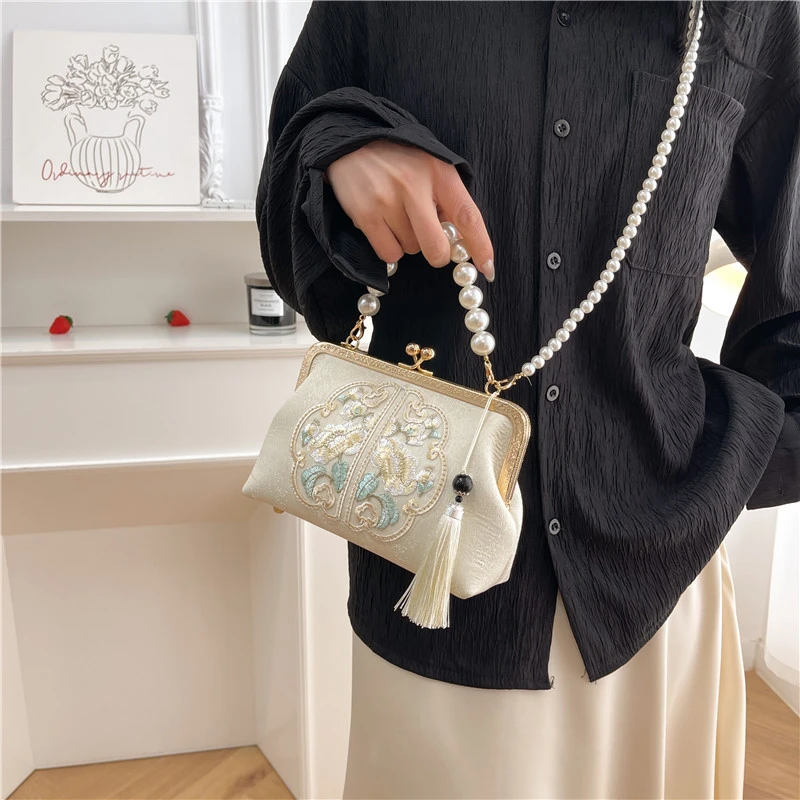
Beaded Chain Gold Chain ($14.98) — The beaded chain introduces tactile weight and a certain jewellery register. It reads as evening or as the kind of elevated daytime carry that belongs to cultural visits, gallery openings, editorial appointments. The beads catch light independently of the embroidery, creating a layered shimmer conversation.
Short Necklace + Long Necklace ($15.56) — The dual necklace configuration is the most maximalist of the three. It offers full carry flexibility: wear short for a crossbody that sits at the hip; wear long for a shoulder drop. The two chains together have a sculptural presence that makes the bag perform as an accessory statement even before it's examined closely.
Gold Long Chain ($14.10) — The single long gold chain is the most minimal and perhaps most versatile configuration. It's the choice for European daily life: commuting, café meetings, market mornings. The chain elongates the visual line of the body. The embroidery provides all the ornament required. Nothing competes.
Editorial note: When photographed in soft Parisian morning light, the gold chain configurations each produce a distinctly different photographic register — the beaded chain refracting light into small constellation points, the long chain casting a linear shadow that complements the floral embroidery's organic forms.
The Polyester Question: Why Substrate Matters as Much as Embroidery
Some readers may pause at polyester. The European luxury lexicon has historically devalued synthetic fibres, but this reflects a bias that conflates material price with material performance. For precision embroidery, polyester is in many respects the superior substrate. According to textile research published by the Textile Institute (2023), polyester fibres maintain dimensional stability and colour-fastness under conditions that cause natural fabrics — cotton, linen — to distort, fade, and stretch over repeated use and cleaning cycles.
What this means for the embroidered handbag: the stitching retains its tension, the floral forms hold their shape, and the dimensional relief created by layered threads does not flatten over time the way it might on a less stable weave. The bag you receive is the bag you will carry for years.
The inner lining is also polyester — practical, cleanable, resistant to everyday stress. The hidden zip pocket offers the kind of secure inner organisation that European daily life demands: phone, keys, card wallet, and a small notebook all assigned their place without anxiety.
Styling for the European Wardrobe, Season by Season
The Embroidered Chinese-Style Handbag operates across a broad seasonal and sartorial range. Its scale — compact at 250×160×90mm — positions it as a secondary or statement carry rather than an everyday workhorse, which paradoxically gives it more styling freedom.
Autumn/Winter: Against the dark wools and structured coats of the European autumn wardrobe, the embroidered surface performs as focal colour. Carry it with a charcoal bouclé coat and clean trousers. The gold chain introduces warmth. The florals echo the last memory of summer.
Spring/Summer: Linen dresses in sand or white create a neutral field against which the embroidery reads with maximum clarity. The long gold chain configuration works particularly well here — simple, luminous, unhurried. The kind of bag that makes a simple outfit look considered.
Evening: The beaded chain configuration is specifically evening-calibrated. It introduces a jewellery-weight materiality that feels appropriate for dinner, theatre, or the kind of cultural events that constitute European social life at its most pleasurable.
One under-discussed styling principle: embroidery is one of the few surface treatments that reads as well on camera as in person — often better, because light at any angle reveals new facets of the stitching. For women who document their wardrobes visually, this is a significant advantage. The bag photographs differently in every shoot.
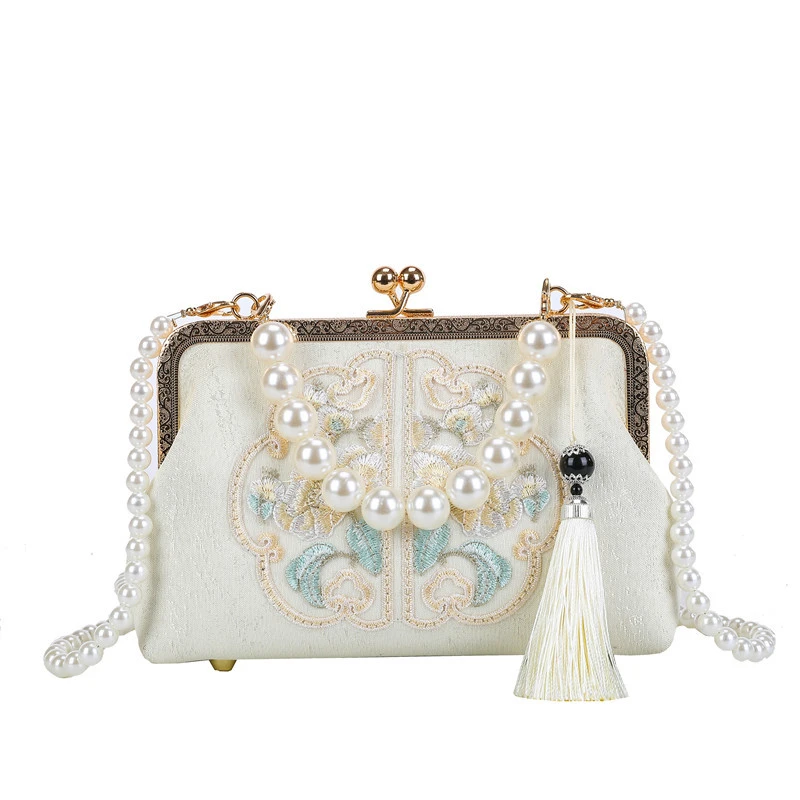
Embroidered Chinese-Style Handbag — Women's Shoulder & Crossbody
Dimensions: 250 × 160 × 90 mm
Weight: 370 g
Bag shape: Horizontal rectangular
Interior: Hidden zip pocket
Style: Urban minimalist / Embroidered fashion
What the Cultural Moment Demands: Why This Bag Is Right for 2026
In 2026, the European fashion conversation has arrived at a productive tension between craft authenticity and commercial accessibility. High-end maisons are deploying embroidery at five-figure price points as proof of technical commitment. Meanwhile, a growing cohort of European women — educated, culturally curious, resistant to pure logomania — are seeking objects that carry genuine cultural weight without requiring a luxury price as proof of their value.
The Embroidered Chinese-Style Handbag is positioned precisely at this intersection. Its embroidery is real. Its cultural vocabulary — Ming Dynasty floral motifs, the precision of gradient needlework — is documented and genuine. Its price is an argument against the equation that worth must equal cost. At $14.10 to $15.56, it asks European women to judge objects by their intelligence rather than their retail positioning.
This is not a mass-market proposition dressed up as artisanal. It is an artisanal proposition available to everyone.
Frequently Asked Questions
The Gold Long Chain ($14.10) is the most versatile for daily European life. The single elongated chain sits cleanly across the body, the compact bag rests at the hip without bulk, and the embroidery provides sufficient visual interest without requiring any additional accessorising. Studies on everyday bag use suggest women prioritise functional simplicity in their primary crossbody (Mintel Fashion Report, 2025).
Polyester maintains structural integrity and colour-fastness through repeated spot-cleaning cycles that would damage natural fabrics. Use a damp cloth with mild soap for surface marks on the embroidery. Avoid harsh solvents. The polyester substrate is specifically chosen for durability — textile research confirms synthetics outperform naturals in long-term stitch retention (Textile Institute, 2023).
The hidden zip pocket sits against the back interior wall, offering secure storage for flat essentials: credit cards, folded currency, a small phone. The main compartment handles larger items. At 250×160×90mm interior, the bag comfortably accommodates a modern smartphone, card wallet, keys, and lip product — the European woman's essential daily inventory.
Its versatility is its defining feature. The beaded chain configuration reads as evening or cultural event carry. The long gold chain suits daytime urban use. At the core, the embroidery's Ming Dynasty floral vocabulary makes it appropriate for any occasion where a woman wishes to introduce cultural depth into her visual presentation — which, in 2026, is most occasions.
The floral vocabulary draws on the broader Ming Dynasty court embroidery tradition, which synthesised regional styles into a courtly standard. The peonies, botanical scrolls, and floral fill patterns visible on the surface are consistent with xuānjī xiù (宣机绣) court embroidery conventions — a tradition that UNESCO's 2024 Silk and Textiles Programme identifies as among the world's most technically accomplished needlework forms.
Conclusion: The Object That Earns Its Space
Not every object earns its space. Some take up room without offering anything in return — visual noise dressed as style. The Embroidered Chinese-Style Handbag offers the opposite proposition: a compact form at 250×160×90mm that carries six centuries of floral embroidery intelligence, three configuration possibilities, and a surface that changes character with every change of light.
For the European woman aged 25–45 who approaches her wardrobe as a considered act of self-presentation rather than a passive consumption of trends, this bag is a precise and affordable argument. It says: I know where beautiful things come from. I am not waiting for a price tag to tell me their value.
Three chains, one embroidery vocabulary, six centuries of Ming Dynasty authority — from $14.10.
1. UNESCO Silk and Textiles Programme — "Chinese Embroidery Heritage", retrieved 2026-11-13, https://en.unesco.org/silkandtextiles/
2. Textile Institute — "Synthetic vs Natural Fabric Durability in Precision Embroidery Applications", retrieved 2026-11-13, https://www.textileinstitute.org/
3. Mintel — "European Fashion Accessories Report 2025", retrieved 2026-11-13, https://www.mintel.com/