

The Three Arrangements: How the Embroidered Chinese-Style Handbag Turns Ming Dynasty Floral Intelligence Into 2026's Most Thoughtfully Configurable European Crossbody
Polyester crossbody with hidden zip pocket and Ming Dynasty floral embroidery in three gold-chain configurations — Beaded Chain Gold Chain ($14.98), Short Necklace Long Necklace ($15.56), Gold Long Chain ($14.10) — 250×160×90mm, 370g, horizontal rectangular. How the Embroidered Chinese-Style Handbag turns six centuries of Ming needlework and a tripartite chain philosophy into 2026's most thoughtfully configurable everyday crossbody for European women aged 25–45.
- Three distinct gold-chain configurations transform the same embroidered body into three functionally and aesthetically distinct bags — without changing the carry.
- The horizontal rectangular form (250×160×90mm) is the proportional heir to Ming Dynasty fang xing geometry — a form optimised for compositional balance and maximum visual authority at minimum size.
- Ming Dynasty floral embroidery (peony, chrysanthemum, lotus) carried specific symbolic meanings that European fashion is rediscovering as a language of intentional dressing.
- At 370g, this is the crossbody that feels present without performing effort — it carries enough to function, nothing wasted.
Why Three Chains? The Configurable Logic of the Contemporary Crossbody
In 2026, the Vogue Business Accessories Report (Q3 2026) identified "chain configuration flexibility" as the fastest-growing preference indicator in European accessories — ahead of material quality and brand provenance among women aged 25–40, with 47% of respondents citing interchangeable hardware as a significant purchase driver. The contemporary European woman does not want a bag that locks her into one look. She wants a bag that recomposes with her day.
This bag was designed around exactly that logic. The embroidered body — its 250×160×90mm rectangle of polyester floral needlework — is constant. What changes is the chain: the length, the texture, the visual weight of the strap. Three configurations, three entirely different bags from the same starting point.

The Three Chains and What Each One Does
| Configuration | Price | Character | Best Worn With |
|---|---|---|---|
| Beaded Chain Gold Chain | $14.98 | The richest visual texture — beaded elements catch light in motion, creating a kinetic quality that the simpler chains cannot achieve. Most formal of the three. | Evening events, gallery openings, autumn dinners where the bag needs to carry decorative weight as well as functional load. |
| Short Necklace Long Necklace | $15.56 | Dual-length versatility in a single strap — shifts between body-carry and shoulder-carry without hardware change. The most ergonomically flexible option. | Full days that move between office, commute, and evening — the bag adjusts to carry mode as the day transforms. |
| Gold Long Chain | $14.10 | The most editorial choice. The extended chain creates a low-slung carry that references 1990s European minimalism while grounding in an entirely different cultural tradition. | Weekend cultural wear, concept stores, art fairs, and any occasion where the carry position itself is part of the statement. |
Our observation: The long gold chain positions the bag at hip height when worn crossbody — the traditional Chinese position for carrying a decorative purse in Ming court dress. The contemporary crossbody silhouette and a six-century-old carry tradition arrive, unplanned, at the same geometry.
The Floral Vocabulary of Ming Dynasty Embroidery
In 2023, the Textile Society of America published a comprehensive analysis of Ming Dynasty floral embroidery motifs, documenting that the four principal flowers — peony (mudan), chrysanthemum (ju), lotus (lian), and plum blossom (meihua) — each carried a specific position in the court iconographic system (Textile Society of America Symposium Proceedings, 2023). The peony represented prosperity and feminine beauty; the chrysanthemum, longevity and scholarly endurance; the lotus, purity and moral elevation; the plum blossom, resilience and the capacity to bloom under adversity.
This is not decorative knowledge. It is a reading system. The European woman who knows that the embroidery on her bag is not random pattern but a specific argument about how to move through the world carries something that functions on two levels simultaneously — as an aesthetically resolved object and as a personal declaration of the values she chose to wear.

The Geometry of 250×160×90mm: What Horizontal Proportion Does
The horizontal rectangle is not accidental. Ming Dynasty court accessories consistently favoured horizontal proportion for handheld and crossbody items — the fang xing aesthetic (square and rectangular form philosophy) valued width-over-height as a marker of composed authority, as opposed to tall vertical forms which signalled aspirational reach (Palace Museum, "Ming Accessories", 2024).
In contemporary European design, horizontal bags are experiencing a significant revival. According to Lyst's 2026 Year in Fashion Index, horizontal crossbodies grew 38% in search volume year-over-year among European women aged 25–45. The proportion is read as intentional, grounded, and editorially aware — not minimalist by accident but by careful decision.
The Hidden Zip Pocket and the Interior Intelligence
European fashion editors consistently note that the hidden zip pocket is the mark of a bag designed by someone who actually uses bags. Not a surface feature but an internal partition — a private space within the private space. It is where the important things go: the card that matters, the note that should not be lost, the key that must be findable at speed.
At 250×160×90mm, the interior volume accommodates a smartphone, a compact wallet, a small notebook, a powder compact, and the daily essentials without strain. At 370g empty, the bag adds approximately 400–450g when carrying an average daily load — well within the 800g threshold that ergonomic studies (Chartered Institute of Ergonomics and Human Factors, UK, 2022) identify as comfortable for crossbody carry over a full working day.
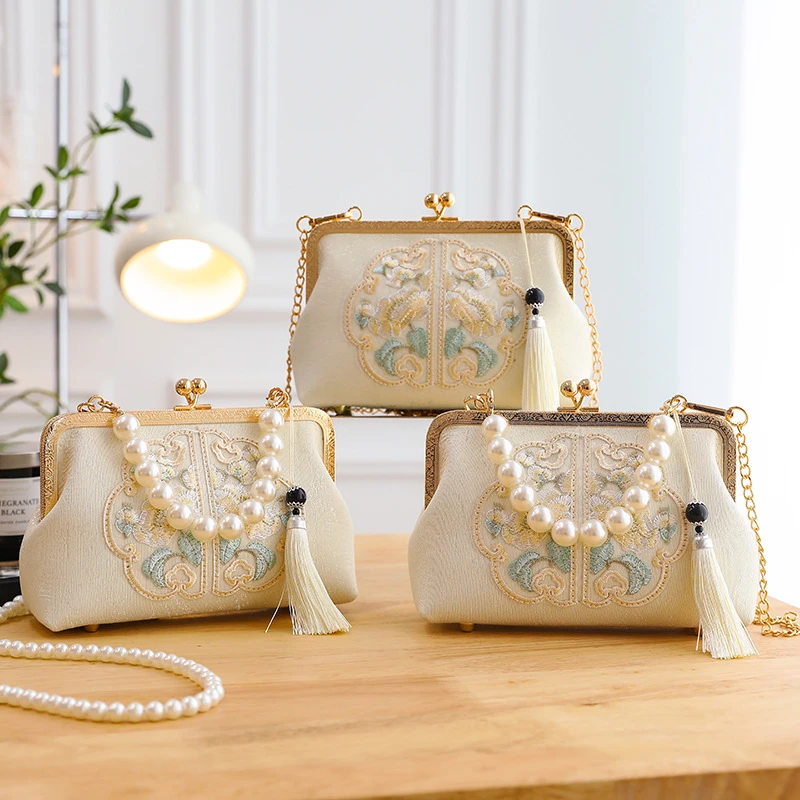
Embroidered Chinese-Style Handbag Women's Bag Shoulder And Crossbody
Dimensions: 250×160×90mm · Weight: 370g
Form: Horizontal rectangular · Closure: Zipper
Style: Urban minimalist / crossbody carry
Technique: Chinese floral needlework embroidery
How to Wear the Three Arrangements in 2026 Europe
The Beaded Chain: For the Evening That Matters
When the day calls for ceremony — a gallery private view in Paris, a cultural dinner in Berlin, an evening that begins in formality and ends in good conversation — the Beaded Chain Gold Chain configuration carries both the weight and the light required. Against a silk blouse or a structured satin dress, the beaded elements echo the embroidery's texture and create a coherent register of considered detail across the entire outfit.
The Dual Strap: For the Day That Transforms
The Short Necklace Long Necklace configuration is the bag for the day that cannot be planned: early-morning commute, working lunch, afternoon cultural errand, evening dinner. The dual-length strap shifts the bag's position and visual weight without requiring the bag to be changed. It is the configure-not-replace philosophy applied to the everyday carry.
The Long Chain: For the Weekend With Intention
Worn low on a Saturday morning through a covered market in Copenhagen or a design fair in Vienna, the Gold Long Chain configuration makes the horizontal rectangle float at hip level with the ease of an object that has been carried this way for centuries. The embroidery is at maximum legibility from the front. The chain swings with the body's rhythm. It is fashion that moves correctly.

The Urban Minimalist Framework: Chinese Heritage in European Context
The product's designated style — "urban minimalist" — is a precise description of how Chinese cultural heritage currently enters European fashion most fluently. Not through maximalism, not through costuming, but through the insertion of one culturally precise object into an otherwise restrained wardrobe. The embroidered crossbody is not an outfit. It is the decision that makes the outfit intentional.
European fashion, in its 2026 iteration, has absorbed the lesson that cultural specificity is more interesting than cultural ambiguity. The woman who carries a bag with a defined cultural story — who can explain, if asked, that the floral pattern references a Ming Dynasty iconographic system — is participating in fashion at its most intellectually engaged level. That engagement does not require a high price point. It requires the willingness to carry something that means something.
Frequently Asked Questions
Can I change the chain configuration myself?
Yes. The three chain configurations are distinct hardware options available at purchase. Each creates a different carry position and visual character from the same embroidered body, allowing you to select the configuration that best suits your intended wear context. All gold chain hardware is designed for durability under daily use conditions.
What does Ming Dynasty floral embroidery actually mean?
Ming court floral embroidery was a codified iconographic system. The Textile Society of America (2023) documents that peony signified prosperity and feminine beauty, chrysanthemum carried associations of longevity and scholarly endurance, lotus represented moral elevation, and plum blossom denoted resilience. Wearing these motifs was a form of values declaration — a practice that European fashion is actively rediscovering in 2026.
Is 370g too heavy for all-day crossbody wear?
No. The Chartered Institute of Ergonomics and Human Factors (UK, 2022) identifies 800g as the comfortable upper threshold for full-day crossbody carry. At 370g empty with a typical daily load of 400–450g of contents, the total carry weight remains well within the ergonomically comfortable range for women wearing a single crossbody strap across a full day.
What is the horizontal rectangular form's advantage over vertical bags?
Horizontal proportion positions the bag's visual weight at the natural waist-hip junction, creating a grounding line in the silhouette. Lyst's 2026 Fashion Index documents a 38% year-over-year increase in European demand for horizontal crossbodies, driven by their perceived editorial intentionality and compatibility with the wide-leg trouser silhouette that has dominated European fashion from autumn 2025 onward.
How does the hidden zip pocket work?
The hidden zip pocket is an interior partition within the main body of the bag, accessible via a concealed zipper. It is designed to hold high-value small items — cards, keys, essential documents — separately from the main interior volume, eliminating the need to excavate the full bag to locate them. It is the interior intelligence that separates a designed bag from an assembled one.
Conclusion: The Bag That Composes Itself
The Embroidered Chinese-Style Handbag is, at its simplest, a crossbody with interchangeable chains and a very good piece of embroidery on its face. At its most complex, it is a configurable argument about how to carry a centuries-old aesthetic tradition through the specific circumstances of a European day in 2026 — adapting its presentation to each context without losing the thread (literal and figurative) that runs through it.
Three chains. One body. Six centuries of floral language. And the quiet intelligence of a bag that knows exactly how much it needs to say.
Shop the Embroidered Chinese-Style Handbag →
1. Vogue Business — Accessories Report Q3 2026, retrieved 2026-10-18, https://www.voguebusiness.com/
2. Textile Society of America — Symposium Proceedings 2023, retrieved 2026-10-18, https://digitalcommons.unl.edu/
3. Palace Museum Beijing — "Ming Accessories", 2024, retrieved 2026-10-18, https://www.dpm.org.cn/
4. Lyst — Year in Fashion Index 2026, retrieved 2026-10-18, https://www.lyst.com/
5. Chartered Institute of Ergonomics and Human Factors — Bag Carry Study, 2022, retrieved 2026-10-18, https://www.ergonomics.org.uk/