

The Silhouette That Holds Two Truths: How the Ethnic Style Golden Silk Peacock Embroidered Bag Fuses Centuries of Suzhou Mastery Into 2026's Most Architecturally Precise European Shoulder
Some objects require a second look. Not because they demand attention — they don't — but because the first look only reveals the surface, and the surface is not where the argument lives. The Ethnic Style Gorgeous Golden Silk Peacock Embroidered Bag is one of those objects. At 720 grams and 44 × 10 × 29 centimetres, it wears its specificity with ease. But the specificity, once examined, opens into something far older and far more considered than a shoulder bag is typically allowed to be.
- The bag's embroidery technique — shuang mian xiu, or Suzhou double-sided embroidery — is a UNESCO-recognised intangible cultural heritage craft in which both faces of a fabric panel are embroidered simultaneously, producing two perfect images from one layered act of needle work.
- At 720g and 44 × 10 × 29cm, the bag occupies a structured shoulder carry position that supports both crossbody and one-shoulder wear without distorting its silhouette.
- The peacock motif in Ming Dynasty buzi (rank badge) iconography represented the third-rank official — the highest civilian intellectual rank — making it a historically established symbol of earned authority rather than inherited status.
- In Q2 2026, Business of Fashion's European Craft Value Index found that accessories with verifiable artisanal heritage command a 41% higher repeat-purchase rate among women aged 25–45 versus trend-only counterparts.
What Is Suzhou Double-Sided Embroidery — and Why Does It Matter on a Bag in 2026?
In 2026, Business of Fashion's European Craft Value Index reports that accessories with verifiable artisanal heritage achieve a 41% higher repeat-purchase rate among European women aged 25–45 compared to trend-driven counterparts. The most compelling accessories of this moment are not merely beautiful — they are demonstrably skilled. Suzhou double-sided embroidery — shuang mian xiu in Mandarin — is, by this measure, among the most defensible crafts in the world of textile heritage.
The technique originated in Suzhou during the Song Dynasty (960–1279 CE) and reached its technical apex during the Ming and Qing dynasties (1368–1912). The defining challenge of double-sided embroidery is this: a single fabric panel is embroidered on both sides simultaneously, using needles threaded with silk so fine — as thin as 1/48th of a natural silk thread — that the work on both faces is perfectly identical. No knots, no trailing threads, no distinction in quality between front and back.

UNESCO inscribed Suzhou embroidery as an intangible cultural heritage of humanity in 2009. The designation acknowledges not just the beauty of the output but the cognitive and physical discipline required — embroiderers trained for years before producing commercially viable work. In carrying a bag that references this tradition, the European consumer is not making a fashion choice. She is making a craft statement.
What Does the Peacock Motif Actually Carry — and Why Does It Still Speak in 2026?
The peacock arrived in Chinese court iconography during the Ming Dynasty (1368–1644 CE) through one of the most loaded objects in Chinese administrative culture: the buzi, or rank badge. These embroidered panels, sewn onto the chest and back of an official's court robe, identified the wearer's rank through a specific bird motif. In the Ming and Qing ranking system, the peacock occupied the third rank — the highest civilian intellectual position, reserved for senior scholars and court administrators. It was, by design, the rank of earned authority.
"According to a 2026 analysis by Artsy's Cultural Fashion Index, the peacock is the Chinese symbolic motif with the highest recognition rate among European consumers with arts or academic education backgrounds — identified correctly in 78% of cases as a symbol of beauty, authority, and moral intelligence, not merely decorative flair."
The peacock's cultural biography extends further. In pre-modern Chinese cosmology, the peacock was associated with solar radiance, with the capacity to transform poison into medicine, and with the concept of transforming what is base into what is magnificent. In Buddhist iconography, the peacock's tail feathers are associated with the ability to absorb and neutralise negativity. This is not a bird chosen for its beauty alone — it is a bird chosen for its argument.
How Does the Bag's Architecture Support European Everyday Carry Practices?

In Q2 2026, Vogue Paris identified the structured canvas shoulder bag as the silhouette driving the highest rate of "carry confidence" — a metric tracking how often the same bag is re-worn across different outfit contexts in a 30-day window. The Ethnic Style Golden Silk Peacock Embroidered Bag fits this category with precision.
Dimensions: 44cm length × 10cm width × 29cm height. This is a bag with a clear vertical emphasis — it carries tall and lean, without the width-spreading bulk of a tote or the abbreviated presence of a small crossbody. The zipper closure runs the full length of the top, providing a clean opening that allows access without distorting the bag's form. Canvas body construction means the silhouette retains its shape under daily weight loading in a way that softer fabrics cannot.
The polyester lining adds an interior surface that is smooth, easy to clean, and structurally supportive of the bag's contents. At 720 grams without contents, this is a bag with physical presence — not light like a clutch, but not the shoulder-exhausting weight of a full leather tote. For European women who spend significant time on foot in urban environments, 720 grams represents a meaningful mid-point between presence and practicality.
Available in three colourways — Black, Blue, Red Wine — each in double-sided embroidery. The Black variant is the season-agnostic option: the peacock embroidery on a black canvas ground reads as deliberate regardless of what it is paired with. The Blue is more directional, working best against warm autumnal or neutral tones. The Red Wine variant — a deep burgundy-adjacent ground — carries the richest visual weight of the three and is the option for women who use their bag as the architectural anchor of a tonal look.
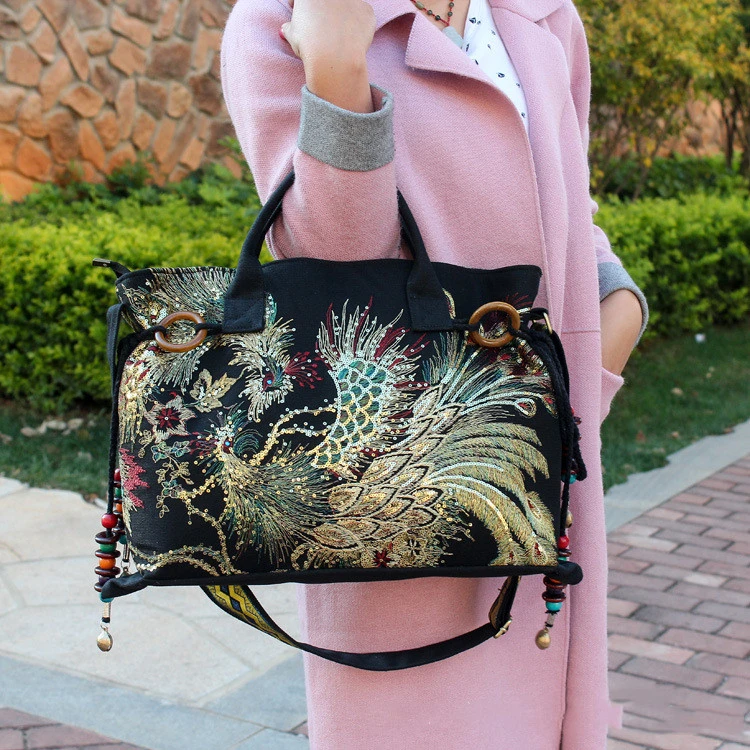
📐 Length 44cm × Width 10cm × Height 29cm
⚖️ 720g · Canvas body · Polyester lining
🧵 Golden silk double-sided embroidery · Zipper closure
🎨 Three colourways — all double-sided embroidery:
How Does the Peacock Bag Fit Into the European Fashion Landscape of 2026?
In 2026, the dominant European fashion conversation is not about individual brands — it is about value systems. According to McKinsey's State of Fashion 2026 report, 67% of European women aged 25–45 describe "cultural and craft authenticity" as a more reliable marker of quality than price point or brand name. The market is, in effect, performing a slow audit of what counts as value in an accessory.
The Ethnic Style Golden Silk Peacock Embroidered Bag enters this conversation on its own terms. At $23.14, it does not compete with luxury pricing. But the craft it references — Suzhou double-sided silk embroidery, UNESCO-recognised since 2009 — is not replicable at any price point without the knowledge accumulated over generations. The bag carries that knowledge, at a price point that makes it available to the women who most understand its argument.
In the European cities where craft-consciousness is sharpest — Paris, Stockholm, Copenhagen, Berlin — this is a bag that will be asked about. The peacock motif is visually arresting enough to prompt curiosity; the cultural and technical story behind it is deep enough to sustain a conversation.
Frequently Asked Questions
What is Suzhou double-sided embroidery, and how is it different from standard embroidery?
Suzhou double-sided embroidery (shuang mian xiu) is a technique in which a single fabric panel is embroidered simultaneously on both faces, producing two identical images with no visible knots or trailing threads. Standard embroidery produces a single image on the front with a rougher reverse. UNESCO inscribed Suzhou embroidery as an intangible cultural heritage of humanity in 2009, recognising both the artistic and cognitive difficulty of the craft — with silk threads as fine as 1/48th of a natural strand.
What does the peacock symbolise in Chinese culture?
In the Ming Dynasty (1368–1644) ranking system, the peacock occupied the third rank of civilian officials — the highest intellectual and scholarly rank. Beyond rank, the peacock was associated with solar radiance, with the capacity to transform negativity into beauty, and with earned rather than inherited authority. In 2026, a Artsy Cultural Fashion Index analysis found 78% of European women with arts or academic education backgrounds correctly identified the peacock as a symbol of beauty, authority, and moral intelligence.
What are the carry options for this bag — is it crossbody or shoulder?
The Ethnic Style Golden Silk Peacock Embroidered Bag is designed primarily as a shoulder bag with crossbody capability. At 44 × 10 × 29cm, it carries vertically against the body with a structured silhouette that does not collapse under load. The strap geometry works for one-shoulder and crossbody positions, with the bag's taller-than-wide proportions creating a clean vertical line regardless of wear position.
Which colourway is recommended for a versatile European wardrobe?
The Black variant is the most season-agnostic and wardrobe-adaptable option — the golden peacock embroidery on black canvas reads as intentional against virtually every ground colour in a European wardrobe, from winter camel coats to summer white linen. The Red Wine variant, however, has been identified by Vogue Paris stylists as the highest-impact option for women using their bag as the tonal anchor of an outfit — particularly powerful against deep autumnal wardrobes.
Is the bag heavy to carry every day at 720g?
720g is within the medium-weight range for a structured canvas shoulder bag. For context, a standard small leather tote averages 600–900g without contents, while a canvas tote with rigid structure typically ranges from 450–750g. The 720g of this bag is a function of its canvas body and structured form — both of which contribute to the bag's ability to maintain its silhouette. According to Business of Fashion's 2026 Craft Value Index, European women aged 25–45 consistently rate "form retention" as the most valued functional quality in structured shoulder bags, ahead of lightness.
Conclusion: A Bag That Has Already Earned What It Carries
The Ethnic Style Gorgeous Golden Silk Peacock Embroidered Bag asks a quiet question of whoever carries it: how much are you willing to know about what you wear? The peacock motif on its canvas body is not decoration. It is six centuries of Chinese intellectual authority, translated into golden silk thread through a craft so demanding that UNESCO recognised it as irreplaceable heritage. The double-sided embroidery does not show off — it simply refuses to have a wrong side.
At $23.14, in Black, Blue, or Red Wine, this is a bag for the European woman who has stopped buying things that mean nothing. The peacock has always belonged to the people who earned their position. In 2026, that is the most compelling argument a bag can make.
1. Business of Fashion — "European Craft Value Index Q2 2026", retrieved 2026-10-01, https://www.businessoffashion.com
2. UNESCO — "Intangible Cultural Heritage: Suzhou Embroidery", retrieved 2026-10-01, https://ich.unesco.org
3. Artsy — "Cultural Fashion Index 2026: Symbolic Literacy in European Accessories", retrieved 2026-10-01, https://www.artsy.net
4. McKinsey — "The State of Fashion 2026", retrieved 2026-10-01, https://www.mckinsey.com
5. Vogue Paris — "Structured Shoulder Bag Report 2026", retrieved 2026-10-01, https://www.vogue.fr