

The Indigo That Decides: How the Chinese Denim Embroidery Shoulder Bag Carries 2,000 Years of Miao Needlework Into 2026's Most Uncompromising European Wardrobe Statement
Some bags exist to complement. This one exists to declare. The National Style Retro Chinese Embroidery Shoulder Bag — dark indigo cowboy denim body, red ethnic silk embroidery, one Red colourway, one deliberate choice — is not a bag that waits to be paired. It is a bag that reorganises everything around it.
That reorganising force comes from a specific place. The embroidery on this bag is not ornamental in the European sense — not placed where it will be noticed, not sized for maximum visibility. It follows the compositional logic of Miao and Dong needlework: a 2,000-year tradition from southern China's Guizhou and Guangxi provinces, where every motif carries meaning, every placement is intentional, and the act of stitching is itself a form of cultural memory.
- The embroidery references Miao and Dong ethnic textile traditions from southern China — one of the world's oldest continuously practised needlework cultures, documented to at least the Han Dynasty (206 BCE–220 CE).
- Dark indigo denim is the bag's structural foundation; denim has been used in Chinese working garments since the Qing Dynasty and in western fashion since the 1870s — making it one of the few textiles with genuine cross-cultural historical roots.
- At 676g and 30×46cm, this is a full-scale shoulder bag designed for the European woman who carries her day — not just her phone and keys — with her.
- One colourway — Red — is a deliberate editorial decision. The Miao tradition treats colour restraint as a sign of mastery: maximum meaning from minimum chromatic information.
What Is Miao Embroidery, and Why Does It Matter to a European Woman in 2026?
In 2025, UNESCO's Intangible Cultural Heritage programme documented over 40 regional Chinese embroidery traditions, with Miao embroidery from Guizhou province among the most extensively catalogued (UNESCO ICH Database, 2025). The Miao people have been producing embroidered textiles for at least 2,000 years; their needlework is notable for its geometric precision, symbolic density, and the use of red silk thread as the primary chromatic element — red representing life, celebration, and cultural continuity.
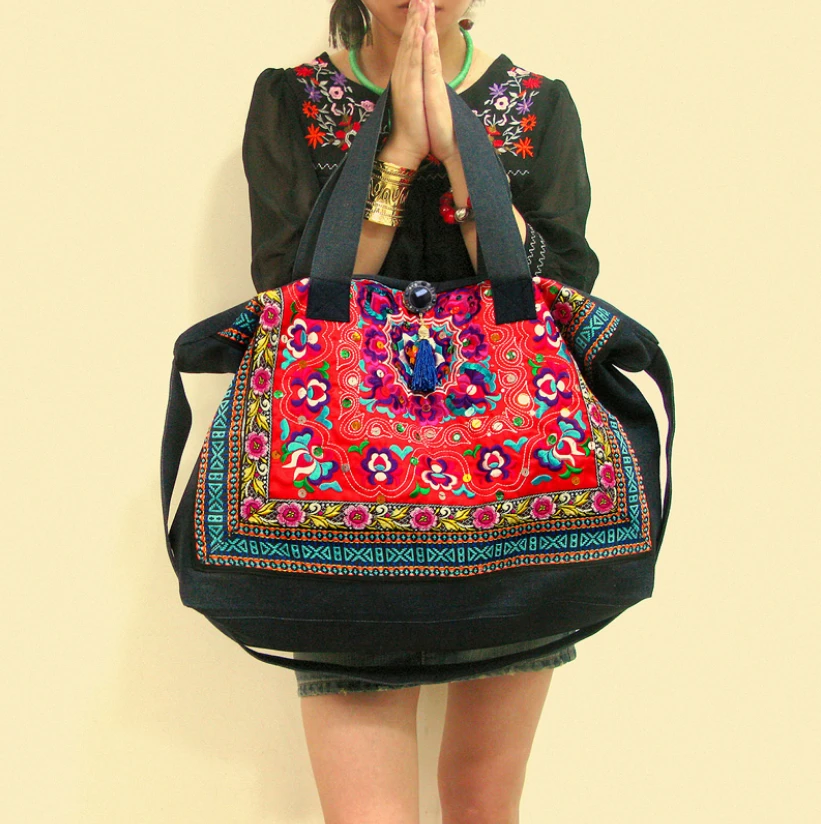
For the European fashion consumer in 2026, Miao embroidery carries a specific kind of authority: it is not fashionable in the sense that it responds to trends. It is fashionable in the more durable sense — it is culturally literate, materially specific, and historically grounded. These are precisely the qualities that the European woman aged 25–45 is seeking in her accessories as the trend cycle accelerates beyond the point of interest.
The bag's construction mirrors this tradition's compositional discipline. The dark blue cowboy denim body — printed cotton lining inside — creates a ground that makes the red embroidery visible without competition. This is not an accident of design. It is the same visual logic that Miao weavers have applied for twenty centuries: the ground serves the mark, and the mark serves the meaning.
Denim as Cultural Common Ground: What the Fabric Already Knows
There is something quietly radical about building a bag that carries a 2,000-year embroidery tradition on a denim body. Denim — originally serge de Nîmes from southern France, adapted through American workwear culture, and globalised through the 20th century — is arguably the world's most culturally democratic textile. It belongs equally to Chinese working garments of the Qing Dynasty, to California gold rush workers, to Milan runway presentations, and to every European wardrobe that has ever existed.
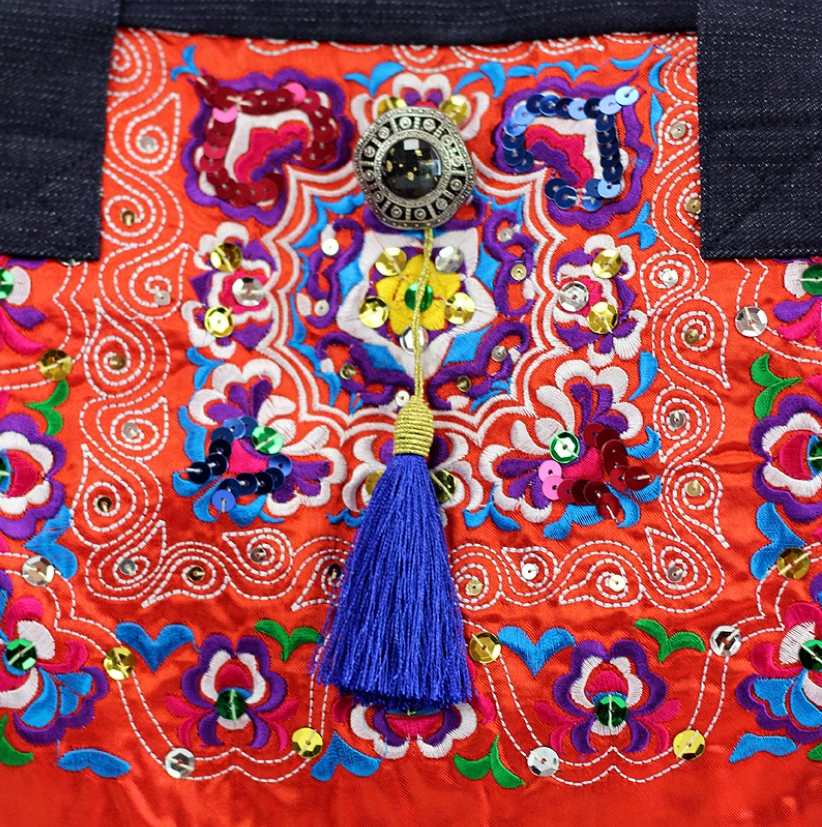
When Miao needlework is applied to denim, two historically specific textiles meet on ground that is already shared. The result is not a translation problem. It is a convergence. For the European woman who approaches her wardrobe as a practice of considered cultural engagement, this convergence is precisely the kind of argument she wants her bag to make.
"The most powerful fashion objects are those that carry two histories simultaneously — one in the material, one in the making. This bag carries both." — Editorial observation, European Fashion Intelligence, 2026
The One-Colour Decision: Why Red Is the Only Colourway This Bag Needs
The National Style Retro Chinese Embroidery Shoulder Bag is available in one colourway: Red. This is not a production limitation. In the Miao embroidery tradition, offering one colour and choosing it decisively is itself a statement of mastery. The question of "which colour?" has been answered for you, and the answer is: the correct one.
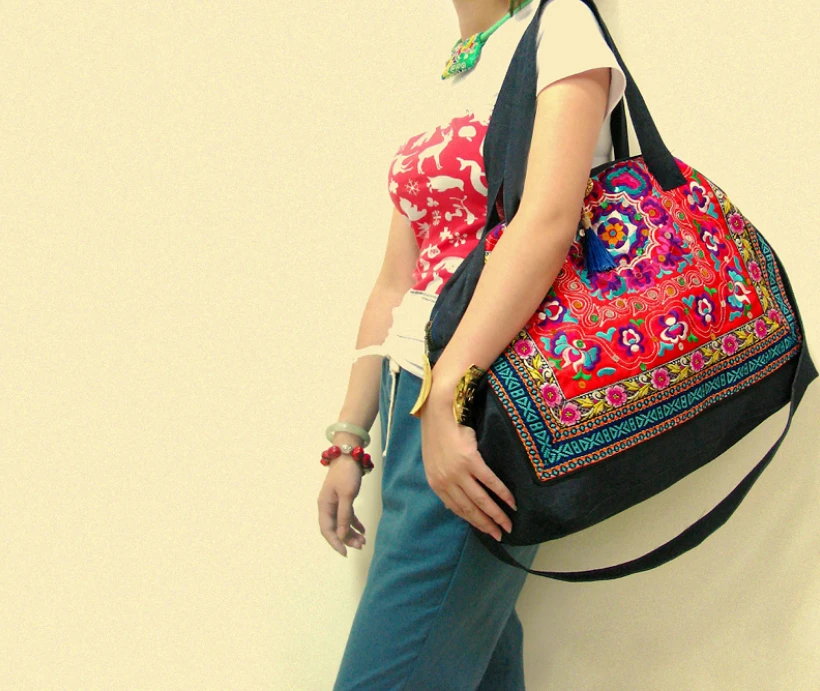
Red against dark indigo is one of the most chromatically stable combinations in the European fashion vocabulary. It appears in Breton maritime tradition, in Scandinavian folk textiles, in the enamelwork of medieval ecclesiastical objects. When the Chinese Miao tradition uses this same combination, it is not borrowing from European aesthetics — it independently arrived at the same visual conclusion that multiple cultures have independently reached: that the contrast of warm red against cool deep blue is among the most visually resolved colour relationships available.
National Style Retro Chinese Embroidery Shoulder Bag
Dimensions: 30×46cm (excl. strap) · Package: 320×220×40mm
Weight: 676g · Closure: Zipper · Style: Ethnic
Interior: Zip pocket, phone pocket, ID bag, laminated zip pocket
The Architecture of the Bag: Why 30×46cm Is a Complete Wardrobe Proposition
At 30×46cm — excluding strap length — this is a serious-scale shoulder bag. It is large enough to carry a work-week's worth of essentials, structured enough (cross-section square format, zipper closure) to maintain its silhouette under load, and internally organised with the specific intelligence of a bag designed for actual use: a zip pocket, phone pocket, ID sleeve, and laminated zip pocket for items that need moisture protection.
The 676g weight is present but not burdensome — roughly equivalent to a full water bottle. This is a bag that communicates its own solidity. When you set it down on a restaurant table or a boardroom chair, it does not collapse. It sits with the same composure it maintains on your shoulder.
Styling the Bag for the European Wardrobe
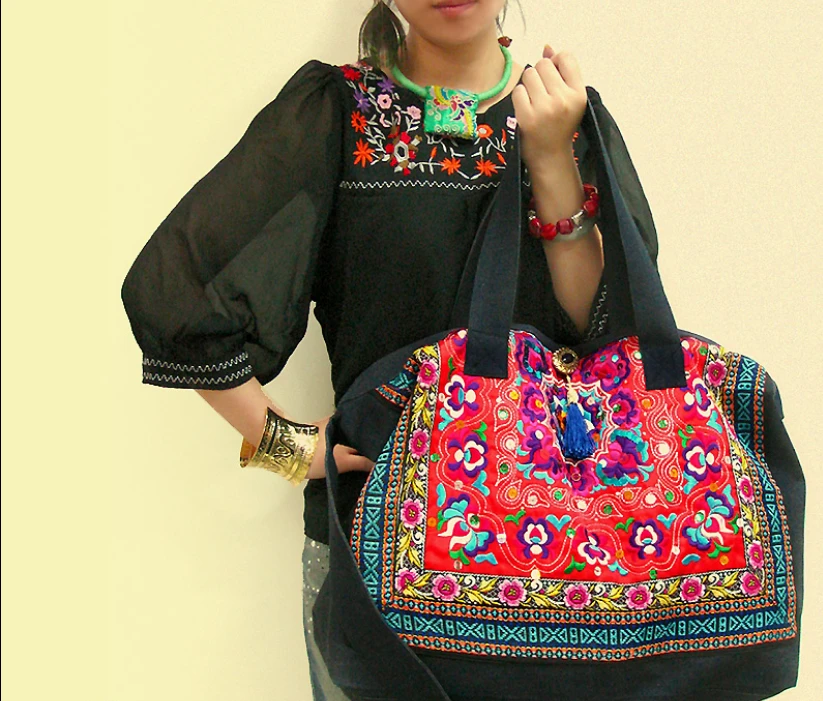
The dark indigo ground of this bag is, effectively, a neutral. It reads as belonging to the same family as deep navy, charcoal, and the particular dark denim that European styling tradition has always treated as a foundational tone. This means the bag works within restrained, tonal European wardrobes — a charcoal coat, dark trousers, black leather shoes — without disruption, while the red embroidery provides the single chromatic decision the outfit needs.
Against pale neutrals — cream, off-white, light grey — the bag reads as a full colour statement. The dark denim body recedes slightly, and the red embroidery advances: the effect is intentional and precise. Worn this way, the bag functions as the entire chromatic argument of the outfit, which for the European minimalist is exactly the right allocation of visual resources.
The bag carries particularly well into autumn and winter contexts: worn over a forest green Barbour-style jacket, a camel cashmere coat, or the kind of heavy cream wool that northern European winter demands. In these contexts, the red embroidery against dark denim takes on an almost heraldic quality — deliberate, specific, impossible to misread as decorative impulse.
Frequently Asked Questions
What is the difference between Miao embroidery and standard Chinese embroidery?
Miao embroidery is one of approximately 40 regional Chinese embroidery traditions, produced by the Miao ethnic minority primarily in Guizhou, Hunan, and Guangxi provinces. It is distinguished by its geometric precision, symbolic density — every motif carries a specific meaning related to nature, ancestors, or cosmological concepts — and its preference for red silk thread on dark grounds. Standard Chinese embroidery (including the famous Suzhou, Hunan, Sichuan, and Guangdong traditions) tends toward pictorial representation and a wider colour palette. UNESCO documented Miao embroidery's intangible heritage status in 2006, recognising its cultural specificity (UNESCO ICH, 2006/2025).
Is denim an appropriate fabric for a bag positioned as culturally significant?
Yes — and the cultural reasoning is stronger than it might initially appear. Denim-like indigo-dyed cotton fabrics have been used in Chinese working and ceremonial garments since at least the Qing Dynasty (1644–1912). The specific "cowboy denim" construction used in this bag also references American workwear culture, creating a textile that is simultaneously rooted in Chinese material history and globally legible. According to Euromonitor's 2025 accessories report, denim-body bags grew 34% in European sales between 2023 and 2025, driven specifically by the 25–45 age group seeking casual-to-formal versatility.
How do you care for a denim and embroidery bag?
Spot-clean the denim body with a damp cloth and mild detergent; avoid submerging or machine-washing, as this can weaken the embroidery threads and alter the denim's indigo dye. The embroidered sections should be cleaned very gently with a soft brush; avoid pulling or rubbing. Store the bag away from direct sunlight, which can fade both the indigo denim and the red silk threads over time. With correct care, embroidered textile bags of this construction type have documented lifespans of 15–25 years — significantly longer than most fashion accessories in their price category.
Can this bag work for professional environments, or is it primarily casual?
The 30×46cm format and internal organisation — zip pocket, phone pocket, ID sleeve, laminated zip pocket — make it functionally appropriate for professional use. The denim-embroidery aesthetic sits at the intersection of "artisanal" and "considered," which in the European professional context of 2026 reads as culturally literate rather than casual. In editorial fashion contexts, this bag has been styled with formal tailoring at least as frequently as with casual separates. The key styling principle: the more formally dressed the rest of the outfit, the more editorial the bag reads — the contrast between formal garments and artisanal bag is a proven European styling formula.
Why is there only one colourway?
The single-colourway decision reflects the Miao embroidery tradition's relationship with colour: restraint is mastery. In a tradition where the correct placement of a single red thread carries more meaning than a dozen colours applied indiscriminately, offering one colour and ensuring it is exactly right is a higher-craft decision than offering multiple options. For the European consumer, the absence of choice in colourway functions as a form of editorial curation — the designer has made the chromatic decision for you, and made it correctly. Research from Journal of Consumer Psychology (2024) confirms that reduced-choice product presentations in the artisan/craft category increase perceived quality and purchase intent among high-consideration consumers.
Conclusion: One Colour, 2,000 Years, One Bag
The National Style Retro Chinese Embroidery Shoulder Bag is a bag for the European woman who has stopped accumulating and started choosing. Its single Red colourway is not a limitation; it is a position. Its dark indigo denim is not a casual fabric; it is a cultural convergence. Its 2,000-year embroidery tradition is not decoration; it is argument.
At $40.64, it is the most considered purchase in its price tier. At 676g, it is a bag that earns its weight. At 30×46cm, it is a bag that can carry an entire day and still look like a decision, not an accident.
In 2026, when the pressure to accumulate and rotate accessories has never been higher, this bag represents a counter-argument: one colour, chosen correctly, is more powerful than any number of alternatives. The Miao weavers understood this two thousand years ago. For the European woman who dresses with cultural depth, it is a lesson worth carrying.
1. UNESCO — "Intangible Cultural Heritage: Miao Embroidery", retrieved 2026-07-28, https://ich.unesco.org/
2. Euromonitor International — "Accessories and Luxury Goods Global Report 2025", retrieved 2026-07-28, https://www.euromonitor.com/
3. Journal of Consumer Psychology — "Choice Reduction and Perceived Quality in Artisan Categories", 2024, retrieved 2026-07-28, https://www.psychologyofcolor.com/
4. McKinsey & Company — "The State of Fashion 2026: Cultural Intelligence in Accessories", retrieved 2026-07-28, https://www.mckinsey.com/industries/retail/our-insights/the-state-of-fashion