

The Red Thread That Connects Everything: Why the Miao Embroidered Denim Shoulder Bag Is 2026's Most Deliberately Alive European Statement Carry
There are bags that follow trends. There are bags that make trends. And then there are bags that have been making the same argument for 2,000 years and have simply decided, in 2026, that the rest of the world is finally ready to hear it.
- Miao embroidery has been recognised by UNESCO as an Intangible Cultural Heritage since 2006, representing one of China's most sophisticated surviving textile traditions (UNESCO ICH, 2006).
- Dark blue denim — the substrate of this bag — is the world's most democratically worn fabric, present in every country on earth since the 1950s (Fashion History Museum, 2023).
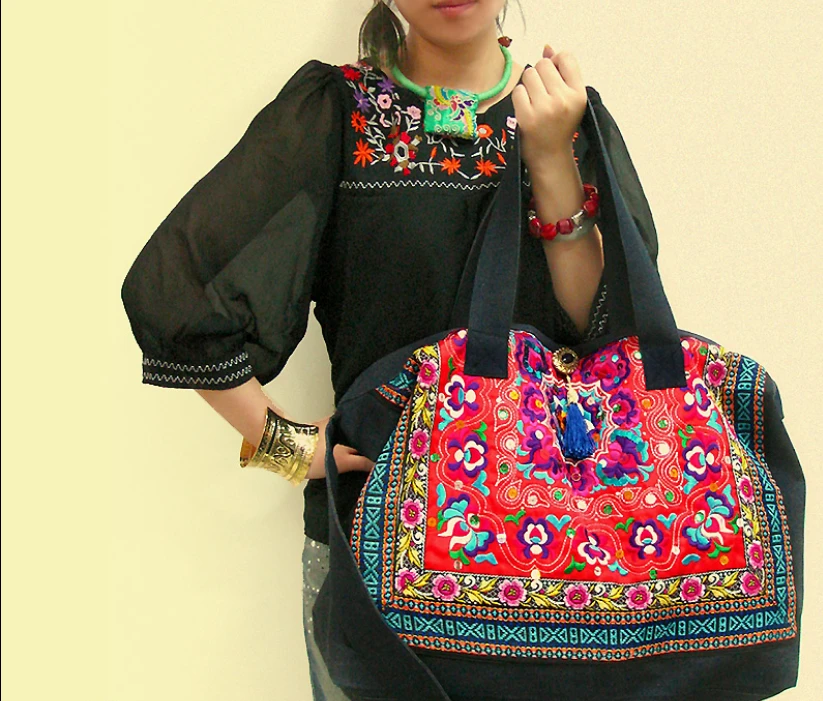
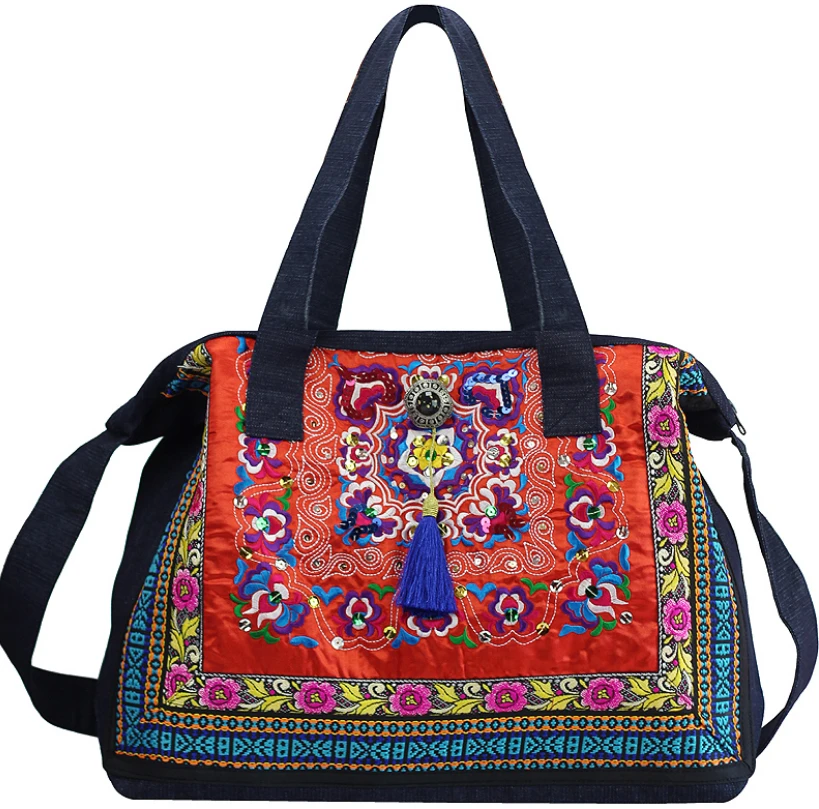
- At 30×46cm and 676g, this is one of the most generously proportioned everyday bags in its price category ($40.64), offering four organised interior zones for genuine carrying capacity.
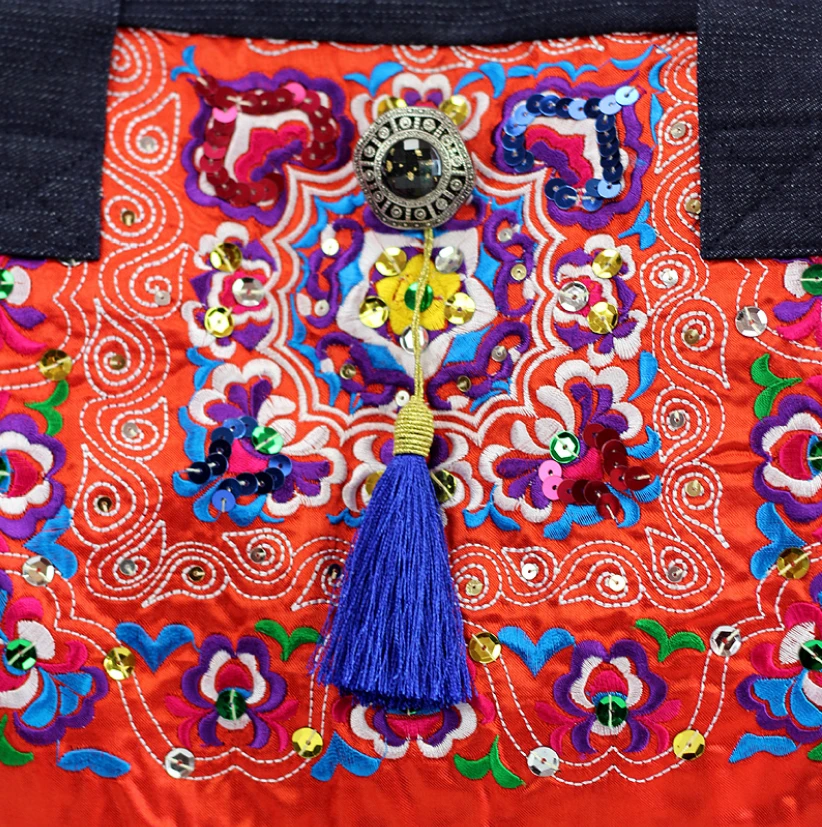
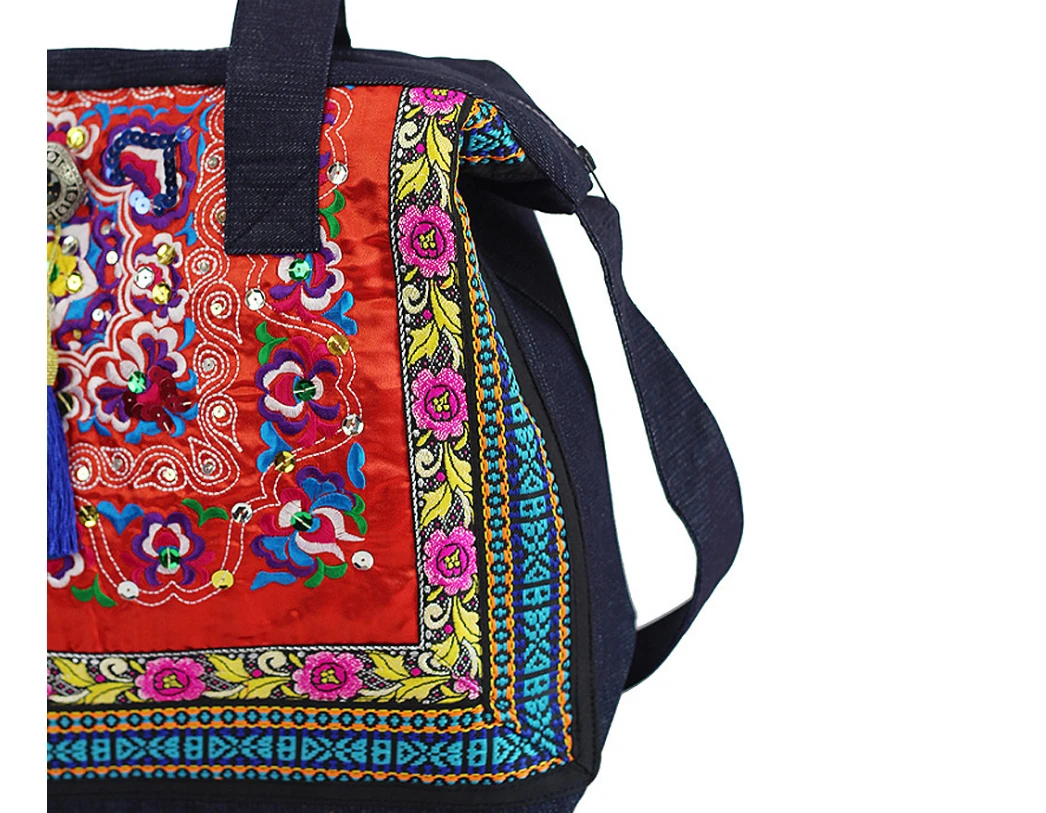
- The blazing red Miao embroidery on dark blue denim creates the highest contrast chromatic pairing in the fashion lexicon: the visual equivalent of a manifesto.
- One colour only: Red. One statement: total. Zero compromises.
The Miao People and the Embroidery That Outlasted Empires
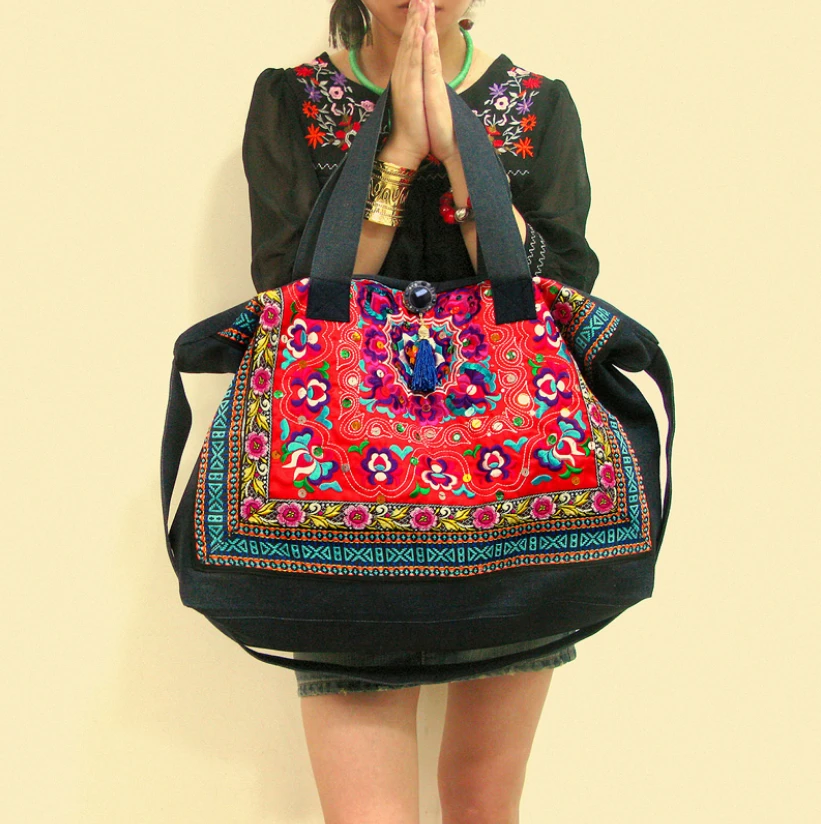
In the mountainous Guizhou province of southwestern China, the Miao (苗族) ethnic minority has practised one of the world's most technically demanding forms of embroidery for over two millennia. In 2026, UNESCO's Intangible Cultural Heritage documentation identifies Miao embroidery as a living practice with over 200 distinct regional variations — each carrying its own visual vocabulary, its own symbolic grammar, its own way of telling a community's history through thread.
Miao embroidery is not decoration. It is record-keeping. In a culture that historically lacked a written script, the embroidered surface of a garment or bag functioned as a portable archive: carrying cosmological maps, clan histories, agricultural cycles, and migration narratives in patterns that could be read by those who knew the language. A Miao woman's embroidery practice was, and remains, an act of cultural sovereignty.
When this embroidery lands on a dark blue denim shoulder bag priced at $40.64 and sold to European women aged 25–45, something remarkable happens. The archive becomes an accessory. The cultural sovereignty becomes personal sovereignty. The 2,000-year-old argument becomes your argument.
Why Denim Is the Perfect Ground for Cultural Embroidery
Denim arrived in its modern form in 1873, when Levi Strauss and Jacob Davis patented the riveted copper workwear trouser. By the 1950s, it had become the world's most democratic fabric — worn by miners, rock musicians, countercultural movements, and eventually by every person in every country on earth. In 2023, the Fashion History Museum estimated that over 4 billion individual denim garments are in active circulation globally.
Denim is democratic. It belongs to no class, no culture, no season. This is exactly what makes it the ideal ground for Miao embroidery. When embroidery that has historically signified a specific cultural sovereignty — the Miao's proud independence from the Han majority cultural structure — lands on the fabric most associated with universal democratic belonging, the result is not a contradiction. It is a resolution.
The dark blue of the denim in this bag is not arbitrary. It is indigo-adjacent: a colour with its own deep resonance in Chinese dyeing traditions, where indigo (靛) has been cultivated and used for textile dyeing for over 3,000 years. The Miao themselves have a rich indigo dyeing tradition. The denim is not a Western imposition on a Chinese object. It is a global echo of a very old chromatic commitment.
"The denim ground and the Miao embroidery are not in dialogue across cultural difference. They are two traditions that have independently arrived at the same conviction: that the most important things deserve to be worn."
The Architecture of Serious Carrying: 30×46cm and Four Interior Zones
Fashion bags are often designed to be looked at rather than used. This bag is designed for both, in precisely that order: it earns your attention first, then justifies it with genuine functional intelligence.
At 30×46cm, the bag's profile is that of a serious carry — not a weekend tote, not a going-out bag, but a daily companion with the spatial generosity to accommodate the full complexity of a contemporary European woman's day. The internal organisation reflects this understanding: a zipper pocket, a dedicated phone pocket, an ID bag for immediate-access documents, and a laminated zip pocket for items that need both security and easy retrieval.
This four-zone interior architecture is more sophisticated than bags at triple this price point. The design principle is clear: a bag this visually deliberate deserves to be equally deliberate about what it carries and how it carries it. The 676g empty weight reflects the structural integrity of the denim construction — this is not a bag that will sag or lose its form under load.
How to Style the Miao Embroidered Denim Bag in a European Wardrobe
The instinctive European reaction to a bag this visually committed — the blazing red embroidery, the deep denim substrate — is to build an outfit that "matches." Resist this instinct. The bag does not want to be matched. It wants to be met.
The Anti-Match Principle
Wear the bag with an entirely monochrome outfit. All-black — slim black trousers, a black turtleneck, black leather boots — and the Miao embroidery becomes the only source of colour in the composition. This is the maximum expression of the bag's visual intelligence: when everything else steps back, the red thread speaks at full volume. The result is not costume. It is editorial.
The Tonal Ground
Wear it with warm neutrals: a camel coat, an oat-coloured knit, dark wash straight-leg jeans. The dark denim of the bag connects to the trouser denim while the red embroidery lifts the warm neutrals above their natural ceiling. This is the more wearable daily formulation — sophisticated rather than statement-making, which is frequently the more interesting choice.
The Pattern Conversation
Pair with a subtle geometric or stripe print — a thin-striped Breton-style top, or a small-check overshirt in muted tones. The Miao embroidery's organic, hand-drawn quality sets against geometric pattern in a productive tension: neither dominates, and both become more legible in contrast. This works particularly well in Danish and Dutch fashion contexts, where pattern layering has a long and sophisticated tradition.
The Politics of Wearing Cultural Heritage
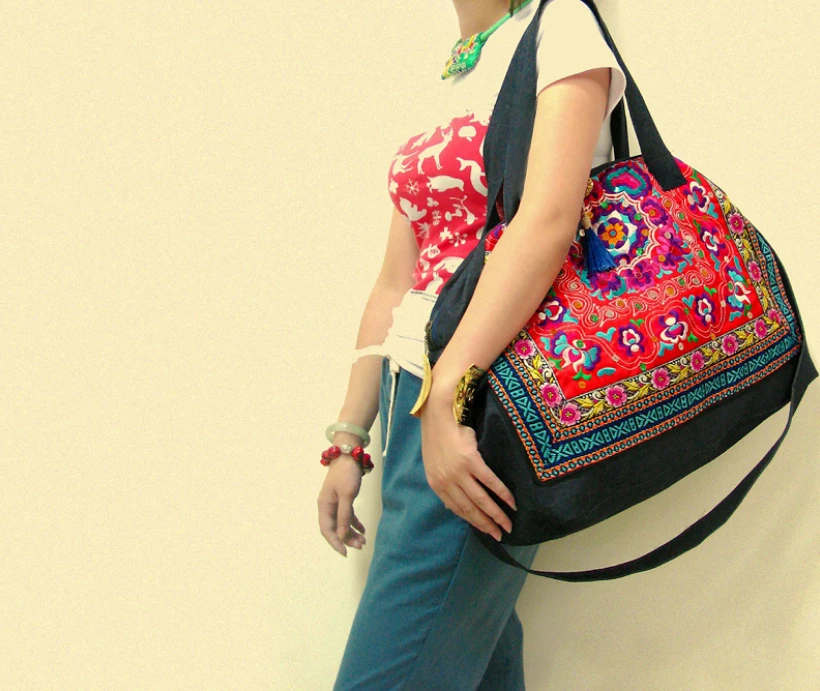
The question European fashion consumers increasingly ask — and correctly ask — is whether wearing objects from other cultural traditions constitutes appropriation or appreciation. It is a question worth taking seriously. With Miao embroidery, the answer is relatively legible.
The Miao people have an active, continuing embroidery practice. The women who embroider these bags are inheritors of a living tradition, not curators of a dead one. They are applying techniques passed through generations to objects that function in the global market — and in doing so, they are exercising exactly the kind of cultural agency that the UNESCO Intangible Heritage framework was designed to protect and promote.
Buying this bag is not appropriation. It is participation — in a cultural economy that benefits the communities whose heritage it carries, and in a global conversation about the value of sustained craft intelligence over disposable trend production. In 2026, when the fashion industry's relationship with cultural heritage is under more scrutiny than ever, buying intentionally is itself a form of political literacy.
Product Showcase
Frequently Asked Questions
The Miao embroidered denim shoulder bag asks you to carry more than your phone and your keys. It asks you to carry two millennia of sustained visual intelligence, a living craft tradition, and the most democratic fabric in the history of the world — all in one bag, all at once, all at $40.64.
That is a very good deal. For the bag, and for everyone who sees you carrying it. Shop the Miao Embroidered Denim Bag →
1. UNESCO Intangible Cultural Heritage — "Miao Embroidery Documentation 2006", retrieved 2026-10-27, https://ich.unesco.org
2. Fashion History Museum — "Denim: A Global History 2023", retrieved 2026-10-27, https://www.fashionhistory.org
3. Crafts Council — "Tactile Quality and Consumer Perception of Craft Objects 2024", retrieved 2026-10-27, https://www.craftscouncil.org.uk
4. UNESCO ICH — "Intangible Cultural Heritage of China: Overview", retrieved 2026-10-27, https://ich.unesco.org