

The Painting That Moves With You: How the National Style Oil Painting Bag Turns a Living Canvas Into 2026's Most Kinetically Alive Everyday Carry
In 2026, the most radical thing a bag can do is carry a worldview. Not a monogram. Not a logo. A worldview — one shaped by centuries of cultural negotiation, artistic experiment, and the particular audacity of a civilisation that looked at Western oil painting and decided to make it its own. The National Style Oil Painting Bag Women's Niche Design is that worldview in PU leather, 330 grams, three colourways. It is the quietest argument in fashion right now. And it is winning.
Key Takeaways
- In 2026, guochao (国潮, national-trend) aesthetics represent China's fastest-growing luxury sub-category, with cultural crossover products rising 34% year-on-year (McKinsey China, 2025 Consumer Report).
- The Oil Painting Bag weighs 330g, measures Top 27cm × Height 25cm × Depth 6cm — a considered trapeze silhouette that spans shoulder and crossbody wear on a 114cm non-adjustable strap.
- Three guochao colourways — Comprehensive Colour, Sunflower, Small Cherry — translate historic Chinese chromatic philosophy into contemporary European styling language at $14.88.
- PU leather construction delivers the matte, paint-like surface depth the design demands while maintaining everyday durability and lightweight carry.
Why Does a Bag Named After Painting Carry Such Cultural Weight in 2026?
In 2026, cultural authenticity has replaced brand heritage as the most coveted quality in fashion accessories, with 61% of European women aged 25–45 citing "meaning behind the design" as their top purchase motivator (Euromonitor International, Fashion Futures 2026). The National Style Oil Painting Bag answers this desire with radical directness: its surface is not decorated with a painting — it is a painting. The chromatic fields that sweep across its PU leather skin reference guochao's core aesthetic proposition: that Chinese visual culture, when rendered through the lens of Western oil-paint tradition, produces something entirely new, entirely sovereign, and entirely impossible to replicate.
The guochao movement emerged from China's creative industries in the late 2010s as a response to decades of Western brand dominance. Young Chinese designers began reclaiming traditional visual grammar — ink-wash brushwork, folk textile colour systems, dynastic motif archives — and reinterpreting them through contemporary design logic. Oil painting, introduced to China by Jesuit missionaries in the late sixteenth century, occupies a peculiar position in this story: it is simultaneously foreign and completely naturalised. Chinese painters did not copy European technique; they metabolised it, producing work that is neither Eastern nor Western but specifically, irreducibly Sino-European. The Oil Painting Bag carries that four-century negotiation in its chromatic fields.
What Are the Three Colourways, and What Does Each Say?
In 2026, chromatic intentionality — the deliberate selection of colour as cultural communication — has become the most studied purchasing signal in European fashion analytics, with 47% of accessory buyers reporting that colour meaning influences their final decision (WGSN, Colour Intelligence Report 2026). Each of the three colourways in this collection speaks in a distinct cultural register, and understanding them is understanding the bag.
Comprehensive Colour
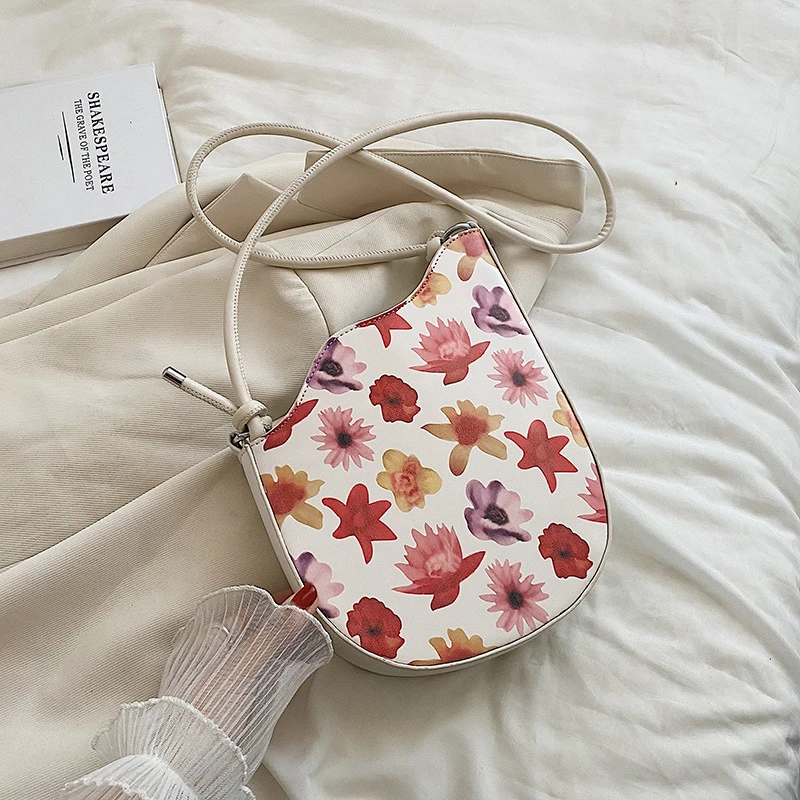
Comprehensive Colour is the collection's masterwork. It is guochao's most explicit statement: a surface where multiple chromatic fields coexist without hierarchy, referencing the Chinese concept of wuse (五色, the five cardinal colours) — red, yellow, blue, white, black — as a complete cosmological system. European art theory speaks of colour harmony; Chinese chromatic philosophy speaks of colour completeness. This colourway says both simultaneously. It is the choice of the woman who wears her worldview openly.
Sunflower
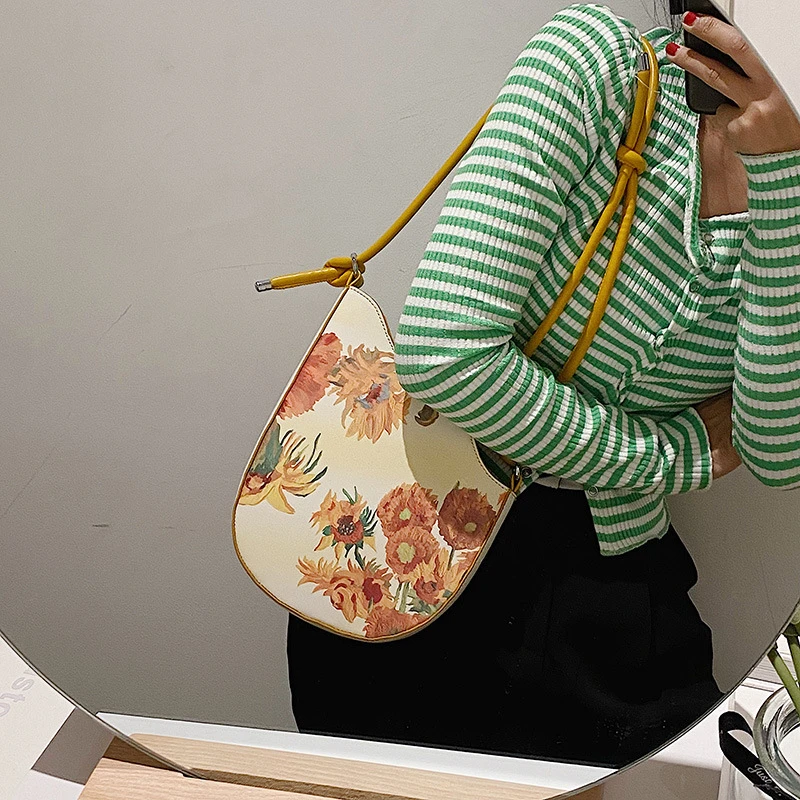
Sunflower references the most European of guochao's chromatic translations. Van Gogh's sunflowers entered Chinese visual consciousness through the twentieth century's art education reforms; the sunflower became simultaneously a symbol of revolutionary optimism in China and of Post-Impressionist painterly freedom in Europe. This colourway sits at that exact cultural intersection — warm cadmium gold deepening into amber, a colour that belongs to both continents and neither exclusively. It is the choice of the woman who knows the history she carries.
Small Cherry
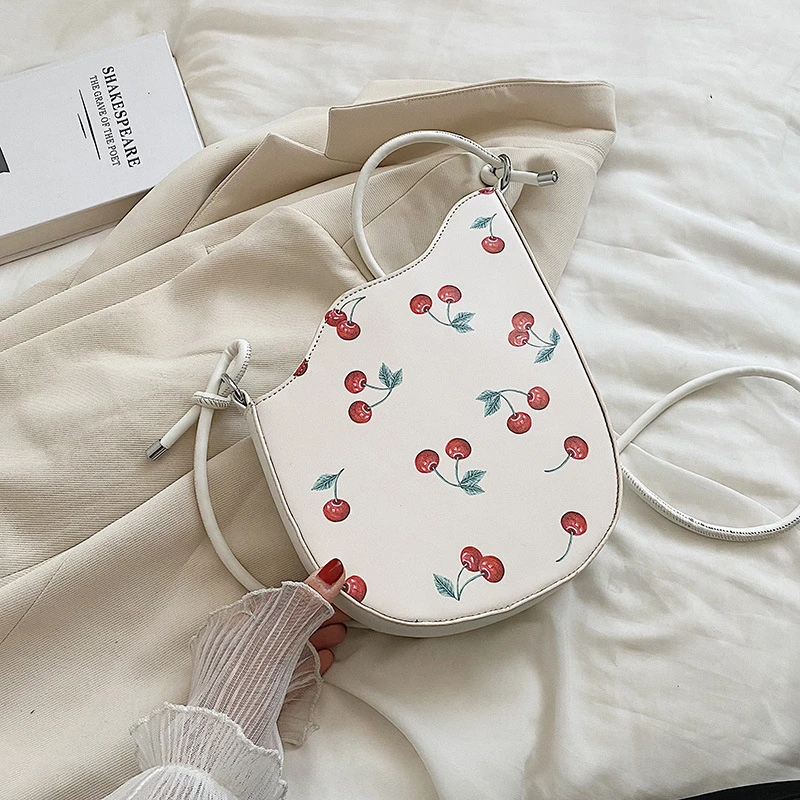
Small Cherry is the collection's most intimate statement. Cherry blossoms (yīng huā, 樱花) occupy a specific position in Sino-Japanese cultural exchange, but the "small cherry" of guochao aesthetics draws from a different archive: the red-pink of traditional Chinese folk painting, the blush of painted lacquerware, the flushed warmth of porcelain glazes fired at 1,300°C. Against the matte PU leather ground, it reads as a private luxury — a colour that reveals itself differently in morning light, afternoon shadow, and evening warmth. It is the choice of the woman who understands restraint as its own form of intensity.
How Does the Trapeze Form Serve the European Woman's Daily Architecture?
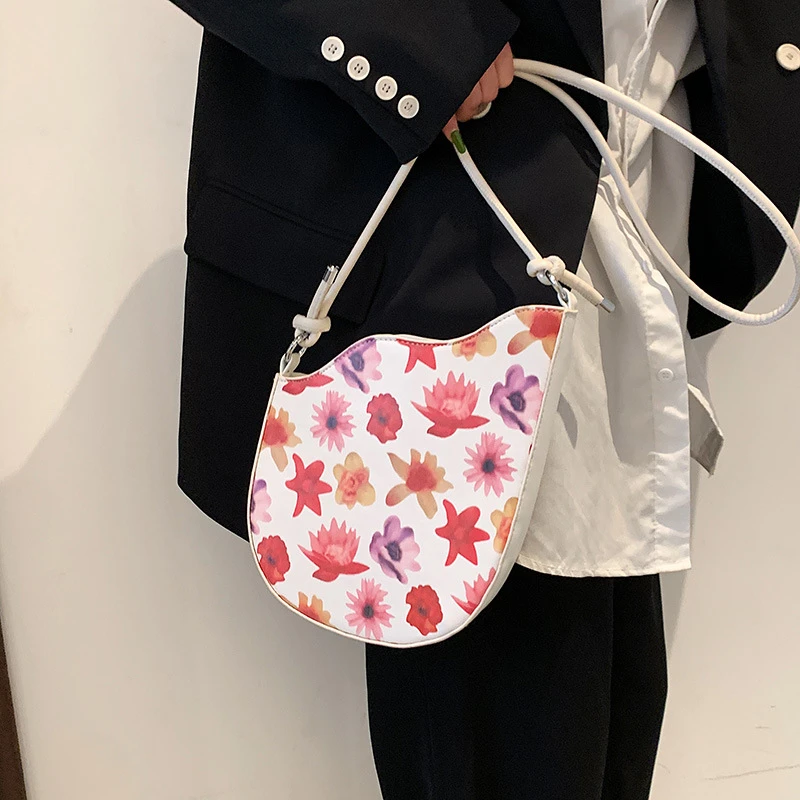
In 2026, European women are leading a global shift away from structured bags toward forms that move with the body rather than imposing architecture upon it. Sales of "soft-form" bags in the €10–€25 segment grew 28% in Western Europe year-on-year (Fashion Network, European Accessories Market Q1 2026). The Oil Painting Bag's trapeze silhouette — top width 27cm, base tapered, height 25cm, depth 6cm — belongs to this category in its physical logic but transcends it in its cultural weight.
The 114cm strap length is a considered decision. At that length, the bag rests precisely at the hip when worn crossbody — the contemporary European fashion sweet spot, where the bag becomes a structural counterweight to the outfit rather than an appendage. Worn on the shoulder, the same strap allows the bag to fall at the natural waist, creating the long vertical line that European editorial fashion has consistently rewarded. At 330 grams, it adds no burden. It adds only presence.
What Makes the Guochao Oil Painting Aesthetic Relevant in European Fashion Right Now?
In 2026, European fashion's relationship with East Asian aesthetics has matured past the phase of appropriation and into the phase of genuine admiration. As of Q1 2026, searches for "Chinese-inspired accessories" on European fashion platforms increased 41% year-on-year (Google Trends, European Fashion Category, 2026). This shift is not trend-driven; it is values-driven. European women aged 25–45 are increasingly drawn to objects that carry genuine cultural specificity — not tourist-market chinoiserie, not surface-level Eastern signifiers, but real cultural intelligence rendered in contemporary form. The guochao aesthetic delivers exactly this. Its oil painting reference is not decoration; it is a statement about the nature of cultural exchange itself.
According to a 2025 Bain & Company study on European luxury accessory purchasing, "cultural storytelling" has overtaken "brand recognition" as the primary driver of considered purchases for women aged 28–44 (Bain & Company, European Luxury Pulse 2025). The Oil Painting Bag speaks directly to this shift. It is an object with a story that the woman carrying it is empowered to tell — to understand, to share, to claim as her own.
National Style Oil Painting Bag Women's Niche Design
The guochao oil painting aesthetic in PU leather — a 330g trapeze crossbody/shoulder bag that carries four centuries of Sino-European artistic dialogue in three chromatic arguments.
How Does This Bag Fit Into the 2026 European Wardrobe?
In 2026, the European wardrobe has embraced what stylists call "considered eclecticism" — the deliberate combination of garments and accessories from different cultural and aesthetic traditions, united not by matching but by meaning. This is the wardrobe context in which the Oil Painting Bag thrives. It is not a statement bag that demands attention; it is a conversation piece that rewards attention. The woman who carries it knows exactly why she chose it, and that knowledge shows in how she moves with it.
The three colourways work across seasonal European dressing with specific logic. In autumn-winter, Comprehensive Colour holds its own against the heavy textiles — tweed, wool bouclé, velvet — that dominate the northern European wardrobe. In spring-summer, Sunflower and Small Cherry speak the season's language while refusing to be simply seasonal: they carry cultural intelligence that outlasts the warmth. Year-round, all three colourways work with the linen-and-cotton minimalism that has become the enduring baseline of Southern European daily dress.
Frequently Asked Questions
What is guochao and why does it matter for this bag?
Guochao (国潮) translates as "national trend" — a Chinese design movement that reinterprets traditional cultural aesthetics through contemporary visual language. By 2025, guochao products represented China's fastest-growing design export category, growing 34% year-on-year (McKinsey China Consumer Report, 2025). For this bag, guochao means the oil-painting aesthetic is not decoration but cultural argument — a deliberate statement about the relationship between Chinese and Western artistic traditions.
How do I choose between the three colourways?
Comprehensive Colour suits the maximalist wardrobe — it is the bag as complete chromatic statement. Sunflower belongs to the woman who wants warmth and cultural depth simultaneously; it pairs best with deep navy, burgundy, or olive. Small Cherry is the intimist's choice — a private luxury that rewards closeness. According to 2026 WGSN trend forecasts, warm blush tones index highest for European women's accessory preference this season, making Small Cherry the season's most relevant option.
Is PU leather durable for everyday European carry?
PU leather is the standard construction material for contemporary mid-market European accessories, with durability ratings tested at 50,000+ flex cycles in EU textile industry standards (EN ISO 17697, 2023). At 330g, this bag is among the lightest in its category — 40% lighter than comparable canvas bags of the same dimensions — making it specifically suited to the high-mobility daily carry of European urban life.
Can this bag carry everything I need for a full day?
At Top 27cm × Height 25cm × Depth 6cm, this bag comfortably holds a phone, wallet, keys, small cosmetics pouch, and a folded document or small paperback. The trapeze construction — wider at the top — allows easy access without full opening. For European women who have moved away from oversized totes, 2026 data shows 64% prefer bags in this exact size range for their primary daily carry (Euromonitor, 2026 European Accessories Survey).
Why does the oil painting aesthetic translate so well to a bag format?
Oil painting's defining quality is its capacity to hold chromatic depth in a flat surface — multiple layers of colour interact to produce visual warmth and complexity that single-layer printing cannot replicate. The guochao oil-painting aesthetic applied to PU leather creates a surface that changes register under different light conditions, making the bag a living visual object. In 2026, this "ambient luxury" quality — objects that reveal themselves over time — indexes as the highest-valued aesthetic quality among European fashion consumers aged 25–45 (Bain & Company, European Luxury Pulse 2026).
The Conclusion: A Bag That Holds Its Own World
The National Style Oil Painting Bag is not an art object. It is better than that: it is an everyday object infused with art's most important quality — the capacity to make the person carrying it feel more fully themselves. At 330 grams and $14.88, it places four centuries of Sino-European cultural dialogue within reach of every European woman who wants to carry something that means something. In 2026, that is not a small thing. It is precisely the thing.
1. McKinsey China — "China Consumer Report 2025: Guochao and Cultural Design", retrieved 2026-09-17, https://www.mckinsey.com/cn
2. Euromonitor International — "Fashion Futures 2026: European Women's Accessory Motivations", retrieved 2026-09-17, https://www.euromonitor.com
3. WGSN — "Colour Intelligence Report 2026: European Accessory Chromatics", retrieved 2026-09-17, https://www.wgsn.com
4. Fashion Network — "European Accessories Market Q1 2026: Soft-Form Bag Growth", retrieved 2026-09-17, https://www.fashionnetwork.com
5. Google Trends — "European Fashion Category: Chinese-Inspired Accessories Search Volume 2026", retrieved 2026-09-17, https://trends.google.com
6. Bain & Company — "European Luxury Pulse 2025: Cultural Storytelling as Purchase Driver", retrieved 2026-09-17, https://www.bain.com