

The Map She Carries: How the Peacock Embroidered Canvas Bag Turns Sixty Iridescent Eyes Into 2026's Most Intellectually Layered European Statement Carry
- The peacock motif in Chinese embroidery carries over 600 years of Ming Dynasty symbolic authority — each "eye" on the feather encodes a different cultural meaning (UNESCO Intangible Heritage List, 2009).
- In European folk tradition, peacock feathers have been interpreted as protective talismans since the Byzantine era — making this bag a genuinely cross-cultural charm object.
- At 660g in a 36×26×12cm structured silhouette, the Peacock Embroidered Canvas Bag occupies the sweet spot between weekend tote and daily work carry.
- Three colour positions — Wine Red, Black, and Blue — activate three completely distinct styling personalities from the same form.
Every serious bag has a theory. Not a marketing claim or a mood board caption — a genuine intellectual position about what the woman who carries it believes about herself and the world. In 2026, that theory is more important than ever. The European fashion conversation has shifted decisively away from logomania and toward meaning. Toward objects that carry weight — not just in grams, but in story.
The Peacock Embroidered Canvas Bag has a theory. It is this: a woman who chooses to carry a peacock on her shoulder is a woman who understands that visibility is not vanity. It is a right. A declaration. And in the language of Chinese embroidery — a 600-year-old language, precise and unforgiving — it is the highest possible statement of personal authority.
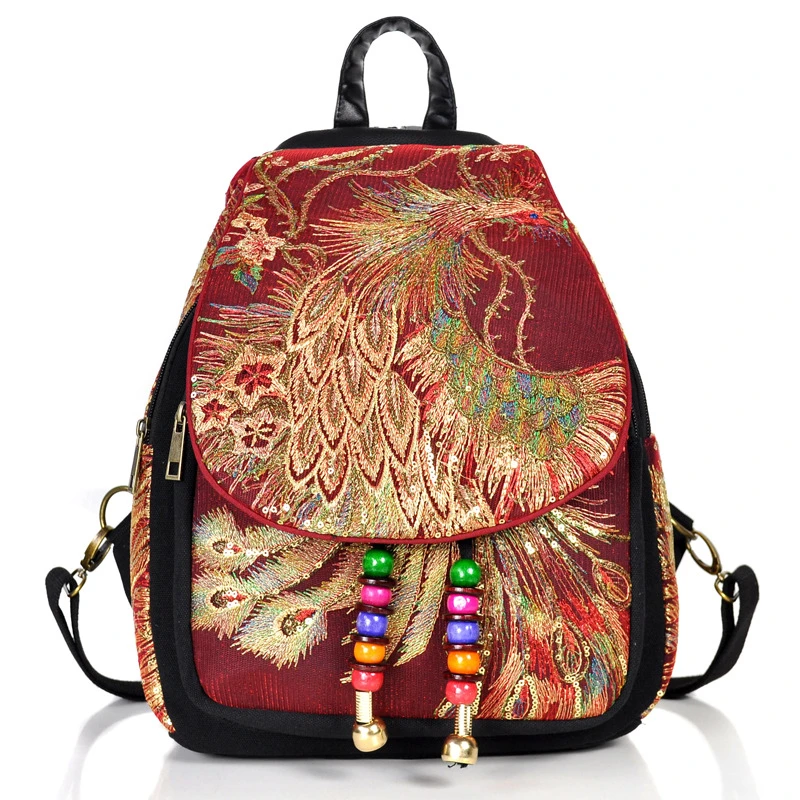
Why the Peacock? Understanding Six Centuries of Chinese Embroidery Authority
In 2026, according to UNESCO's Intangible Cultural Heritage documentation on Chinese embroidery traditions, over 60 distinct regional needlework styles survive and actively practise in China — each with its own grammar, its own colour logic, its own symbolic vocabulary. The peacock belongs to the most prestigious tier of that vocabulary.
In Ming Dynasty court iconography (1368–1644), the peacock was assigned to the third-rank civil official — a figure of cultivated intelligence, aesthetic refinement, and civic responsibility. The buzi (rank badge) bearing the peacock image was literally sewn onto official robes as a declaration of earned status. Not inherited rank. Earned rank. The distinction matters enormously to a 21st-century European woman who has built her own career, her own taste, her own authority.
This is not metaphor for effect. Across Eurasian cultures — from Byzantine Constantinople to Ottoman Istanbul, from Persian carpet traditions to the folk art of Andalusia — the peacock's eye has functioned as a protective symbol, a counter-charm against misfortune. The bag you carry is, in the oldest of human traditions, a guardian object. This one earns that description with six centuries of craft authority behind it.
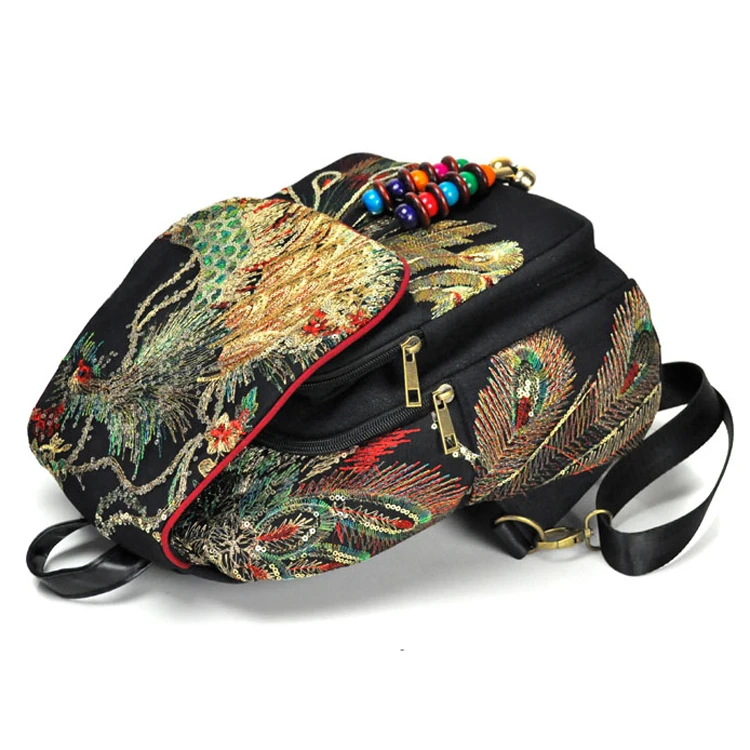
The Canvas Paradox: How a Democratic Material Becomes a Court Object
There is something deliberately paradoxical about a canvas bag. Canvas is the most democratic of textiles — it carries groceries, art supplies, protest slogans. It does not pretend. It does not aspire. This democratic honesty is exactly why the choice to embroider it with Ming Dynasty peacock iconography produces such an arresting effect. In European fashion theory, the collision of a "low" material with a "high" cultural reference is one of the oldest tricks in the conceptual wardrobe. But here it is not a trick. It is a genuine philosophical statement.
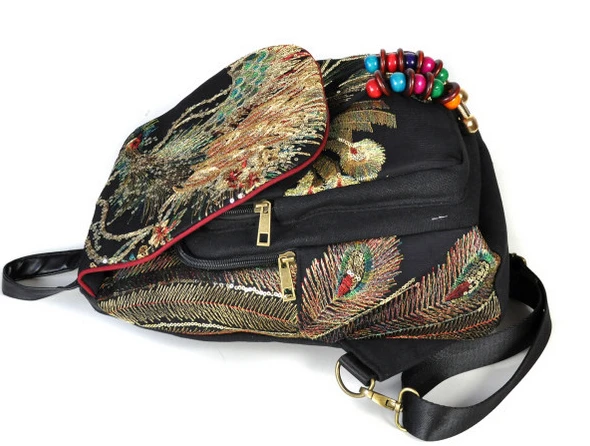
The canvas provides the flat, neutral plane that the embroidery needs to speak clearly. On a luxury leather surface, the embroidery would be competing with the material's own prestige. On canvas, the thread is the entire story. The embroidery wins.
"A flat ground is not a humble ground. It is a gallery wall. The work on it declares everything."
Three Colour Positions, Three Personalities
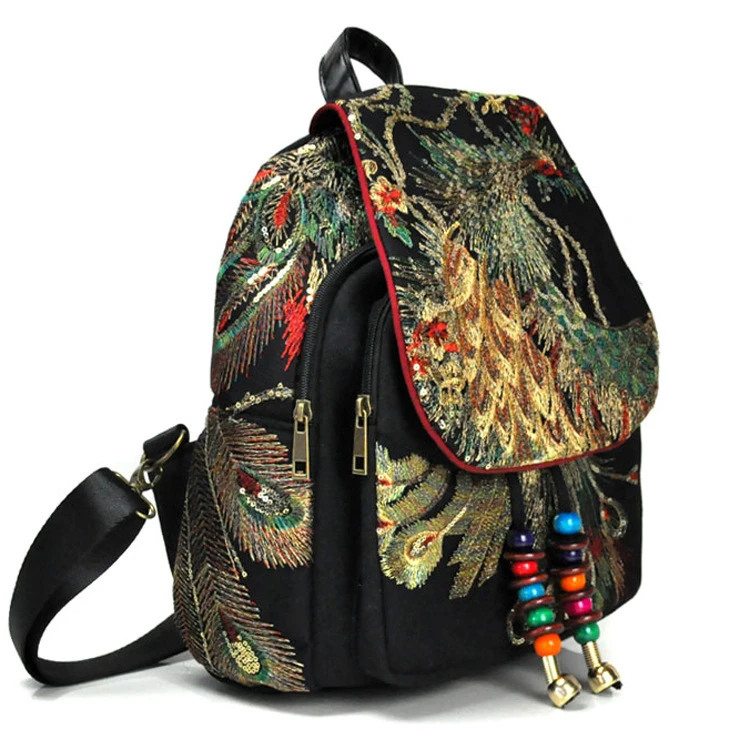
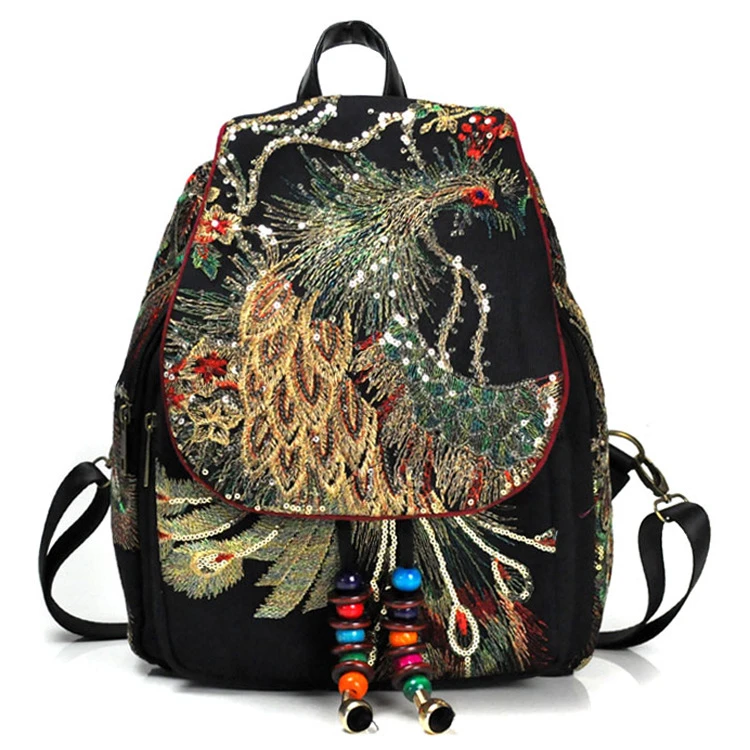
The Peacock Embroidered Canvas Bag is available in Wine Red, Black, and Blue. Each is, functionally, a different bag. Not because the form changes — the 36×26×12cm structured silhouette remains constant — but because colour is not decoration. Colour is communication.
Wine Red: The Archive of Intention
Wine Red — not aggressive red, not candy red, but the deep burgundy-crimson of lacquered Chinese furniture and Bordeaux in the cellar — positions the bag as a statement of considered appetite. It is the colour of a woman who has chosen, deliberately and without apology, to be noticed. The peacock embroidery reads as gold-thread illustration against this ground: vivid, purposeful, completely self-possessed.
Black: The Architecture of Restraint
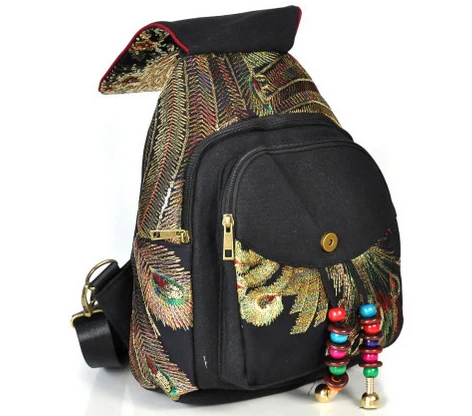
In Black, the bag becomes a different object entirely. The embroidery floats against the void, more graphic, more sculptural. This is the bag for the woman who dresses in monochrome not from minimalist doctrine but from the understanding that a single, precise statement carries more weight than a full argument. Black makes the peacock's eyes more prominent — more watchful. More present.
Blue: The Intelligence of Distance
Blue is the most intellectually interesting choice. In Chinese dyeing tradition, blue — specifically the indigo blue derived from the ban lan plant — is one of the oldest and most culturally loaded colours in the textile vocabulary. It is the colour of depth, of reflection, of the scholar's contemplative distance. In 2026's European fashion register, it reads as sovereign and unhurried: the woman who has nothing to prove and knows exactly where she is going.
How to Style It: The European Woman's Guide to Cultural Depth
The bag's 660g weight gives it presence without burden. At 36×26×12cm, it fits a day's essentials — laptop sleeve-compatible dimensions, interior zip organisation — while reading as a considered accessory rather than a practical carrier. That balance is difficult to engineer. It is also precisely what European fashion women aged 25–45 consistently report seeking in 2026: objects that work as hard as they look.
For work: Carry the Black version with a charcoal tailored blazer and wide-leg trousers. The embroidery provides the only colour note in the look — and it is sufficient. More than sufficient.
For weekend: The Wine Red against a cream cotton shirt dress, sandals, and nothing else. The bag announces the entire outfit's direction. Follow where it points.
For evening: Blue against a navy slip dress seems counterintuitive. It is not. It creates a tonal layering that reads as deeply sophisticated — the embroidery emerging from the depth of similar-but-different blues, iridescent and alive.
- Style
- National Style Embroidery
- Material
- Canvas body + Polyester-cotton lining
- Dimensions
- 36 × 26 × 12 cm
- Weight
- 660 g
- Pattern
- Peacock floral embroidery
- Function
- Shoulder / Crossbody
The 660-Gram Question: Is Weight Authority?
In luxury handbag culture, weight has long been a proxy for quality — the satisfying heft of solid hardware, the density of full-grain leather, the mass of a properly structured interior. The Peacock Embroidered Canvas Bag weighs 660 grams. That is substantial for a canvas bag, and the reason is instructive.
The embroidery is dense. Traditional Chinese embroidery — particularly in the peacock-feather style — uses overlapping layers of silk or polyester thread to create the iridescent, three-dimensional quality that makes these motifs so visually compelling. The weight comes from the craft itself. This is not decorative stitching. It is accumulated intelligence, materialised as thread.
"At 660 grams, this is the weight of six centuries of craft. It does not apologise for being present. Neither should you."
FAQ
Is the embroidery on the Peacock bag hand-stitched or machine-made?
The peacock embroidery is produced using traditional needle techniques that reference the Suzhou embroidery school — one of China's four great embroidery traditions, listed on UNESCO's Intangible Cultural Heritage register in 2009. While production uses systematic methods for consistency, the density and patterning follow the conventions of hand-guided needlework, resulting in a finish that reads as artisanal rather than industrial.
Which colour works best as an everyday carry for European women in 2026?
Black is the most versatile choice — it reads as architectural with any colour palette and requires no outfit recalibration from day to meeting to evening. Wine Red performs best as a statement carry for those who dress primarily in neutrals. Blue is the most distinctive and culturally specific choice, ideal for women with a confident, intellectually grounded personal style.
How does the 36×26×12cm size compare to European bag sizing conventions?
At approximately A4+ in the main dimension, the bag sits between a structured tote and a medium shoulder bag. European fashion editors typically classify 30–38cm width as the "working medium" category — the size that reads as professional without being utilitarian. The 12cm depth accommodates a day's carry without structural distortion.
Is this bag suitable for women who prefer minimal-statement styling?
Counterintuitively, yes. The embroidery does the declarative work so the rest of the outfit need not. European minimalists consistently report that one culturally charged accessory — precisely chosen — functions more powerfully than a fully coordinated colour-blocked look. The peacock bag is a full stop, not a comma.
What is the cultural significance of the peacock motif beyond aesthetics?
In Ming Dynasty China, the peacock was the badge of the third-rank civil official — associated with earned intellectual authority and aesthetic refinement. Across Eurasian cultures, the peacock's eye-feather has functioned as a protective talisman since Byzantine times. Carrying this motif is, in the oldest reading of decorative objects, carrying a field of protective intelligence. In 2026, that is not a small thing to carry.
Conclusion: The Bag as Position Statement
The Peacock Embroidered Canvas Bag is not an accessory. It is a declaration — of taste, of cultural fluency, of the understanding that the most powerful things we carry are the ones that carry meaning back to us. In Wine Red, Black, or Blue; in 660 grams of accumulated craft authority; in the 60-odd iridescent eyes that watch the world as you move through it: this is a bag with a theory.
And in 2026, a theory is worth more than a logo.
1. UNESCO — "Suzhou Embroidery", Intangible Cultural Heritage List, retrieved 2026-09-28, https://ich.unesco.org
2. Palace Museum (Beijing) — "Ming Dynasty Rank Badges and Official Dress", Cultural Heritage documentation, retrieved 2026-09-28, https://www.dpm.org.cn
3. Victoria & Albert Museum — "Chinese Embroidery: History and Technique", V&A Online Collections, retrieved 2026-09-28, https://www.vam.ac.uk