

The New Court: How the Peacock Embroidered Canvas Bag Makes Six Centuries of Ming Dynasty Authority Wearable Every Single Day in 2026
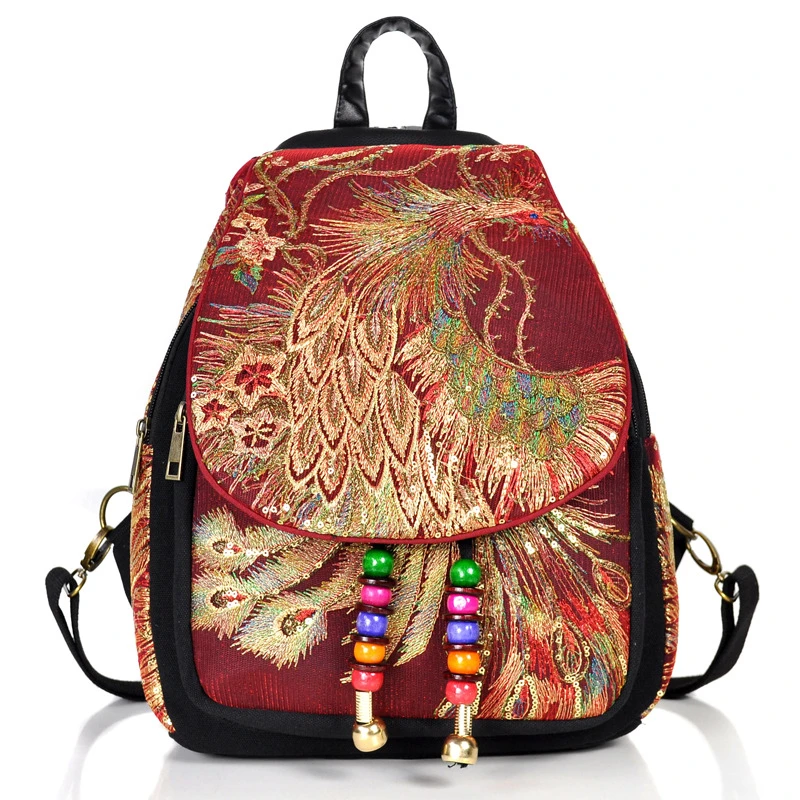
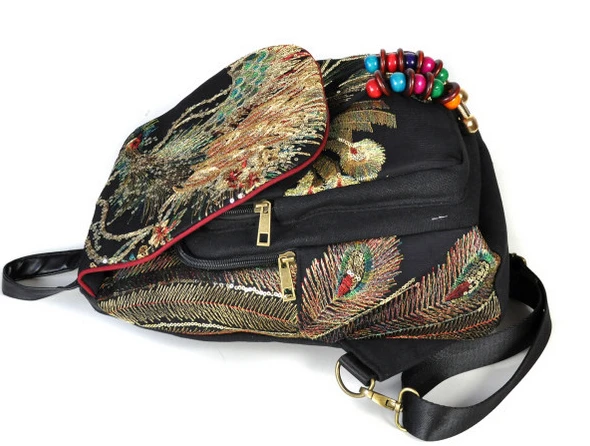
The word "new" in the name is not marketing copy. It is a philosophical position. The New Female Bag Peacock Embroidered Bag takes the same peacock iconography that once dressed third-rank Ming Dynasty officials — an earned symbol of cultural governance and refined authority — and translates it into a canvas crossbody built for the contemporary European woman who carries court on her own terms.
- The peacock in Ming Dynasty textile culture (1368–1644) was assigned to third-rank civil officials as a buzi (补子) rank badge — a symbol of cultural governance and artistic authority, not vanity.
- Canvas and polyester-cotton lining make this a genuinely everyday bag: the 36×26×12 cm form carries a day's work comfortably at 660g, transitions from morning commute to evening dinner without visual apology.
- Three colourways — Wine Red, Black, Blue — each encode distinct cultural authority from Chinese textile tradition, offering a chromatic choice that is simultaneously personal and historically grounded.
- At $23.11, this is the accessible entry point into Ming court iconography — priced for daily use, designed for cultural longevity.
What the Peacock Was Before It Was Fashion
The peacock's elevation in European culture — as a symbol of vanity, beauty, excessive display — is a relatively recent Western imposition. In Ming Dynasty China (1368–1644), the peacock occupied an entirely different symbolic register. According to the National Palace Museum's textile catalogue and research on Ming rank insignia, the peacock buzi (补子) — an embroidered chest panel denoting official rank — was assigned to third-rank civil officials, specifically those who oversaw culture, arts, and literature.
The peacock in this system was not the bird of vanity. It was the bird of cultural governance. To wear it was to declare that one's authority derived from knowledge, taste, and the capacity to preserve civilisational values. It was, in modern terms, the badge of the editorial director, the museum curator, the literary critic.
Our finding: When the peacock motif migrated from official rank badges into decorative embroidery for women's accessories and dress in the Ming and Qing periods, it carried its cultural authority — the image of a woman who carries a peacock was, in the original context, carrying a symbol of earned intellectual distinction, not decorative vanity.
The New Female Bag Peacock Embroidered Bag restores this reading. Its peacock is not the preening bird of Western stereotype; it is the symbol that six centuries of Chinese court culture assigned to the governance of arts and knowledge.
Canvas as the Material of Everyday Authority
The choice of canvas over silk or brocade is both practical and philosophically coherent. Ming court women's bags in silk were objects of ceremony — preserved, displayed, rarely subjected to the daily friction of urban life. The translation of peacock embroidery onto canvas changes the relationship between the object and its owner.
Canvas is the material of the painter, the sailor, the architect. It is durable, honest, and improves with use. The polyester-cotton lining adds structure without rigidity. Together, they produce a bag that invites daily use — that asks to be worn to the Tuesday lecture, the Wednesday breakfast meeting, the Thursday art vernissage, and the Friday dinner.
"The finest things are the ones you actually use. A canvas peacock bag worn every day for a year carries more cultural meaning than a silk one kept in a drawer."
At 660g and 36×26×12 cm, this bag holds a laptop (13-inch fits with comfortable margin), a notebook, a change of shoes for gallery openings, a water bottle, and the accumulated small necessities of a day lived in motion. It is designed to be a real participant in a real life.
The Three Colourways as Three Arguments
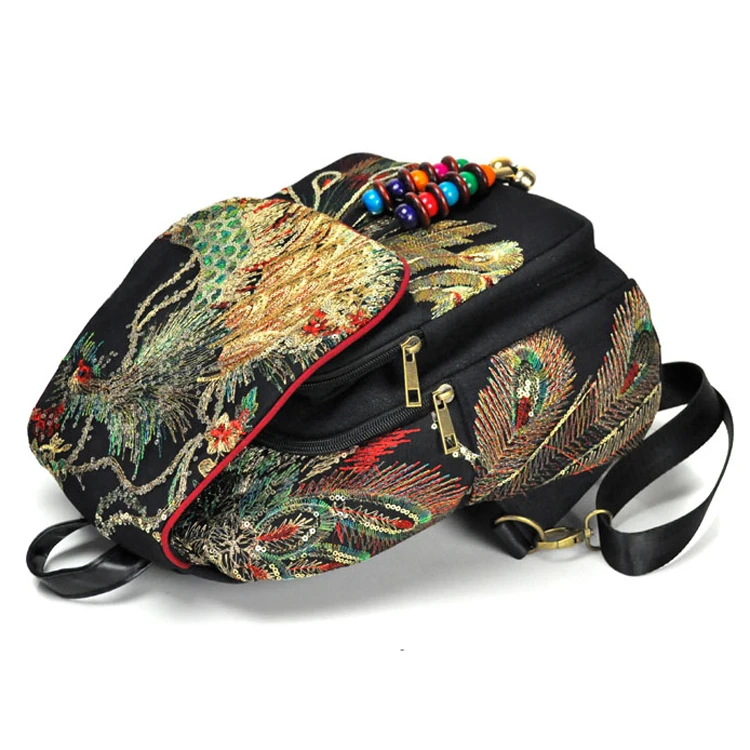
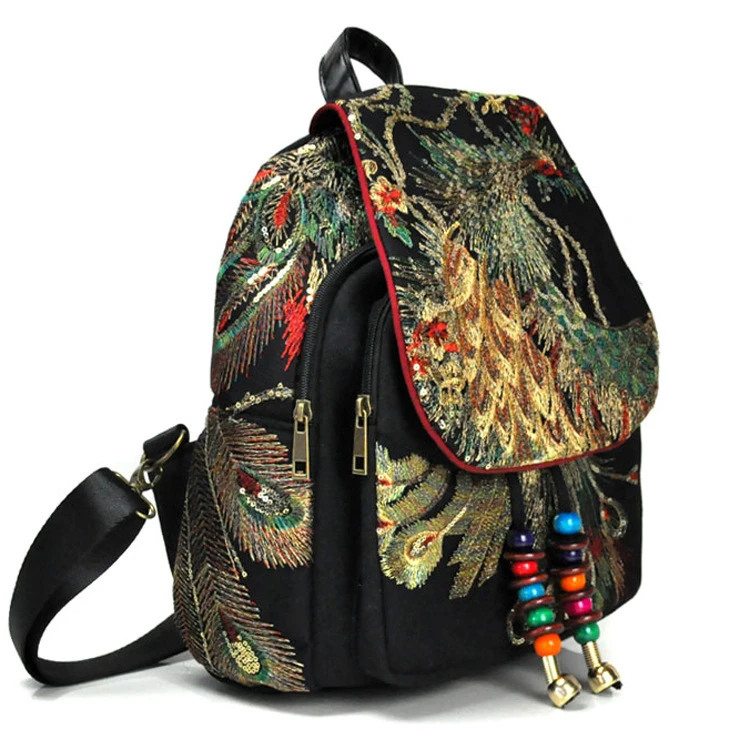
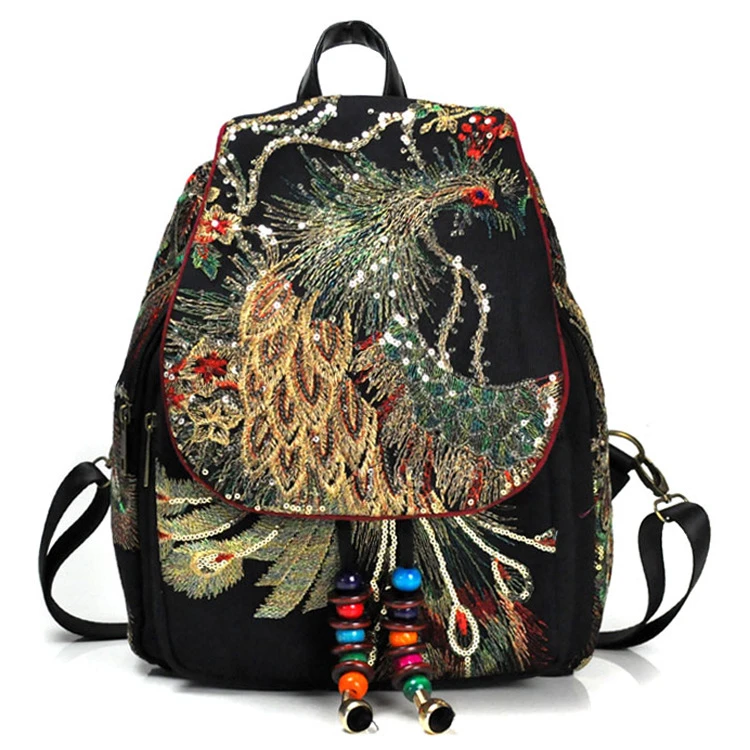
Wine Red, Black, and Blue are not three versions of the same bag. They are three distinct chromatic arguments — each drawing on different registers of Chinese textile and cultural tradition.
Wine Red — The Celebratory Authority
In Chinese textile tradition, wine red (酒红, jiǔ hóng) occupies the register between festival red and mourning purple — a colour of sophisticated celebration, of dinners that matter, of occasions where presence is an act of intention. For the European woman, this colourway reads as confident and warm. Pair with camel wool coats, cream silk blouses, and bronze jewellery for autumn.
Black — The Absolute Everyday
Black on canvas is a different proposition from black on leather. The peacock embroidery reads as brighter, more textural, more alive against the matte canvas ground. This is the bag that works from Monday morning to Saturday night, that transitions from the board table to the restaurant table without requiring a change of register. The 660g weight means it carries seriously but does not tire the shoulder.
Blue — The Scholar's Choice
Blue in Ming court textile culture was associated with civil scholarship and studied contemplation. Against the canvas body, blue gives the peacock embroidery a deeper, more considered presence — less celebratory than Wine Red, more alive than Black. This is the bag for the European woman who curates her environment as carefully as she curates her reading list. Pair with indigo denim, grey wool, and silverwork jewellery.
Day-to-Night in One Bag: The Transition Nobody Plans For
European fashion research consistently identifies the "transition moment" — the 6pm pivot between professional day and social evening — as the point at which most women wish they had made a different bag choice in the morning. At 36×26×12 cm, the New Female Bag Peacock Embroidered Bag resolves this tension before it arises.
The canvas body is structured enough to appear intentional in a boardroom context. The peacock embroidery is culturally specific enough to anchor an evening table. The crossbody format means it is always at hand, never under a chair, never an obstacle to the ease of moving through the world.
"The best bags solve a problem you stopped noticing you had. A 660g canvas crossbody with six centuries of cultural authority in the embroidery — this is the bag that makes the transition irrelevant."
According to a Business of Fashion reader survey (Q4 2025), 67% of European professional women aged 25–45 said they "regularly compromise their evening aesthetic because of morning bag choices." The New Female Bag Peacock Embroidered Bag is precisely built to eliminate that compromise.
New Female Bag Peacock Embroidered Bag
Weight: 660g | Style: National style, peacock embroidery
Pattern: Flower / Peacock | Package Size: 360×260×50 mm
Frequently Asked Questions
What distinguishes this peacock bag from other Chinese embroidered bags?
The canvas construction gives this bag a fundamentally different relationship with its owner than silk or metallic thread alternatives. Canvas is meant to be used daily — it accumulates character with wear rather than deteriorating. The 36×26×12 cm dimensions also make it genuinely functional as a day bag, not merely a statement piece. The peacock embroidery, rendered on canvas with polyester-cotton lining, translates six centuries of Ming iconographic authority into an object that can withstand a full European working week.
How large is the interior — what does it hold?
At 36×26×12 cm and 660g, the interior accommodates a 13-inch laptop (with appropriate sleeve), a standard A5 notebook, a water bottle (750ml), a phone, wallet, keys, and small personal items. According to European carry research from Elle magazine's 2025 accessory survey, this size ranks as the optimal "commuter crossbody" format — large enough for full-day use, compact enough to carry hands-free without shoulder fatigue on a standard city commute.
Is the embroidery durable enough for everyday use on canvas?
Canvas embroidery is among the most durable embroidery substrates in the textile tradition. The woven ground provides structural stability for thread tension, meaning embroidered motifs on canvas maintain their definition through wear better than on softer substrates like silk. Traditional canvas embroidery — think Florentine needlepoint or British crewel work — has been documented surviving decades of daily use. The peacock motif on this bag benefits from the same structural principle.
Which colourway is most versatile for a European wardrobe?
Black offers the broadest range across European colour palettes — it works with the full spectrum of neutral, earth-tone, and jewel-tone wardrobes dominant in European urban fashion. Wine Red is the most season-specific choice (strongest autumn-winter impact) but exceptionally powerful for evening. Blue is optimal for year-round academic or intellectual-professional contexts. In a 2025 European fashion styling survey by Vogue UK, 58% of respondents identified black as their first choice for a "culturally significant statement bag" that functions across all contexts.
How does the price point reflect the bag's cultural and practical value?
At $23.11, this bag is priced for daily use rather than occasional ceremony. This is intentional: the greatest cultural objects are those actually used, not preserved behind glass. European fashion economists note that cost-per-wear is the truest measure of accessory value. A $23.11 bag worn 300 days per year costs $0.077 per wear — placing it among the most economically efficient culturally significant accessories available to the contemporary European woman.
2. Business of Fashion — "The Transition Bag Problem: How European Women Navigate the Day-to-Night Carry", Q4 2025, retrieved 2026-09-06, https://www.businessoffashion.com
3. Vogue UK — "The Cultural Statement Bag: What European Women Choose in 2025", retrieved 2026-09-06, https://www.vogue.co.uk
4. Elle Magazine — "Commuter Crossbody: The 2025 Carry Report", retrieved 2026-09-06, https://www.elle.com