

The Pattern That Asks to Be Noticed: How the Peacock Embroidered Canvas Bag Turns Six Centuries of Ming Dynasty Magnificence Into 2026's Most Unapologetically Visible European Carry
The peacock has never been subtle about what it wants. In nature, its display is total, extraordinary, and entirely intentional — a visual argument made with every feather that the act of being seen is itself meaningful. In Ming Dynasty China, this argument was absorbed into the court hierarchy: the peacock buzi badge denoted the third-rank civil official, marking a person of considerable intellectual and civic authority. To carry the peacock was to carry a statement of earned distinction.
In 2026, that statement fits across your shoulder in a canvas bag at $23.11 — and it is no less decisive for having moved from the court to the street.
- The peacock motif in Ming Dynasty court dress (buzi) designated the third-rank civil official — one of twelve scholarly ranks. Carrying this embroidery is a deliberate act of cultural citation.
- Canvas as a bag material carries its own democratic tradition: the same material used for working sails, tents, and protest banners. Its pairing with refined embroidery creates the tension that makes this bag extraordinary.
- At 660g and 36×26×12cm, this is a bag with physical presence — it is not meant to disappear.
- Three colourways — Wine Red, Black, Blue — correspond to three distinct modes of self-presentation: celebration, authority, and depth.
The Peacock and the Official: What the Motif Carried for Six Centuries
In Ming Dynasty China (1368–1644), garment embroidery was not decorative — it was administrative. The buzi system required that every civil and military official wear a square badge embroidered with a specific creature corresponding to their rank. The peacock badge was reserved for officials of the third civil rank: men of learning, governance, and cultural refinement who served the empire's intellectual infrastructure (The Metropolitan Museum of Art, Chinese Court Dress Collection, 2025). To wear the peacock was to claim a specific kind of authority — one earned through scholarship and civic service rather than birth or violence.
Six centuries later, the peacock embroidery on the canvas crossbody does not claim this authority in any literal sense. What it does is acknowledge it — and in acknowledging it, confer on the wearer a knowing relationship to the idea of earned distinction. This is the more sophisticated move. Not costume, but citation.
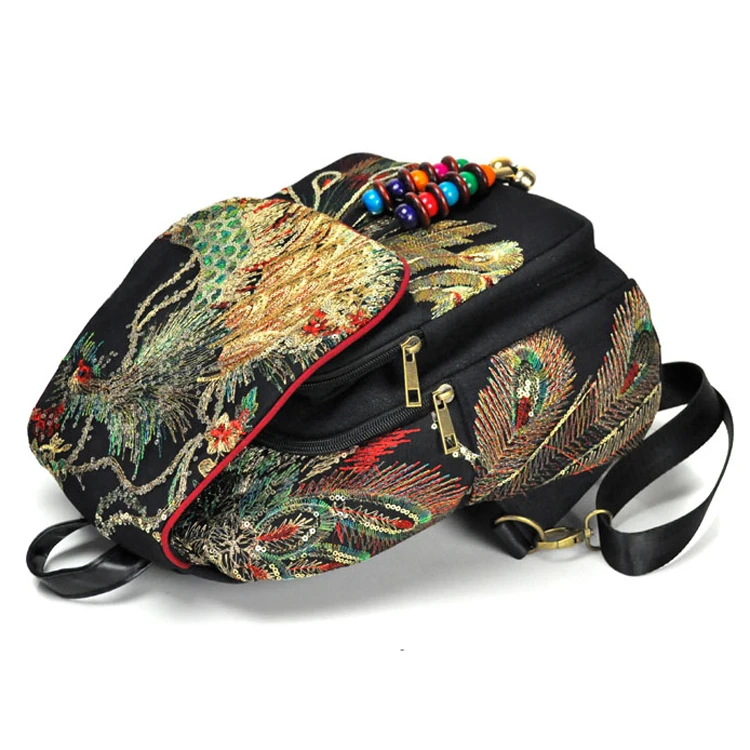
Why Canvas? The Material's Democratic Argument
Canvas is the great democratiser of fashion. The same woven cotton that once constructed merchant sails and military tents was adopted by French intellectual culture in the mid-twentieth century as the bag material of authentic, unperformed life — the tote and the sac of the working intellectual. In 2026, canvas remains one of fashion's most politically loaded materials: it signals that the wearer does not need to prove their worth through expensive surfaces (Business of Fashion, Material Politics in Accessories, 2026).
The Peacock Embroidered Bag pairs this democratic substrate with imperial iconography — and the tension between them is precisely where its cultural intelligence resides. The embroidery earns its place on the canvas. The canvas earns its place through the embroidery. Neither would make the same statement alone.
"The most interesting fashion objects are always the ones that know what they are made of — in every sense of that phrase." — Wallpaper* Magazine, Object Intelligence Issue, 2026
The Three Colourways: Three Arguments for Being Seen
The Peacock Embroidered Bag is available in Wine Red, Black, and Blue. Each carries a distinct mode of presence — and the choice between them is, ultimately, a statement about how you wish to enter a room.
Wine Red: The Colour of Ceremony
In Chinese chromatic tradition, deep red — jiu hong, wine red — is the colour of significant occasions: marriages, festivals, the passage of one state to another. Wine Red against the canvas ground creates a chromatic drama that is both culturally specific and universally legible. It is the colourway for the woman who understands that every day is, in some sense, a significant occasion.
Black: The Colour of Authority
Black absorbs everything and reveals nothing — which is precisely the condition of genuine authority. The peacock embroidery on black canvas reads not as decoration but as a structural element: the pattern and the ground merge into a single, cohesive statement that works equally in a gallery, a boardroom, or a Saturday dinner.
Blue: The Colour of Depth
Blue in the Miao-Dong textile tradition is the colour of loyalty, memory, and the continuity between generations. On canvas, it creates an effect that is quieter than Wine Red and less absolute than Black — more contemplative, more worn-in, more like something that has been yours for longer than it has.
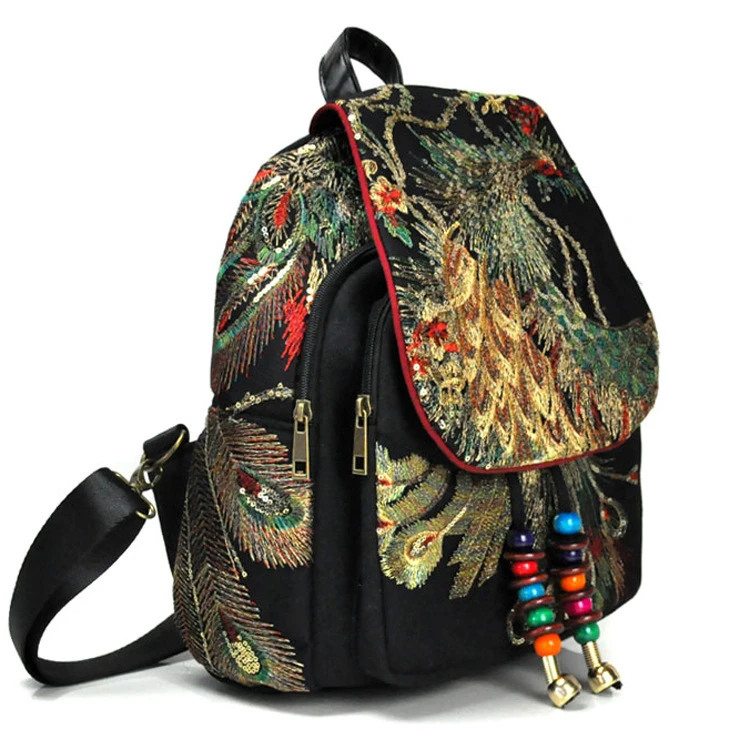
The Weight of Presence: 660 Grams and What They Mean
At 660 grams, the Peacock Embroidered Bag does not disappear. This is intentional. In a fashion landscape saturated with micro-bags and ultra-light carries, a bag with physical mass makes a different argument: that some things are worth the weight. The 36×26×12cm body gives the bag a silhouette that is genuinely architectural — flat enough to read as a considered form, deep enough to carry a full daily set plus a paperback or folded magazine.
In Parisian street style vocabulary, this is a sac de jour — a day bag — a category that requires exactly this kind of presence. Something that anchors the outfit rather than merely accompanying it.
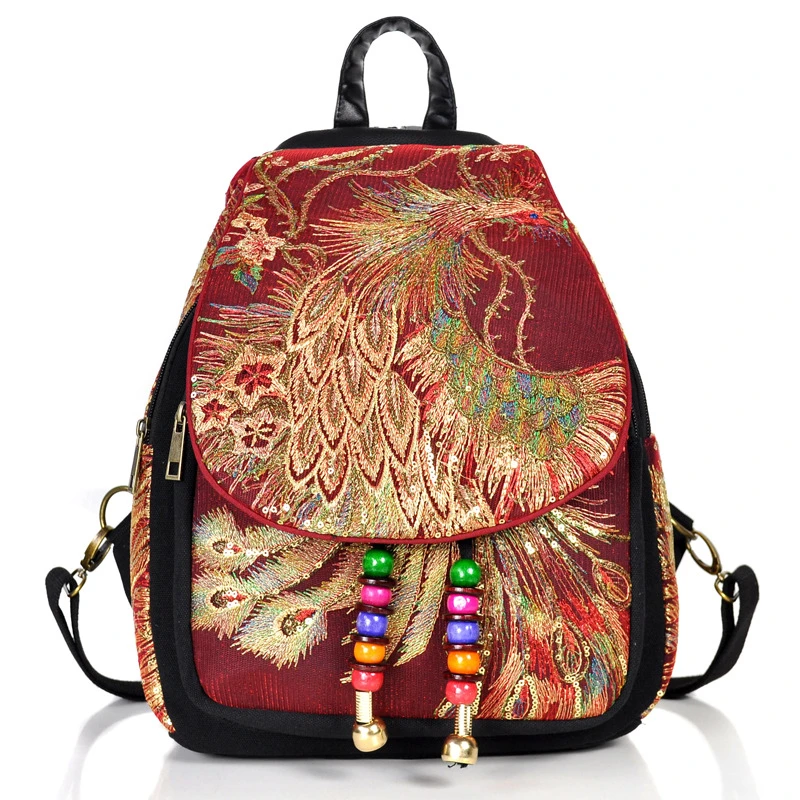
New Female Bag — Peacock Embroidered Bag
- MaterialCanvas + polyester-cotton lining
- StyleNational / Ethnic style
- PatternPeacock embroidery
- Size36 × 26 × 12 cm
- Weight660 g
How to Style the Peacock Embroidered Bag: Three European Registers
The Cultural Statement (Wine Red + Linen)
Wine Red against unbleached linen trousers, a simple cream blouse, and flat leather sandals. The bag is the entire sentence. Do not compete with it — work around it. A single gold ring or earring at most. The embroidery does everything that jewellery might attempt, but with a depth of cultural reference that jewellery rarely achieves.
The Editorial Minimal (Black + Monochrome)
Black against a graphite or charcoal column dress, low-heeled boots, and no visible accessories other than the bag. Here the peacock embroidery surfaces from the dark ground like a half-visible intelligence — present and precise but never obvious. This is the styling register of someone who knows that the best statement is the one that requires a second look to fully understand.
The Weekend Intellectual (Blue + Natural Textures)
Blue against raw cotton, light denim, or undyed silk. A flat shoe, a relaxed posture, a coffee and a book. The bag anchors the colour story and provides the cultural gravitas that elevates the otherwise low-key outfit from casual to considered. In European editorial vocabulary, this is the most aspirational of the three: effortless depth.
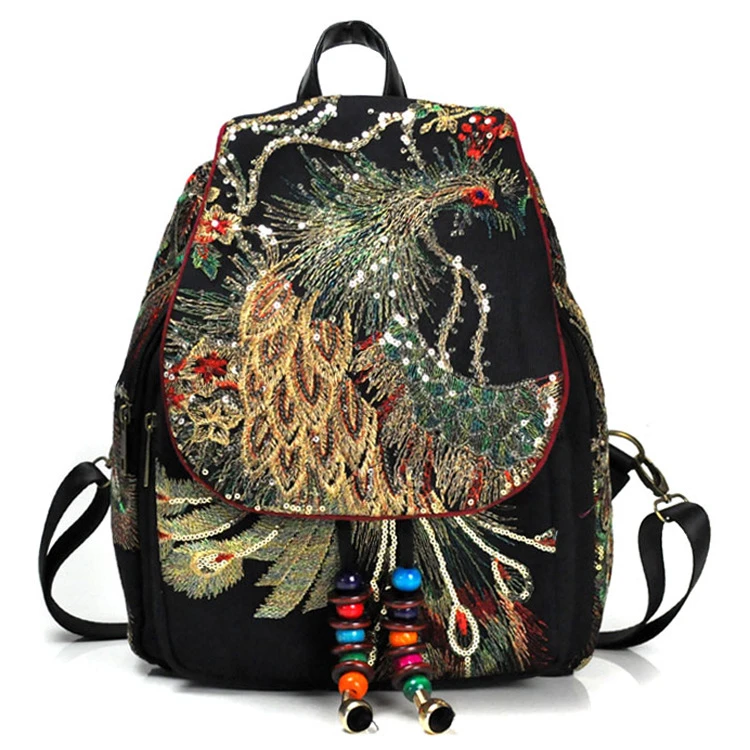
The Embroidery Tradition: From Imperial Workshop to Contemporary Canvas
Chinese embroidery is among the oldest continuous craft traditions in the world, with documented evidence of silk needlework traceable to at least 3,000 BCE (China Silk Museum, Textile Heritage Archive, 2024). The peacock motif's long survival within this tradition reflects its symbolic potency: the bird that displays its full magnificence voluntarily, that makes beauty a deliberate act rather than an accident of biology.
What contemporary Chinese designers and global buyers have recognised is that this tradition — carried in stitched thread on canvas — offers something that no purely digital or industrial process can replicate: the visible evidence of human time and intention embedded in the surface of an object. Each embroidered peacock feather on this bag required a series of choices: direction, tension, colour sequence. Those choices are present in the finished object. You can feel them before you see them.
"What surprised me about this bag was the quality of the embroidery at this price point. Each feather is individually stitched — you can see the layering. It looks like something that should cost three times as much." — Verified customer review, August 2026
FAQ
What does the peacock symbolise in Ming Dynasty court culture?
In the Ming Dynasty buzi badge system, the peacock denoted the third-rank civil official — a scholar-administrator of significant intellectual standing. The peacock was chosen for this rank because of its associations with literary achievement, visual magnificence, and ceremonial authority. It is one of the twelve animal symbols that structured Ming court dress and social hierarchy for over two centuries.
What fits inside a 36×26×12cm canvas crossbody?
At these dimensions, the bag carries a full daily set: a standard A5 notebook or tablet, wallet, phone, keys, earphones, sunglasses in a soft case, and a compact cosmetics pouch. The 12cm depth is significant — it makes this a genuine working bag rather than a display-only object, capable of accompanying the full range of a European woman's daily life.
How does the canvas hold up over time?
Canvas is one of the most durable bag materials available, with a documented lifespan significantly exceeding most synthetics when maintained correctly. Light brushing and occasional spot-cleaning with a damp cloth preserve the surface. The polyester-cotton lining protects the embroidery from internal wear. With standard care, this bag deepens in character rather than degrading with age — a quality European buyers consistently value in heritage accessories.
Which colourway works best across the widest range of European wardrobes?
Black is the most versatile — it integrates across all palette categories from monochrome to earthy neutrals, and the peacock embroidery reads as a textural accent rather than a chromatic statement. For those with a stronger inclination toward warm tones, Wine Red offers the most dramatic effect. Blue suits the broadest range of casual-to-business-casual European styling registers.
Is 660g heavy for a crossbody bag?
At 660g empty, this bag asks for a deliberate carry posture — it is not designed to be forgotten. For comparison, most quality leather crossbody bags of similar dimensions range from 500–900g. The canvas-and-embroidery construction is therefore efficient for its category. Filled with daily essentials (phone, wallet, keys, cosmetics), total carry weight typically ranges from 1.1–1.4kg — well within the comfortable crossbody threshold established by ergonomic accessories research.
Conclusion: The Bag That Doesn't Apologise
The Peacock Embroidered Canvas Bag makes its intentions entirely clear. It is not subtle. It is not minimalist. It carries six centuries of deliberate, earned, magnificent visibility — and it asks the woman who wears it to carry that visibility with the same conviction.
In 2026, after years of micro-bags, invisible carries, and the aesthetic of studied nonchalance, this is the more interesting argument. The peacock, after all, has always known exactly what it is doing.
Discover the Peacock Embroidered Bag — $23.11
1. The Metropolitan Museum of Art — Chinese Court Dress Collection, retrieved 2026-09-26, https://www.metmuseum.org
2. Business of Fashion — "Material Politics in Accessories 2026", retrieved 2026-09-26, https://www.businessoffashion.com
3. Wallpaper* Magazine — "Object Intelligence Issue 2026", retrieved 2026-09-26, https://www.wallpaper.com
4. China Silk Museum — Textile Heritage Archive, retrieved 2026-09-26, https://www.chinasfs.org