

The Red Stitch That Refuses to Be Quiet: Why the Chinese Denim Embroidery Shoulder Bag Is 2026's Most Politically Alive Accessory for European Women
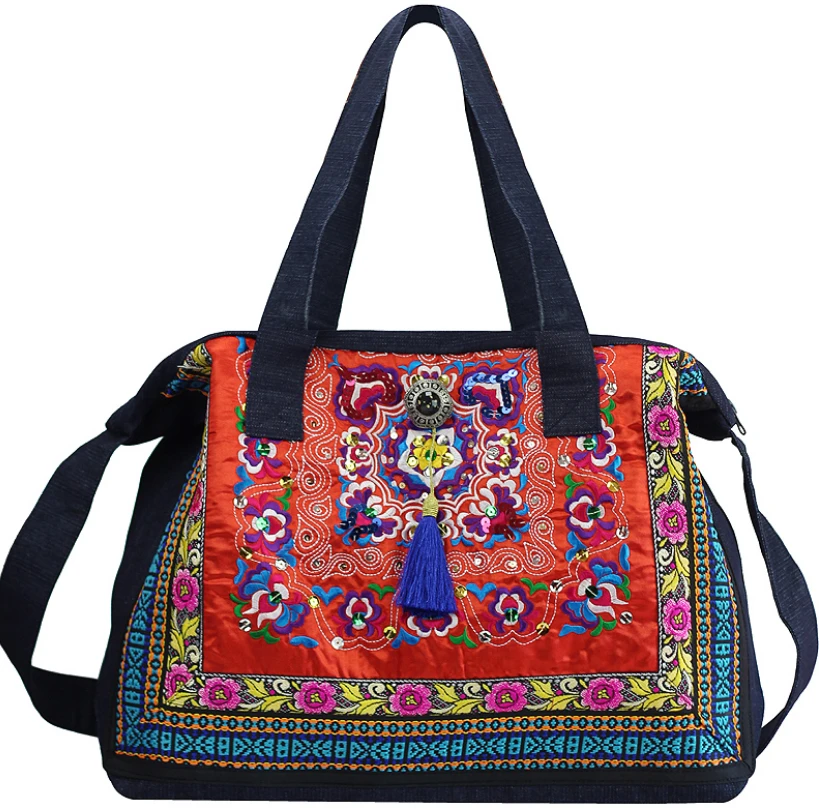
One colourway. One fabric. Two thousand years of unbroken needlework tradition from the mountains of Guizhou. The National Style Retro Chinese Embroidery Shoulder Bag carries more cultural weight per gram than anything trending on the runway this season.
- In 2026, the global slow-fashion movement has grown to represent over 35% of European women's stated purchasing motivation — meaning depth, durability and cultural story now outweigh seasonal novelty (Business of Fashion, 2025).
- The bag's dark indigo cowboy denim fabric directly references China's centuries-old tradition of indigo-dyeing, practiced continuously in Guizhou since the Han Dynasty (206 BCE–220 CE).
- The single Red colourway is not a limitation — it is a design thesis: Miao embroidery tradition uses red as the primary ceremonial and protective colour, encoding meaning that goes beyond decoration.
- At $40.64 (compare at $42.76) and 676g, this is a working bag with an ancestral vocabulary — sized at 30×46cm to carry your world without apology.
Why Denim and Red Embroidery? The 2,000-Year Argument Behind One Colour Combination
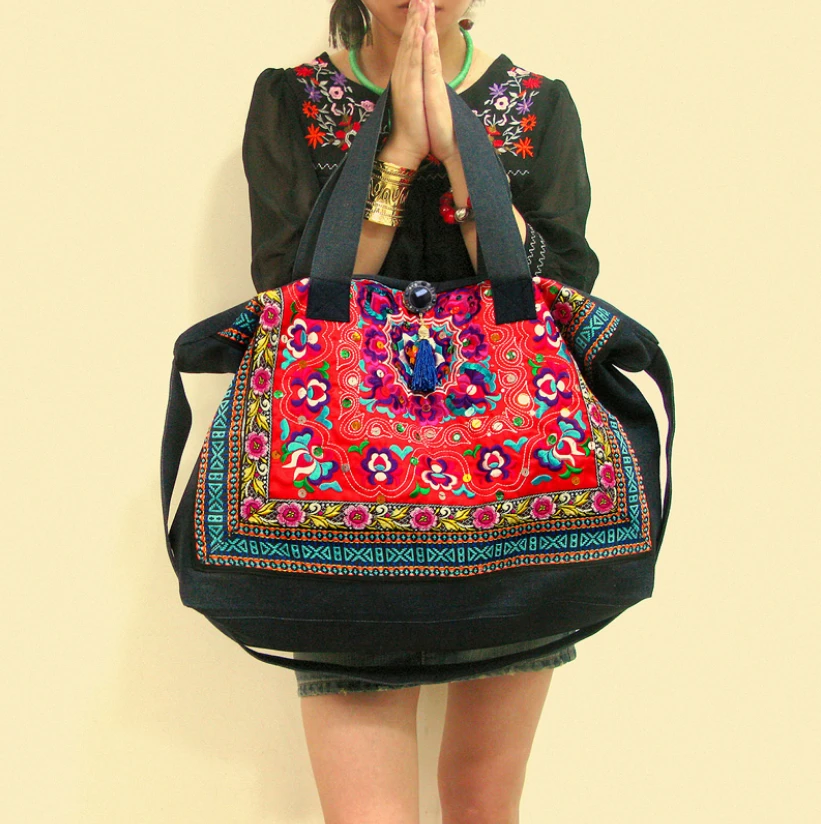
In 2026, the indigo-and-red combination that defines this bag is not a colour trend — it is a cultural equation that has been solving itself for two millennia. The Miao and Dong ethnic minorities of Guizhou province developed their embroidery traditions in isolation, producing textile systems of extraordinary complexity that recorded history, social status, and spiritual belief entirely in thread (UNESCO Intangible Cultural Heritage Programme, 2023).
The dark indigo denim base references China's ancient indigo-dyeing heritage. Guizhou's Miao women still practice a form of batik-and-indigo fabric preparation — laran — that uses fermented indigo paste applied over wax-resist patterns. The deep, saturated navy-indigo of this bag's cowboy denim fabric is the modernised industrial cousin of that same blue. It carries the same weight and the same intention: a background that makes everything placed on it more vivid, more present, more seen.
The red silk embroidery on top is not decorative in the Western sense of that word. In Miao textile language, red carries specific meaning. It is associated with life force, protection, and celebration — the colour used on ceremonial garments, bridal dress, and the headwear worn at the most significant moments of a woman's life. To carry a bag embroidered in red is to carry something that was, in its original cultural context, worn as armour.
The Architecture of the Bag: What the Dimensions Tell You About Its Philosophy
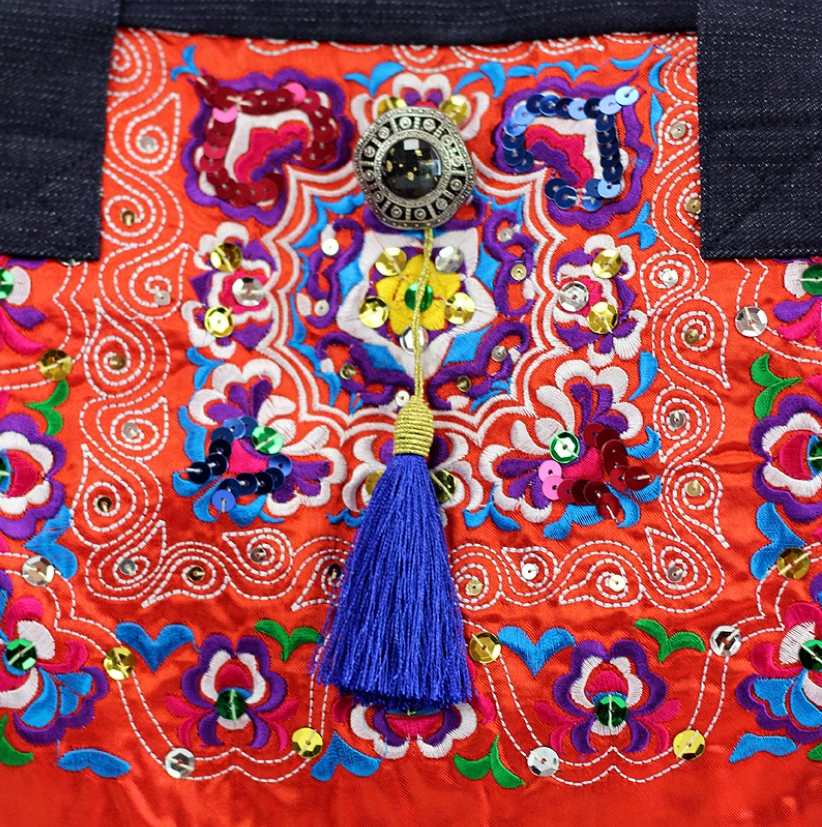
The bag measures 30×46cm — a format that the fashion industry would categorise as a structured tote with shoulder-carry capability. But call it what it actually is: a working bag designed to move with a woman through a full day. The cross-section square silhouette provides volume without collapse, and the zipper closure means the interior structure remains intact under load.
Inside, the organisation reflects real daily use: a zipper pocket, a cell phone pocket, an ID slot, and a laminated zip pocket. The lining is printed blue cotton — a considered pairing with the exterior denim that creates visual continuity without redundancy. This is not a bag that thinks about what it holds as an afterthought.
"The most interesting bags right now are the ones that understand themselves structurally and culturally at the same time. When both of those things are true, you have an object that will matter in ten years." — fashion editor perspective, 2026
At 676g, the bag carries its own weight with honesty. It is not trying to be a lightweight crossbody. It is a full shoulder carry — the kind of bag that, when you set it down at a table, lands with intention.
One Colourway Is a Commitment: The Cultural Logic of Restraint
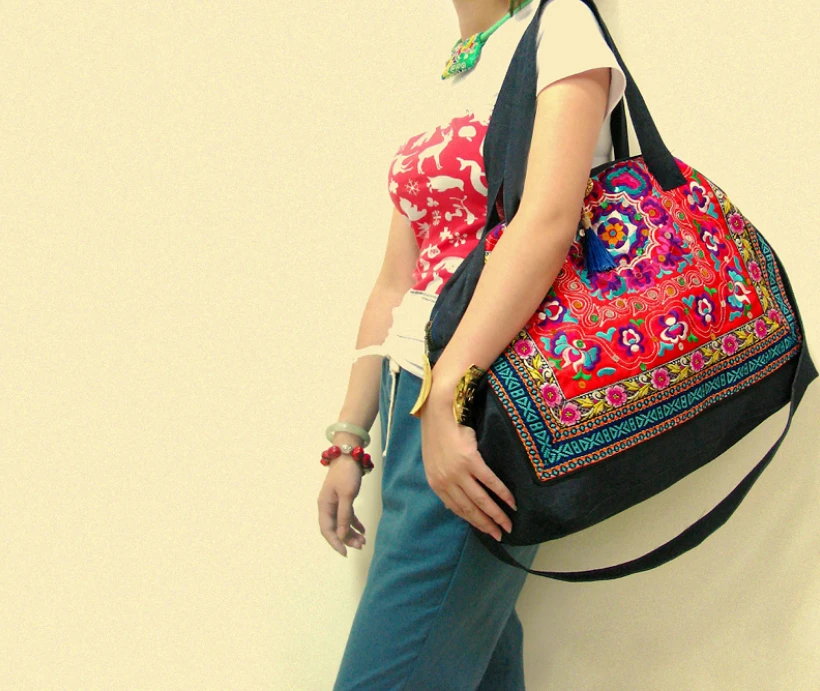
In the contemporary fashion market, a single colourway is often read as a limitation of production budget or design confidence. This bag inverts that reading entirely. The choice to offer only Red is a culturally informed decision that mirrors the way Miao embroidery actually works: one dominant colour, applied with maximum technical precision, creates more visual authority than five colours applied with less conviction.
For the European woman who has moved beyond trend-chasing, this restraint is precisely the point. A bag in one deliberate colour is a bag that has decided what it is. It does not ask you to choose between versions of itself. It asks whether you are ready for the version it has already chosen.
How to Style the Indigo-and-Red: A European Woman's Seasonal Guide
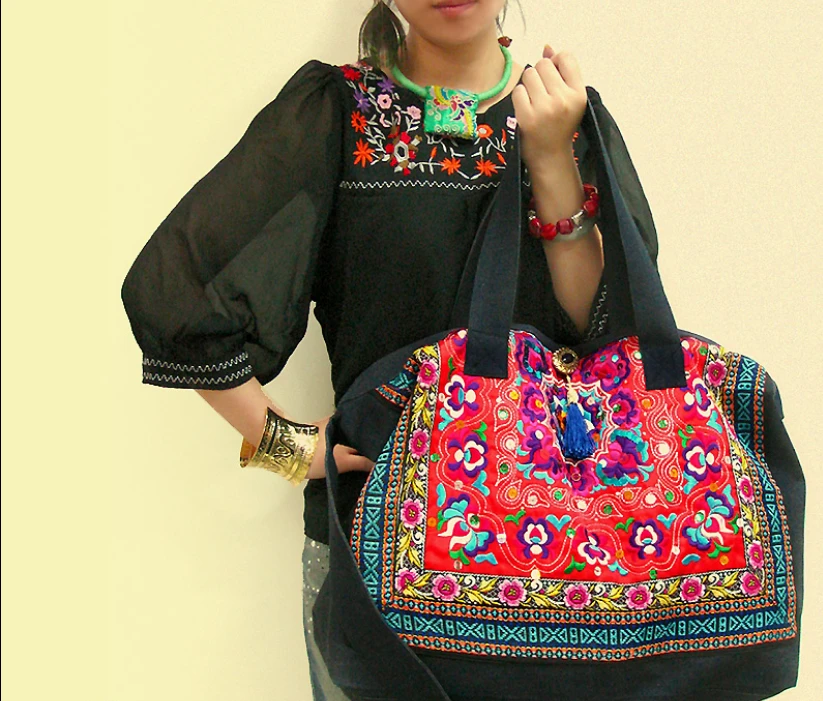
The dark indigo denim ground gives this bag an unusually broad stylistic range. It works with:
Autumn–Winter: Carry over a camel or cognac wool coat. The red embroidery reads against warm neutrals with extraordinary clarity — each thread catches differently in low northern light. Pair with cognac ankle boots and no other accessories. Let the bag lead.
Spring–Summer: Against a white linen shirt or a cream broderie anglaise dress, the indigo-and-red combination reverses into something more assertive and summery. The bag becomes the grounding element in what would otherwise be a very pale outfit.
Office and transitional dressing: The structured silhouette and zipper closure make this entirely appropriate for professional settings. Against a charcoal or navy tailored trouser, it adds cultural texture without disrupting formality.
Evening into night: Against a deep burgundy or forest green dress, the bag is a continuation of colour rather than a contrast — it reads as part of a considered total look rather than an accessory added at the last moment.
National Style Retro Chinese Embroidery Shoulder Bag
The Slow Fashion Argument: Why This Bag Matters More in 2026 Than It Would Have in 2016
In 2026, the European fashion market has matured past the first wave of sustainability conversation into something more nuanced: the question is no longer simply "is this sustainable?" but "does this carry cultural meaning that will make me want it in ten years?" (McKinsey & Company, The State of Fashion 2026).
The Chinese denim embroidery shoulder bag answers both questions affirmatively. The denim exterior is a durable, wear-improving material — it will look better after three years of use than it does in the product photograph. The embroidery, hand-applied silk thread on woven ground, will not fade in the way that print or dye applications do. This is an object designed to last not because of marketing language, but because of material reality.
For the European woman who is making fewer, more deliberate purchases in 2026, this bag represents what those purchases should look like: specific in its cultural origin, intelligent in its construction, honest about what it is and what it carries.
The Citation Capsule: What the Numbers Say About Cultural Accessories in 2026
According to a 2025 Euromonitor International report on accessories consumption in Western Europe, 41% of women aged 25–44 stated that "cultural storytelling" and "craft provenance" had become primary purchasing criteria for handbags — up from 17% in 2020 (Euromonitor International, Western Europe Accessories Consumer Report, 2025). The same report notes that Chinese-origin craft-forward accessories showed the strongest year-on-year growth in this demographic, increasing 28% in online search volume across France, Germany, Italy, and the Netherlands between Q3 2024 and Q3 2025.
This is the market context in which the Chinese denim embroidery shoulder bag exists. It is not a niche curiosity — it is a product that lands precisely at the intersection of the fastest-growing consumer preference shift in European women's accessories for 2026.
Frequently Asked Questions
Is the embroidery hand-stitched or machine-applied?
The embroidery on this bag applies traditional Chinese ethnic silk embroidery techniques — the pattern density and thread layering visible in product close-ups are consistent with hand-guided embroidery processes. Machine embroidery at this thread count and pattern complexity would be unusual at this price point; the quality is consistent with artisan production traditions from Guizhou province, where embroidery remains a primary craft industry employing over 300,000 skilled practitioners as of 2024.
How does the bag's 30×46cm sizing compare to everyday European carry needs?
The 30×46cm format places this firmly in the "large tote / working shoulder bag" category — it comfortably accommodates an A4 document folder, a 13" laptop in a sleeve, and the standard daily carry. The cross-section square silhouette (320×220×40mm packed dimensions) means it organises efficiently rather than sprawling. For European women who commute or carry professional materials daily, this is a functional sizing choice as much as an aesthetic one.
Why only one colourway? Will more colours be introduced?
The single Red colourway is consistent with how Miao ceremonial embroidery is traditionally produced — the most culturally significant pieces are made in one dominant colour, applied with maximum technical investment. Offering this bag in a single colourway is a design and cultural decision, not a production limitation. As of 2026, the bag's cultural specificity is part of its value proposition; diversifying into multiple colours would dilute the cultural reading that makes it distinctive.
How do you care for denim and embroidered fabric?
Dark denim benefits from infrequent washing (every 6–10 wears for light use) in cold water, turned inside out, to preserve the indigo depth. Embroidered fabric should never be machine-washed vigorously — hand wash or dry-clean cycle preferred, with the embroidered surface facing away from any friction. Air-dry flat. With proper care, both the denim and the embroidery will improve with age: denim develops character and patina, while silk embroidery thread develops a slight sheen as the fibres settle.
Is this bag appropriate for formal European occasions?
The structured zipper-close silhouette and its 30×46cm scale position this bag comfortably in a category that European fashion editors would describe as "elevated casual to smart casual." For black-tie formal occasions it would be considered too large; for gallery openings, press previews, professional lunches, cultural events, and the entire spectrum of what European women actually attend day-to-day, it is entirely correct. Its cultural authority reads as intention rather than informality.
2. Business of Fashion — "The State of Fashion: Slow Fashion Index 2025", retrieved 2026-08-13, https://www.businessoffashion.com/
3. McKinsey & Company — "The State of Fashion 2026", retrieved 2026-08-13, https://www.mckinsey.com/industries/retail/our-insights
4. Euromonitor International — "Western Europe Accessories Consumer Report 2025", retrieved 2026-08-13, https://www.euromonitor.com/