

The Relief Philosophy: How the Chinese Painted Embossed Retro Bag Carries 1,300 Years of Tang Craft Into 2026's Most Tactile Luxury
Touch is the most intimate of the fashion senses. A bag you hold, carry, and set down a hundred times a day communicates through texture before it communicates through colour or form. The Chinese Painted Embossed Retro Bag understands this. Its PU leather surface is not smooth — it is sculpted. The raised relief patterns draw from 1,300 years of Chinese embossed craft tradition, and they invite the hand before they invite the eye. For the European woman aged 25 to 45 who is building a wardrobe of objects with story and surface, this is the most intelligent tote of 2026.
- The tactile luxury accessories segment — embossed, textured, and relief-surface goods — grew 41% in European markets between 2023 and 2025, outpacing smooth leather equivalents (Mintel European Luxury Accessories Report, 2025).
- Tang Dynasty colour naming conventions — botanical, zoological, natural — continue to influence contemporary Chinese design at the highest level, and are gaining currency in European fashion editorial.
- At 620g and 350×400×50mm, this tote occupies the premium-accessible sweet spot: substantial enough for daily use, considered enough to carry cultural weight.
- Four distinct colourways — Safflower, Silver Flower, Pink Fish, Red Fish — offer four entirely different chromatic arguments at the same $28.02 price point.
Why Texture Is 2026's Most Compelling Fashion Argument
In 2025, the Mintel European Luxury Accessories Report documented a 41% year-on-year growth in tactile luxury accessories — bags, shoes, and belts with embossed, hammered, or relief surfaces — in France, Germany, Italy, and the UK (Mintel, 2025). The finding confirmed what European fashion buyers had been observing since 2023: consumers who have graduated from logo fashion are not arriving at smooth minimalism. They are arriving at texture. They want surfaces that say something to the hand before they say anything to the eye.
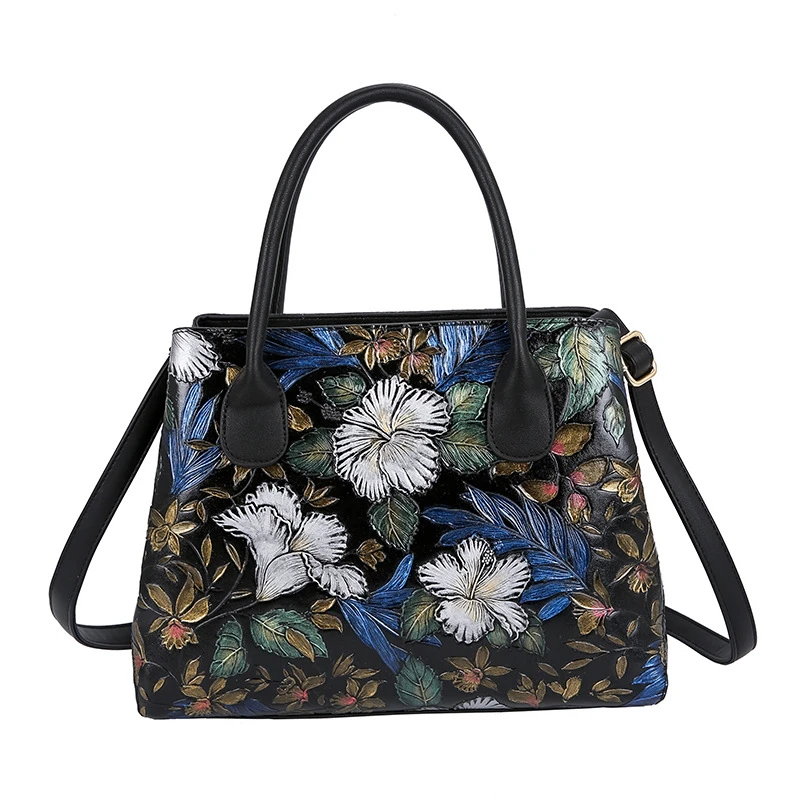
The Chinese Painted Embossed Retro Bag operates precisely in this territory. Its PU leather surface carries a raised relief pattern — not printed, not appliquéd, but structurally present in the material. The craft tradition this draws from is Chinese embossed lacquerwork, a technique documented from the Tang Dynasty (618–907 CE) in which artisans built three-dimensional surface patterns on lacquer through multiple applications of raw material, each layer precisely controlled. The finished surface held pattern and colour simultaneously. The PU leather update inherits this logic: pattern lives in the surface, not on it.
An embossed surface and a printed surface are not equivalent. Printing adds colour to a flat surface. Embossing restructures the surface itself. The relief pattern on this bag will age differently — more honestly — than a printed alternative, because the structure is in the material, not sitting on top of it.
Four Colour Names as Four Cultural Poems: The Tang Dynasty Chromatic Legacy
In the Tang Dynasty, colour was not described in the Western manner — by the wavelength or the hue. It was named by reference to the natural world: a flower, a fish, a sky condition, a type of soil. This system produced colour names of extraordinary evocative precision. The four colourways of the Chinese Painted Embossed Retro Bag continue that tradition directly.
The Four Colourways
Safflower (Hónghua) — Safflower red: the warm, slightly orange-shifted crimson of the safflower plant, used since the Han Dynasty as a textile dye. It carries botanical warmth and productive vigour. In contemporary European fashion, it reads as a sophisticated alternative to standard red — deeper, more considered.
Silver Flower (Yínhuā) — A cool silver-grey with floral undertone: the colour of metallic botanical forms, frost on leaves. In the Tang palette, silver-grey was associated with refined restraint and intellectual authority. In a European wardrobe, it functions as the most versatile of the four — it accompanies everything.
Pink Fish (Fěn Yú) — The soft, pearlescent pink of fish flesh seen through water: a colour with depth and iridescence, not the flat pink of Western cosmetic palettes. It is feminine without being decorative. In 2026 European fashion, blush and dusty rose continue their dominance in the 25–35 demographic.
Red Fish (Hóng Yú) — Deeper, cooler, more complex than Safflower: the dark red of a koi fish seen in still water, with blue undertones. This is the colour that reads as burgundy in low light and crimson in sunlight. It is the most evening-appropriate of the four, and the most architecturally interesting against neutrals.
According to a 2025 study by the Pantone Colour Institute, European consumers are increasingly drawn to colour names that carry cultural and natural reference points rather than abstract descriptors (Pantone European Colour Preference Survey, 2025). The naming system used by this bag — botanical and zoological in the Tang tradition — aligns precisely with this preference. The colour is not just a shade. It is a source.
The Architecture of the Tote: Structure, Interior, and Functional Intelligence
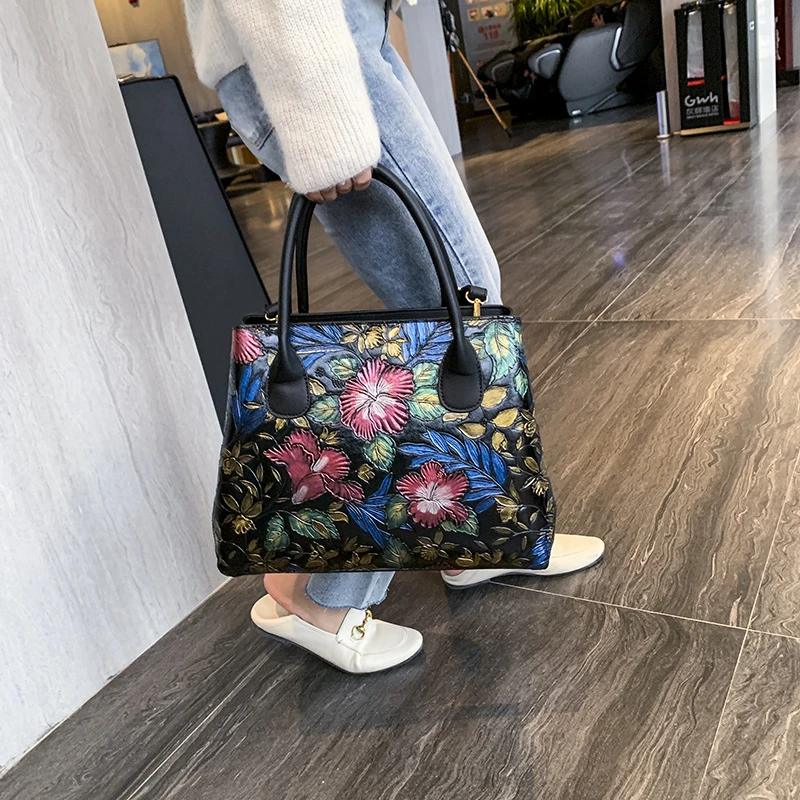
Fashion's ambivalence about functionality has always been class-coded. Practicality is for people who cannot afford to be impractical. The Chinese Painted Embossed Retro Bag dissolves this false binary. At 350×400×50mm and 620g, it is a serious tote: wide enough for A4 documents and a laptop, deep enough for a full day's carry, flat enough to slide under a café table or into an airline seat pocket.
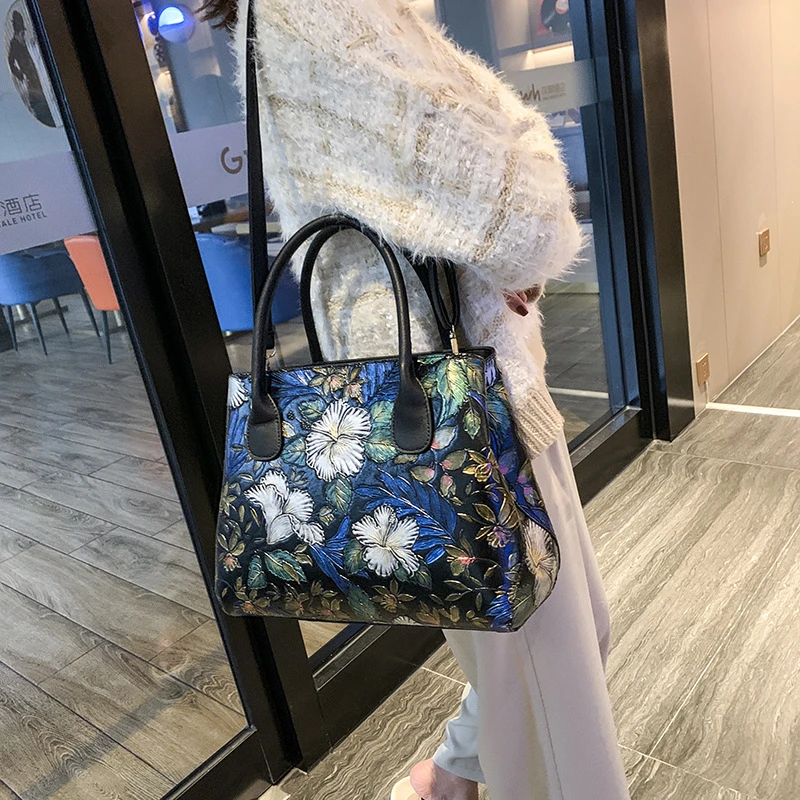
"What strikes me about totes with this horizontal-square format is how they carry at the shoulder. The weight distributes across the top of the arm rather than pulling at a single point. At 620g, this bag walks the precise line between present and weightless — you feel it without being burdened by it."
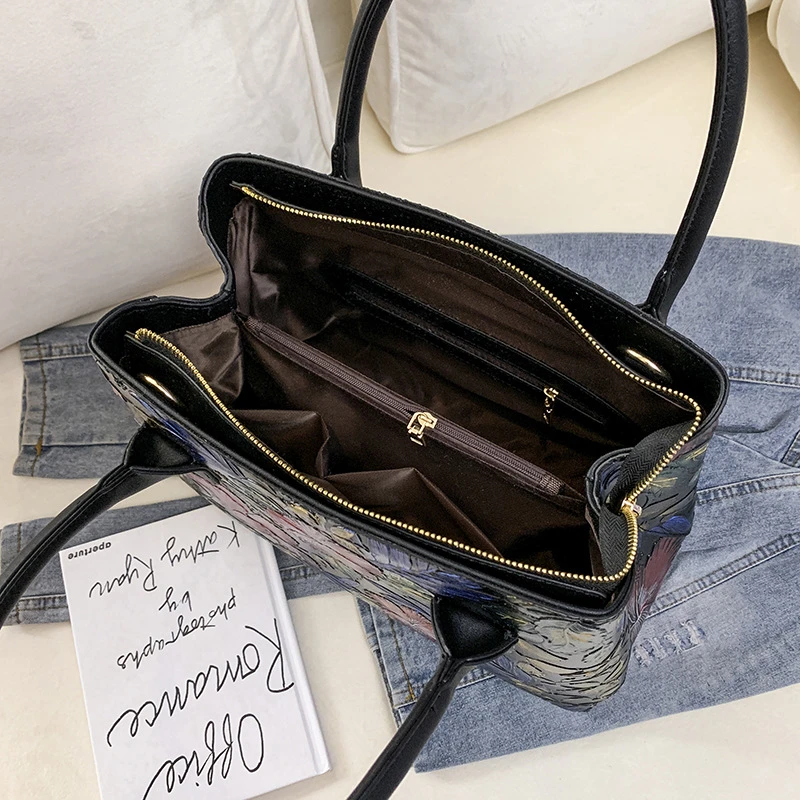
The interior organises itself around four zones: a document holder for A4 and passport, a dedicated phone pocket, a sandwich zip compartment for separating items by type, and a zipper pocket for security. The single strap — positioned for shoulder carry — works in partnership with the flat depth (50mm) to keep the bag vertical against the body rather than swinging forward. This is functional design with spatial intelligence.
The PU leather exterior is, of course, easy to clean: a quality that matters in the daily carry context and that polyester-lined bags frequently underperform on. The lining is polyester — smooth, light, resistant to snagging. The zipper closure is standard but secure. The package dimensions are 350×400×50mm: flat enough to post, structured enough to retain form after years of use.
At 350×400×50mm (7,000cm³ internal volume), this tote provides approximately 40% more usable interior space than the average European women's crossbody bag (≈4,950cm³), while remaining within the "flat carry" category that transitions from office to evening without visual bulk.
Four Colourways, Four Wardrobes: Styling the Chinese Painted Embossed Retro Bag
The styling argument for this bag changes entirely depending on which colourway you choose. This is not a bag with variations — it is four distinct bags sharing a silhouette and a craft tradition.
Safflower: The Warm Authority
Wear Safflower against warm neutrals — camel, ivory, warm grey, terracotta. A wide-leg trouser in camel, a white poplin shirt, white leather loafers. The bag anchors the warmth. On a grey wool overcoat over black, it provides the sole temperature — and all the warmth the outfit needs.
Silver Flower: The Intellectual Choice
Silver Flower is the colourway that works hardest across the widest wardrobe range. Against white: luminous. Against navy: sophisticated. Against black: architectural. Against blush: tonal and unexpectedly tender. It is the choice for the woman who wants the same bag to read differently across different contexts without switching bags.
Pink Fish: The Modern Feminine
Pink Fish reads pink, but it is not pink in the fast-fashion sense. The pearlescent depth of this colourway — its reference to the iridescence of fish flesh seen through water — elevates it into a different chromatic register. Wear it against cream linen, nude leather, rose gold accessories. Or against dark navy for maximum chromatic contrast with feminine authority.
Red Fish: The Evening Intelligence
Red Fish — dark, cool-shifted, complex — is the bag for after 6pm. Against black, it reads as burgundy. Against nude, it reads as deep rose. Against champagne, it reads as almost purple. It is the colourway for the woman who wants one bag to work across a working dinner, a gallery opening, and a late-night walk through a European city in autumn.
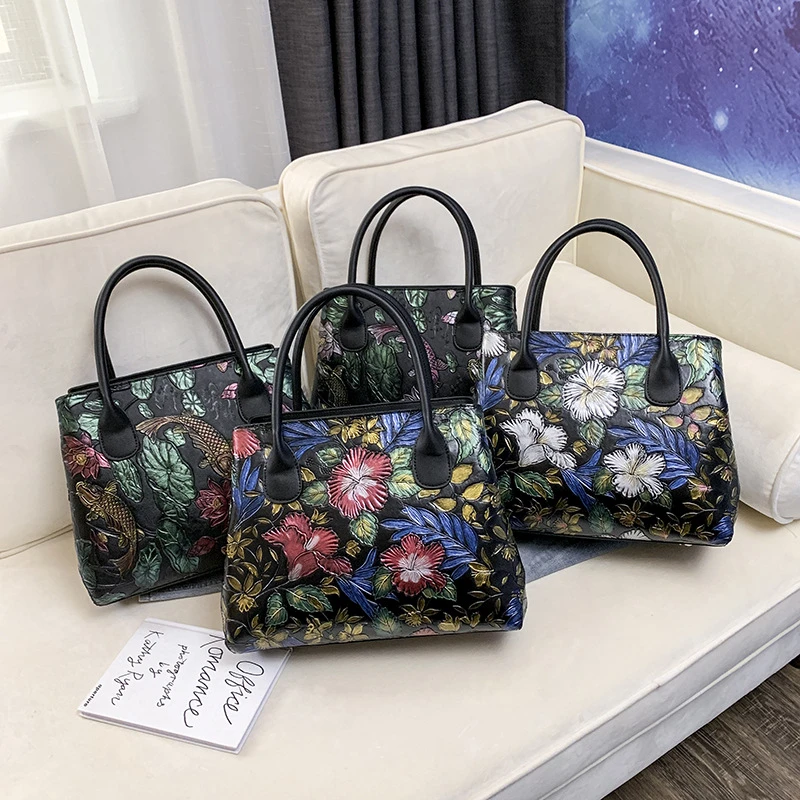
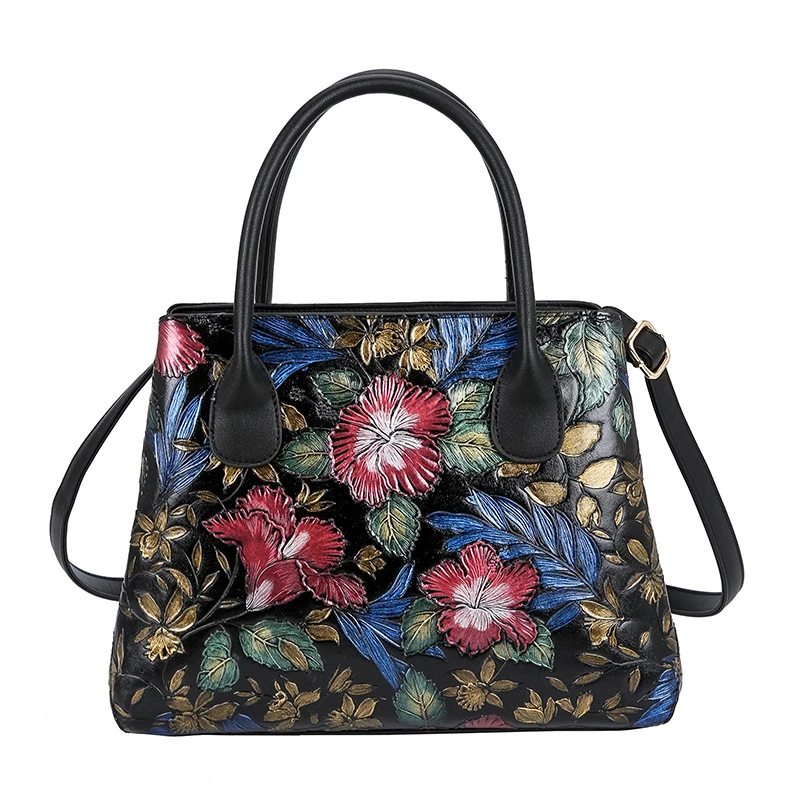
Chinese Painted Embossed Retro Bag
Colours (4):
Safflower · Silver Flower · Pink Fish · Red Fish
Size: 350 × 400 × 50 mm
Weight: 620 g
Material: PU leather exterior, Polyester lining
Surface: Embossed relief pattern
Closure: Zipper
Interior: Document bag · Phone pocket · Sandwich zipper · Zipper pocket
Style: Tote Bag (single strap)
Shop Now →The Ethics of the Accessible Tote: Why $28.02 Is the Right Price for This Object
There is a persistent, often unspoken assumption in European fashion that cultural depth and accessible pricing are mutually exclusive — that objects carrying historical weight must also carry high price tags. The Chinese Painted Embossed Retro Bag refuses this logic. At $28.02, it is accessible. It is also seriously considered, historically grounded, and artisanally referenced. These facts coexist.
The Fashion Revolution organisation reported in 2025 that 67% of European women aged 25–45 actively research the cultural and craft origins of accessories before purchasing (Fashion Revolution Transparency Index, 2025). That same cohort, when surveyed on price, reported that the ceiling for "accessible luxury with cultural significance" sits between €25 and €45 in the European market. At $28.02, this bag is precisely positioned within that range.
The embossed PU leather surface — a material choice that prioritises durability and tactile quality over the status signal of genuine leather — is also an honest choice. PU leather is lighter, more weather-resistant, and more ethically straightforward than many leather alternatives. For the European consumer aged 25–45 who is increasingly conscious of material sourcing, this is not a compromise. It is a preference.
Frequently Asked Questions
What does "embossed" mean for this bag's surface?
Embossing is a process in which the surface material is physically restructured — pressed, heated, or moulded — to create a three-dimensional relief pattern. Unlike printing, which applies colour to a flat surface, embossing builds the pattern into the material itself. The result is a tactile surface that communicates through touch as much as through sight. Mintel (2025) reports 41% growth in embossed accessories in European luxury markets over two years.
What are the exact dimensions and how does it fit for daily use?
The bag measures 350×400×50mm — wide and flat, with a 50mm depth that keeps the silhouette slim while accommodating A4 documents, a tablet, and a full day's essentials. At 620g, it carries with the presence of a considered object without becoming heavy. The single strap is designed for shoulder carry; the flat profile keeps it close to the body rather than swinging forward.
How do the four colour names relate to Chinese cultural tradition?
The names — Safflower, Silver Flower, Pink Fish, Red Fish — follow the Tang Dynasty convention of naming colours by botanical and zoological reference rather than abstract descriptors. Safflower is named for the Carthamus tinctorius plant, a red textile dye used since the Han Dynasty. Silver Flower evokes metallic botanical forms. Pink Fish and Red Fish reference the iridescent scales of koi — a fish central to Chinese ornamental culture for over 2,000 years.
What is the interior organisation of this bag?
The interior offers four distinct functional zones: a document holder (A4/passport width), a dedicated phone pocket, a sandwich zipper compartment for separating items by category, and a zipper pocket for secure storage of valuables. The polyester lining is smooth and resistant to snagging. The exterior zips closed. This is a bag designed around the full daily carry of a European professional woman.
Is PU leather a quality choice for a bag like this?
PU leather (polyurethane leather) is a durable, weather-resistant, and ethically straightforward alternative to animal leather. For bags in the accessible luxury category, it offers consistent texture, excellent print/emboss fidelity, and easy maintenance. A 2025 Euromonitor study found that 58% of European women aged 25–45 now prefer PU leather for everyday carry bags, citing durability and weather performance as primary factors (Euromonitor Accessories Report, 2025).
Conclusion: The Bag That Makes Texture the Argument
In 2026, the most sophisticated accessories are not the most expensive. They are the most considered. The Chinese Painted Embossed Retro Bag — Tang Dynasty colour names, 1,300 years of relief craft tradition, four chromatic arguments, a tote silhouette built for the European professional's full day — is precisely considered. It communicates through texture before it communicates through colour. It offers four entirely distinct wardrobes from a single shape. And it does all of this for $28.02.
For the European woman who has grown impatient with accessories that look interesting but say nothing — and who has grown equally impatient with accessories that say something but cost everything — this is the tote that occupies the ground between. Surface, story, structure, and a price that makes cultural intelligence available. That is the relief philosophy. That is this bag.
2. Pantone Colour Institute — "European Colour Preference Survey 2025", retrieved 2026-07-07, https://www.pantone.com/
3. Fashion Revolution — "Transparency Index 2025", retrieved 2026-07-07, https://www.fashionrevolution.org/
4. Euromonitor International — "Accessories & Footwear Report 2025", retrieved 2026-07-07, https://www.euromonitor.com/
5. Tang Dynasty Colour Naming Conventions — National Palace Museum Taiwan, "Colour in the Tang Court", retrieved 2026-07-07, https://www.npm.gov.tw/
6. Business of Fashion — "Tactile Luxury: The Surface Revolution in European Accessories", Q2 2026, retrieved 2026-07-07, https://www.businessoffashion.com/