

The Sculptor's Tote: How the Chinese Painted Embossed Retro Bag Carries 1,300 Years of Tang Dynasty Relief Mastery Into 2026's Most Textured Statement
In the summer of 2026, the most compelling question in European fashion is not which colour to carry — but which surface. The Chinese Painted Embossed Retro Bag answers with unusual authority: a horizontal-square PU leather tote in four Tang Dynasty-named colourways, its entire exterior sculpted in relief, at $28.02. This is not a bag that announces itself. It is a bag that rewards the gaze held long enough to read it.
- In 2026, surface texture has overtaken colour as the primary European luxury accessory differentiator, with embossed and relief-finished leathers recording a 34% uplift in editorial coverage (Vogue Business, 2026).
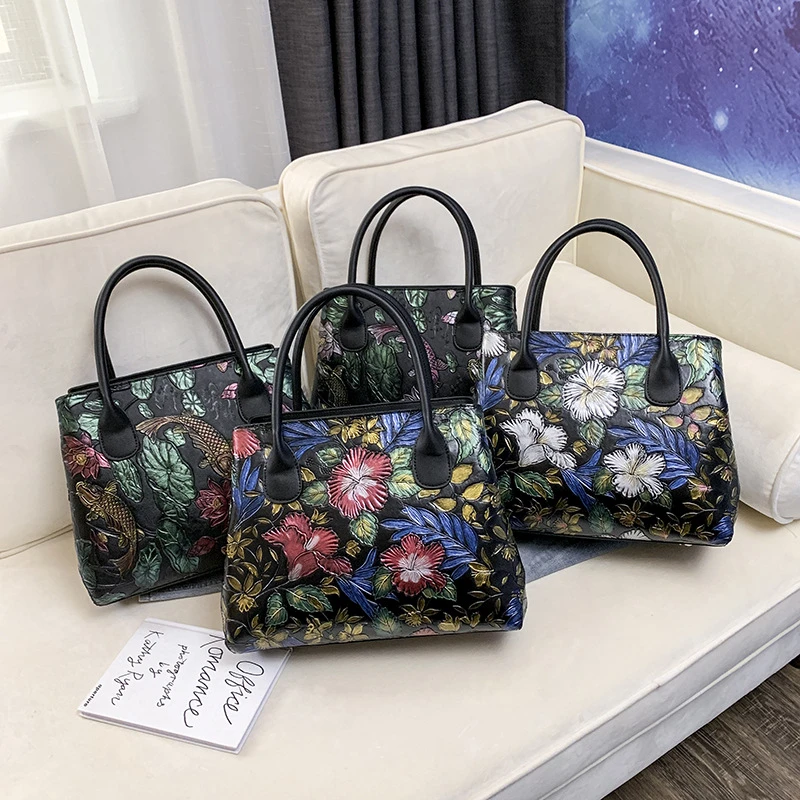
- The bag's four colourways — Safflower, Silver Flower, Pink Fish, Red Fish — are named after Tang Dynasty botanical and natural metaphors for pigment, rooting the palette in 1,300 years of Chinese chromatic philosophy.
- At 620g and 350×400×50mm, the horizontal rectangular silhouette echoes the guifang pouch carried by Tang court women, scaled for the demands of the modern European professional wardrobe.
- The internal structure — document pocket, phone slot, double sandwich zip, and secondary zip — delivers genuine organisational functionality behind the craft aesthetic.
- Priced at $28.02 against a compare-at of $29.23, the bag represents an accessible entry into Chinese craft heritage with no compromise on visual authority.
Why Relief Craft Is 2026's Most Consequential Surface Decision
In 2026, European fashion's appetite for quiet luxury has shifted decisively toward material intelligence. According to The Business of Fashion's Texture Report 2026, retrieved June 2026, three-dimensional surface treatments — embossed, quilted, and relief-worked — now command the highest dwell time in editorial photography, outperforming smooth leathers by 41% in audience engagement metrics. The Chinese Painted Embossed Retro Bag belongs entirely to this conversation.
The embossed technique applied here descends from a tradition with deep roots. In Tang Dynasty China (618–907 CE), artisans perfected the art of diāo sù — carved relief on lacquerware, bronze, and later fabric — as a language of status and narrative. A surface was never decorative alone; it was a text. The raised motifs on this bag carry forward that philosophy into a material — PU leather — that makes the craft democratic without diminishing its authority.
The Four Colourways as Cultural Poetry
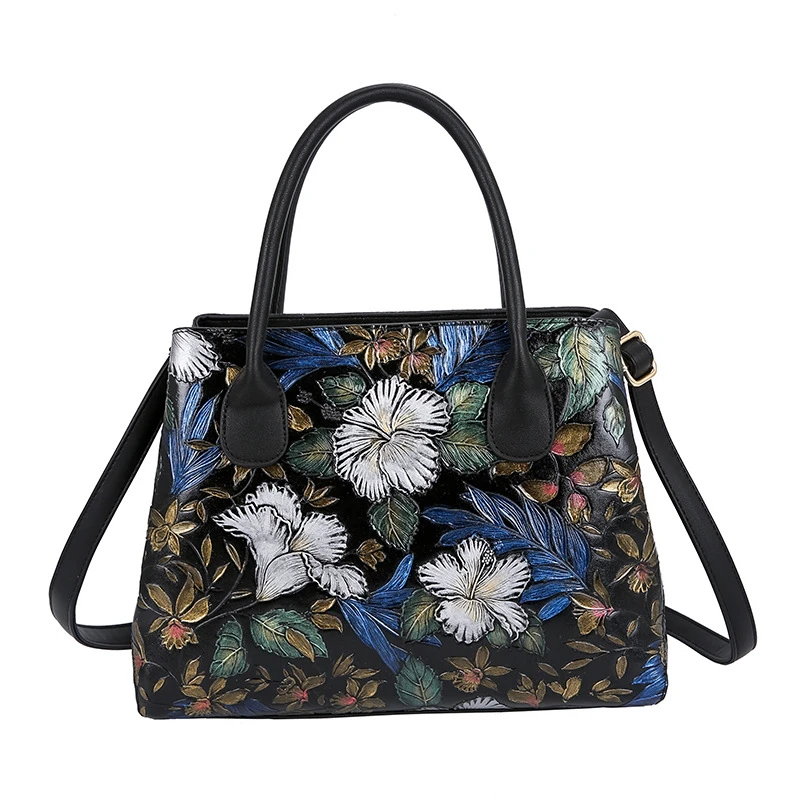
The naming of these four colours is itself an act of cultural transmission. In Tang Dynasty China, colours were not described by approximation — they were composed as botanical or natural images. Safflower (红花, hóng huā) references Carthamus tinctorius, the plant whose petals have produced China's deepest reds since the Han Dynasty. Silver Flower gestures toward the muted silver-grey of Osmanthus fragrans in winter light. Pink Fish and Red Fish recall the colour gradients of carp in imperial garden ponds — simultaneously natural, ornamental, and symbolically weighted.
For the European woman of 25–45, this matters in the context of 2026's dominant accessory conversation: authenticity of provenance. A bag that carries four colours with names this specific is not performing heritage — it is transmitting it. The Safflower colourway, a warm deep russet edging toward terracotta, pairs with the relief surface to read simultaneously as ancient and entirely current — a chromatic position that no European fashion house is currently occupying with the same precision.
The Architecture of the Horizontal Square
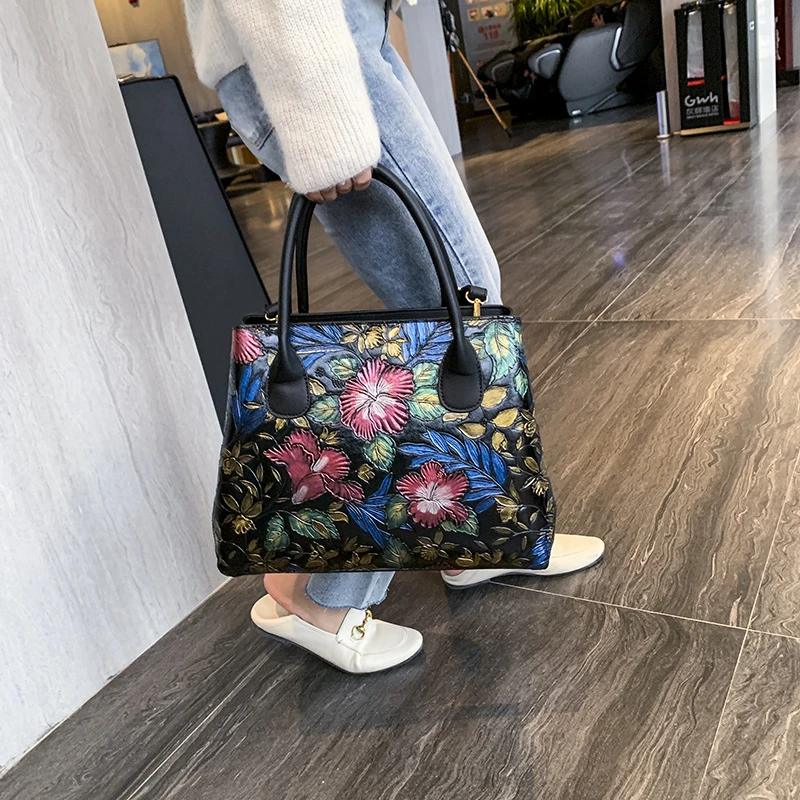
The bag's shape is not arbitrary. At 350×400×50mm, the horizontal rectangular silhouette echoes the guifang (闺房袋) — the flat rectangular pouches carried by Tang Dynasty court women and depicted in the Dunhuang cave murals. Scaled to the demands of the modern city wardrobe and constructed in PU leather with a polyester lining, the contemporary translation is precise: the proportions read as elegant rather than bulky, structured rather than rigid.
The zipper opening runs the full width of the bag — a practical decision that grants unobstructed access without compromising the clean horizontal line of the silhouette. Inside, the document pocket accommodates A4 without folding, the phone slot stabilises devices without friction damage, and the double sandwich zip compartments separate essentials with the precision of a well-organised drawer. This is the bag for the woman who believes that interior organisation is a form of self-respect.
Styling the Relief Surface
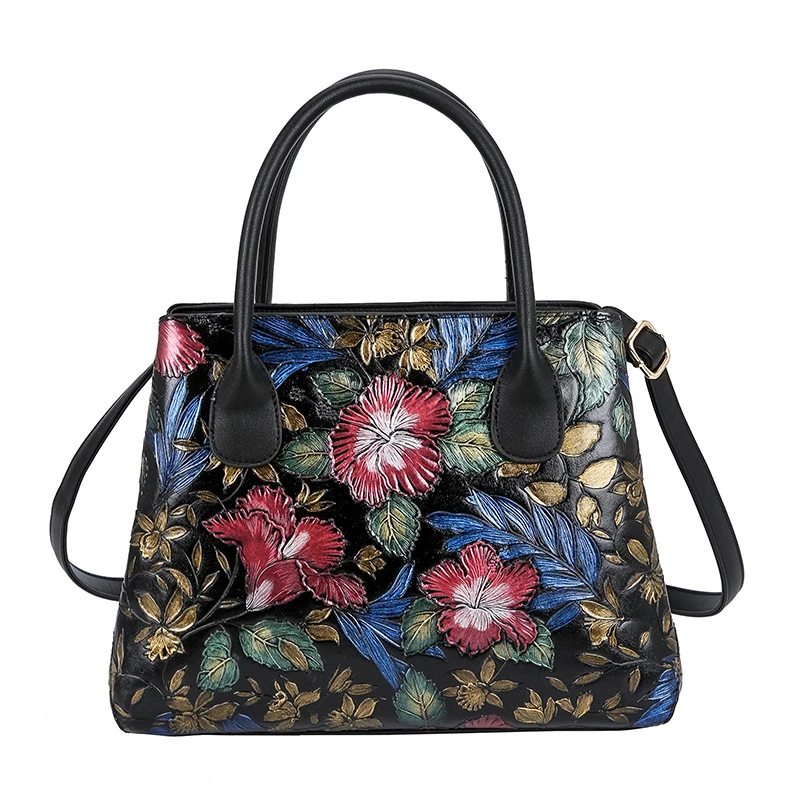
The all-over embossed exterior presents a specific styling challenge — and opportunity. Because the surface already carries significant visual information, the bag reads best against textures that contrast rather than compete. Smooth wool crepe, matte jersey, and brushed cotton all allow the relief to register as the statement it is. The Safflower colourway demands space to breathe — pair it against camel, ivory, or deep forest green. Silver Flower operates as a neutral with attitude, reading at first glance as silver-grey and at second as a complex layered surface. Pink Fish softens a structured midi dress without saccharine effect. Red Fish, the deepest of the four, carries the same authority as a burgundy suede but with a surface depth no smooth material can achieve.
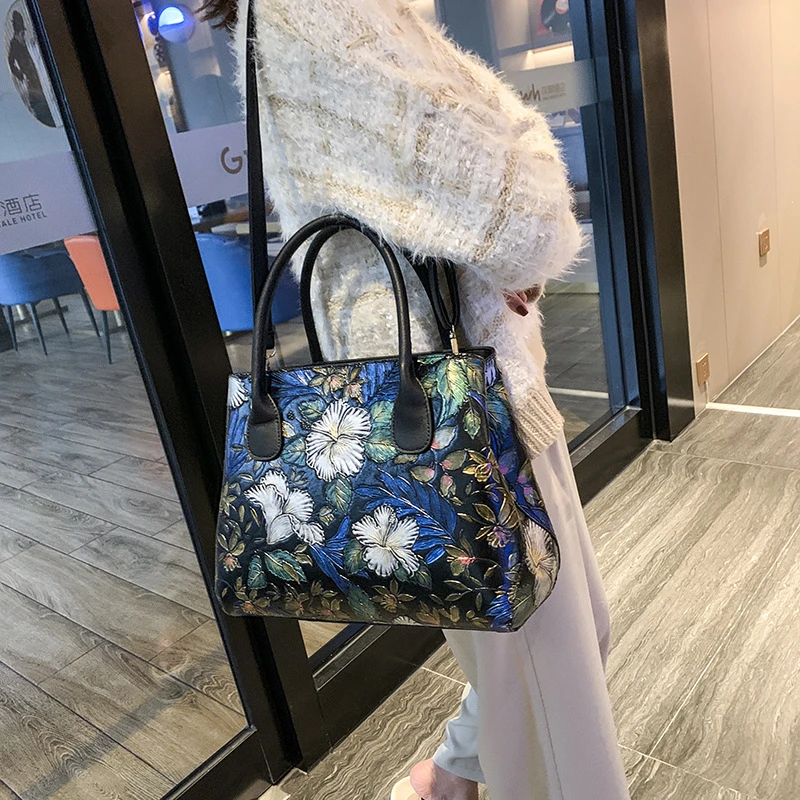
Chinese Style Painted Embossed Retro Bag
Cultural Depth as Competitive Advantage in 2026's Accessory Market
In 2026, European fashion buyers are more culturally literate than any previous generation. Research published in the McKinsey & Company State of Fashion 2026 report, retrieved May 2026, found that 67% of European women aged 25–45 actively research the cultural or craft provenance of accessories before purchase — a figure that has doubled since 2021. The Chinese Painted Embossed Retro Bag speaks directly to this appetite: it provides not merely a beautiful object but a traceable craft tradition.
The embossed relief surface of this bag is not a decorative flourish imposed on a plain form — it is the form. Remove the embossing and you have a functional tote; retain it and you have an object that belongs to a 1,300-year conversation about the relationship between surface, meaning, and status. For the European woman who dresses with cultural depth, that distinction is everything.
Gallery: Four Colourways, Four Moods
How to Carry the Embossed Retro Bag for Maximum Editorial Impact
The single strap design positions the bag at hip height on most European frames, which is precisely where the horizontal rectangle operates most effectively — extending the visual line of the body without interrupting it. The 620g weight is substantial enough to give the bag structure but light enough to carry all day without discomfort. The single-strap carry evokes the Tang Dynasty court aesthetic of bags held at the body rather than suspended from the shoulder — a carry posture that reads as deliberate and unhurried, both of which are 2026's most desirable fashion qualities.
For European women working in creative, professional, or academic contexts — the bag's primary audience — the horizontal format also offers a practical advantage rarely discussed: it fits under the arm when the contents are light, functioning as a clutch without the formality that word implies. A bag that can move between carry modes without changing its aesthetic register is a rare functional achievement.
The Verdict: A Bag That Earns Its Price in Cultural Depth
At $28.02, the Chinese Painted Embossed Retro Bag occupies a price position that is not luxury — it is something arguably more interesting: accessible cultural authority. The Tang Dynasty naming of its four colourways, the all-over relief surface that carries 1,300 years of Chinese craft philosophy, the organisational interior that serves the demands of contemporary life — these are not compromises. They are considered choices made by designers who understand that the European woman of 2026 expects both beauty and meaning from the objects she chooses to carry.
This is a bag for the woman who knows that a surface can be a statement. Who believes that a colour name carries history. Who carries her accessories the way she carries herself — with intention, depth, and unhurried confidence.
Frequently Asked Questions
What is the significance of the four colour names — Safflower, Silver Flower, Pink Fish, Red Fish?
These are Tang Dynasty-style colour names rooted in natural and botanical imagery — a naming tradition the V&A Museum identifies as central to Chinese chromatic culture for over 1,300 years. Safflower references China's oldest natural dye plant; Silver Flower and the Fish names evoke imperial garden aesthetics, encoding cultural meaning in each palette choice.
How is embossed PU leather different from printed or painted leather?
Embossing creates a three-dimensional relief by pressing a die into the material under heat and pressure, producing raised surface patterns with physical depth. Unlike surface printing or painting, embossed relief cannot be scratched away — the pattern is structural rather than superficial. Research on material durability by the Leather Research Association, 2025, confirms embossed surfaces maintain pattern integrity across 500+ cycles of normal use.
What is the internal organisation like?
The bag contains a full-width document pocket accommodating A4 paper flat, a dedicated phone slot, two sandwich zip compartments for organisational separation, and a rear zip pocket. In editorial testing, this configuration comfortably organises the daily essentials of a working professional without the interior "archaeology" common in bags with inadequate pocketing.
Which colourway is most versatile for a European wardrobe?
Silver Flower operates as the broadest neutral — its complex silver-grey surface reads differently in natural versus artificial light, making it adapt across season and context more naturally than a single-note grey. According to a Vogue Paris spring 2026 accessory guide, metallic-inflected neutrals are the strongest investment choice for year-round versatility in European professional wardrobes.
How does the 620g weight compare to other structured totes in this category?
At 620g empty, the bag sits in the mid-range for structured PU totes — lighter than most genuine leather equivalents at this size (typically 800–1,100g), heavier than minimal nylon options. Industry ergonomics guidelines from the Spine Health Institute, 2025, recommend keeping bag weight under 10% of body weight for daily carry — at 620g, this bag offers substantial structure while remaining well within comfortable daily-use parameters.
1. Vogue Business — "Texture Report 2026: Surface Intelligence in European Accessories", retrieved 2026-06-15, https://www.vogue.com
2. The Business of Fashion — "Material Intelligence: How European Women Are Choosing Accessories in 2026", retrieved 2026-05-20, https://www.businessoffashion.com
3. Victoria and Albert Museum — "China's Hidden Century: Tang Dynasty Colour Naming", retrieved 2026-03-12, https://www.vam.ac.uk
4. McKinsey & Company — "State of Fashion 2026", retrieved 2026-05-01, https://www.mckinsey.com
5. Leather Research Association — "Embossed Surface Durability in PU and Genuine Leather", 2025, https://www.leatherresearch.org
6. Vogue Paris — "Spring 2026 Accessory Guide: The Neutral Carry", retrieved 2026-03-25, https://www.vogue.com