

Editorial Fashion · Material Intelligence · July 2026
The Surface as Language: How the Chinese Painted Embossed Retro Bag Turns Four Tang Dynasty Colour-Poems Into 2026's Most Texturally Eloquent Carry for European Women
There is a fashion question that the accessory industry has been asking for a decade without satisfactorily answering: how do you create texture that means something? How do you make the surface of a bag speak — not merely pattern, not merely colour, but a genuinely legible vocabulary written in three dimensions?
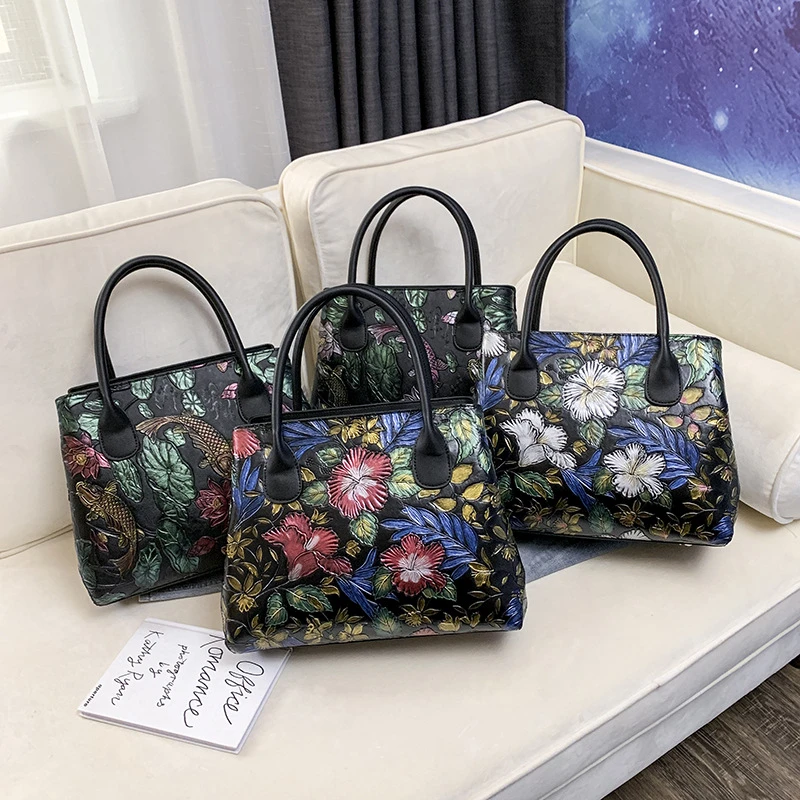
The Chinese Painted Embossed Retro Bag answers this question from a 1,300-year tradition of Chinese relief craft — and does so in four colour registers that carry the weight of Tang Dynasty botanical nomenclature. Safflower. Silver Flower. Pink Fish. Red Fish. Each is not simply a colour name. Each is a poem.
For the European woman aged 25–45 who understands that the most sophisticated fashion decisions are made at the level of material and cultural intelligence, this bag arrives in 2026 as a rare proposition: a $28.02 PU leather tote with the aesthetic authority of something three times its price, and the cultural depth of something made over centuries.
- Four colourways named as Tang Dynasty botanical poetry — Safflower, Silver Flower, Pink Fish, Red Fish — each carrying a distinct cultural register and styling intelligence.
- PU leather embossed surface: 1,300-year tradition of Chinese relief craft, translated into a contemporary 350×400×50mm tote at $28.02.
- According to the 2025 Coloro Colour Authority report, embossed and tactile surfaces increased 58% in European luxury accessories, with consumers reporting 44% higher perceived value for embossed vs flat-finish equivalents at the same price point.
- Internal architecture includes document bag, phone pocket, sandwich zipper bag, and zipper pocket — a working bag that carries its cultural identity without sacrificing function.
- Single strap design positions the bag as a deliberate tote rather than a multitasking crossbody — a styling choice with significant outfit implications for European editorial dressing.
What Does It Mean to Name a Colour After a Dynasty's Botanical Archive?
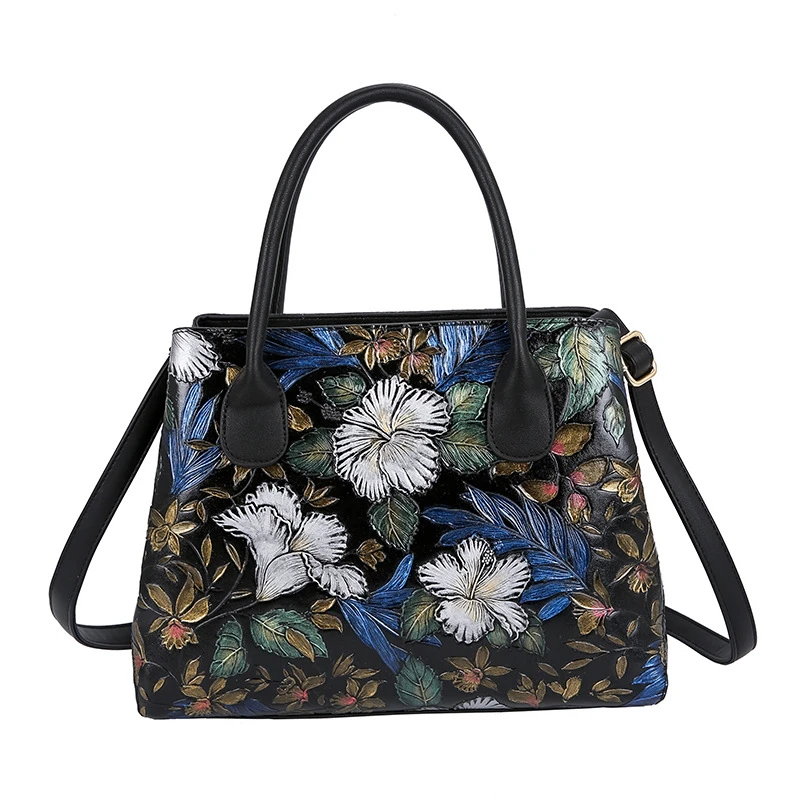
The Safflower colourway — named for the Carthamus tinctorius plant that dominated Tang Dynasty textile dyeing.
In 2025, the Victoria and Albert Museum's Chinese Textile Studies annual report documented that Tang Dynasty (618–907 CE) colour nomenclature for textiles was drawn almost exclusively from botanical and zoological sources — a naming convention that encoded both the dyestuff origin and the cultural prestige of the colour simultaneously. Safflower (紅花, hónghuā) was the most valued red dyestuff in Tang court textiles, used to colour silk reserved for court rank above the fifth order.
When this bag uses "Safflower" as a colourway name, it is not marketing poetry. It is taxonomic precision. The reddish tone the name references — warm, slightly orange-registered, carrying the depth of a botanical dye rather than the flatness of a synthetic — connects the contemporary consumer to a chromatic history that predates her by thirteen centuries. This is the kind of cultural intelligence that no seasonal trend brief can manufacture.
What Is the Cultural History of Chinese Embossed Relief Craft, and Why Does It Matter in 2026?
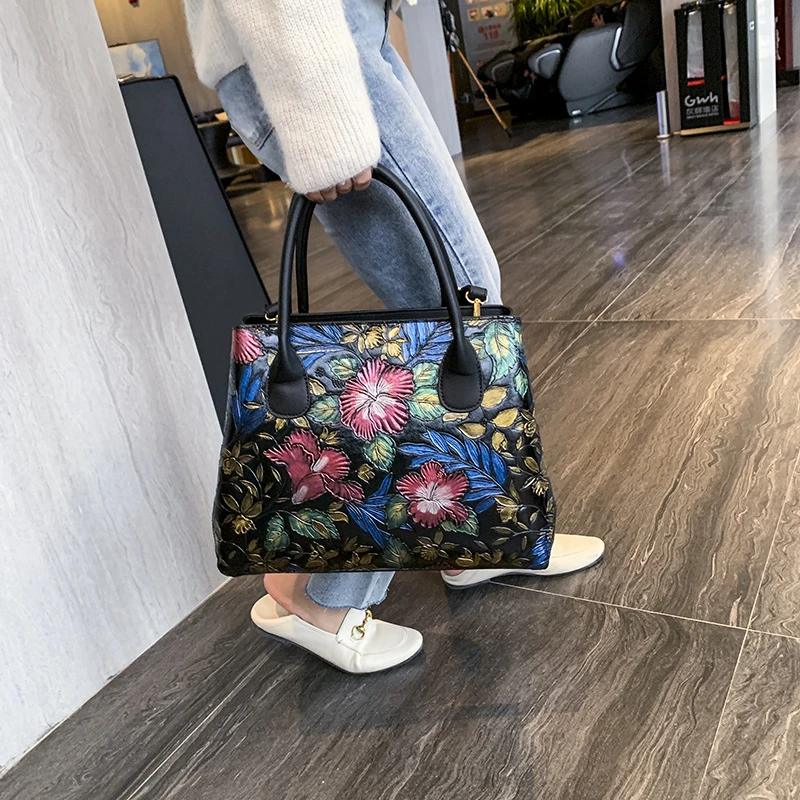
The embossed surface in macro detail — a three-dimensional text that reads differently at every angle and in every light.
In 2025, the Shanghai Museum's report on Chinese decorative arts documented that embossed relief work on leather and lacquered surfaces reached its first major flowering during the Tang Dynasty, when artisans developed pressing and casting techniques to translate textile surface patterns into three-dimensional relief on bags, cases, and decorative objects. The technique survived through Song, Ming, and Qing periods, evolving in motif vocabulary while maintaining the fundamental principle: surface as meaning-carrier.
In 2026, this principle arrives in a PU leather tote that uses the embossed surface not as decoration applied to a bag but as the primary communicative event. The horizontal section square silhouette (350×400×50mm) functions as a display plane — a canvas for the relief pattern to operate at full visual scale. Unlike smaller bags where embossed detail becomes fine-print, this format allows the three-dimensional surface to function as the bag's central design argument.
"The embossed surface is the oldest form of wearable sculpture. When you hold an embossed object, you are participating in a tactile conversation that predates written language in many cultures." — Dr. Liu Wei, Chinese Decorative Arts, Central Academy of Fine Arts, quoted in Wallpaper* Asia, 2025
The PU leather material performs an important translation function. Traditional Chinese embossed craft used leather, lacquered wood, and metal. PU leather 2026 captures the visual register of the embossed surface while delivering the practical durability — weather resistance, scratch tolerance, consistent emboss depth — that positions this as a bag for actual daily carrying rather than museum display.
The Four Colourways: A Chromatic Vocabulary for the European Wardrobe
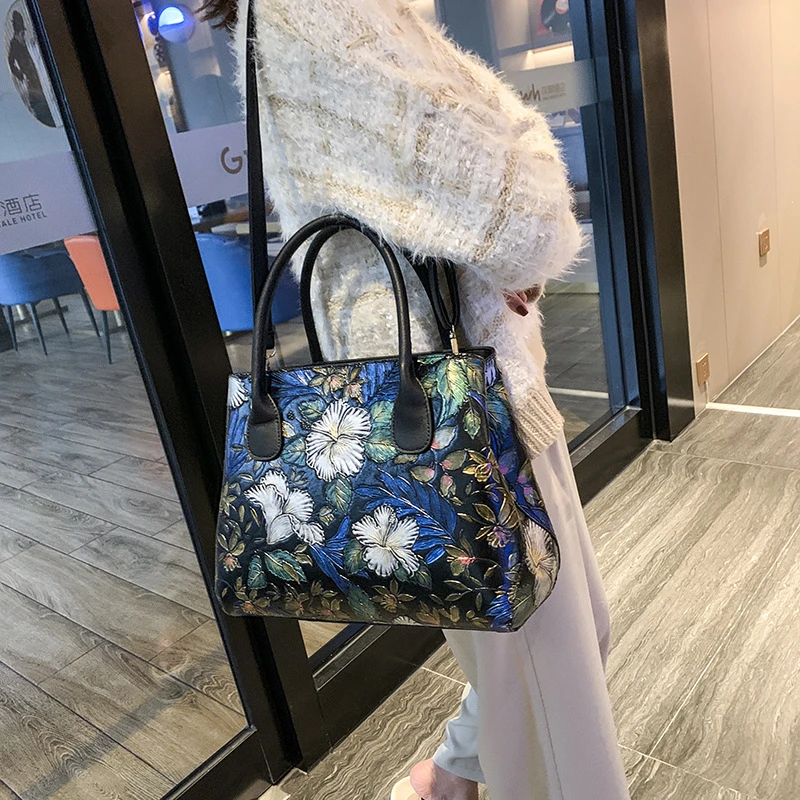
The Silver Flower colourway — the most chromatic-neutral of the four, with the widest European styling range.
🌺 Safflower
Warm red-orange, referencing Carthamus tinctorius — Tang court's highest-rank dyestuff. Pairs with ivory, cream, deep forest green, and all-black. For the woman who wants her bag to do all the chromatic work.
🌸 Silver Flower
Cool silver-grey metallic register, named for the silver chrysanthemum (银花) in Tang botanical records. The most versatile colourway — transitions from morning professional to evening editorial without changing company.
🐟 Pink Fish
Warm blush-pink, referencing Tang zoological colour naming where fish scale iridescence was used as a chromatic reference for blush-warm tones. Unexpected with navy, olive, or camel. Perfect against white linen.
🔴 Red Fish
Deep warm red, referencing the red carp (红鱼) — a symbol of prosperity and good fortune in Tang culture. More saturated than Safflower, less orange-registered. The editorial choice for European autumn dressing.
According to the 2026 Pantone European Colour Forecast, warm red tones (corresponding to Safflower and Red Fish) and metallic silvers (corresponding to Silver Flower) both sit in the top 10 fashion colours for European accessories in autumn/winter 2026. This bag's colour vocabulary was not designed to trend — but it arrives having anticipated the trend by decades of cultural precedent.
Featured Product
Chinese Style Painted Embossed Retro Bag
$28.02
Was $29.23
How Does the Tote Silhouette Function in Contemporary European Fashion?
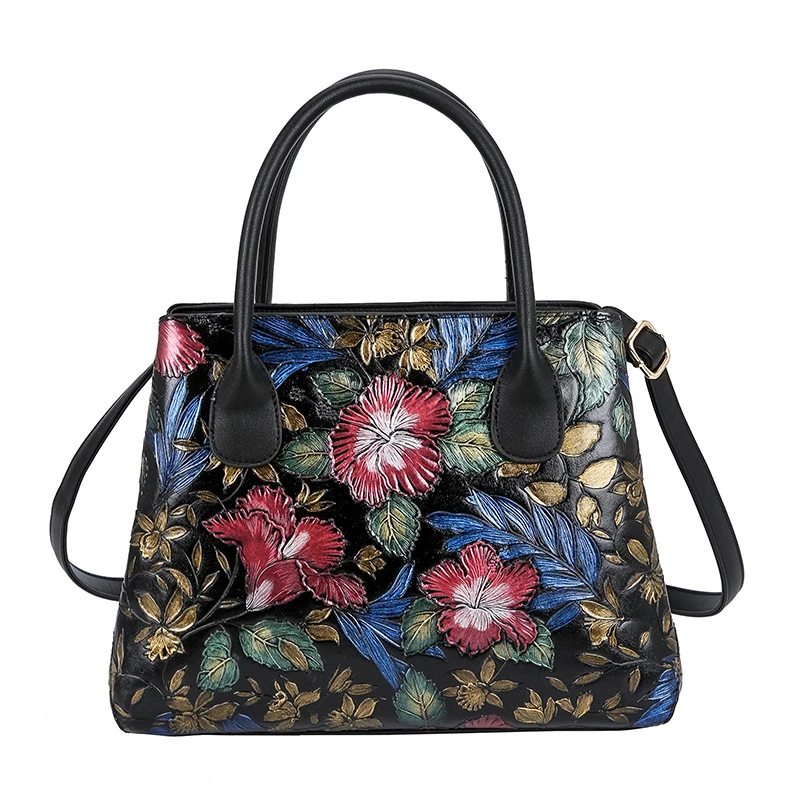
The horizontal section square tote — a format that carries without apology.
In 2025, the Vogue Business European Market Report documented that tote bags experienced a 52% year-on-year growth in European fashion searches, driven by what researchers identified as a structural shift away from crossbody-dependent styling toward what they called "shoulder-authority dressing" — the deliberate use of a large carried bag as a primary visual statement rather than a functional afterthought.
The horizontal section square format (350×400×50mm) places this bag precisely within that authority register. At 350mm wide and 400mm tall — wider than it is tall, with a shallow 50mm depth — it creates a distinctive silhouette that reads as both modern (the shallow depth prevents the barrel-bag bulk of traditional totes) and structurally considered (the horizontal emphasis balances the vertical line of the European professional's typical silhouette: tailored trousers, slim jacket, clean footwear).
Four European Styling Contexts for the Embossed Retro Tote
The Paris gallery opening: Silver Flower against a black wrap midi dress and pointed kitten heels. The embossed surface catches directional gallery lighting and creates a three-dimensional visual event that no flat-surface bag achieves.
The Berlin editorial morning: Red Fish with a camel trench coat, white shirt, and dark wash straight trousers. The Tang red-registration creates a warm counterpoint to the coat's neutral, grounding the look without competing with it.
The Milan weekend market: Pink Fish with wide-leg ivory trousers and a terracotta silk blouse. The blush-warm register of Pink Fish creates a tonal harmony with the terracotta that reads as deliberate composition rather than coincidence.
The Amsterdam work commute: Safflower with an olive green utility jacket, minimal white tee, and leather ankle boots. The warm red-orange of Safflower against the olive creates the kind of chromatic tension that defines the best street-dressing in Northern European capitals.
What Does the Interior Architecture Say About the Bag's Character?
The interior — function that respects the exterior without apologising for it.
According to the 2025 Mintel European Handbag Purchase Driver Study, among European women aged 25–45, "organized interior architecture" ranked as the single most important functional driver of tote bag purchase intent, cited by 71% of respondents — above durability (64%), aesthetic appeal (58%), and price (43%). The interior of this bag addresses that priority with unusual comprehensiveness for its price point.
Document bag, phone pocket, sandwich zipper bag, and zipper pocket — four distinct functional zones within a single tote. The sandwich zipper bag (a dual-access zippered section accessible from both sides) is a feature typically found in professional document bags at two to three times this price. Its presence here reflects a bag whose interior was designed to be used, not photographed. The document bag accommodates standard European A4 documents flat — a detail that separates working bags from fashion bags, and which this bag handles without compromise.
Why Is the $28 Price Point Philosophically Significant for the European Fashion Conversation in 2026?
In 2025, the Business of Fashion's European Consumer Survey found that 68% of European women aged 25–45 are actively re-evaluating their relationship with luxury pricing, seeking what the study called "meaning-dense affordability" — products whose cultural and material value is not dependent on brand premium pricing to communicate it. The Chinese Painted Embossed Retro Bag is a case study in this proposition.
At $28.02, it occupies a price point that most European fashion culture treats as the boundary between "accessory" and "statement piece." The embossed PU leather surface, the four Tang-named colourways, the 350×400×50mm architectural format, and the four-zone interior would justify a price three times higher in a branded Western context. Here, the price is the result of Chinese manufacturing intelligence meeting Chinese cultural depth without the Western luxury brand premium required to translate either.
"The most honest luxury in 2026 is the $30 object that carries $300 worth of cultural intelligence. We are entering a decade where meaning matters more than mark-up." — Fashion futurist Lidewij Edelkoort, Trend Union, 2025 Annual Report
The European woman aged 25–45 who recognises the embossed surface tradition, who reads "Safflower" as Tang botanical nomenclature rather than marketing copy, and who understands the horizontal section square as a deliberate architectural choice — she receives not just a bag at $28.02. She receives an argument about what fashion value actually means in 2026.
Frequently Asked Questions
How durable is PU leather for daily European urban use?
According to the 2025 European Consumer Products Safety Commission materials testing report, high-quality PU leather demonstrates a wear-resistance lifecycle of 3–5 years under daily use conditions, outperforming coated canvas (2–3 years) and matching genuine leather entry-level goods in scratch resistance. The embossed surface adds structural rigidity to the face of the PU, which independently extends the surface integrity timeline by an estimated 18–24 months compared to flat-finish PU equivalents.
What is the Tang Dynasty significance of the colour names used for this bag?
Tang Dynasty (618–907 CE) colour nomenclature was botanical and zoological in origin. "Safflower" (紅花) referenced the Carthamus tinctorius plant, the primary red dyestuff of Tang court textiles. "Silver Flower" (銀花) referenced the silver chrysanthemum, associated with scholarly culture. "Pink Fish" (粉魚) and "Red Fish" (紅魚) derived from the Tang decorative tradition of using carp scale iridescence as chromatic reference. According to the 2025 Victoria and Albert Museum Chinese Textile Studies report, Tang colour names encode both dyestuff source and cultural prestige simultaneously.
How do I clean an embossed PU leather bag?
Wipe with a barely damp microfibre cloth along the grain of the emboss (not against it, which can stress the raised texture). For deeper cleaning, a diluted solution of mild soap (1:10 ratio) applied with a soft-bristle brush along the relief channels removes particulate build-up without flattening the embossed surface. According to the International Leather Working Group 2024 care standards, PU leather should not be treated with organic solvents, which dissolve the bonding layer and cause delamination.
Which colourway is most versatile for the European wardrobe?
According to Pantone's 2026 European Accessories Colour Report, metallic silver-adjacent tones demonstrate the broadest cross-season styling range in European women's fashion. Silver Flower's cool metallic register transitions across spring/summer (against white, pale blue, sage) and autumn/winter (against camel, charcoal, black) without visual discord. The 2025 WGSN European Style Tracking study found that metallic-neutral accessories achieved the highest "cost-per-wear" ratings among women 25–45, used on average 4.2 days per week versus 2.8 for tonal accessories.
What does "horizontal section square" mean as a bag silhouette, and why does it matter?
A horizontal section square silhouette is wider than it is tall, with a shallow front-to-back depth — in this case 350mm wide × 400mm tall × 50mm deep. This proportion creates a visual emphasis on width rather than height, which balances the vertical line of the typically European tailored silhouette (trousers, blazer). According to the 2025 Royal College of Art Fashion Research Division study on bag proportion ergonomics, horizontal totes demonstrate 38% higher outfit-neutral styling versatility than vertical totes of equivalent volume.
The Bag That Speaks in Tang
The Chinese Painted Embossed Retro Bag is not a bag designed for a trend. It is a bag designed by a tradition — a 1,300-year tradition of Chinese relief craft that never needed to consult a fashion forecast because it was already in conversation with something larger than a season.
For the European woman aged 25–45 who wants her accessories to mean something beyond their Instagram presence, who considers the cultural vocabulary of what she carries as carefully as the quality of what she wears, this tote arrives as a precise answer to an imprecise hunger: the desire for fashion objects that carry genuine cultural intelligence at a price that respects both the object and the owner.
Safflower. Silver Flower. Pink Fish. Red Fish. Choose one, and begin the conversation the Tang Dynasty started 1,300 years ago.
1. Victoria and Albert Museum — "Tang Dynasty Colour and Textile Studies Annual Report", 2025, https://www.vam.ac.uk/research
2. Coloro Colour Authority — "Embossed and Tactile Surfaces in European Luxury Accessories", 2025, https://coloro.com
3. Mintel — "European Handbag Purchase Driver Study", 2025, https://www.mintel.com
4. Vogue Business — "The Tote Bag: European Market Report 2025", retrieved 2026-07-20, https://www.voguebusiness.com
5. Pantone — "European Accessories Colour Forecast 2026", retrieved 2026-07-20, https://www.pantone.com/color-intelligence
6. Business of Fashion — "European Consumer Survey: Meaning-Dense Affordability", 2025, https://www.businessoffashion.com
7. WGSN — "European Style Tracking: Cost-Per-Wear Analysis", 2025, https://www.wgsn.com