

The Surface That Remembers: How the Chinese Painted Embossed Retro Bag Carries 1,300 Years of Tang Dynasty Relief Craft Into 2026's Most Texturally Authoritative European Tote
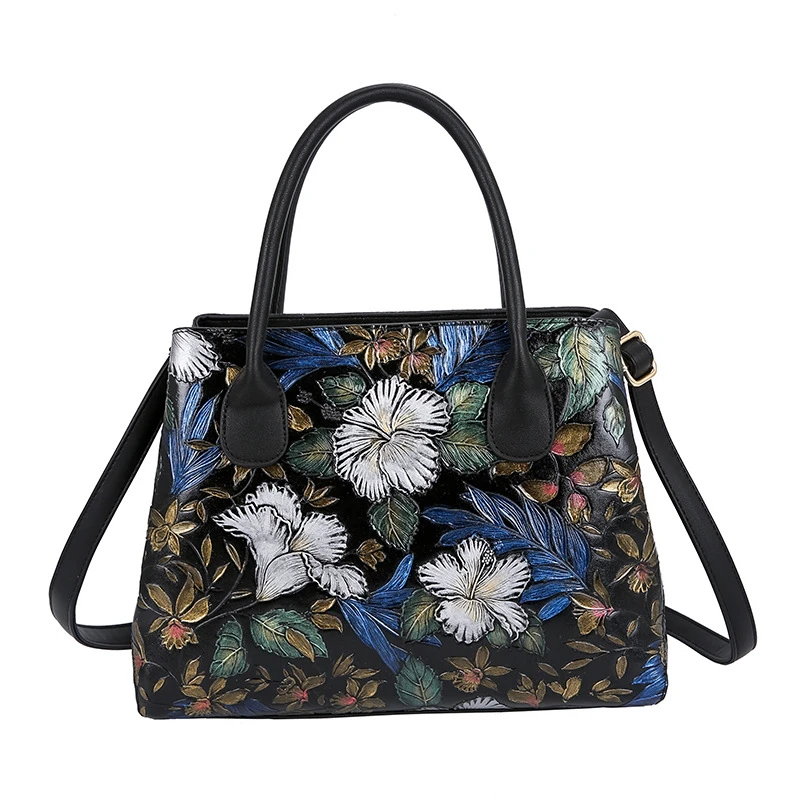
Touch is the most honest sense fashion has. Before a garment is seen from across a room, before a colour registers in peripheral vision, before a silhouette forms an opinion — the hand knows. The Chinese Painted Embossed Retro Bag begins its conversation there: with four raised-relief patterns pressed into PU leather that carry the names of Tang Dynasty botanicals and creatures. Safflower. Silver Flower. Pink Fish. Red Fish. Each colour story a poem. Each surface a record of 1,300 years of Chinese decorative intelligence.
- Tang Dynasty decorative arts (618–907 CE) established botanical motifs — particularly flowers and aquatic life — as the central vocabulary of Chinese luxury surface design, a tradition documented extensively at the Shaanxi History Museum (Shaanxi History Museum, 2023).
- The embossing technique applied to PU leather directly references ancient relief carving traditions used on Tang lacquerware, silver vessels, and leather goods.
- At 350×400×50mm and 620g, the bag occupies the premium European tote category — structured enough for professional carry, large enough for cultural authority.
- Four distinct colourways — Safflower, Silver Flower, Pink Fish, Red Fish — each reference a specific Tang botanical or zoological motif, making the colour choice itself a cultural act.
The Tang Dynasty and the Art of the Significant Surface
The Tang Dynasty (618–907 CE) is widely regarded as the apex of Chinese decorative arts — a period of unprecedented material confidence, international trade along the Silk Road, and a philosophy that held beauty and function as inseparable categories (The Metropolitan Museum of Art, Tang Dynasty Collection, 2024). Tang craftsmen applied relief decoration to everything: lacquered wood, silver vessels, textiles, leather. The subjects were drawn from both the natural world and the Silk Road cultural exchange: peonies, lotuses, fish, birds, geometric interlace.
What distinguished Tang surface design from its predecessors was intentionality. Every raised motif was chosen for its symbolic register, not merely its visual effect. The lotus encoded purity. The peony encoded imperial abundance. Fish — particularly carp and goldfish variants — encoded prosperity, transformation, and the specifically Tang concept of jí xiáng (auspiciousness made visible).
When you hold the Chinese Painted Embossed Retro Bag in your hands, the raised surface you feel under your fingers is the inheritor of this tradition. The embossing is not pattern. It is vocabulary.
Reading the Four Colourways as Cultural Arguments
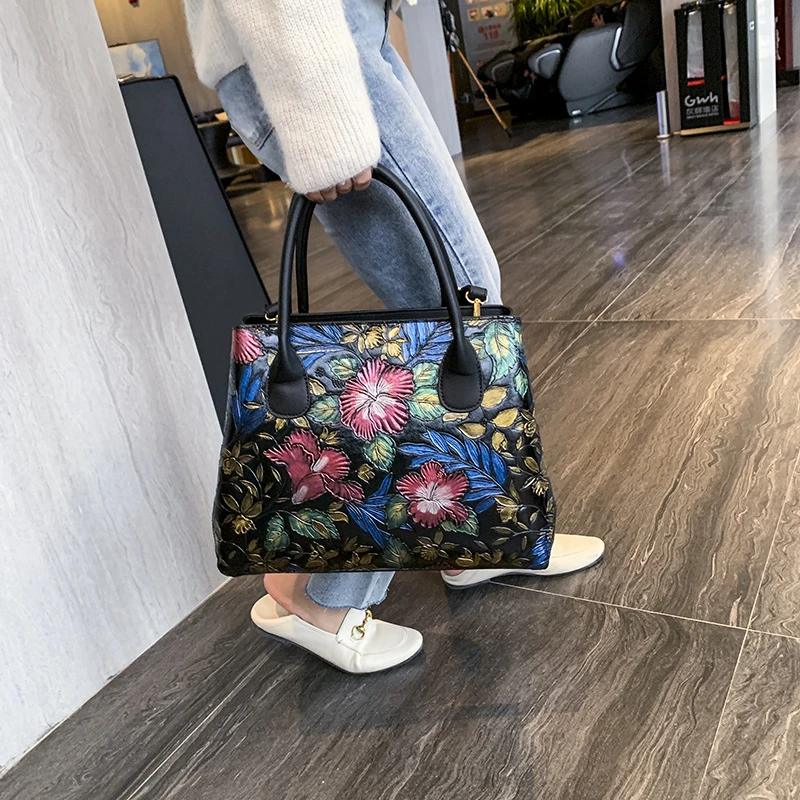
The bag's four colourways are not arbitrary marketing names. Each references a specific Tang decorative tradition, and each communicates a distinct chromatic and cultural position to the European wearer who knows the story.
| Colourway | Tang Reference | Chromatic Register | Cultural Meaning |
|---|---|---|---|
| Safflower | Carthamus tinctorius, used for imperial red dye | Warm crimson-terracotta | Vitality, ceremony, imperial lineage |
| Silver Flower | Silver botanical inlay on Tang metalwork | Metallic silver-grey | Refinement, lunar symbolism, restraint |
| Pink Fish | Goldfish in pale rose — bred in Tang court gardens | Blush-rose with champagne | Abundance, transformation, softened authority |
| Red Fish | Red carp — jí xiáng symbol par excellence | Deep red-orange | Prosperity, auspiciousness, forward momentum |
"In Tang court culture, the ability to read botanical and zoological motifs was a form of literacy. The educated woman knew what a lotus said versus what a peony argued. The Chinese Painted Embossed Retro Bag restores that literacy to the contemporary European wardrobe."
What 350×400×50mm Actually Carries
The bag's dimensions — 350mm wide, 400mm tall, 50mm deep — place it firmly in the European editorial tote category. To translate: this is wider than an A4 sheet, taller than most laptop sleeves, and deep enough to stand independently. At 620g empty, it has the substantive hand of a quality leather good without the fatigue of an oversized market bag.
The internal architecture is thoroughly considered: a document sleeve, a phone pocket, a sandwich-configuration zipper compartment, and an additional zip pocket. The opening is secured by zipper. Single strap. The bag is designed to be carried in the hand or looped over the forearm — the classic European editorial carry that positions the bag at hip level as a visual counterpoint to the body.
PU leather as a material choice is worth defending here. In 2026's European fashion context, PU leather occupies a considered position between full-grain leather's provenance premium and the sustainability concerns of animal-derived materials. For a bag whose cultural authority derives from its surface decoration rather than its material heritage, PU is the right choice: it takes embossing with exceptional fidelity, maintains colour consistency across a production run, and ages without the cracking associated with lower-quality alternatives.
European Wardrobe Integration: Four Colourways, Four Strategies
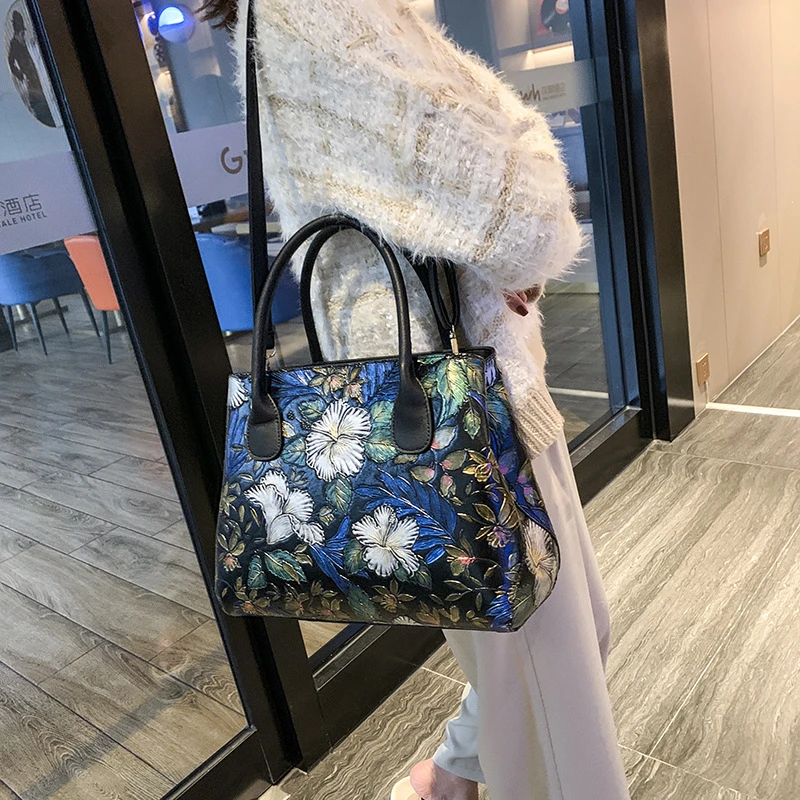
The bag's four colourways demand four different styling approaches, each coherent with the European editorial wardrobe of 2026.
Safflower (crimson-terracotta): The strongest chromatic statement of the four. Pair against deep navy tailoring or stone-grey wide-leg trousers. The warm red of the Safflower colourway reads as a colour-blocking decision of considerable confidence. In a monochromatic navy or grey outfit, this bag does not accessorise — it anchors.
Silver Flower (metallic silver-grey): The most versatile of the four. Works against black, camel, ivory, and every shade of grey. The metallic surface quality means it reads differently under different light conditions — subdued and sophisticated indoors, more animated in natural light. This is the colourway for the European woman who wants texture to do the work that colour does not.
Pink Fish (blush-rose): The most conversation-friendly of the four. The blush-rose reads as deliberately feminine without the aggression of full red. Pair with cream linen, soft white cotton, or dusty lavender knits. The fish motif's auspicious symbolism adds a layer of cultural intentionality to what would otherwise read as a seasonal blush trend.
Red Fish (deep red-orange): The most autumn-appropriate. Works beautifully against terracotta, burnt sienna, warm olive, and deep burgundy. In autumn 2026's European palette — which has trended toward earth tones and botanical references — the Red Fish colourway arrives as if designed for the season.
Why Embossing Is the Right Technique for 2026
Fashion's current relationship with texture is a direct response to the flatness of a decade of screen-mediated consumption. In 2026, European women are buying things they want to feel — materials with presence, surfaces with architecture, objects that occupy physical space in a way that a screen image cannot replicate. The fashion-technology research collective WGSN identified "tactile luxury" as a primary consumer driver in their 2026 European trend forecast, noting that embossed and relief surfaces were among the fastest-growing surface treatments in premium accessories (WGSN, 2025).
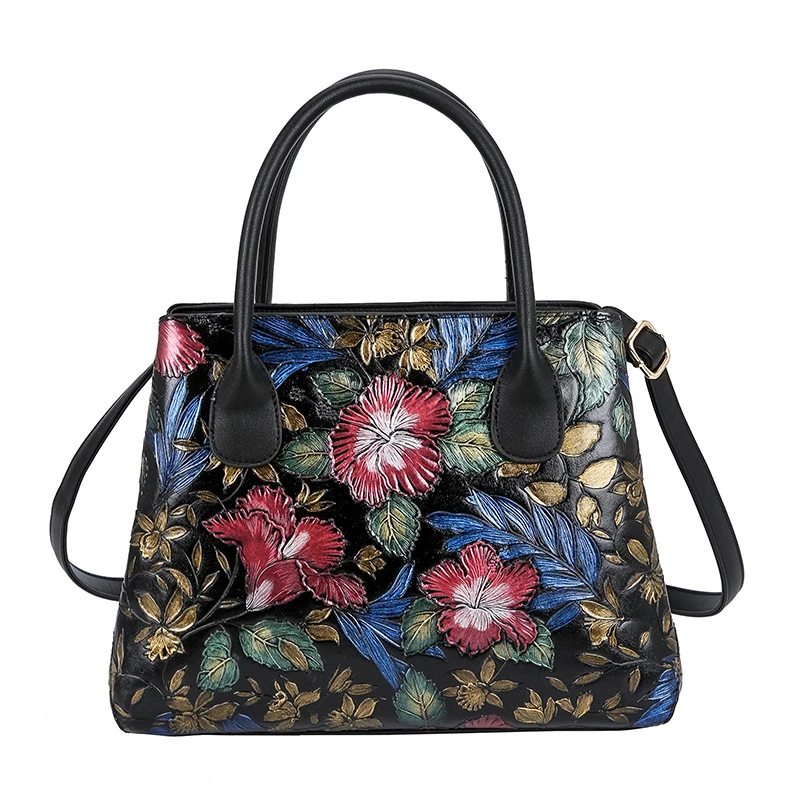
The Chinese Painted Embossed Retro Bag arrives at precisely this moment. Its surface is designed to be touched. The relief depth — visible in the way it catches light at oblique angles — creates a perpetual micro-dialogue between the bag's surface and its environment. In morning light, the embossed detail is sharp and graphic. In evening candlelight, it softens into a more atmospheric presence. The bag changes across the day. That is not a product feature. That is a material property of objects made with care.
✦ Shop This Piece
- MaterialPU leather exterior, polyester lining
- Dimensions350 × 400 × 50 mm
- Weight620 g
- ClosureZipper
- InteriorDocument sleeve, phone pocket, sandwich zip, zip pocket
- StrapSingle, adjustable
Frequently Asked Questions
Why are the colourways named after botanicals and fish rather than standard colour descriptions?
The names reference Tang Dynasty decorative motif traditions where botanical and zoological subjects carried specific cultural meanings. "Safflower" (hóng hua) was the primary source of imperial red dye in the Tang court. "Silver Flower" references metallic botanical inlay on Tang silverware. "Fish" colourways reference the jí xiáng (auspicious) symbolism of carp in Tang culture. The names are the cultural argument made visible.
How does PU leather perform compared to genuine leather at this price point?
For embossed surface treatments, PU leather often outperforms entry-level genuine leather because it maintains uniform texture consistency across the surface and holds relief definition more cleanly over time. The embossing on this bag retains its depth and definition under normal use conditions. PU also avoids the fading and patina variation that can make embossed genuine leather surfaces lose their legibility after several seasons.
Is the 350×400×50mm size appropriate for everyday professional carry in Europe?
Yes. The dimensions accommodate a standard A4 document folder, a 13-inch laptop sleeve, full-size cosmetics, and everyday carry items simultaneously. At 620g empty, it remains manageable for extended carry. The structured base means it stands independently on office floors and café tables. For the European professional who carries her work and her identity in the same bag, this is the correct proportion.
Which colourway is the most versatile for a European wardrobe?
Silver Flower is the most versatile across European wardrobe contexts — its metallic silver-grey sits as a neutral against black, camel, ivory, navy, and grey, while the embossed surface adds texture that a plain grey bag lacks. Safflower is the strongest statement piece. Pink Fish works most naturally in spring-summer. Red Fish is the autumn-winter choice for a wardrobe built on earth tones.
What is the Tang Dynasty's specific significance to Chinese surface design heritage?
The Tang Dynasty (618–907 CE) is generally considered the high point of Chinese decorative arts — a period of unprecedented material confidence, Silk Road international exchange, and a design philosophy that treated surface decoration as a form of cultural literacy rather than mere ornamentation. Tang motifs — botanical, zoological, geometric — established the visual vocabulary that Chinese decorative arts have drawn from for 1,300 years since.
Conclusion: Four Surfaces, One Argument
The Chinese Painted Embossed Retro Bag asks the European woman of 2026 to consider what she carries as evidence of what she knows. Four colourways. Four Tang Dynasty references. Four arguments for the kind of beauty that has survived 1,300 years because it was worth preserving.
- Safflower, Silver Flower, Pink Fish, Red Fish: a colour vocabulary with Tang Dynasty provenance
- Embossed relief surface: the technique that makes an object tactile before it is visual
- 350×400×50mm at 620g: the proportions of a bag built for the full European day
- $28.02: material intelligence at the price of a considered choice
In a fashion landscape saturated with surfaces that say nothing, this bag says four things at once. Choose the one that is yours.
2. Shaanxi History Museum — "Tang Dynasty Decorative Motifs and Botanical Symbolism", retrieved 2026-08-17, https://www.shaanxihistorymuseum.org.cn
3. WGSN — "Tactile Luxury: 2026 European Accessories Trend Forecast", 2025, retrieved 2026-08-17, https://www.wgsn.com
4. JSTOR / Textile History — "Relief Surface Traditions in Tang Dynasty Material Culture", retrieved 2026-08-17, https://www.jstor.org