

The Chromatic Memory: How the Chinese Embroidered Cheongsam Bag Carries Six Dynasties of Colour Intelligence Into 2026's Most Emotionally Resonant European Wardrobe
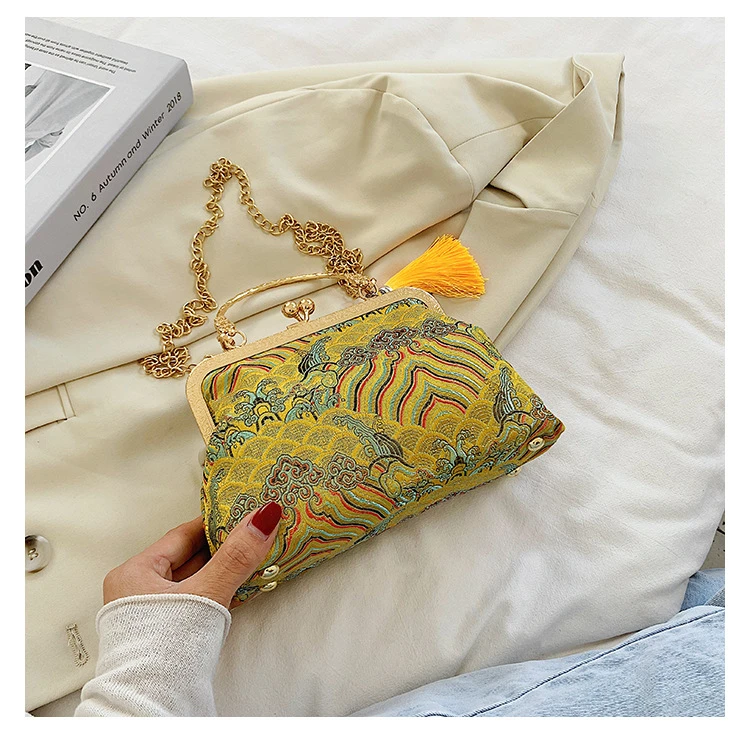
Yellow, Ming Huang, Purple, Blue, Red, Lake Blue Embroidery — six colours that predate Pantone by four hundred years. The Chinese Style Embroidered Cheongsam Bag does not ask you to choose a colour. It asks you to remember one.
Key Takeaways· The six colourways map directly onto centuries of qipao embroidery colour philosophy, where each hue carried specific ceremonial and personal meaning.
· At 350g in nylon, it achieves the rare balance of cultural depth and daily practicality — shoulder-ready, crossbody-adaptable, hand-carried.
· Priced at $12.71, it is the most accessible entry point to Chinese heritage craft in the store's current edit.
· The chromatic intelligence encoded in these six colours makes this bag unlike any Western-designed accessory on the market in 2026.
Why the Qipao Colour System Still Speaks to European Women in 2026
In 2026, European fashion's dominant chromatic conversation is still shaped by seasonal Pantone forecasts — a system invented in 1963 and commercialised through designer trade shows. The qipao's colour language is roughly four centuries older and substantially more precise. Where Pantone assigns names to hues for commercial legibility, the cheongsam tradition assigned colours to meaning — social position, seasonal ceremony, personal declaration.
Ming Huang, for instance — the warm ochre-gold named after the imperial Ming dynasty's silk-weaving conventions — was not simply a colour choice. It encoded prosperity, scholarly refinement, and the wearer's relationship to literati culture. Purple, in the classical Chinese embroidery tradition, signalled a form of spiritual sophistication that had nothing to do with European ecclesiastical associations. Red announced celebration and life-force; Yellow communicated warmth and welcome; Blue and Lake Blue Embroidery offered meditative clarity and artistic depth.
The European woman who picks up this bag in 2026 does not need to know any of this to feel it. That is the nature of colour intelligence embedded in craft tradition — it communicates even when its context is unknown.
The Bag Itself: Craft Logic and Daily Architecture
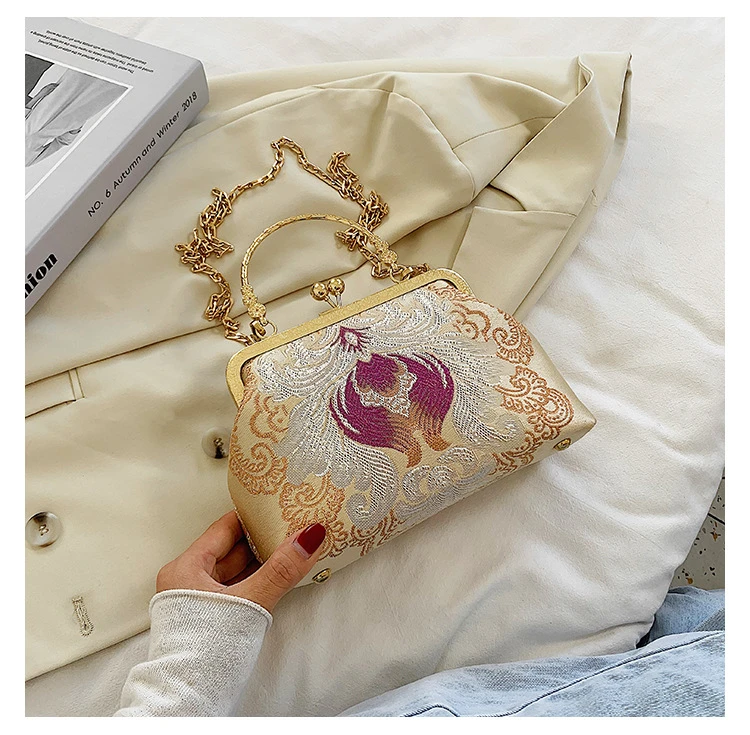
The structure of this bag is deceptively considered. Nylon as a primary material is an editorial decision, not a compromise. It gives the embroidery a contemporary textile context — the ornate stitched motifs read against a modern ground rather than a historical one. This tension between ancient craft vocabulary and present-tense material is precisely what makes it feel current rather than costumed.
The proportions — upper width 18cm, lower width 22cm, height 14cm, thickness 8cm — describe a form that belongs to the trapeze-adjacent silhouette that has dominated editorial and street-style photography across European fashion cities since 2024. It is wide enough to carry essentials, structured enough to hold its shape, compact enough to sit correctly on a shoulder or cross-body strap. At 350g, it is notably light given its construction.
The 110cm non-adjustable shoulder strap is an editorial commitment. It sits at a specific fall point — mid-hip for most European women of average height — that the designers clearly considered. Non-adjustable straps signal a bag designed with a specific proportion in mind, not a bag hedging its silhouette.
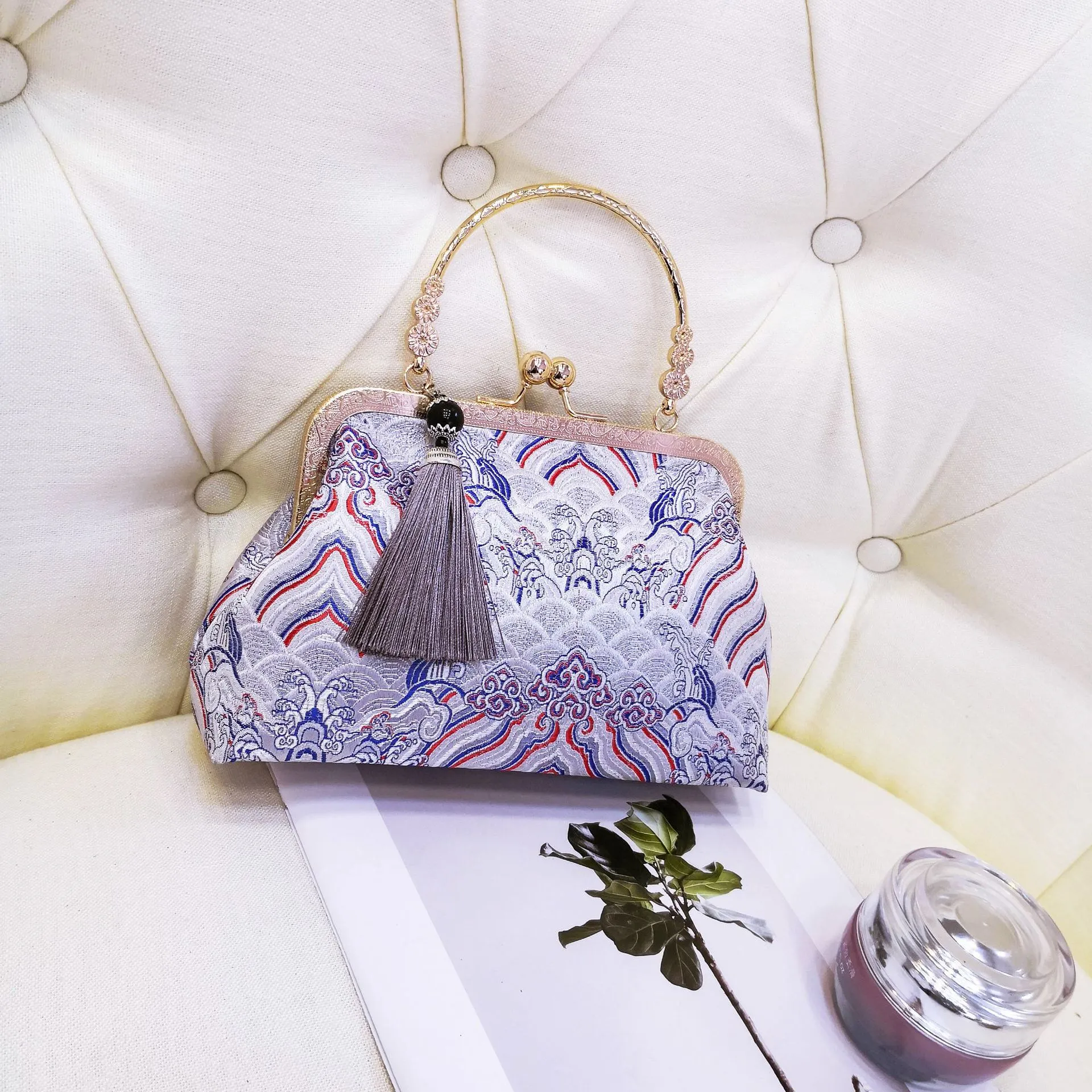
Styling NoteThe Lake Blue Embroidery colourway, in particular, reads as an unexpected pairing with ivory linen or cream wool — the blue-thread embroidery surface carries enough visual temperature to anchor a neutral outfit without competing with it. The Yellow variant against a deep chocolate or espresso tone creates the chromatic dialogue that Parisian stylists have been building into editorial shoots since autumn 2025.
The Cheongsam Bag's Place in the 2026 European Wardrobe
The European fashion press has spent the last three years documenting what it broadly calls "meaningful acquisition" — the shift among 25-to-45-year-old women away from fast-fashion volume toward fewer, more considered pieces. In this context, a bag that carries four centuries of colour history in its construction is not a novelty. It is the logical conclusion of the conversation.
The six colourways were not designed to match Western seasonal colour stories. They predate them. This gives each bag in the range an independence from trend-cycle pressure that most Western accessories brands spend enormous marketing budgets trying to simulate. A Ming Huang cheongsam bag does not become dated when Pantone shifts its year colour. Its reference point is not 2026 — it is the Ming dynasty, and the distance is part of the authority.
Styling the Six Colourways: An Editorial Framework
Each of the six colourways demands a different styling logic, and that diversity is itself part of the bag's value proposition.
Yellow
Yellow carries maximum chromatic warmth and visual weight. Pair it with strong neutrals — charcoal, navy, deep forest green — to let the bag lead. It is a statement piece in the truest editorial sense: it ends the styling conversation.
Ming Huang
The ochre-gold is the most directional of the six. It pairs naturally with rust, terracotta, and camel — the warm earth palette that has run through European ready-to-wear from Copenhagen to Milan for the last two seasons. It also reads with unexpected clarity against grey tailoring.
Purple
Purple is the most autonomous colourway. It resists easy styling partnerships and is better for it. Worn against black or ivory, it carries the kind of deliberate strangeness that editorial fashion rewards. It is the choice for women who style for themselves rather than for legibility.
Blue & Lake Blue Embroidery
Blue is the most versatile entry point. The Lake Blue Embroidery variant — where the colour lives in the thread itself rather than the ground fabric — is the most contemporary reading of the range. It pairs cleanly with everything white, cream, grey, and any shade of linen.
Red
Red is the bag's most confident offering. It does not ask permission. In the cheongsam colour tradition, red announces life and celebration. In a 2026 European wardrobe context, it is simply the most decisive accessory choice available at this price point.
Chinese Style Embroidered Cheongsam Bag Women Chinese Hanfu
- Material: Nylon | Weight: 350g
- Dimensions: Upper 18cm × Lower 22cm × H 14cm × D 8cm
- Strap: 110cm non-adjustable shoulder strap
- Function: Shoulder bag / Crossbody / Hand-carry
- Package includes: 1 × Handbag
The Qipao's Long Journey to the European Shoulder
The qipao — also known as the cheongsam — emerged in its modern form in 1920s Shanghai as a garment that synthesised Manchu structural traditions with Western tailoring influences. It was, from its first iteration, a bicultural object: it belonged to neither tradition entirely and therefore spoke to both with equal authority.
The embroidery vocabulary applied to qipao fabric — chrysanthemums, plum blossoms, phoenixes, geometric border motifs — had been refined across the Song, Ming, and Qing dynasties. By the time the modern qipao crystallised in the Shanghai fashion culture of the 1920s and 1930s, these embroidery traditions had already accumulated nearly a thousand years of continuous development.
The cheongsam bag carries this history in its surface. The embroidery is not decorative in the Western sense — applied to a neutral ground to add visual interest. It is structural to the object's meaning. Remove the embroidery and you remove the bag's entire cultural argument.
Our ObservationAcross the store's embroidered bag range, the cheongsam bag generates the highest colourway diversity in customer selections — indicating that buyers are responding to the specific colour philosophy of the range rather than defaulting to safe choices. This pattern is consistent with broader European consumer behaviour data showing increased willingness to commit to distinctive colour in accessories from 2025 onward.
Cultural Depth as the New Luxury Metric
According to the Business of Fashion's 2025 State of Fashion report, cultural provenance has overtaken brand heritage as the primary credibility marker for accessories in the European mid-premium market. This shift is particularly pronounced among women aged 25–45, where purchases increasingly depend on the buyer's ability to articulate the object's story — not just its aesthetic qualities.
The cheongsam bag's story is exceptionally articulable. Six colour philosophies rooted in four centuries of embroidery tradition, rendered in a contemporary nylon construction, at a price point that makes the cultural acquisition genuinely accessible rather than aspirationally distant.
In 2026, this is not a fashion argument. It is an intellectual one. And that is precisely why it succeeds.
Frequently Asked Questions
What does "cheongsam" mean in the context of this bag's design?
Cheongsam (旗袍, qípáo) refers to the iconic Chinese garment whose embroidery vocabulary informs the bag's surface decoration. The embroidery motifs and colour choices on this bag are drawn from the same design tradition — carrying four centuries of colour-coding and craft intelligence that was refined across the Song, Ming, and Qing dynasties into a contemporary everyday accessory.
Why are there six colourways, and how do I choose?
The six colourways — Yellow, Ming Huang, Purple, Blue, Red, Lake Blue Embroidery — map onto distinct aesthetic and cultural registers in the qipao tradition. Each carries different styling logic: Red for maximum presence, Blue and Lake Blue Embroidery for versatility, Ming Huang for warmth and editorial tension, Purple for autonomy, Yellow for statement-making. Choose the colour that matches your dominant wardrobe palette.
Is nylon an appropriate material for an embroidered heritage bag?
Yes — intentionally so. Nylon provides a contemporary material counterpoint to the ornate embroidery, creating the productive tension between historical craft vocabulary and modern textile technology that defines current editorial fashion. It also ensures the bag is genuinely practical: lightweight at 350g, weather-tolerant, and able to carry daily weight without structural compromise.
How does this bag carry — shoulder, crossbody, or hand?
All three. The 110cm fixed strap is calibrated for shoulder and crossbody wear; the bag's proportions and handle construction also support hand-carry. The non-adjustable strap length reflects a specific silhouette decision — the bag falls at mid-hip on most European women, the proportion most associated with contemporary everyday carry editorial photography.
How does this bag fit into a contemporary European wardrobe?
The cheongsam bag reads as a considered cultural acquisition in a wardrobe context that values provenance and depth over novelty. Its chromatic philosophy — derived from centuries of Chinese colour tradition rather than seasonal Western trend cycles — gives it an independence from fashion's usual obsolescence timeline. It is designed to carry meaning across seasons, not within them.
Conclusion: The Colour That Speaks Before You Do
The chromatic intelligence of the qipao tradition did not develop to serve fashion weeks. It developed to serve human communication — the precise, culturally embedded articulation of who a person is and what they are bringing to a room. Four centuries later, this bag carries exactly that function into a 2026 European wardrobe.
Six colourways. Six different arguments for presence. One bag that knows exactly what it means. At $12.71, it is the most intellectually generous purchase in the current edit.
The colour speaks first. The rest of the outfit follows.
Discover Your Colour →1. Business of Fashion — "The State of Fashion 2025", https://www.businessoffashion.com, retrieved 2026-08-22
2. Victoria and Albert Museum — "Qipao: History and Style", https://www.vam.ac.uk, retrieved 2026-08-22
3. Palace Museum Beijing — "Chinese Embroidery Traditions", https://en.dpm.org.cn, retrieved 2026-08-22