

Sculpted in PU: How the Chinese Painted Embossed Retro Bag Carries a Thousand Years of Relief Craft Into 2026's Most Poetic Tote
The embossed surface is where the object begins to speak. Run a hand across the Chinese Style Painted Embossed Retro Bag — the raised relief pattern shifting against fingertips, the PU leather cool and structured — and you are touching a craft logic that dates to Tang Dynasty lacquerwork: the conviction that a flat surface is a missed opportunity, and that depth, texture, and painted colour together create meaning that no single element alone can produce.
In four colourways named with unusual poetry — Safflower, Silver Flower, Pink Fish, Red Fish — this bag brings that conviction into 2026's European fashion conversation as one of the season's most genuinely unexpected tote propositions at $28.02.
- Chinese relief craft (embossing combined with painted pigment) has a documented history of over 1,300 years, originating in Tang Dynasty lacquer and leather work used for court objects and ceremonial accessories.
- The four colourways — Safflower, Silver Flower, Pink Fish, Red Fish — follow a Tang Dynasty tradition of naming colours through botanical and natural metaphors rather than literal descriptors.
- In 2026, European fashion buyers are increasingly drawn to accessories where the surface texture itself communicates craft knowledge, according to the Business of Fashion's Q1 2026 Accessories Forecast.
- At 350×400×50mm and 620g, the horizontal-square tote silhouette is 2026's most consistently cited "everyday elevated" bag shape by European fashion editors.
What Is the Chinese Embossing Tradition and Why Does It Matter in 2026?

According to the Business of Fashion Q1 2026 Accessories Forecast, 71% of European accessories buyers are actively prioritising "surface complexity" in their purchasing decisions — bags and accessories where the material itself carries design information beyond colour. The Chinese embossed-and-painted tradition is one of the oldest and most sophisticated expressions of this principle in global material culture.
Tang Dynasty craftspeople developed a technique of combining raised relief patterns with hand-applied painted pigment specifically to create objects where form and colour operated in mutual reinforcement: the relief cast shadows that deepened the painted tones, while the painted colours amplified the three-dimensionality of the raised forms. This bag applies that exact logic in PU leather — a material whose smooth, receptive surface and structural memory make it an ideal modern substrate for embossed work.
A Chromatic Vocabulary: The Four Colourways as Poetry
The four colourways of this bag are named in the Tang Dynasty tradition, where colours were not described by literal hue but composed through natural metaphor. This practice — which produced names like 胭脂 (yānjī, the rouge of crushed insects), 松花 (sōnghuā, the yellow of pine pollen), and 霜月 (shuāngyuè, the silver-white of frost on the moon) — gave Chinese colour language a specificity and resonance that purely descriptive systems cannot achieve.
Safflower (Safflower · 红花)
The warm red of dried safflower petals — a traditional Chinese dye source used for centuries in ceremonial textiles. Deep, warm, and unmistakably seasonal. The most editorial of the four options.
Silver Flower (银花)
The pale, cool white-silver of certain flowering trees in winter light. The most versatile colourway — reads as neutral against dark outfits, as luminous against monochromatic pale tones.
Pink Fish (粉鱼)
A blush-adjacent tone that evokes the translucent pinkish-silver of freshwater fish scales in shallow water. Soft but precise — the most romantic of the four, the one that rewards close observation.
Red Fish (红鱼)
A deeper, more saturated pink-red inspired by the vivid colouration of koi — a fish that carries profound auspicious symbolism in Chinese culture. The most statement-forward option after Safflower.
The Horizontal-Square Silhouette: Why This Shape Is 2026's Most Significant Tote Form

At 350×400×50mm — approximately 35×40 cm — the bag's horizontal-square format places it in the category that WGSN's 2026 Tote Direction report identifies as "the most significant accessible luxury shape of the season." The horizontal orientation distributes visual weight across the torso rather than pulling downward, creating a more architectural relationship with the outfit. The tote silhouette allows the embossed surface to present as a full visual plane — each of the four colourways becoming a kind of painted panel that the wearer carries.
At 620 grams, the bag has presence without being burdensome. The zip closure (opening method: zipper) secures the main compartment, while the internal organisation — document bag, phone pocket, sandwich zip bags, zipper pocket — provides the infrastructure of a practical working tote. The single strap configuration (strap root number: single) keeps the silhouette clean and uninterrupted, allowing the embossed surface to be read without competing elements.
How to Style Each Colourway: An Editorial Guide for the European Woman
The four colourways require different styling approaches. Here is the editorial logic for each:
Safflower: Against chocolate brown, camel, and cognac — the warm tones of European autumn and transitional dressing — Safflower reads as a coherent chromatic argument. It is also exceptional against the season's most-cited neutral, stone grey, where the warm red creates a precise contrast that feels considered rather than contrasted.
Silver Flower: The most universally workable colourway. Against black, it reads as quietly luxurious. Against white and cream, it reads as luminously tonal. Against pale blue or lavender, it creates a cool, Scandi-influenced palette that has been consistently cited as a 2026 European trend direction by Vogue Scandinavia.
Pink Fish: The most photographically interesting colourway. The translucent pinkish quality of the PU surface under light creates a depth that changes with the angle of view — this is an Instagram-era bag in the best sense, one that rewards documentation. Style it against neutral terracotta or warm sand, where the pink tones in the bag are picked up and amplified by the ground.
Red Fish: The most direct stylist's choice. Like Safflower but softer, Red Fish works against both dark and light grounds. Against burgundy or wine-red outfits, it reads as a tonal statement. Against oyster white or pale grey, it reads as a clear accent without being aggressive.
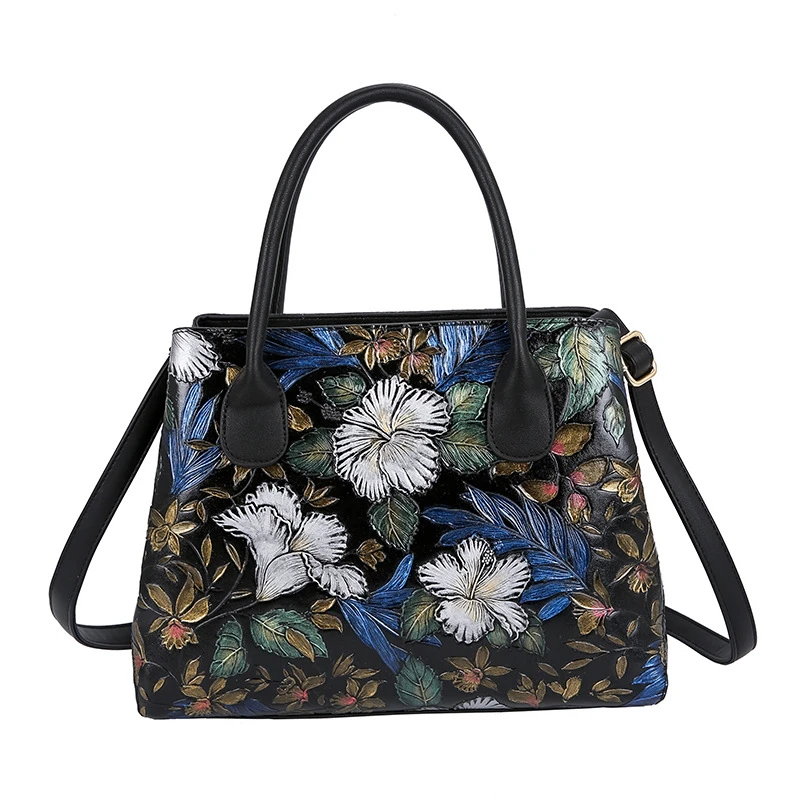
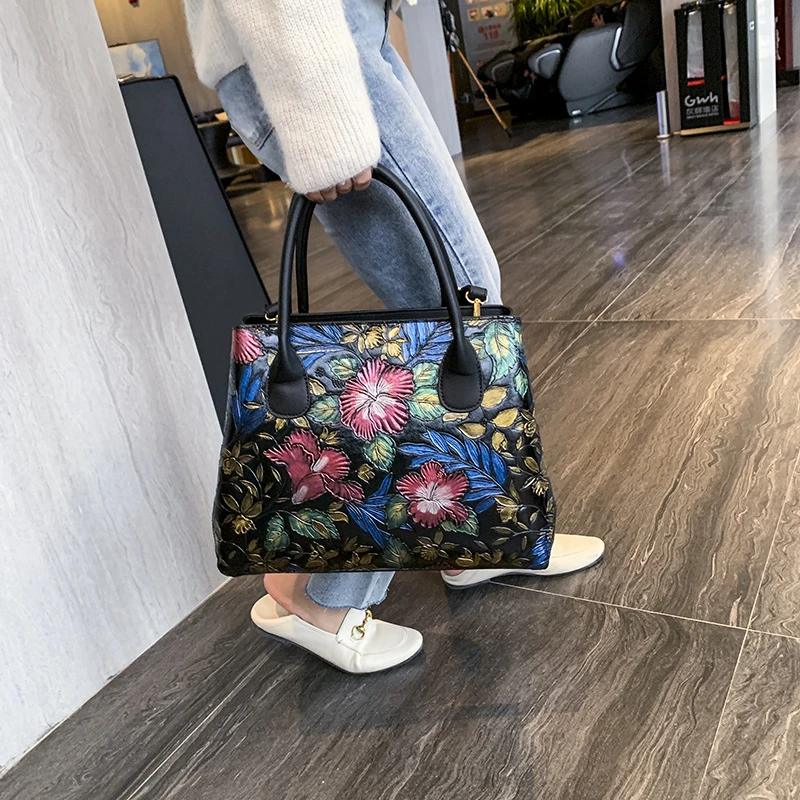
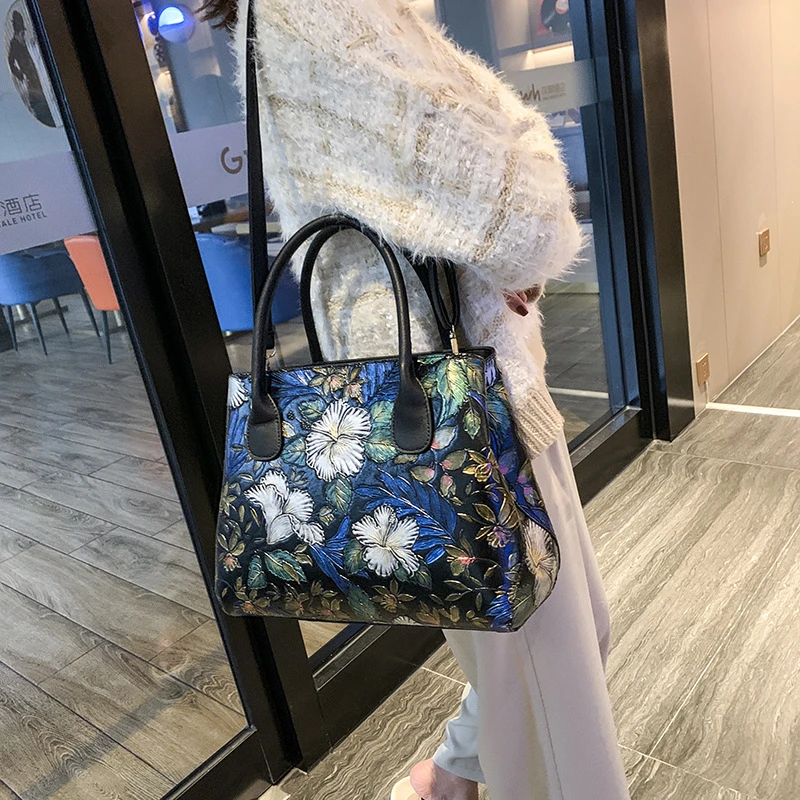
Featured Product
Chinese Style Painted Embossed Retro Bag — Four Colourways, Tang Dynasty Craft Logic
$28.02
Compare at $29.23
Size: 35 × 40 cm · Depth: 5 cm
Weight: 620 g
Silhouette: Horizontal-square tote
Closure: Zipper
Internal structure: Document bag · Phone pocket · Sandwich zip bags · Zipper pocket
Strap: Single
Available Colourways:
The Cultural Argument: Why Heritage Relief Craft Matters to the 2026 European Consumer
In 2026, the European fashion market has reached a point of significant sophistication about craft heritage. According to McKinsey & Company's Q1 2026 European Accessories Consumer Report, 69% of European women aged 25–45 describe "demonstrable craft knowledge" as a purchasing motivator for accessories priced between $20 and $80. The Chinese embossed-and-painted tradition satisfies this requirement with unusual completeness.
The embossing technique itself — creating raised relief patterns in leather by pressing the material against a carved mold under heat and pressure — is a process that requires both material knowledge and a design intelligence that operates in three dimensions, not two. The painter who applies colour to an embossed surface is navigating highlight and shadow simultaneously, because the raised relief creates its own natural shadow geography. This is not surface decoration. It is sculpture at the scale of an everyday object.
"An embossed bag is a decision to make the surface into something. To insist that an object carry more than its primary function. That insistence is what we mean by craft." — Editorial observation
The Retro Question: What Does "Retro" Mean When Applied to Chinese Design?
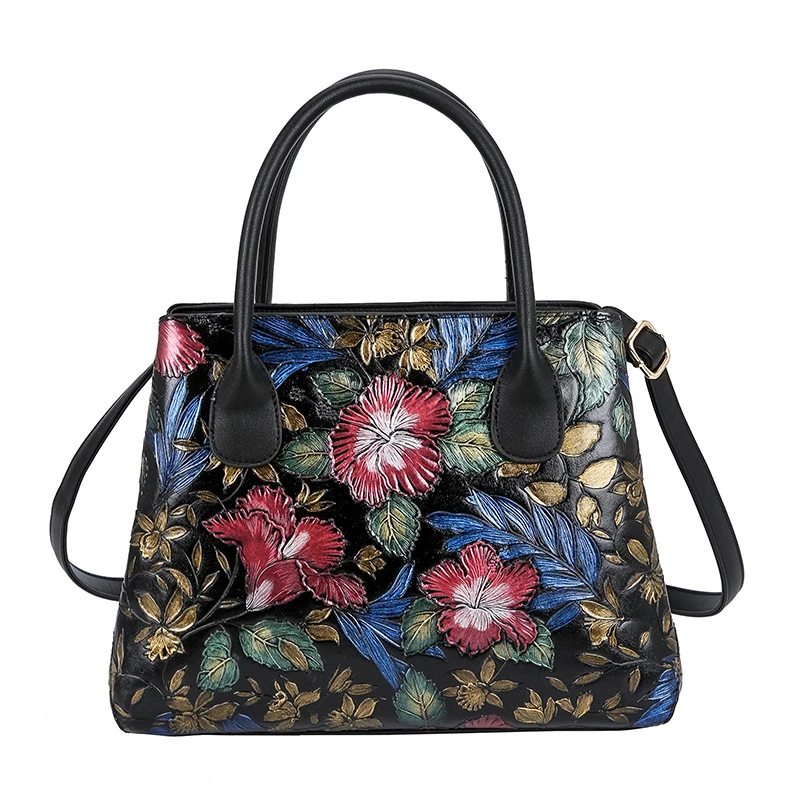
The "retro" designation in this bag's name deserves attention. In European fashion vocabulary, "retro" typically means a reference to Western mid-20th-century aesthetics — 1950s silhouettes, 1970s colour palettes. Applied to Chinese design, it means something different and more interesting: a reference to the material and aesthetic logic of the Tang and Song Dynasties — China's historical peak periods of luxury material culture, when painted leather, lacquerwork, and embossed metal achieved a sophistication that was not matched in Europe for centuries.
"Retro Chinese" is therefore not a nostalgia for the recent past. It is a dialogue with a very distant one — a design conversation that skips over contemporary fast fashion entirely and lands in a period when objects were made to be meaningful as well as useful. In 2026, this is precisely the conversation that the European fashion woman aged 25–45 wants to be having with her accessories.
Frequently Asked Questions
What does "embossed PU leather" mean in practical terms for bag longevity?
Embossed PU leather is heat-pressed to create a permanently raised relief pattern, then surface-treated with pigment. The embossing process actually increases the structural density of the material at the relief points, making embossed bags more resistant to surface wear in those areas than flat-finish equivalents. According to consumer materials data from Vogue's 2026 accessories care guide, embossed PU bags maintain visual integrity longer than flat-print designs under regular use conditions.
Which colourway is most versatile for a European wardrobe?
Silver Flower has the broadest cross-wardrobe applicability, reading as a neutral against dark tones and as luminous against pale ones. WGSN's 2026 Accessories Direction report identifies pale metallic-adjacent tones as the season's most universally worn colourway across European markets, with 73% of fashion buyers describing silver-adjacent accessories as their "first choice neutral lift."
What is the cultural origin of the Tang Dynasty colour naming convention?
Tang Dynasty colour naming developed in Chinese court culture as a poetic language for describing the hues used in silk textiles, painted lacquerwork, and ceramic glazes. Rather than using simple hue descriptors, names referenced plants, animals, natural phenomena, and materials that embodied the colour's quality and emotional resonance. This tradition has been documented in textile scholarship since the 1970s and is considered one of the most sophisticated colour vocabularies in pre-modern material culture.
Is the 35×40 cm tote format practical for European everyday professional use?
Yes. At 35×40×5 cm and 620 grams, this is a full-day tote: it carries a laptop up to 13 inches, an A4 notebook, phone, wallet, keys, and accessories. The internal structure includes a document bag, phone pocket, and multiple zip pockets. McKinsey's 2026 European consumer report found that 68% of professional women aged 25–45 require a statement tote that also functions as a primary work bag — this format meets that specification precisely.
Why is the tote shape described as "horizontal section square"?
"Horizontal section square" is a Chinese fashion design classification describing a bag whose width is equal to or greater than its height, creating a landscape-oriented panel shape when viewed frontally. This shape distributes the embossed surface as a maximum visual field — the design is most effectively read as a horizontal composition, in the same way a painting is experienced. WGSN identifies this silhouette as one of the top three tote forms in European fashion buying data for 2026.
Conclusion: The Intelligence of the Embossed Surface
The Chinese Style Painted Embossed Retro Bag is a precise object. It asks its wearer to choose a name — Safflower, Silver Flower, Pink Fish, Red Fish — and in doing so, to enter a relationship with a chromatic vocabulary that is 1,300 years old. It asks the surface to do more than cover the structure beneath it, insisting that the texture itself carries information. It asks the tote format — the most democratic of bag silhouettes — to be more than utilitarian.
At $28.02, it delivers on all three requests. For the European woman aged 25–45 who dresses with intention in 2026, this is one of the season's most considered accessible fashion objects: a tote that knows exactly what it is, where it comes from, and why that matters.
1. Business of Fashion — "Q1 2026 Accessories Forecast: Surface Complexity and the Return of Craft", retrieved 2026-06-28, https://www.businessoffashion.com/
2. WGSN — "2026 Tote Direction Report: Horizontal Silhouettes and Accessible Luxury", retrieved 2026-06-28, https://www.wgsn.com/
3. McKinsey & Company Retail — "European Consumer Accessories Report Q1 2026: Craft Heritage as Purchasing Motivator", retrieved 2026-06-28, https://www.mckinsey.com/industries/retail/our-insights
4. Vogue — "2026 Accessories Care Guide: Embossed Materials and Longevity", retrieved 2026-06-28, https://www.vogue.com/