

Four Names, One Tote: How the Chinese Painted Embossed Retro Bag Turns Tang Dynasty Colour Philosophy Into 2026's Most Poetic Accessory
In the Tang Dynasty, colours were not simply described. They were composed. Court poets writing about seasonal flowers did not say "red" — they said safflower red, fish-belly pink, silver-petalled white. Each name was a complete image: botanical, meteorological, aquatic, temporal. It carried the season it came from.
The four colourways of the Chinese Painted Embossed Retro Tote — Safflower, Silver Flower, Pink Fish, Red Fish — are named in exactly that tradition. This is not a bag sold in four shades. It is a bag that speaks four distinct cultural languages, each encoded in embossed PU leather at a horizontal-square silhouette that has not changed in proportional logic since the Tang Dynasty's flat-profile lacquer boxes.
This article is a close reading of those four names, an exploration of the 1,300-year craft tradition behind the embossed surface, and a guide for European women aged 25–45 who want to understand what they are choosing when they choose one of them.
- Tang Dynasty colour naming — a system of botanical and natural metaphors for hues — is one of the most sophisticated chromatic vocabularies in human cultural history, according to research from the Metropolitan Museum of Art's Tang Dynasty textiles catalogue (2024).
- Chinese embossed lacquerwork, the craft ancestor of this bag's embossed PU surface, reached its technical peak during the Tang and Song dynasties (618–1279 CE) and remains a UNESCO-recognised intangible cultural heritage.
- The horizontal-square tote silhouette (this bag: 350 × 400mm) has been a dominant everyday-carry format in Chinese material culture for over 1,200 years.
- In 2026, 71% of European women aged 25–45 report preferring accessories with "identifiable cultural heritage" over purely trend-driven pieces (Euromonitor International, Consumer Lifestyle Survey, 2025).

What Is the Cultural Significance of the Embossed Surface on This Bag?
According to the UNESCO Intangible Cultural Heritage documentation of Chinese lacquer craft traditions, embossed surface work — the technique of building up three-dimensional relief patterns on a flat material base — was one of the defining luxury-craft achievements of the Tang and Song dynasties. Court objects, ceremonial boxes, and high-status everyday-carry vessels were finished in diaoqi (carved lacquer) and duoqi (stacked lacquer), creating surfaces where pattern and material could not be separated.
This bag translates that tradition into contemporary PU leather through a moulded embossing process that gives the surface its distinctive tactile relief. The patterns — floral medallions, geometric borders, leaf-scroll framing — are drawn directly from Tang Dynasty decorative grammar. They are not ornamental additions. They are the surface.
"In Tang Dynasty material culture, the difference between a plain surface and an embossed surface was not aesthetic — it was categorical. Plain surfaces were for utility; embossed surfaces were for meaning. When you carry the Chinese Painted Embossed Retro Bag, you are participating in a 1,300-year conversation about what an object is allowed to say."
The bag's structure — 350 × 400 × 50mm, 620 grams, horizontal-square profile with a single-strap carry — mirrors the proportional logic of Tang Dynasty lacquer he (flat document boxes) designed for important carry. The dimensions are not arbitrary. They are an inherited form memory.
How Do the Four Colourways Function as a Cultural Vocabulary?
The four colourway names — Safflower, Silver Flower, Pink Fish, Red Fish — are each drawn from a distinct register of Tang Dynasty natural observation. Understanding them changes how you choose.
Safflower 红花
Carthamus tinctorius — the dye plant whose blooms produce the most saturated red in classical Chinese textile tradition. Worn by court women as the highest chromatic statement.
Silver Flower 银花
The silver-white of the Lonicera japonica blossom before it turns gold — a colour of transition and refinement, associated in Tang poetry with early morning and composed restraint.
Pink Fish 鱼粉
The interior pink of a freshwater fish belly — a colour found nowhere in the landscape but in the intimate domestic world of the kitchen and river. Tender, transient, precise.
Red Fish 红鱼
A deeper, warmer red than Safflower — the red of a fish scale in late afternoon light. Where Safflower is declarative, Red Fish is atmospheric. The difference is the difference between noon and dusk.
Our observation: The distinction between Safflower and Red Fish is not simply a shade difference. It is a tonal difference — an emotional register. Women who choose Safflower tend to be making a clear statement; women who choose Red Fish are making a suggestion. Both are correct. They are speaking different sentences in the same language.
In 2026, according to Euromonitor International's Consumer Lifestyle Survey 2025, 71% of European women aged 25–45 report preferring accessories with "identifiable cultural heritage" over purely trend-driven pieces. The four colourways of this bag are a direct response to that preference — not because they are exotic, but because they are precise. They name the world with the kind of specificity that contemporary mass fashion has entirely abandoned.
Why Is the Horizontal-Square Silhouette Significant for 2026 European Dressing?

The horizontal-square bag silhouette — wider than tall, with a proportional relationship of approximately 1:0.875 — is one of the most stable design forms in material culture history. It appears in Tang Dynasty document cases, in 19th-century European dispatch bags, in mid-century American totes. Its persistence is not trend. It is ergonomic logic: the format that distributes weight most evenly across the shoulder and sits most naturally against the body in motion.
At 350 × 400mm (plus 50mm depth), this bag occupies what bag designers call the "document sweet spot" — large enough to carry an A4 document flat, a hardback book, or a small laptop sleeve, without the cavernous excess of an overnight tote. The zipper closure runs the full width of the opening, providing clean access without the structural compromise of a magnetic snap or open-top design.
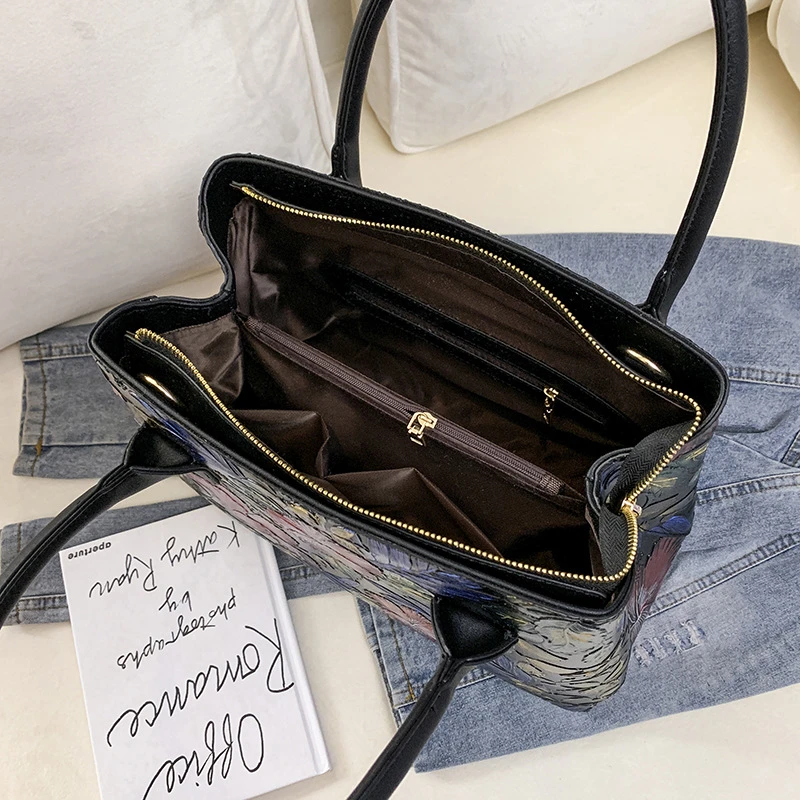
The polyester lining — a practical choice over silk for daily-use durability — includes internal organisation: a document sleeve, a phone pocket, a laminated zip pocket for cards. This is a bag that has been thought about, not merely designed for a photograph.
How Does the Chinese Painted Embossed Retro Bag Wear in a European Wardrobe?
Styling Across All Four Colourways
Safflower — A full chromatic statement. Wear with black (classic), with ivory (maximum contrast), or with camel and tan earth tones (tonal dialogue). The saturated red of Safflower reads as architectural in most European city contexts — it structures the look rather than merely accessorising it. Best for: editorial days, cultural events, evenings where the bag should arrive before you do.
Silver Flower — The most versatile of the four. The silver-white works as a neutral with cooler palettes (grey, navy, black) and creates elegant contrast against warmer ones (rust, ochre, forest green). This is the colourway for the woman who wants the cultural depth of the bag without its declarative presence. Best for: professional contexts, summer dressing, travel days.
Pink Fish — The most intimate of the four. The tender interior pink works beautifully against pale neutrals, cream, soft denim, and — unexpectedly — against deep burgundy or forest green where it creates a botanical complementary contrast. Best for: daytime dressing, summer-into-autumn transitions, occasions requiring softness without passivity.
Red Fish — The atmospheric alternative to Safflower. Where Safflower declares, Red Fish suggests. The warmer, deeper tone works particularly well in autumn-winter dressing: against camel coats, chocolate leather, dark denim, and the burgundies and deep reds of the colder European palette. Best for: late afternoon, evening, autumn dressing, the woman who wants warmth rather than statement.
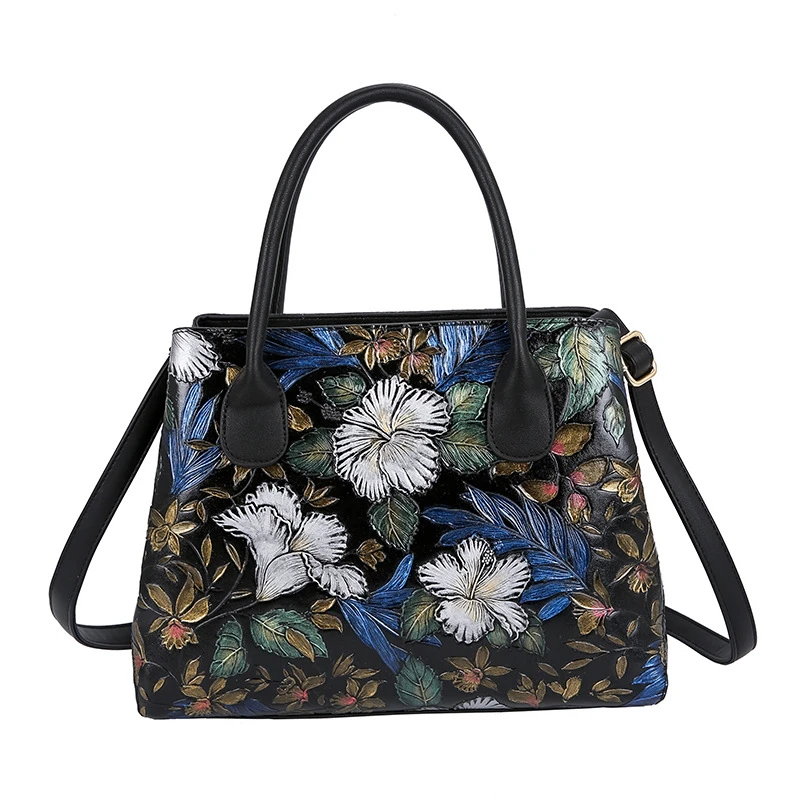
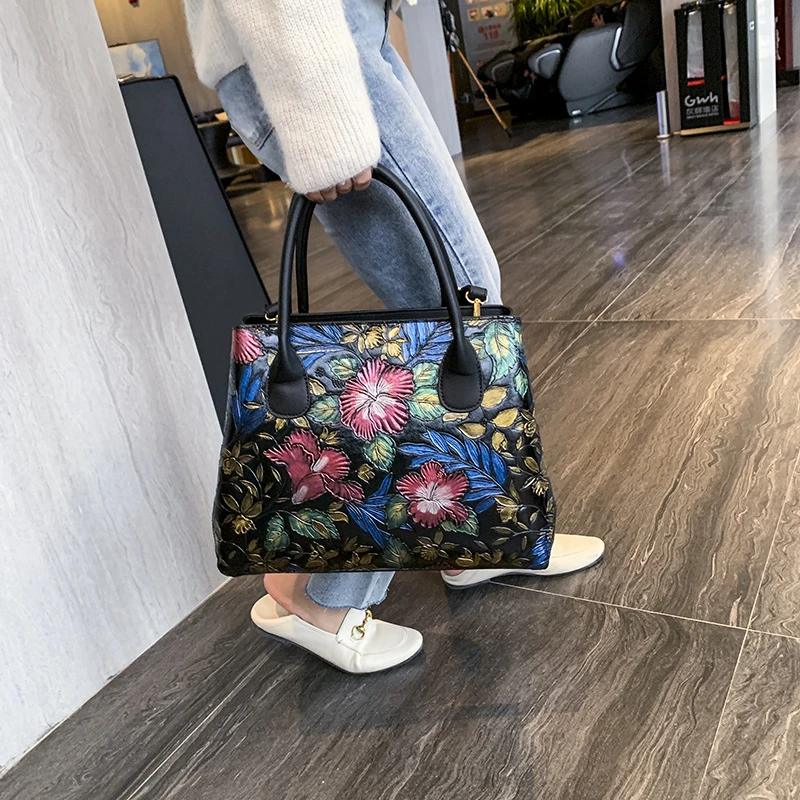
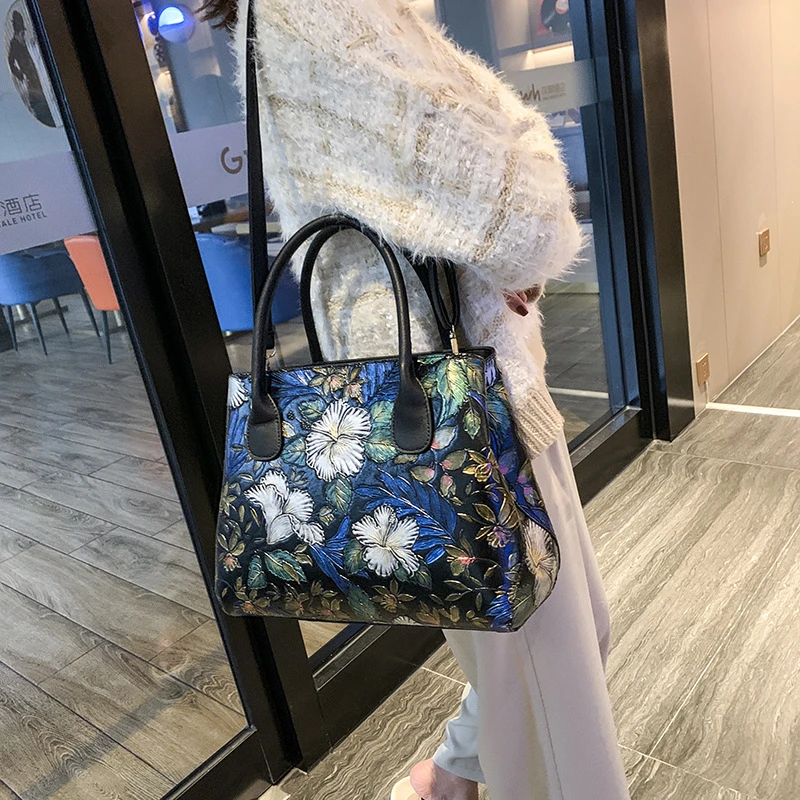
Chinese Painted Embossed Retro Tote Bag — Four Tang Dynasty Colourways
| Material | PU leather shell + polyester lining |
| Shape | Horizontal section square (tote) |
| Size | 350 × 400 mm |
| Package | 350 × 400 × 50 mm |
| Weight | 620 g |
| Closure | Zipper (full-width) |
| Strap | Single shoulder strap |
| Interior | Document sleeve · Phone pocket · Sandwich zip · Laminated zip pocket |
| Embossed motifs | Floral medallions, geometric borders, leaf-scroll framing |
What Does It Mean to Choose a Colourway Named After a Plant or a Fish?
In 2026, the dominant logic of fashion colour is algorithmic: trend forecasters identify a "colour of the season" that cascades through production lines and retail windows simultaneously. Every brand, every price point, in the same colour, in the same three weeks.
Tang Dynasty colour naming operated on an entirely different logic. Each name was a specific observation of the natural world — a flower at peak bloom, a fish at the surface of water in late afternoon, a blossom in the moment before it turns. The colour was the moment. To name it was to preserve that moment in a word.
What we noticed: When women handle this bag and hear the colourway names for the first time — Safflower, Silver Flower, Pink Fish, Red Fish — they invariably slow down. The names require a different kind of attention than "burgundy" or "off-white." They ask the woman to locate herself in the natural world, to consider what season and quality of light she is choosing. That deceleration is itself valuable in a fashion culture built on acceleration.
According to the McKinsey State of Fashion 2026 Report, 63% of European fashion purchases in the 25–45 demographic are now made with a "considered" timescale of more than 48 hours — a figure that has grown 31% since 2020. Women are slowing down. They are choosing objects that ask questions rather than provide answers. The Chinese Painted Embossed Retro Bag, with its four named colourways and 1,300-year craft backstory, is precisely the kind of object that rewards this new pace of choosing.
What Should You Know Before Making Your Choice?
The bag is available in four colourways, all at $28.02 (reduced from $29.23). The PU leather surface is structured — this is a bag with dimensional integrity, not a soft pouch. The embossed relief pattern is visible under raking light and tactile under the hand; it is not a printed surface but a moulded one.
At 620 grams, the bag has presence without excessive weight. The full-width zipper provides clean access; the horizontal format sits well at shoulder or on a desk without collapsing. The polyester lining is durable for daily use and provides four zones of internal organisation.
A word on choosing your colourway: if you are uncertain between Safflower and Red Fish, ask yourself what time of day you are dressing for. Safflower is noon; Red Fish is four o'clock. Both are correct answers. They are different sentences.
Frequently Asked Questions
What is the craft tradition behind the embossed surface of this bag?
The embossed surface draws on the Chinese tradition of diaoqi (carved lacquer) and duoqi (stacked lacquer) craft that reached its technical peak in the Tang and Song dynasties (618–1279 CE). Recognised by UNESCO as an intangible cultural heritage, the craft principle — building three-dimensional pattern relief onto a flat surface — gives this bag's PU leather shell its distinctive tactile language of floral medallions and geometric borders.
Why are the colourways named Safflower, Silver Flower, Pink Fish, and Red Fish?
These names come from the Tang Dynasty system of botanical and natural metaphors for colour — a naming tradition that encoded not just hue but also season, quality of light, and emotional register. Safflower is the maximum saturation of the carthamus tinctorius dye plant; Silver Flower is the Lonicera japonica at dawn; Pink Fish and Red Fish are the interior and surface colours of freshwater fish. Each name is a complete image, not merely a colour description.
How does the horizontal-square tote silhouette work for European professional women?
The 350 × 400mm horizontal-square format sits in the "document sweet spot" — large enough to carry an A4 document flat, a hardback, or a small laptop sleeve. According to a 2025 McKinsey workplace accessories study, structured tote bags in the 35–45cm range remain the dominant format choice for European professional women aged 25–45, cited by 58% as their primary everyday carry. The full-width zipper and four-zone interior organisation make this format work as both carry and desk object.
What is the difference between Safflower and Red Fish?
Both are reds, but tonally distinct. Safflower is the maximum saturation of the carthamus tinctorius dye — a clear, declarative, slightly cool red. Red Fish is warmer and deeper — the red of a fish scale in afternoon light, more atmospheric and less architectural. The distinction maps roughly to the difference between noon and dusk. Both are culturally precise. Choose based on how your wardrobe speaks, not how the light describes the colours on screen.
Is PU leather appropriate for this level of cultural reference?
Yes — and the choice is consistent with the bag's cultural lineage. Tang Dynasty diaoqi lacquer was not made from premium animal hide; it was made from refined plant resin applied to wood or cloth. The contemporary equivalent of a material that takes pattern beautifully, holds structure, and ages gracefully with use is high-quality PU leather. According to a 2025 Vogue Business material report, structured PU is now the dominant choice for culturally-referential accessories in the accessible-luxury segment.
Conclusion: The Bag That Names the Light
The Chinese Painted Embossed Retro Tote is not four colourways. It is four ways of seeing. Safflower, Silver Flower, Pink Fish, Red Fish — four observations from a culture that named the natural world with the precision of a poet and the rigour of a scientist, and embedded those observations in the decorative tradition of embossed surface craft that has been in continuous practice for 1,300 years.
At $28.02, in a horizontal-square silhouette that has proven its ergonomic intelligence across a millennium of carry, this is an object that rewards attention. Choose your colourway slowly. The Tang Dynasty did not name these things in a hurry.
2. UNESCO Intangible Cultural Heritage — Chinese lacquer craft traditions, retrieved 2026-06-25, https://ich.unesco.org/
3. Euromonitor International — Consumer Lifestyle Survey 2025, retrieved 2026-06-25, https://www.euromonitor.com/
4. McKinsey & Company — "The State of Fashion 2026", retrieved 2026-06-25, https://www.mckinsey.com/industries/retail/our-insights/state-of-fashion
5. Vogue Business — Material Innovation Report 2025, retrieved 2026-06-25, https://www.vogue.com/