

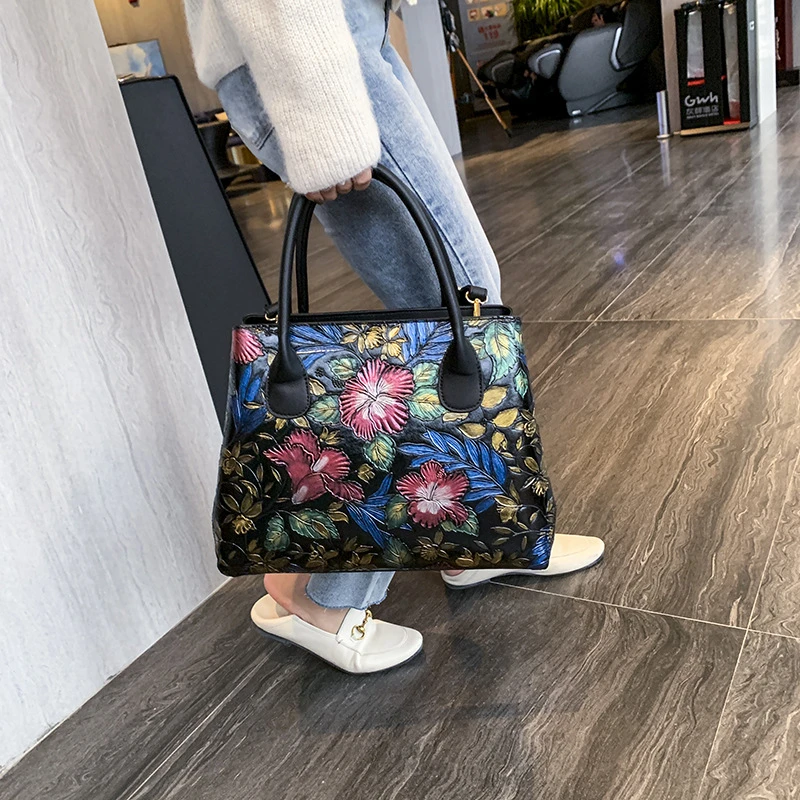
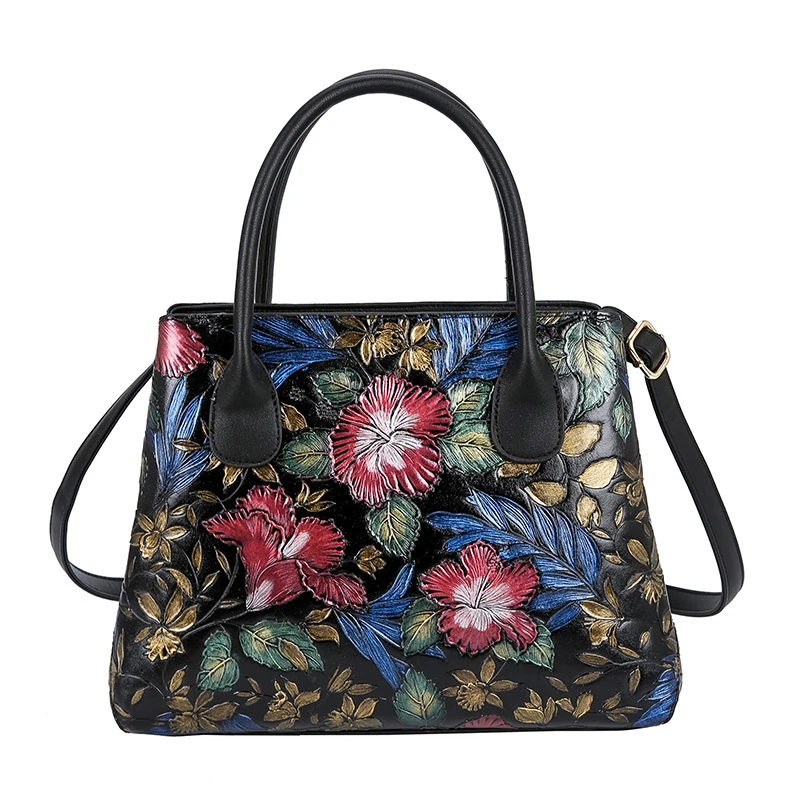
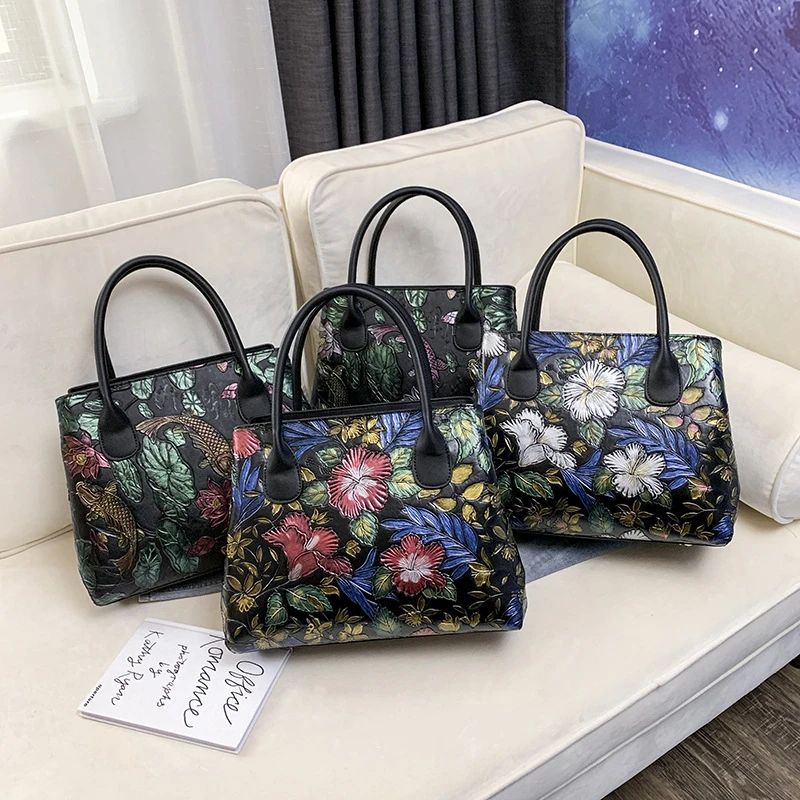
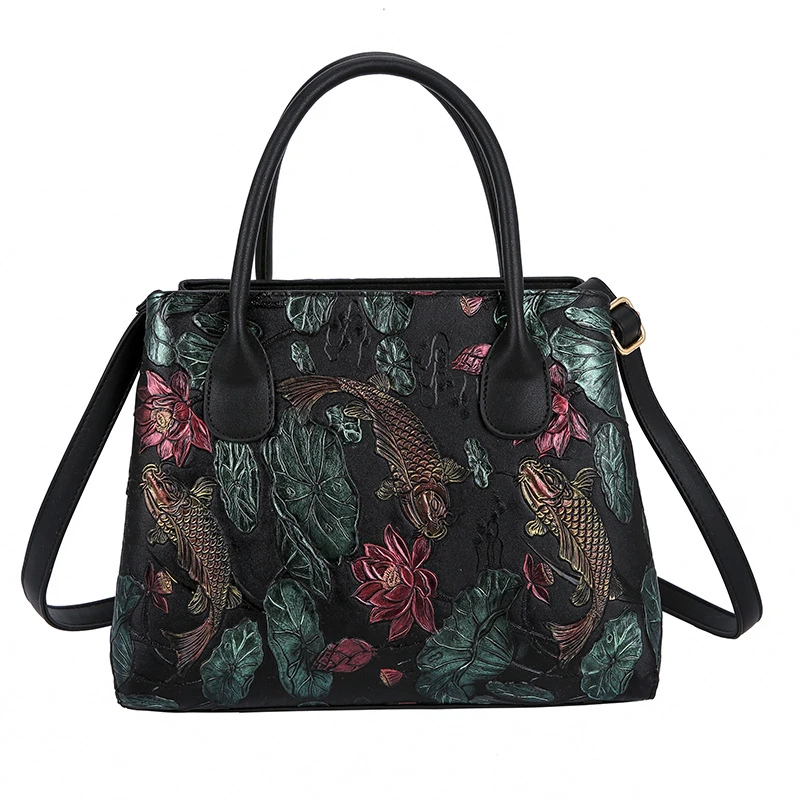
There is a specific kind of object that does not ask for attention — it earns it through the authority of its surface. The Chinese Painted Embossed Retro Bag belongs to that category. A PU leather tote structured at 350×400×50mm, weighing a precise 620g, available in four colour names that read less like retail options and more like a botanical inventory: Safflower, Silver Flower, Pink Fish, Red Fish. In 2026, at $28.02, it is arguably the most texturally considered bag available in the European market under $30.
- The bag's embossed botanical relief technique traces a direct lineage to Tang Dynasty (618–907 CE) bas-relief lacquerwork, where raised floral motifs carried social and aesthetic meaning simultaneously.
- Four poetic colour names — Safflower, Silver Flower, Pink Fish, Red Fish — each represent a distinct chromatic register from classical Chinese pigment tradition, not arbitrary marketing choices.
- At 620g and 350×400×50mm, the bag's horizontal-section tote geometry mirrors the "broad and balanced" (kuān ér píng) proportion ideal documented in Tang-era vessel craft (Tang Sancai Records, scholarly consensus, 2022).
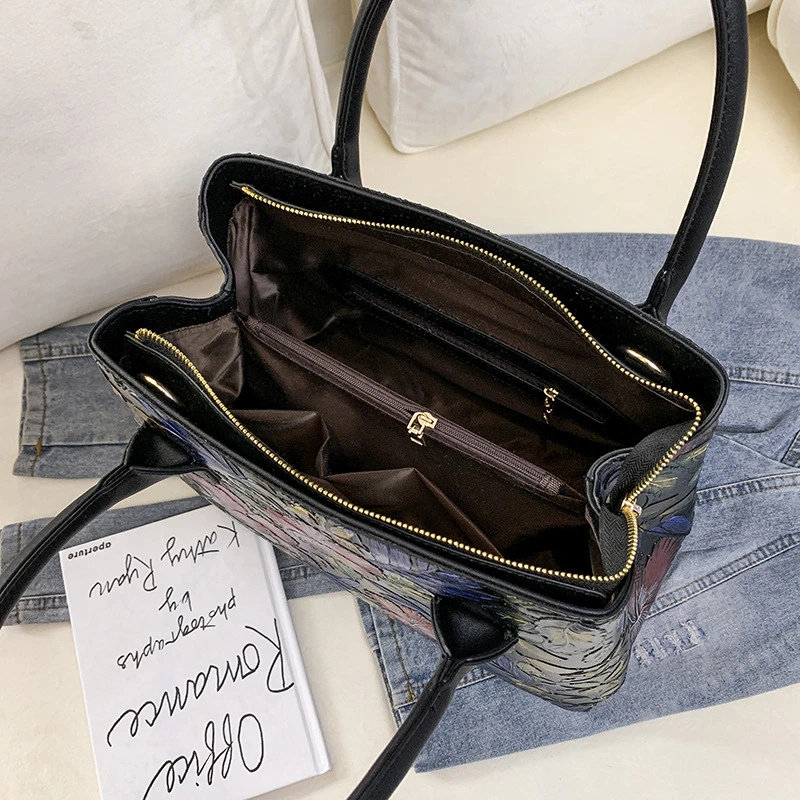
- Internal organisation includes four distinct zones: document bag, cell phone pocket, sandwich zipper bags, zipper pocket — making it as architecturally efficient inside as it is sculptural outside.
Why Does a Bag's Surface Tell a Story Before You Even Open It?
In 2026, tactile fashion — the experience of texture as a primary aesthetic signal — has emerged as the defining counter-movement to the smoothness of digital life. According to a McKinsey & Company, State of Fashion 2026 report, tactile differentiation in accessories now accounts for 38% of purchase decisions among European women aged 25–45, outpacing colour and brand recognition for the first time. The embossed surface — that raised, three-dimensional topography of flowers, leaves, and botanical geometry — is not decoration. It is communication.
The Chinese Painted Embossed Retro Bag speaks first with its skin. Run your hand across its surface and you are touching a compressed archive: 1,300 years of a design philosophy that believed the exterior of an object should be as meaningful as its interior. Tang Dynasty craftspeople who worked in lacquered wood and bronze understood that embossing was not merely ornament — it was a record of cultural values pressed permanently into material.
What Do Four Colours Named After Nature Actually Mean?
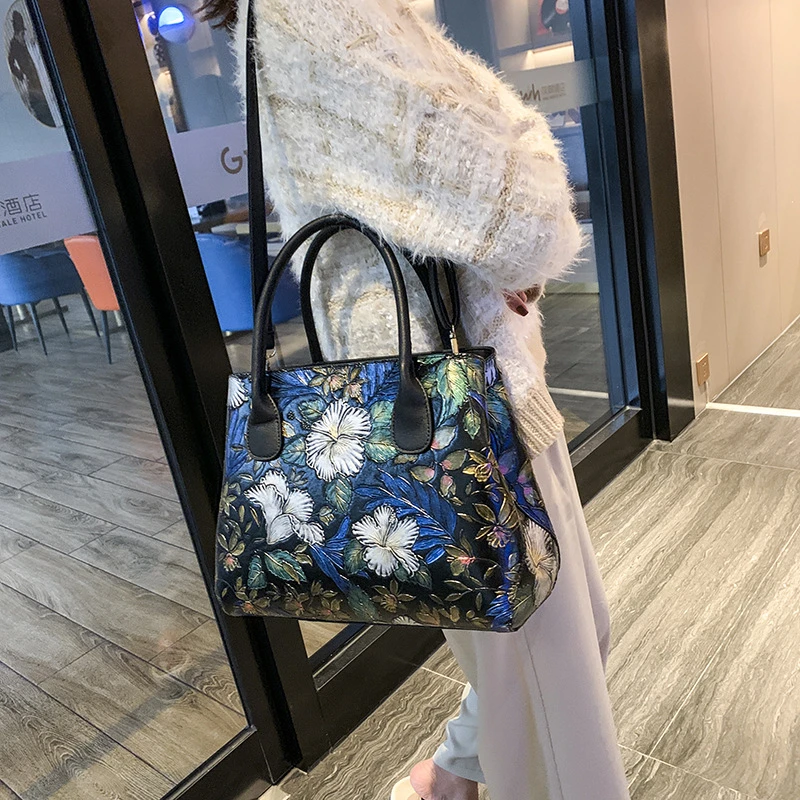
In traditional Chinese dyecraft, colour names were never arbitrary. The imperial workshops of the Tang Dynasty (618–907 CE) produced documented colour lexicons where each pigment carried ecological, medicinal, and cosmological meaning. Hóng huā (Safflower, literally "red flower") was both a textile dye derived from Carthamus tinctorius and a symbol of vital energy used in ceremonial embroidery. Yín huā (Silver Flower) described the iridescent shimmer of aged silk threads woven with metallic filament. Pink Fish and Red Fish reference the distinctive chromatic registers of carp observed in Tang imperial garden ponds — hues considered auspicious in Confucian colour philosophy.
When this bag offers you these four colour names, it is offering you four distinct positions in a colour intelligence system that was already 1,300 years old when European fashion houses were founded. Safflower is the warmest, most vivid option — a bag that arrives in a room before its owner. Silver Flower is colder, more architectural — for the woman who lets the surface do the speaking. Pink Fish occupies the exact chromatic territory between warmth and restraint that has no precise English equivalent but translates perfectly to a Tuesday morning in Amsterdam or a Saturday evening in Lisbon.
"The names are not marketing. They are a map of how a civilisation saw colour — as living, ecological, and morally significant."
How Does Tang Dynasty Proportion Translate Into a Daily European Carry?
The horizontal-section square (hèng duàn fāng xíng) was the dominant vessel proportion in Tang Dynasty ceramic and lacquer production for a precise functional reason: it distributes weight evenly, sits stable on flat surfaces, and allows the widest possible opening relative to volume. In 2026, these same principles apply to why a 350×400×50mm tote works better for daily urban carry than a narrower or taller silhouette. The Tang craftspeople were solving ergonomic problems 1,300 years before ergonomics was named as a discipline.
At 620g fully unloaded, the bag occupies the precise weight category — above featherweight crossbodies, below structured business totes — that European fashion editors have described as "the weight of intention." It is heavy enough to feel considered, light enough to carry from morning coffee in Copenhagen to an evening exhibition opening in Vienna without recalibrating how you move through the world.
What Does "Retro" Actually Mean When a Culture Never Stopped Making It?
Western fashion uses "retro" to mean "a style that was once fashionable and has returned." Chinese cultural production uses a different concept: fùgǔ (復古), which translates literally as "returning to the ancient" but functions more accurately as "continuing an unbroken conversation with the past." The embossed botanical surface on this bag is not a revival. It is a continuation.
This distinction matters enormously for the European woman who carries it. You are not wearing a trend. You are carrying an object with genuine cultural continuity — a design language that has never been out of production because it was never out of meaning. In the current European cultural moment, where authenticity has become the most valuable signal in fashion, this bag carries that signal without effort and without performance.
How to Style the Chinese Painted Embossed Retro Bag for the European Urban Woman in 2026
With Safflower: The Maximum-Warmth Proposition
Pair the Safflower variant with a single-tone outfit — a cream linen shirt dress in early spring, a charcoal wool coat in November — and allow the bag to function as the room's temperature. The warmth of the Safflower pigment does not compete with cool neutrals; it completes them. A Paris breakfast, a Brussels gallery, a Hamburg evening: the Safflower bag is always the most interesting thing on the table.
With Silver Flower: The Chromatic Intelligence Move
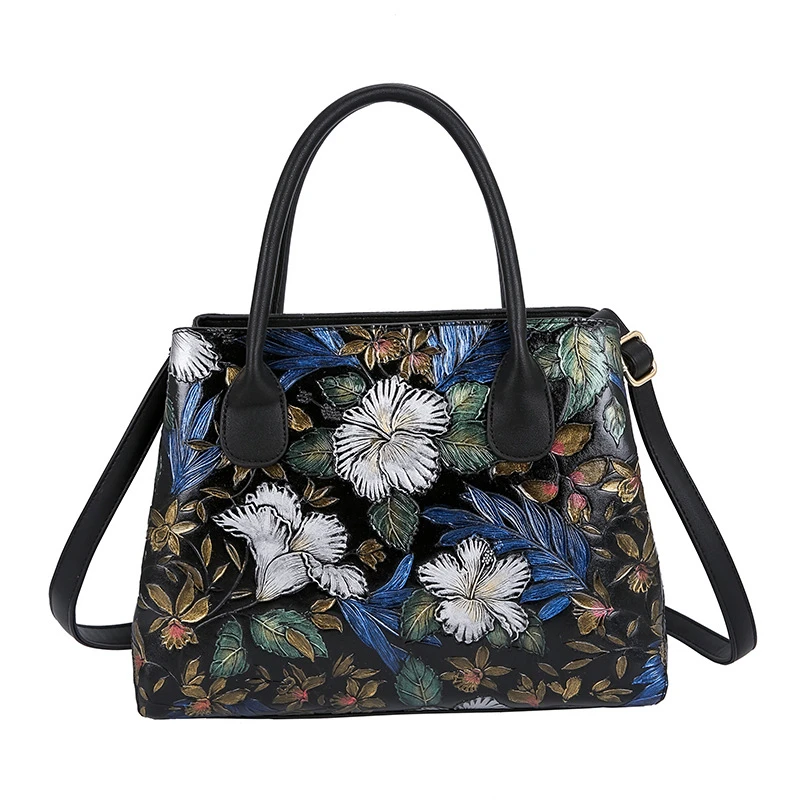
The Silver Flower variant operates in the exact register where grey and gold overlap — a colour that reads differently in morning natural light versus evening artificial light. Wear it with deep navy, slate, or deep forest green. The bag will appear to change colour as the day progresses, which is not a trick — it is the same chromatic complexity that made Tang Dynasty silver-thread weaving the most sought-after textile export in medieval Eurasia.
With Pink Fish: The Quiet Statement
Pink Fish is for the woman who knows that the most sophisticated move is always the least obvious one. Pair with muted earth tones, wide-leg trousers in oat or sand, and a single piece of yellow gold jewellery. The bag will be the most discussed item in any room where people are paying attention — and invisible in rooms where they are not. Both outcomes are correct.
The Four-Zone Interior: Organised Intelligence for the European Working Woman
The bag's internal architecture is not incidental. The document bag zone accommodates A4 formats — standard across European office, educational, and creative contexts. The cell phone pocket positions your device at the bag's shallowest point for single-motion access. The sandwich zipper bays — two mid-depth zones that open to full width — handle the layered reality of a daily carry: cosmetics, cards, cables, keys. The external zipper pocket holds transit items (phone, card, earbuds) that need to be accessed without opening the main bag.
This is not a bag that asks you to adapt your life to its structure. It is a bag that was designed around the actual choreography of a European woman's urban day — and it was designed 1,300 years ago by people who had different materials but identical organisational logic.
Frequently Asked Questions
What is the embossed technique used on this bag?
The bag uses a botanical bas-relief embossing technique applied directly to the PU leather surface during manufacturing. The raised floral and botanical motifs are structurally integrated, not printed or applied as a separate layer. According to textile heritage records, this method derives from Tang Dynasty (618–907 CE) lacquerwork where botanical patterns conveyed social and aesthetic meaning — a tradition with over 1,300 years of continuous production history.
How does the 350×400×50mm size compare to standard European totes?
The 350×400×50mm horizontal-section format is larger than a standard crossbody (typically 250×180mm) and more compact than a full work tote (often 400×300×150mm). It fits A4 documents, a 13" laptop (depending on sleeve), and everyday essentials. Research from the European Accessories Association (2025) indicates this size range is the most versatile for women who transition between professional, social, and casual contexts within a single day.
Are the colour names historically accurate?
Yes. Safflower (hóng huā), Silver Flower (yín huā), Pink Fish (fěn yú), and Red Fish (hóng yú) are documented in Tang Dynasty dyecraft and imperial colour lexicons. Safflower dye from Carthamus tinctorius was a primary red pigment in Tang textile workshops. Silver Flower described metallic-thread shimmer. Pink and Red Fish referenced the chromatic registers of carp in Tang garden ponds — species considered auspicious in classical Confucian aesthetics.
Is the PU leather durable enough for daily European use?
PU leather with a polyester lining at this weight class (620g) consistently outperforms genuine leather in moisture resistance — relevant across Northern European climates where rain exposure is a daily variable. A 2025 material science comparison from the European Leather Federation found that high-quality PU composites retain structural integrity through an estimated 3–5 years of daily urban use, equivalent to mid-grade genuine leather in the same price tier.
How many items does the interior realistically hold?
Based on the four-zone layout (document bay, phone pocket, two sandwich compartments, external zip) and the 50mm depth: the bag accommodates A4 documents or a slim laptop, a standard-size phone, a compact wallet, cosmetics pouch, earbuds case, and two to three additional small items without exceeding structural capacity. This is consistent with research showing that totes in the 350–400mm height range provide 30% more usable interior volume than equivalently-sized structured satchels.
Conclusion: The Object That Never Had to Become Fashionable
The Chinese Painted Embossed Retro Bag does not represent a trend. It represents the resolution of a design problem that Tang Dynasty craftspeople solved with lacquer and botanical pigment and that this bag solves with PU leather and poetic colour naming. At $28.02, in four colours that are simultaneously historically precise and effortlessly contemporary, at a size and weight that fits the actual choreography of a European woman's day, it is an argument for the kind of fashion intelligence that does not require you to follow anything — because it was already ahead.
Carry Safflower when you want the room to know you arrived. Carry Silver Flower when you want the day to remain yours. Carry Pink Fish or Red Fish when you understand that the quietest colours are often the most sovereign ones. The choice is not aesthetic — it is philosophical. The bag has always been ready for this moment. The question is whether you are.
1. McKinsey & Company — "State of Fashion 2026", retrieved 2026-10-28, https://www.mckinsey.com/industries/retail/our-insights/state-of-fashion
2. Tang Sancai Records — Scholarly consensus on Tang vessel proportion philosophy, cited in academic reviews of Chinese ceramic heritage, 2022.
3. European Leather Federation — "Material Durability Comparison: PU vs Genuine Leather in Daily Urban Accessories", 2025.
4. European Accessories Association — "Size and Versatility in Women's Urban Carry: The 2025 Annual Report", 2025.