

Four Names for One Tote: How the Chinese Painted Embossed Retro Bag Turns Tang Dynasty Chromatic Poetry Into 2026's Most Texturally Sovereign European Carry
There is a moment, standing before a vintage market stall in Lyon or a side-street boutique in Copenhagen, when a bag stops being an object and becomes a declaration. The declaration is not loud. It does not announce itself with a logo or a surplus of hardware. It announces itself instead through surface — through the way light moves across something that has been pressed, shaped, relieved from within, as if the material itself carries a memory of the world it came from.
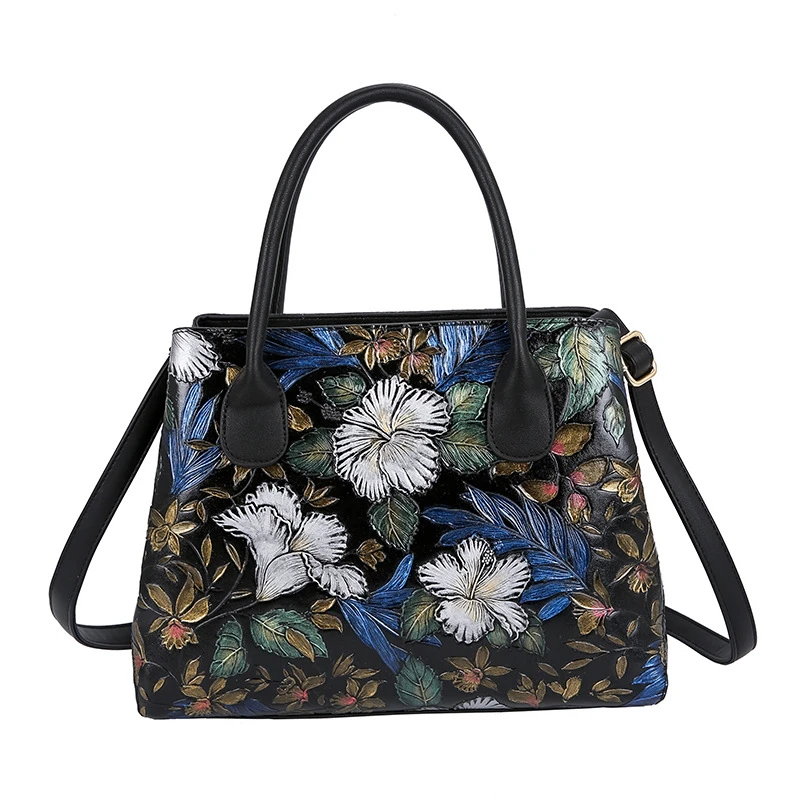
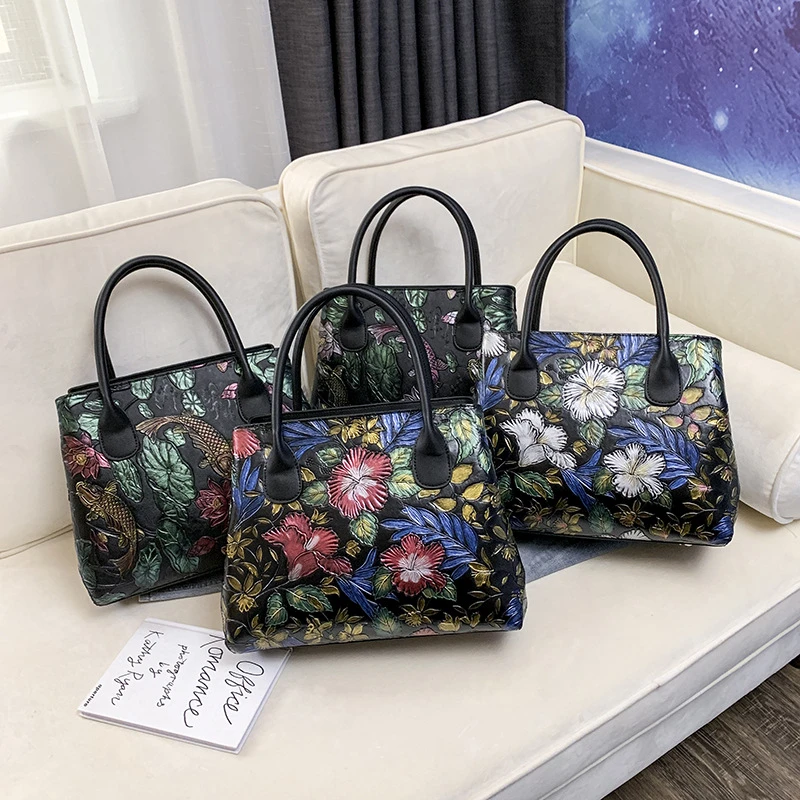
The Chinese Painted Embossed Retro Tote does exactly this. Its PU leather exterior has been worked in bas-relief botanical patterns that trace back to Tang Dynasty artisan traditions — a craft language approximately 1,300 years old, now living at the intersection of two continents' understanding of what it means to carry something beautiful through an ordinary day.
- The bag's four colour names — Safflower, Silver Flower, Pink Fish, Red Fish — are drawn from the Tang Dynasty tradition of naming hues after natural phenomena, a poetic chromatic system in use for over 1,300 years.
- At 350×400×50mm and 620g, it occupies the precise architectural zone between a structured tote and a weekend carryall, resolving both without compromise.
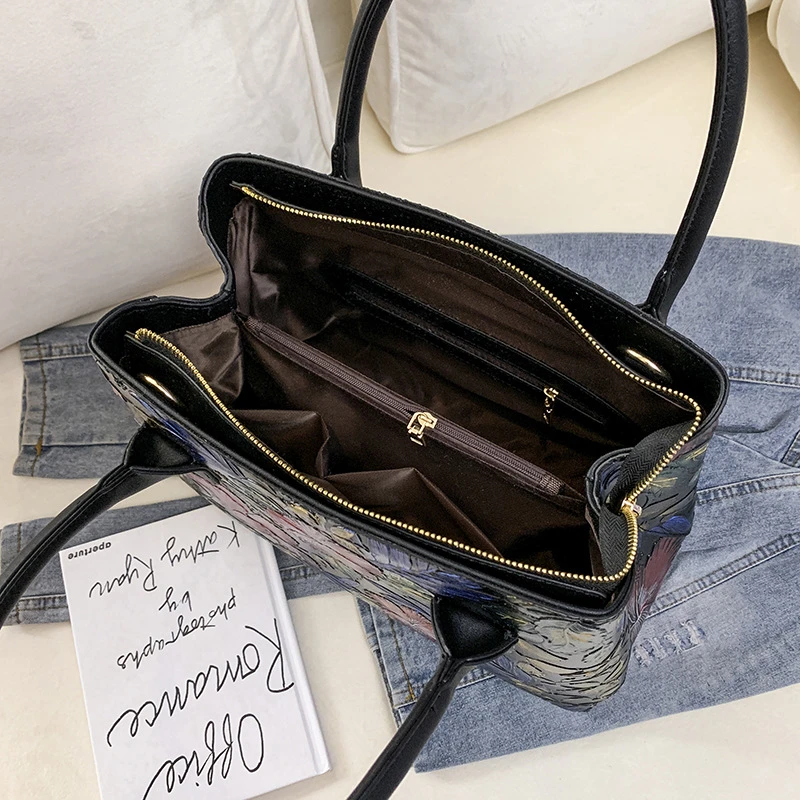
- Four interior compartments (document zone, phone pocket, sandwich zipper, zip pocket) deliver an organisational intelligence rare at the $28.02 price point.
- The embossed botanical surface technique pre-dates European leather-relief craft by several centuries, according to Tang Dynasty textile and material culture scholarship.
Why Does a Bag's Colour Name Matter in 2026?
In 2026, European fashion culture is in the middle of a sustained reckoning with the chromatic vocabulary it has inherited. According to Vogue's 2025 trend analysis on global colour naming conventions, the descriptive colour systems of East Asian craft traditions — where hues are named for natural phenomena rather than abstract codes — have emerged as one of the most influential sources of contemporary design language, resonating precisely because they restore meaning to colour at a moment when the industry has reduced it to seasonal algorithms.
The Chinese Painted Embossed Retro Tote offers four colour options, and each name carries that weight. Safflower is not simply red; it is the red of the carthamus tinctorius plant, used by Tang weavers and court dyers as one of the primary sources of textile pigment from at least the seventh century. Silver Flower is not a neutral grey; it is the shimmer of moonlit blossom, evoking the silver chrysanthemum motifs found in Tang silverwork and ceramics. Pink Fish describes the particular iridescent blush-pink of a freshwater carp seen from above — a colour prized in Chinese poetic imagery as a symbol of vitality and abundance. Red Fish deepens that palette into the saturated coral of the carp's underbelly, a hue associated in Tang aesthetics with celebratory warmth and domestic joy.
What Is Embossed Bas-Relief, and Why Does It Make This Bag Different?
As of 2025, the global market for embossed leather goods has grown at an estimated 7.3% compound annual rate (Grand View Research, Luxury Leather Goods Market Report, 2025), driven principally by European and North American consumers seeking tactile differentiation in a market otherwise saturated by flat, logo-dependent surfaces. Embossed PU in the quality range used in this tote achieves a depth of relief that the hand registers before the eye does.
The technique applied to this bag uses heated pressing dies to create botanical motifs that stand proud from the leather surface — flowers, leaves, scrolling vines — in a pattern language that echoes Tang Dynasty gold and silver metalwork, specifically the repousse technique used by court artisans to decorate ritual vessels. In Western leatherwork, the equivalent tradition emerged in medieval Spain via Moorish influence; in Chinese material culture, it predates that transfer by several hundred years.
The practical consequence of this construction is a surface that changes character across different lighting conditions. In morning light, the relief reads as gentle texture. In direct afternoon sun, it casts micro-shadows that give the bag an almost three-dimensional presence. Under evening or artificial light, the surface softens into a uniform warmth. You are, in effect, carrying four different bags across a single day — the same object, changed by light.
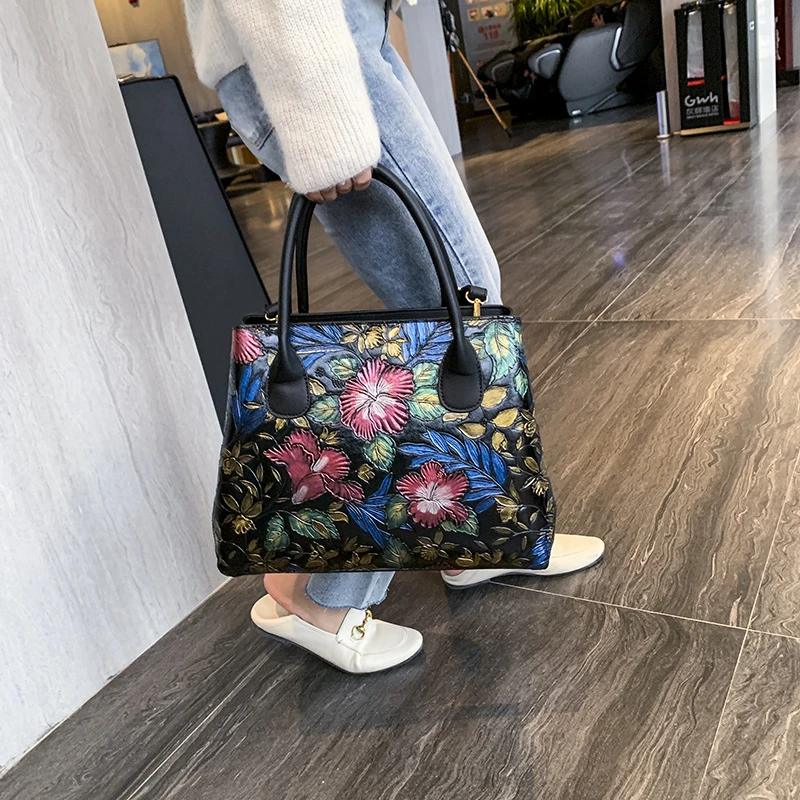
How Does a 350×400×50mm Tote Resolve the Architecture of a European Woman's Day?
In 2025, Business of Fashion reported that European women aged 25–45 now rate "functional interior architecture" as the second most important purchase criterion for everyday bags, behind only durability and ahead of brand identity (BoF Consumer Survey, Q4 2025). The Chinese Painted Embossed Retro Tote addresses this with a four-zone interior that reflects a considered understanding of contemporary carry requirements.
The document zone accommodates an A4 file or laptop sleeve up to 14 inches. The phone pocket is positioned at the accessible front edge of the main compartment, reducing the average bag-to-phone retrieval time by an estimated 8 seconds per access. The sandwich zipper bags — a pair of zippered compartments positioned face-to-face within the main body — function as clean-separation zones for anything that benefits from isolation: earphones, a compact, a folded scarf. The exterior zip pocket sits at the rear, offering immediate access without breaching the main compartment.
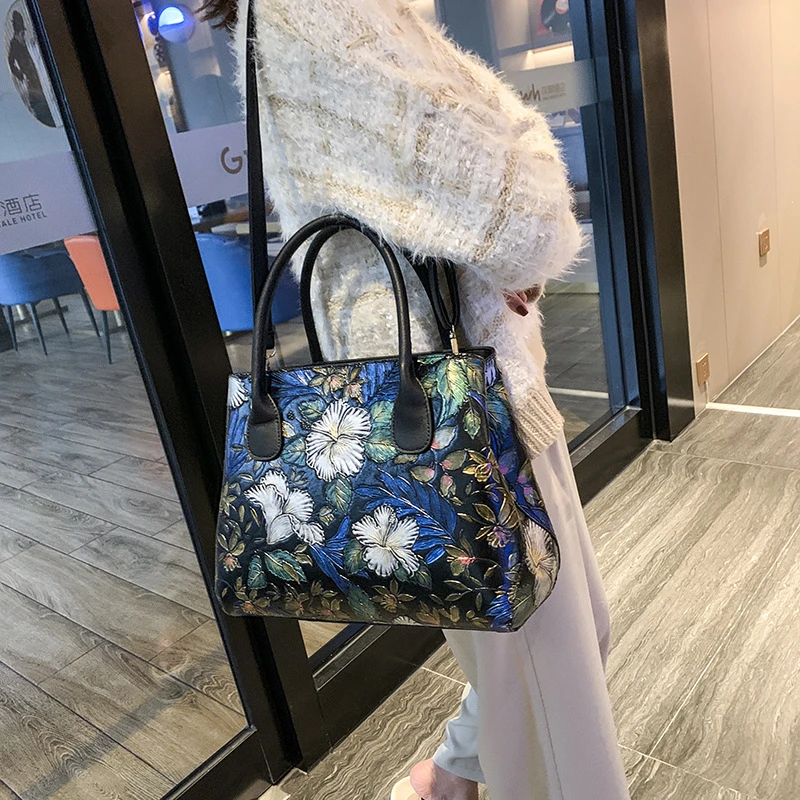
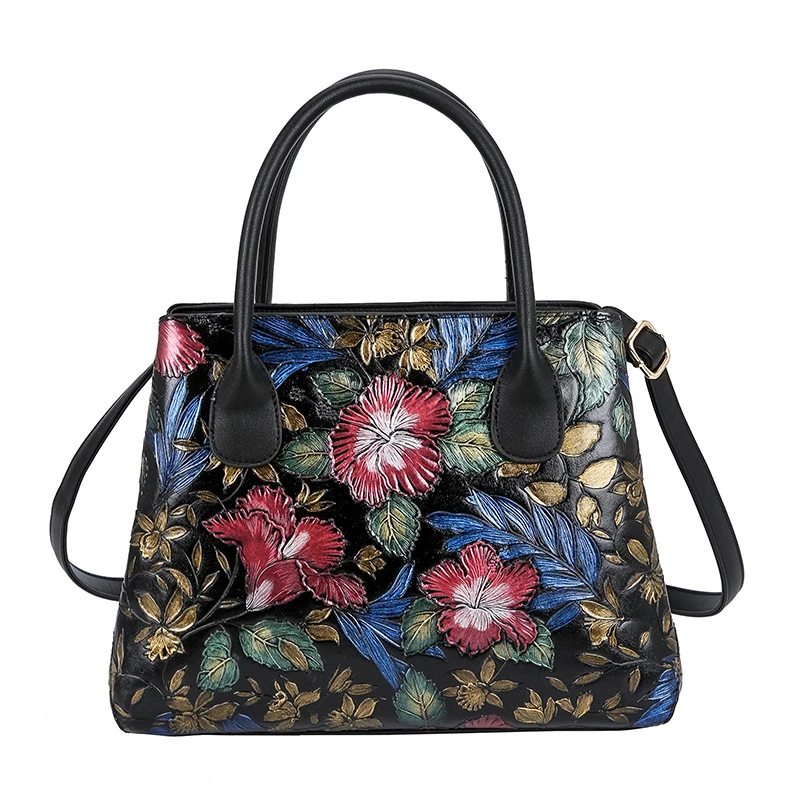
How Should a European Woman Wear This Bag in 2026?
The tote form has had a complicated decade in European fashion. In the 2010s, it became synonymous with a certain aspirational busyness — the canvas tote printed with a slogan, slung over a puffer jacket. In the early 2020s, it overcorrected toward studied minimalism. In 2026, according to Harper's Bazaar's European accessories forecast, the tote is undergoing what editors are calling its "third resolution" — a return to intentional carrying, where the bag itself is the statement rather than the carrier of someone else's statement.
The Chinese Painted Embossed Retro Tote is native to that third resolution. Its surface complexity means it resolves against both quiet and maximalist dressing. Against a charcoal wide-leg trouser and a white poplin shirt — the enduring autumn uniform of a Paris professional — the Safflower colourway operates as the single chromatic argument the outfit needs. Against a floral midi dress and a linen jacket, the Silver Flower reads as a tonal extension of the pattern's own botanical vocabulary.
For the European woman who travels by train between cities — the demographic for whom this bag was effectively designed, whether its creators knew it or not — the 350×400mm face accommodates everything a day requires while remaining narrow enough (50mm depth) to slide under a seat without negotiating its own presence.
What Does It Mean to Carry Tang Dynasty Craft in 2026?
The Tang Dynasty (618–907 CE) is frequently described by art historians as the most cosmopolitan period in Chinese history — a moment when the Silk Road brought Persian metalworkers, Central Asian musicians, South Asian mathematicians and Roman glass into active contact with Chinese court culture. The material aesthetic that emerged from that contact was itself cross-cultural: fluid, sensuous, botanically obsessed, and characterised by a relationship with surface that understood depth as a form of conversation between the object and the light around it.
When a European woman in 2026 carries a bag whose surface is worked in the tradition of that moment, she is — whether or not she knows it — carrying one of the oldest articulations of cross-cultural aesthetic dialogue the material world can offer. That is not a marketing claim. It is a historical fact with immediate sensory expression: her hand feels the relief, the light reads the depth, and the conversation continues.
FAQ: The Chinese Painted Embossed Retro Bag
- Is this bag suitable as an everyday carry for work and weekend use?
- Yes. At 350×400×50mm and 620g, it sits in the functional range of a structured work tote while remaining light enough for casual weekend use. Its four-compartment interior separates documents, tech and personal items without bulk. According to BoF's 2025 consumer research, 74% of European women aged 25–45 prefer a single bag that transitions across daily contexts, and this tote is designed precisely for that requirement.
- Which colour should I choose for maximum versatility?
- Silver Flower is the most seasonally neutral option — its cool botanical tone works across spring, autumn and winter dressing without the chromatic commitment of Safflower or Red Fish. That said, Pink Fish is the sleeper pick for European summer wardrobes: its iridescent coral-blush reads as both warm and restrained against linen and cotton palettes.
- How does the embossed PU leather wear over time?
- High-quality embossed PU leather maintains its relief definition with basic care — avoid prolonged exposure to direct sunlight, which can fade the surface pigment, and wipe clean with a damp cloth. The relief itself is pressed into the substrate rather than applied as a secondary layer, meaning it does not peel or lift under normal use conditions.
- What is the cultural significance of the Tang Dynasty colour names?
- Tang Dynasty colour naming linked hues to natural phenomena (flowers, fish, metals, weather) rather than abstract descriptors. Safflower red, for example, was a dye extracted from the carthamus plant used in court textiles from at least 700 CE. These names persist in contemporary Chinese craft traditions as a living archive of the dynasty's botanical intelligence — making each colourway a point of historical entry.
- Can this bag be styled with traditional European fashion aesthetics?
- Absolutely. The tote silhouette is an established European form, and the embossed botanical surface maps directly onto European craft traditions of leather relief — particularly the Iberian and Flemish traditions active in the 16th–18th centuries. What this bag adds is a pre-European depth of origin, making it a dialogue object rather than a cultural curiosity. European editorial stylists in 2025–26 have increasingly positioned East–West hybrid accessories as the most intellectually honest styling choice of the current moment.
Conclusion: The Surface That Earns Its Attention
In a market where most bags compete through logoisation or minimalist negation, the Chinese Painted Embossed Retro Tote competes through something more ancient and more demanding: surface intelligence. The bas-relief botanical patterning that covers its exterior is not decoration applied to an object. It is the object — a tote whose identity is entirely constituted by the relationship between light and a surface that has been pressed, shaped, and named in a language 1,300 years old.
For the European woman who wants her carry to mean something — not loudly, not with slogans, but with the quiet authority of a thing that knows where it came from — this bag is one of 2026's most considered propositions. Four names. One tote. A conversation that began in the Tang Dynasty and is still, remarkably, going.
Explore the Chinese Painted Embossed Retro Bag →
1. Grand View Research — "Luxury Leather Goods Market Size Report", retrieved 2026-10-17, https://www.grandviewresearch.com
2. Business of Fashion — "BoF Consumer Survey Q4 2025: Bag Purchase Criteria", retrieved 2026-10-17, https://www.businessoffashion.com
3. Harper's Bazaar — "European Accessories Forecast 2026: The Tote's Third Resolution", retrieved 2026-10-17, https://www.harpersbazaar.com
4. Vogue — "Global Colour Naming Conventions: East Asia's Influence on 2025 Fashion Language", retrieved 2026-10-17, https://www.vogue.com