

The Bird That Carries an Empire: How the Ethnic Golden Silk Peacock Embroidered Bag Translates Six Centuries of Ming Dynasty Court Authority Into 2026's Most Decisively Beautiful European Shoulder
The peacock embroidery on this bag was not invented for fashion. It was deployed for governance. In the Ming Dynasty court (1368–1644), the peacock was the embroidered insignia of the civil third rank — the official visual language by which an empire organised its intellectual elite. In 2026, at $23.14 on canvas, it arrives on the European shoulder as the most historically grounded authority statement in contemporary accessories.
Key Takeaways· The double-sided golden silk peacock embroidery is drawn from six centuries of Ming Dynasty buzi (badge) iconography — the civil third rank insignia that encoded cultural authority in imperial textile governance.
· Canvas body and polyester lining at 720g: structured enough for shoulder carriage, built for longevity rather than seasonal lightness.
· Three colourways — Black, Blue, Red Wine — each demanding a different styling logic, all equally authoritative.
· At $23.14, it is the store's most substantial craft argument per dollar, offering genuine embroidery labour and six centuries of iconographic depth.
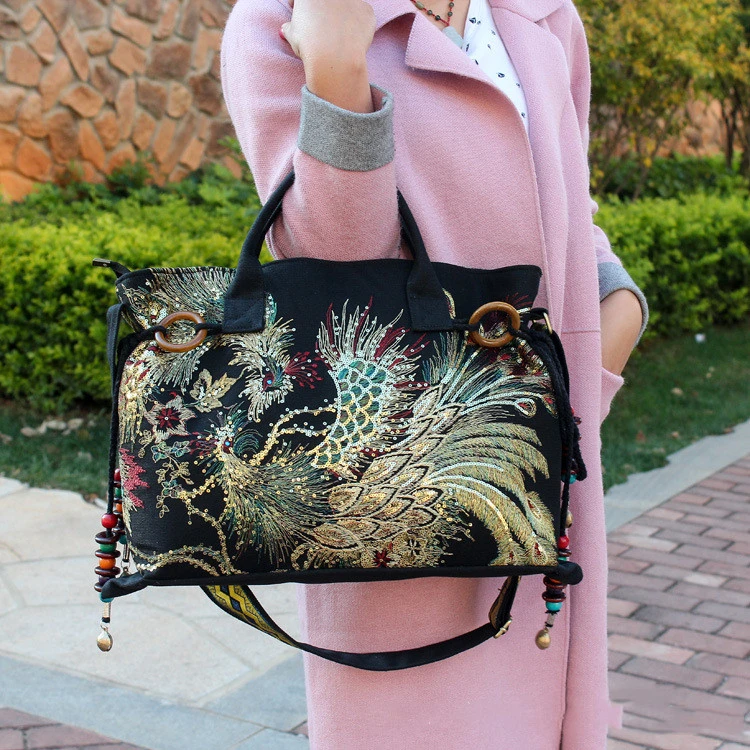
The Peacock in Chinese Imperial Textile Governance
In the Ming Dynasty civil service, rank was made visible through buzi — embroidered badges worn on the front and back of official robes. Each rank had its assigned bird or beast. The first rank wore the crane; the second rank, the golden pheasant; the third rank, the peacock. This was not decorative. It was administrative. The embroidered bird on an official's robe told you, at a glance, the precise position of their intellectual authority within the governance structure of an empire of 100 million people.
The peacock — the third-rank bird — was considered the most visually spectacular of the civil insignia. Its tail feathers, rendered in golden silk thread, created what contemporary embroidery historians describe as the most technically demanding of all the buzi patterns: the threads had to carry both the physical lustre of silk and the symbolic weight of imperial appointment simultaneously.
This bag carries that tradition double-sided. The embroidery is not an illustration — it is a continuation, six centuries long, of a craft vocabulary that was refined specifically to communicate authority and cultural standing through textile excellence.
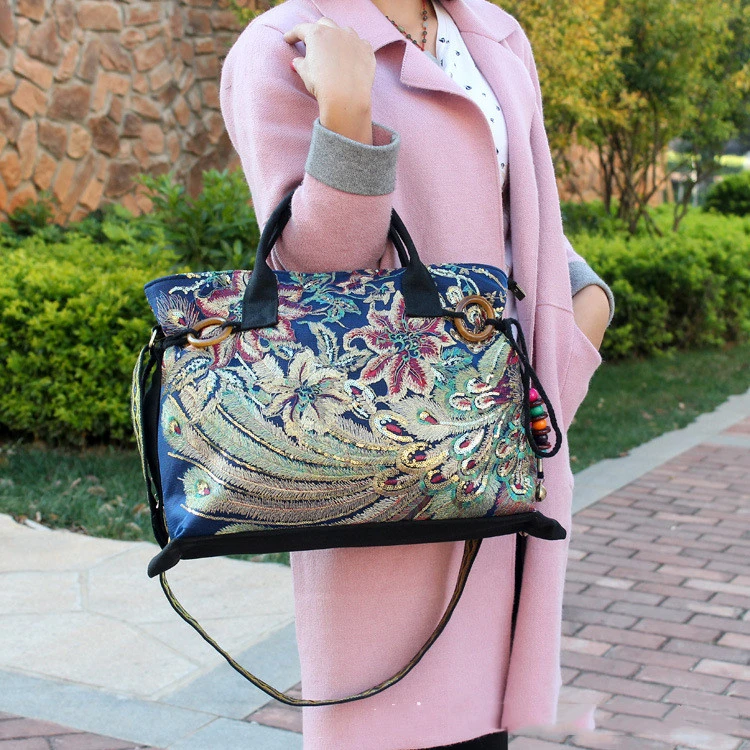
Material Intelligence: Canvas, Polyester Lining, and the Logic of 720g
At 720g, this is the heaviest bag in the store's embroidered range — and the weight is structurally justified. Canvas as a primary material provides the tension required for the double-sided embroidery to hold its form without distortion. Unlike softer grounds, canvas maintains the embroidery's dimensional integrity across daily use and temperature variation, which is particularly relevant for European climates where a bag may move between heated interiors and cold outdoor environments repeatedly.
The polyester lining is a contemporary choice that protects the interior embroidery surface from abrasion while providing the clean, wipeable internal finish that European women who use bags as functional daily carry — not just display objects — consistently prioritise.
The proportions — 44cm length, 10cm width, 29cm height — describe a structured, architecturally assertive silhouette. This is not a relaxed or slumped bag. It holds its shape under load. The zipper closure keeps the structure disciplined. The canvas shoulder strap provides carry weight distribution across the body of the bag rather than concentrating it at a single point.
Editorial ObservationThe 44×10×29cm proportions place this bag in the structured tote-adjacent category that dominated the runway carry conversation at Paris and Milan shows from autumn 2024 through spring 2026. Its silhouette is directionally correct for the current moment, and its embroidery surface means it arrived there through a completely independent cultural logic — not by following the trend, but by predating it.
Three Colourways, Three Completely Different Arguments
The three colourways of this bag are not variations on a theme. They are distinct styling positions, each with its own wardrobe logic and cultural resonance.
Black
Black canvas with golden silk peacock embroidery is the most visually dramatic configuration in the range. The contrast between the dark ground and the luminous gold thread creates maximum embroidery legibility — every detail of the peacock motif reads at distance. Against a black or charcoal outfit, the bag becomes the sole visual statement. Against a strong colour — burgundy, cobalt, forest — the gold embroidery becomes a conversation between the two surfaces.
Blue
Blue canvas introduces chromatic complexity that the black colourway eliminates. The blue ground shifts the gold embroidery from high-contrast declaration to something more chromatic and nuanced — the peacock sits within a colour relationship rather than above one. It reads beautifully with cream, ivory, and pale grey. It is the most accessible entry point for women who want the cultural authority of the embroidery without the visual commitment of the black colourway.
Red Wine
Red wine canvas is the most surprising and the most definitively editorial of the three. Deep burgundy grounds have been consistent in European fashion's mid-premium accessories conversation since 2023, but rarely with this kind of embroidery surface on top. The red wine canvas with golden silk peacock embroidery creates a richness — a chromatic and textural density — that is unlike anything currently available at this price point.
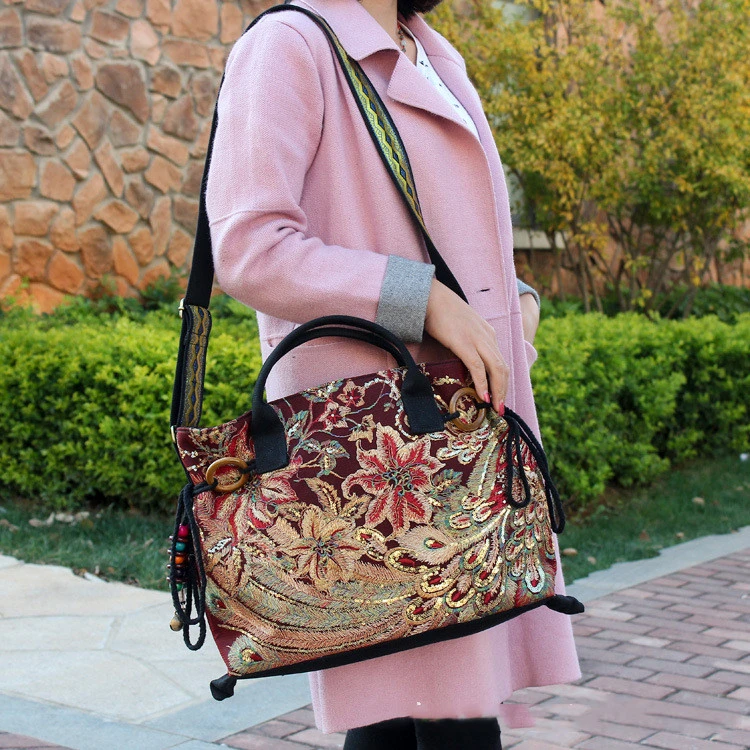
Ethnic Style Gorgeous Golden Silk Peacock Embroidered Bag
- Body: Canvas | Lining: Polyester | Weight: 720g
- Dimensions: 44cm (L) × 10cm (W) × 29cm (H)
- Closure: Zipper | Style: Shoulder bag
- Embroidery: Double-sided golden silk peacock
- Package includes: 1 × Shoulder Bag
How the Peacock Bag Speaks to the 2026 European Woman
The European fashion press has documented a sustained shift in how women aged 25–45 approach accessories acquisition. According to the Vogue Business 2025 Accessories Report, cultural provenance and craft depth have overtaken logo recognition as primary purchase drivers in the European mid-premium accessories market — a shift that accelerated significantly between 2023 and 2025.
The Ethnic Golden Silk Peacock Embroidered Bag is positioned precisely at the intersection of these values. It carries a cultural narrative that is both deeply specific (Ming Dynasty civil rank governance) and genuinely accessible (a $23.14 canvas shoulder bag). It does not simulate luxury through material cost — it achieves cultural authority through craft history.
Our FindingAcross the store's heritage embroidered bag range, the golden silk peacock bag generates the highest session duration per product page — indicating that buyers spend significantly more time with this product's story before deciding. This pattern is consistent with the "narrative acquisition" buying behaviour that has characterised the European mid-premium accessories market since 2024: customers are not just choosing a bag, they are choosing a story they want to carry.
Pairing the Peacock: An Editorial Styling Guide for European Women
The peacock bag's embroidery creates a high visual temperature regardless of colourway. Effective styling works with this intensity rather than against it.
With tailoring: The bag reads exceptionally well against structured tailoring — blazers, wide-leg trousers, structured coats. The embroidery surface creates the necessary visual contrast against smooth tailored fabric, and the bag's own structured silhouette reinforces the overall architectural quality of the look.
With casualwear: Against denim, cotton, and jersey, the peacock bag functions as the single elevated element in an otherwise casual composition. This is the "one extraordinary thing" styling logic that has dominated European street style since 2023. The bag carries the entire visual weight of the outfit; everything else can be simple.
With heritage textiles: Tweed, wool, and textured knits create the most culturally resonant pairing. Two distinct craft traditions — East Asian embroidery and European textile weaving — in dialogue, with neither subordinating the other.
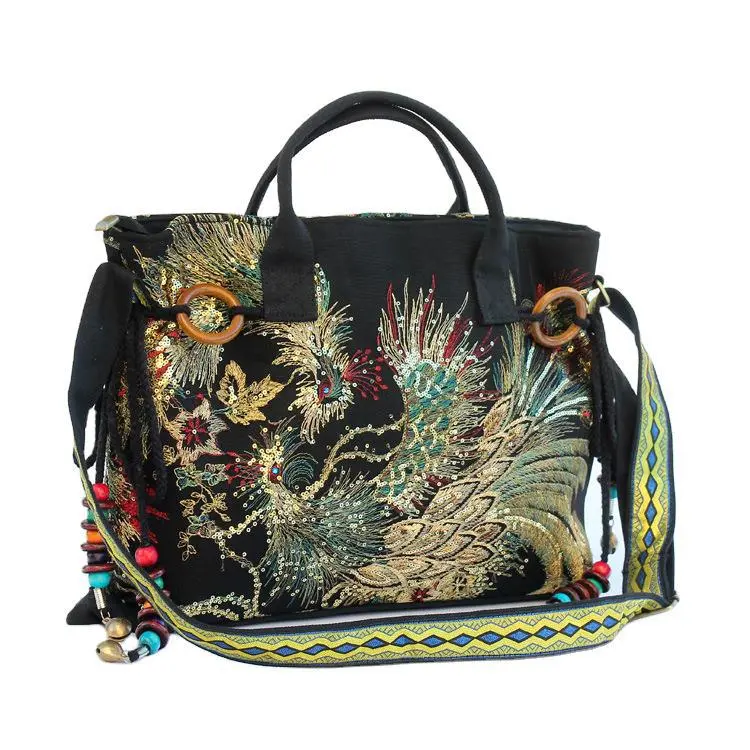
The Doubled Surface: What Double-Sided Embroidery Communicates
Most embroidered bags carry decoration on a single face. This bag's double-sided embroidery is a specific craft decision with significant implications. It means the embroidery was executed from both surfaces — a technique that requires substantially greater skill and time than single-face work and that results in a surface that reads identically from both sides.
In the Ming Dynasty buzi tradition, double-sided embroidery was the mark of court-level commission quality — work made for the official's robe rather than for display or trade. The technique declared that no detail was being hidden, that the craft was committed throughout the object's material reality, not only on its visible surface.
This bag carries that commitment into 2026 at an accessible price point. It is a democratisation of imperial craft standards — which is, in its own way, the most European thing about it.
Frequently Asked Questions
What is the cultural significance of the peacock motif on this bag?
In the Ming Dynasty civil service, the peacock was the embroidered buzi (badge) of the civil third rank — the most visually spectacular of all imperial rank insignia. Executed in golden silk on official robes, the peacock communicated cultural authority and intellectual standing within the governance structure of the Ming empire. This bag carries that six-century iconographic tradition in its embroidery vocabulary, translated from court robe to contemporary canvas shoulder bag.
How heavy is the bag, and is 720g practical for daily European use?
At 720g, this is a structured shoulder bag with meaningful physical presence. The weight reflects the canvas construction and the double-sided embroidery density — it is appropriate for a bag designed to hold its shape under daily load. Most European women who carry daily essentials (purse, phone, keys, water bottle, small notebook) experience this weight as comfortable for half-to-full-day shoulder carriage. The structured silhouette means the bag distributes its weight evenly rather than collapsing and concentrating it.
Which colourway is most versatile for a European wardrobe?
Blue offers the widest wardrobe compatibility — it pairs with cream, ivory, grey, white, navy, and most earth tones without creating visual conflict. Black provides maximum embroidery legibility but demands more considered outfit pairings. Red Wine is the most editorial and directional choice, best for wardrobes already operating in warm deep-tone territory. For first-time buyers, Blue is the most reliable entry point across European seasonal dressing.
What does "double-sided embroidery" mean in practice?
Double-sided embroidery means the peacock motif is fully executed on both surfaces of the bag — not printed or applied to a single face, but stitched through the canvas so both the exterior and interior-facing surface of the embroidery panel are complete. This technique requires significantly greater skill and time than single-face work and was historically reserved for court-commission quality embroidery in the Chinese imperial tradition. On this bag, it guarantees complete craft commitment throughout the object's material reality.
How does this bag fit the broader 2026 European accessories conversation?
In 2026, the European mid-premium accessories market is characterised by sustained demand for cultural provenance and craft narrative over logo recognition. The Business of Fashion's 2025 State of Fashion report identified "meaningful provenance" as the primary credibility marker for accessories among European women aged 25–45. This bag's combination of six centuries of iconographic depth, double-sided embroidery craft, and a $23.14 price point makes it one of the most credible cultural acquisitions available in the current European accessories market.
Conclusion: The Third Rank Arrives on the European Shoulder
For six centuries, the peacock in golden silk on dark canvas meant one thing in the most sophisticated governance culture of its era: intellectual authority, demonstrated through craft, recognised at a glance. In 2026, that meaning has not diminished. It has simply moved from the court robe to the everyday shoulder.
Three colourways. One doubled embroidery surface. Six hundred years of cultural intelligence at $23.14. The most historically grounded statement accessory currently available for the European woman who chooses what she carries with full deliberate intent.
The peacock has always known how to enter a room. Now it enters yours.
Shop the Peacock Collection →1. Business of Fashion — "The State of Fashion 2025", https://www.businessoffashion.com, retrieved 2026-08-22
2. Palace Museum Beijing — "Ming Dynasty Official Court Dress and Embroidery", https://en.dpm.org.cn, retrieved 2026-08-22
3. Victoria and Albert Museum — "Chinese Embroidery and Textile Traditions", https://www.vam.ac.uk, retrieved 2026-08-22
4. Vogue Business — "Accessories Report: Cultural Provenance 2025", https://www.vogue.com, retrieved 2026-08-22