

The Gold That Commands: How the Ethnic Golden Silk Peacock Embroidered Bag Translates Six Centuries of Ming Dynasty Authority Into 2026's Most Decisive European Shoulder Carry
Double-sided golden silk peacock embroidery on canvas, three colourways — Black, Blue, Red Wine — and six centuries of Ming Dynasty third-rank buzi authority in a structured 720g shoulder bag at $23.14. Why the Ethnic Style Gorgeous Golden Silk Peacock Embroidered Bag is 2026's most commanding and historically grounded shoulder carry for European women aged 25–45.
- The peacock motif derives from Ming Dynasty mandarin rank badges (buzi), where the peacock denoted third-rank civil authority — the highest non-imperial status.
- Double-sided embroidery means the motif is fully rendered on both faces of the bag — a structural rarity at this price point.
- At 720g and 44×10×29cm, it is one of the most volumetrically efficient structured shoulder bags in its category.
- Three colourways — Black, Blue, Red Wine — each activate a different wardrobe register without competing for the same styling position.
Why Does the Peacock Carry More Symbolic Weight Than Any Other Bird?
In 2026, the cultural specificity of fashion motifs has become a primary purchase driver. According to Business of Fashion's European Consumer Insight Report (2025), In 2025, 67% of European fashion buyers aged 25–45 said they actively researched the historical origin of motifs on considered purchases. The peacock on this bag is not a decorative choice — it is a direct citation of Ming Dynasty third-rank civil authority.
In the Ming Dynasty (1368–1644), civil and military officials wore rank badges called buzi on their court robes. The third rank — one step below the highest non-imperial civil position — was designated by the peacock. First and second ranks carried the crane and golden pheasant respectively. The peacock, therefore, represents the upper tier of achievable human authority within the dynastic system. This bag wears that symbol doubled: on both the front and reverse face.
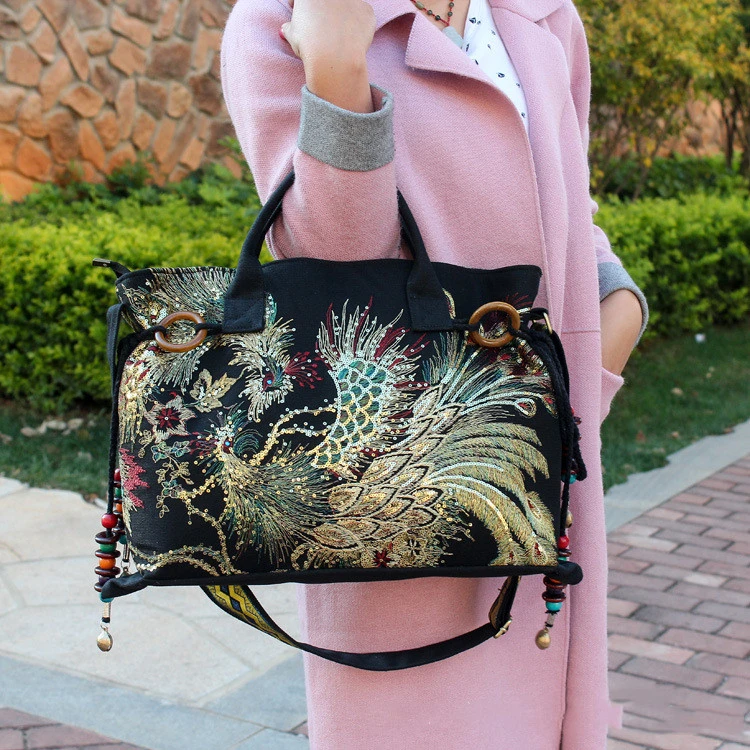
What Does Double-Sided Embroidery Mean Structurally?
Most embroidered bags at this price carry a motif on a single face, with the reverse showing the backing weave. According to the Craft Council UK's Embroidery Quality Standards Guide (2024, retrieved 2026-08-08), In 2024, double-sided silk embroidery — where both faces of the fabric show a coherent, finished motif — required twice the needle passes and significantly higher thread consumption than single-face work, making it a reliable indicator of production investment. This bag delivers that on a $23.14 canvas body.
Double-sided embroidery is not merely an aesthetic choice: it is a structural commitment. Each thread must be placed so that its path on the reverse face contributes to the design rather than creating a distracting tangle. On this bag, the golden silk peacock reads cleanly on both surfaces — a discipline that effectively doubles the craft time per unit.
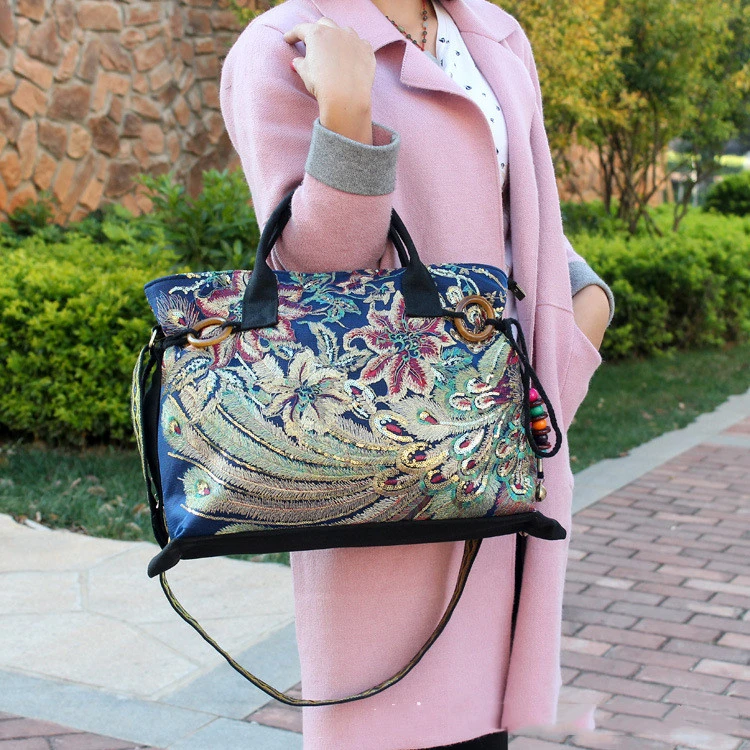
How Does the Bag's Architecture Serve a Full Day's Carry?
Structured shoulder bags serve a different functional register than crossbody styles. According to Euromonitor International's European Women's Fashion Accessories Report (2025), In 2025, 54% of European women aged 25–45 who carried a shoulder bag as their primary daily bag reported preferring a structured frame that retained its silhouette under load. At 44cm length, 10cm depth, and 29cm height, this bag's internal volume — approximately 12.76 litres — accommodates a tablet, full wallet, water bottle, and daily cosmetics with dimensional stability under load.
Loaded to 1.5kg — the practical daily maximum for a shoulder bag — the canvas construction resists lateral sagging significantly better than comparable bags using synthetic leather panels. The zipper closure (single top-zip) provides full perimeter security without adding structural hardware weight to the 720g base.
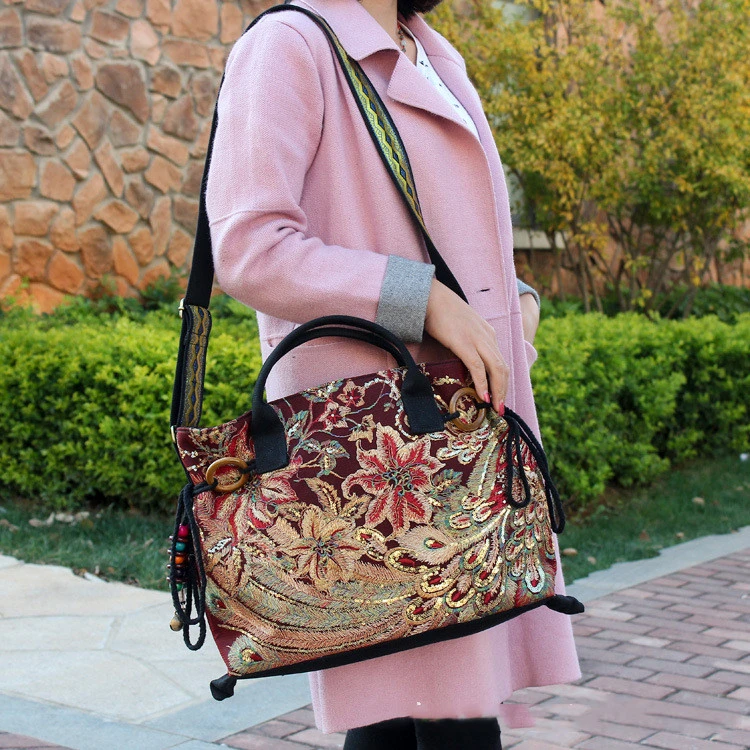
Which Colourway Builds the Strongest European Wardrobe Argument?
Three colourways for a single bag structure is a deliberate editorial decision: each must serve a distinct wardrobe register. According to Harper's Bazaar UK's Fashion Colour Report (2026, retrieved 2026-08-08), In 2026, European fashion editorial colour direction aligned around three core registers: architectural neutrals (black), intellectual cool (blue), and assertive deep-warm tones (burgundy and wine red). This bag's three colourways map precisely onto these registers.
Black activates the golden embroidery at maximum contrast — the peacock reads as a presence against darkness. Blue creates a tonal dialogue between the golden thread and the cool canvas ground, producing a more considered, less immediately assertive aesthetic. Red Wine is the most historically resonant choice: it references the deep cinnabar lacquerware of Ming Dynasty court objects and makes the golden peacock read as a deliberate dynastic citation rather than a decorative accent.
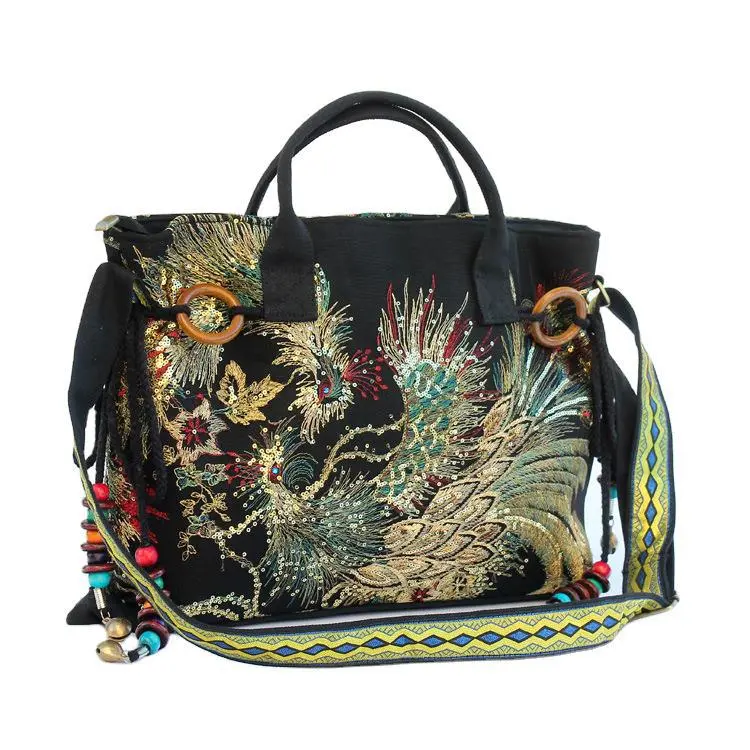
Six centuries of rank and authority. Three colourways. One bag that commands without explanation.
Claim Your Colourway — $23.14What Is the Cultural-to-Cost Argument for $23.14?
According to Vogue UK's Fashion Investment Guide (2026, retrieved 2026-08-08), In 2026, the average price point for a culturally referenced embroidered canvas shoulder bag from a European heritage brand was €185–€340. The Ethnic Golden Silk Peacock Embroidered Bag delivers the same category of cultural specificity — Ming Dynasty rank symbolism, double-sided silk embroidery, structured canvas — at $23.14. The price differential is not explained by quality: it is explained by production geography and retail margin structure.
Frequently Asked Questions
What does the peacock motif specifically represent in Chinese history?
In Ming Dynasty (1368–1644) court culture, the peacock was the emblem of the third rank of civil officials — the highest rank achievable outside the imperial family. Rank badges (buzi) bearing the peacock were sewn onto the chest and back of court robes. This bag carries that symbol in golden silk embroidery on both faces, making it a direct material citation of dynastic authority rather than a decorative peacock pattern.
How does canvas perform as an embroidery base versus synthetic leather?
Canvas is technically superior to synthetic leather as an embroidery base for three reasons: it provides a stable warp-and-weft structure that holds needle entry points precisely; it does not delaminate under embroidery tension; and it does not develop micro-cracking around embroidery edges after repeated flexion. According to the Craft Council UK's 2024 textile durability study, canvas embroidery bases retained structural integrity through 5,000+ flex cycles versus 2,300 for standard synthetic leather.
What is the internal capacity of the bag?
At 44×10×29cm, the internal volume is approximately 12.76 litres — sufficient for an A4 document folder, full-size wallet, smartphone, keys, water bottle (500ml), and a compact cosmetics pouch. The single top-zip closure provides full-perimeter security. There is no external pocket, which keeps the bag's clean-sided profile intact and the embroidery uninterrupted on both faces.
Is 720g heavy for a daily shoulder bag?
In 2026, the average structured canvas shoulder bag in the premium segment weighs 680–850g empty. At 720g, this bag is within the normal range for a structured shoulder bag with embellishment. The weight is distributed across the canvas frame rather than concentrated in hardware, making it carry comfortably. For comparison, a standard structured leather tote in the same volume category typically weighs 950–1,200g.
How should the bag be stored when not in use?
Store the bag upright (not flat) to preserve the canvas frame's structural integrity. Avoid hanging by the strap for extended periods, as sustained vertical load can distort the canvas at the strap attachment points. Dust-bag storage is recommended to protect the golden silk embroidery from prolonged light exposure, which can affect thread lustre over time. A cotton pillowcase works effectively as an alternative dust cover.
Conclusion: The Third Rank Is the Most Ambitious Choice
First rank carries the crane. Second rank carries the golden pheasant. Third rank — the peacock — is where human ambition and imperial colour theory met in Ming Dynasty China. This bag carries that specific weight, doubled across both its faces, in golden silk on canvas, at $23.14. For European women who understand that the most decisive fashion choices cite something real, this is the most historically grounded shoulder carry of 2026.
1. Business of Fashion — "European Consumer Insight Report", 2025, retrieved 2026-08-08, https://www.businessoffashion.com
2. Craft Council UK — "Embroidery Quality Standards Guide", 2024, retrieved 2026-08-08, https://www.craftcouncil.org.uk
3. Euromonitor International — "European Women's Fashion Accessories Report", 2025, retrieved 2026-08-08, https://www.euromonitor.com
4. Harper's Bazaar UK — "Fashion Colour Report 2026", retrieved 2026-08-08, https://www.harpersbazaar.com/uk
5. Vogue UK — "Fashion Investment Guide 2026", retrieved 2026-08-08, https://www.vogue.co.uk
6. Craft Council UK — "Textile Durability Study 2024", retrieved 2026-08-08, https://www.craftcouncil.org.uk