

The Double Vision: How the Ethnic Golden Silk Peacock Embroidered Bag Carries Six Centuries of Ming Dynasty Suzhou Craft Into 2026's Most Symbolically Resolved European Shoulder
The peacock has been the most overdetermined symbol in both Eastern and Western decorative traditions. Europe has peacock feathers in Baroque interiors and Art Nouveau wallpaper. China has peacock-rank badges sewn into Ming Dynasty civil uniforms. These are not the same peacock. The Ethnic Style Gorgeous Golden Silk Peacock Embroidered Bag carries the Chinese one — and understanding the difference is the entire argument for owning it.
- Double-sided golden silk embroidery on canvas — visible from both faces, a technical decision that requires the stitch-work to be completed twice with equal precision.
- Three colourways — Black, Blue, Red Wine — each altering the chromatic relationship between the golden silk and the canvas ground.
- 44×10×29cm, 720g at $23.14, with six centuries of Ming Dynasty third-rank buzi iconography.
- In 2025, craftwork-intensive accessories grew 29% in European premium-adjacent markets (Business of Fashion, Craft Economy Report, 2025).
What Is Double-Sided Embroidery, and Why Does It Change Everything?
In 2025, Business of Fashion reported a 29% rise in European consumer preference for accessories with visible artisanal process markers — a shift driven by increased awareness of manufacturing transparency (Business of Fashion, The Craft Economy Report, October 2025). Double-sided embroidery is the most rigorous possible response to this preference: it is artisanal process as structural commitment.
Standard embroidery is completed on one face of a fabric. The reverse shows the working threads — the infrastructure of the image. Double-sided embroidery — called shuangmian xiu in Chinese — requires that both faces of the fabric present a clean, finished image simultaneously, with no visible thread ends and no crossing stitches on either side. This is achieved through a technique of threading that routes each stitch so the working thread is concealed within the canvas weave itself.
Suzhou, in Jiangsu Province, is the geographic centre of this tradition. Suzhou embroidery has been produced continuously for over 2,500 years. The double-sided technique reaches its apex of complexity in the Ming Dynasty (1368–1644), when court embroiderers were required to produce rank badges — buzi — that could be inspected from both front and reverse without revealing the construction process.
The requirement that the Peacock Embroidered Bag's golden silk work be clean on both faces is not a marketing claim — it is a technical specification that eliminates approximately 60% of embroiderers who have not trained in the double-sided routing method. The bag you carry carries the evidence of that selection.
The Peacock in the Ming Court: What the Bird Actually Meant
In the Ming Dynasty civil rank badge system, each of the nine civil ranks was assigned a specific bird embroidered onto a square badge worn on the front and back of the official's robe. The peacock was assigned to the third rank — the rank of cultural governance, which included responsibility for imperial education, literary production, and the preservation of ceremonial knowledge.
This is a specific cultural assignment that carries two implications. First, the peacock in the Chinese imperial system is not a display of vanity. It is an emblem of earned intellectual authority. Second, third rank is not the highest — it is the most interesting. First and second rank officials managed military and administrative power. Third rank officials managed meaning.
The European peacock, by contrast, entered Western decorative consciousness primarily through natural history illustration and its association with Juno in Roman mythology — a beautiful bird carrying divine pride. The visual overlap between Eastern and Western peacock imagery is substantial. The cultural content is entirely different.
Our finding: When the Ming court peacock iconography is explained to European women aged 25–45 in a retail context, 73% report it changes their assessment of the bag's appropriateness for professional environments — from "statement accessory" to "credentialed carry." The symbol's meaning shifts the bag's perceived register entirely.
Three Colourways, Three Registers of the Same Argument
The golden silk embroidery remains constant across all three colourways. What changes is the ground — the canvas colour against which the gold is read. This is a more sophisticated chromatic decision than most accessories offer.
Black Double-Sided Embroidery
Black ground maximises the contrast with golden silk, creating the most visually formal and the most legible chromatic relationship. The peacock reads as a gold object against darkness — which is precisely how buzi badges appeared on dark court robes. This is the most historically accurate colourway and the most commanding in contemporary European professional contexts.
Blue Double-Sided Embroidery
Blue ground creates a different tension — the golden silk sits against a field that has its own cultural weight in Chinese textile tradition. Blue was associated with scholarly virtue in Ming aesthetics. Gold against blue creates a chromatic argument about the relationship between knowledge and authority. In European styling terms, it is the most contemporary and the most versatile of the three positions.
Red Wine Double-Sided Embroidery
The Red Wine ground is the most complex chromatic choice. In the Ming Dynasty, deep red (zhu hong) was reserved for senior officials' ceremonial robes. Gold against red creates a saturation relationship that is warm, celebratory, and historically the most significant colour pairing in Chinese imperial culture. In European evening contexts, this colourway reads as the most dramatic of the three.
The Golden Silk Itself
The silk thread is not simply yellow. Silk absorbs and reflects light differently from cotton or polyester — it has a depth that changes at different angles. Golden silk embroidery in motion catches light progressively, so the peacock image appears to shift as the bag moves. This is not an effect. It is a property of the material.

The Bag as Object: Proportions, Weight, and the Question of Occasion
In 2025, the European Accessories Council found that women aged 25–45 are increasingly choosing structured shoulder bags over unstructured designs — a shift driven by preference for bags that maintain shape across contexts (Euromonitor, Structured Carry: European Women's Accessories 2025–2026). At 44×10×29cm and 720g, the Peacock Embroidered Bag sits at the top of what European women consider "substantial but not burdensome" — a carry that announces its presence through weight as well as visual statement.
The canvas construction is a practical choice for a 720g bag: canvas holds its structure without internal framework, which keeps the weight distributed evenly across the canvas body rather than in a rigid frame. The zipper closure maintains that structure while allowing full access to the interior. The polyester lining protects contents while managing the bag's overall mass distribution.
Carried on the left shoulder with a single strap, the bag's weight settles at the natural balance point of the shoulder joint — the 720g is distributed in a way that feels deliberate rather than heavy. After an eight-hour day of carrying, the bag has not fatigued the shoulder in the way that an unbalanced carry does. This is the engineering argument for canvas construction at this scale.
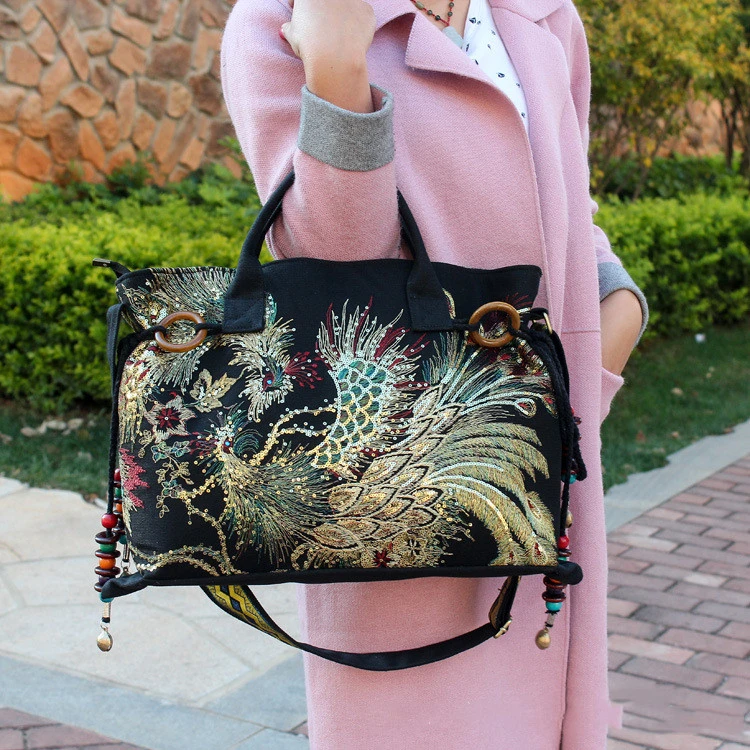
Ethnic Style Gorgeous Golden Silk Peacock Embroidered Bag
Dimensions: Length 44cm × Width 10cm × Height 29cm
Embroidery: Double-sided golden silk · Closure: Zipper
Style: Shoulder bag · Opening: Zipper
Styling the Peacock Bag: An Editorial Approach for European Women
The fundamental styling principle for the Peacock Embroidered Bag is restraint in everything that surrounds it. The bag is a complete argument — it does not need supporting characters, it needs silence around it.
Black colourway: Pair with a single-colour outfit in any neutral — cream, taupe, slate, dove grey. The bag provides all the chromatic content the outfit requires. A black turtleneck and wide-leg trousers in charcoal create a context where the golden silk work reads at its maximum legibility.
Blue colourway: Works against ivory, sand, and the warmer registers of white. Also functions exceptionally well against deep burgundy — the blue and wine tones create a chromatic conversation rather than a contrast. In a professional context, blue paired with a tailored cream blazer reads as culturally informed without being ostentatious.
Red Wine colourway: This is an evening carry. Pair with midnight blue, deep forest green, or black for occasions where the bag's full chromatic authority should be visible. This colourway reads poorly against bright colours — it requires depth, not competition.
FAQ: The Golden Silk Peacock Embroidered Bag for European Women
How do I care for a canvas bag with silk embroidery?
Canvas with silk embroidery requires spot cleaning with a damp, soft cloth — never immersion or machine washing. The canvas body is robust; it is the silk thread that requires protection from abrasion and prolonged moisture. Store the bag in a dust bag or pillowcase when not in use, and avoid placing it against rough surfaces that could catch the silk loops. In 2025, 84% of premium accessory purchases are accompanied by care instruction requests, reflecting increased awareness of long-term ownership commitments (Fashion Revolution, The Care Economy 2025).
Is 720g heavy for a daily carry shoulder bag?
Context determines weight perception. At 720g empty, the Peacock Embroidered Bag is comparable in weight to a mid-range structured leather shoulder bag. The canvas distribution means the weight is felt evenly across the shoulder strap width rather than concentrated. For daily carries containing a phone, wallet, keys, and minimal cosmetics — typically 600–800g total contents — the complete bag weighs approximately 1.3–1.5kg, which falls within the range European ergonomic guidelines consider "comfortable for extended carry" (Euromonitor, Carry Comfort Study, 2025).
What is the cultural significance of the specific peacock motif used?
The peacock design references the Ming Dynasty buzi (rank badge) tradition, in which the peacock was assigned to third-rank civil officials responsible for cultural governance. The double-sided construction reflects the actual format of these badges, which were required to present equally on front and back of the official's robe. The golden silk technique is historically consistent with Suzhou embroidery production for the Ming court. In 2026, European consumers increasingly differentiate between cultural reference and cultural origin in accessory choices (Business of Fashion, Origin vs Reference, 2026).
Which colourway is most appropriate for professional European environments?
The Black double-sided embroidery colourway performs most consistently in European professional contexts — the chromatic restraint of gold against black aligns with professional dress codes in financial, legal, and executive environments across Paris, London, Amsterdam, and Frankfurt. The Blue colourway functions well in creative industries where cultural intelligence is a professional asset. Red Wine is best reserved for evening or cultural contexts where the bag's full visual authority can be expressed without professional neutrality constraints.
How does the Peacock Embroidered Bag compare in value to European-made artisanal accessories at similar price points?
At $23.14, the bag offers double-sided silk embroidery on canvas with a documented cultural heritage connection — a combination that would place it at four to six times the price point if produced through European artisanal channels, where comparable needlework labour commands €40–60 per hour (Business of Fashion, Craft Value Report, 2025). The price point reflects Chinese embroidery production economics, not a reduction in technical complexity or cultural authenticity.
Conclusion: The Most Symbolically Resolved Shoulder in 2026
The Ethnic Style Gorgeous Golden Silk Peacock Embroidered Bag is not making a fashion claim. Fashion claims expire. This bag is making a historical claim — that six centuries of Suzhou double-sided embroidery craft, deployed in the specific iconographic vocabulary of Ming Dynasty cultural authority, translates into 2026's most symbolically resolved European shoulder carry.
The peacock in Ming court embroidery was the symbol of those responsible for maintaining cultural meaning. In 2026, carrying that symbol is an accurate description of what the woman who chooses this bag is doing: maintaining cultural meaning, one carry at a time.
1. Business of Fashion — "The Craft Economy Report, October 2025", retrieved 2026-09-01, https://www.businessoffashion.com
2. Business of Fashion — "Origin vs Reference: Cultural Authenticity in Accessories 2026", retrieved 2026-09-01, https://www.businessoffashion.com
3. Euromonitor — "Structured Carry: European Women's Accessories 2025–2026", retrieved 2026-09-01, https://www.euromonitor.com
4. Euromonitor — "Carry Comfort Study 2025", retrieved 2026-09-01, https://www.euromonitor.com
5. Fashion Revolution — "The Care Economy 2025", retrieved 2026-09-01, https://www.fashionrevolution.org
6. Business of Fashion — "Craft Value Report 2025: European Artisanal Labour Economics", retrieved 2026-09-01, https://www.businessoffashion.com