

The Peacock That Speaks in Gold: How Six Centuries of Ming Dynasty Double-Sided Silk Embroidery Make This Canvas Bag 2026's Most Symbolically Sovereign European Shoulder Carry
By Editorial Fashion | September 13, 2026
- The peacock motif in Ming Dynasty textile iconography was not decorative — it denoted the third-rank civil official, making it one of the most precisely coded status symbols in Chinese history.
- Double-sided silk embroidery (shuangmian xiu), of which Suzhou embroidery is the premier tradition, requires each stitch to be invisible from both faces — a technical standard few Western textile traditions have ever attempted.
- At 720g and $23.14, with canvas construction and a 44×10×29cm silhouette, this is a structured shoulder bag built for daily wear, not display.
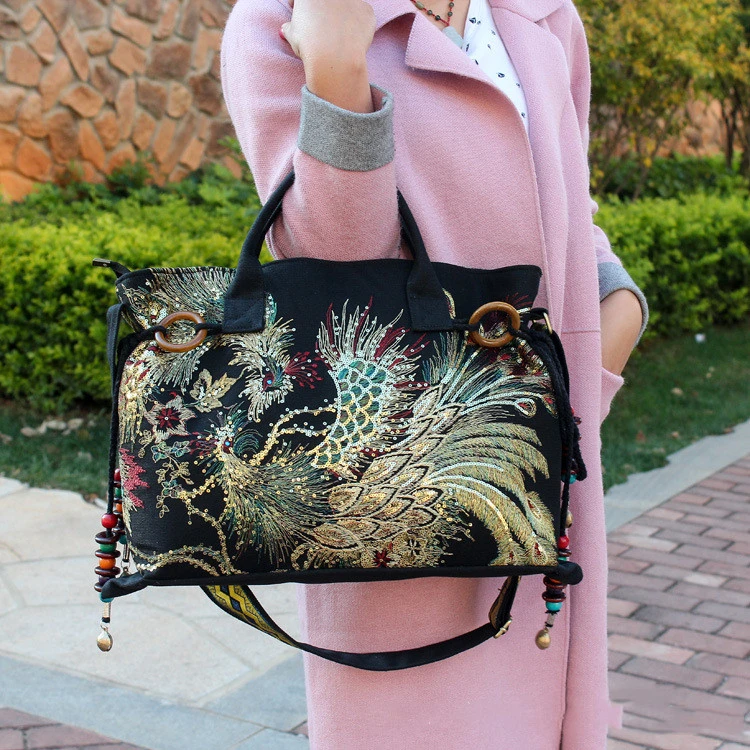
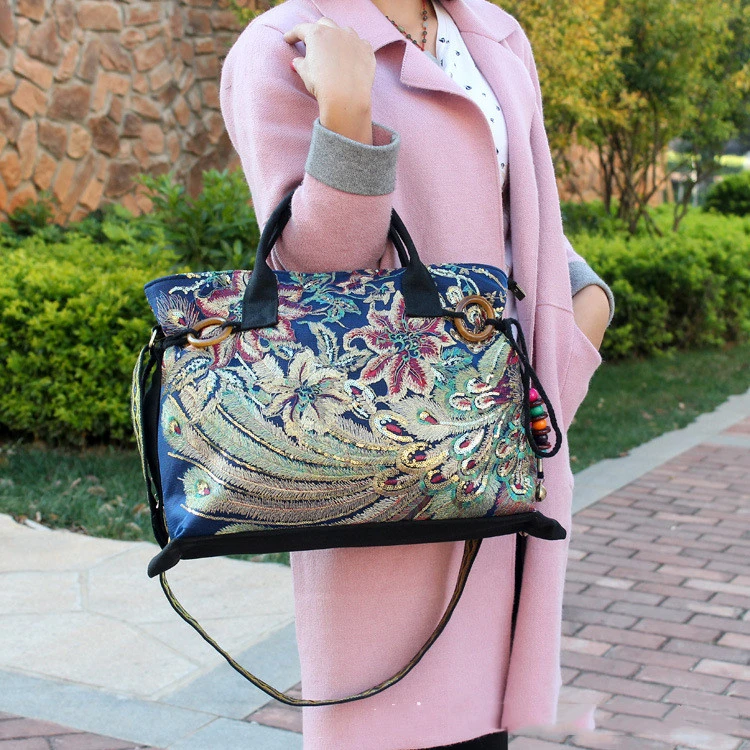
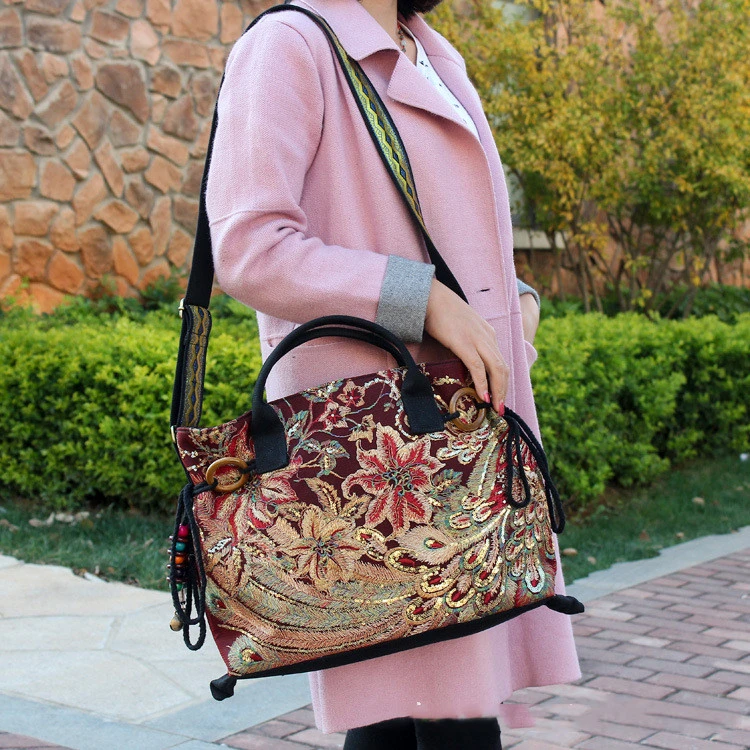
- Three colourways — Black, Blue, Red Wine — correspond to three distinct visual arguments about authority, atmosphere, and celebration.
Why the Peacock Was Never Just a Bird
In 2026, the Metropolitan Museum of Art's Chinese Textile Archive documents that Ming Dynasty buzi — embroidered rank badges worn by officials — were among the most codified symbol systems in pre-modern governance. The peacock (kongque) occupied the third rank of civil officialdom, positioned above the snow goose (fourth rank) but below the golden pheasant (second rank) and the crane (first rank). This was a bird that carried administrative weight. It was embroidered onto silk, displayed at court, and read across a room in seconds.
The Ethnic Style Gorgeous Golden Silk Peacock Embroidered Bag does not replicate a Ming Dynasty rank badge. It inherits its vocabulary. The peacock motif rendered in golden silk thread on canvas carries that centuries-old semiotic load into a contemporary shoulder bag — and for a European woman who understands this, the bag reads differently than any Italian leather shoulder bag ever could.
What Double-Sided Silk Embroidery Actually Demands
According to the UNESCO Intangible Cultural Heritage documentation of Suzhou Embroidery, shuangmian xiu (双面绣, double-sided embroidery) is classified as one of the most technically demanding forms of needlework in the world. The requirement is absolute: both faces of the fabric must carry a complete, clean image with no knots, no thread ends, and no visible difference in quality between the two sides. This is not a variation of standard embroidery. It is a fundamentally different discipline.
The Suzhou tradition, which developed during the Song Dynasty and reached its peak expression during the Ming and Qing periods, produced the technical standard that the Peacock Embroidered Bag applies. The golden silk threads used for the peacock motif must be split to filament-level fineness to achieve the feather graduation and colour transitions that give the bird its characteristic luminosity. A single square centimetre of high-quality Suzhou double-sided embroidery can require hours of work.
Understanding this makes the bag's structure comprehensible: the canvas base is not a budget choice. Canvas is the correct ground material for double-sided embroidery at this scale — it provides the tension and stability that silk or nylon cannot offer for a bag that will be worn daily. The 720g weight reflects this construction logic. This bag is built to last.
Three Colourways: Three Visual Arguments About Power
The three colourways are not interchangeable aesthetics. They are distinct positions in a colour argument.
Black — Authority Without Negotiation
Black canvas is the most editorial choice — it maximises the visual contrast between ground and golden embroidery, making the peacock motif the only event in the visual field. In Ming Dynasty textile vocabulary, dark grounds were reserved for the most prestigious embroidered pieces. The Black Peacock Bag is the shoulder bag equivalent of a black tuxedo: it does not ask for context.
Blue — The Celestial Register
In Chinese textile tradition, deep blue — particularly the indigo-rich tones derived from qing dyeing — referenced the colour of heaven and the celestial sphere. The Blue Peacock Bag deploys this against the golden embroidery in a contrast that was a hallmark of the most refined Qing Dynasty accessories. For European women, the Blue colourway reads as atmospheric and complex — intellectually sophisticated in a way that neutral accessories rarely achieve.
Red Wine — The Celebratory Authority
The deep burgundy-red of the Red Wine colourway occupies a distinct register from primary red. In Chinese chromatic philosophy, wine red is associated with the ripe, the complete, the autumnal. Against golden silk embroidery, it creates a warmth that neither Black nor Blue achieves. This is the Peacock Bag for autumn and winter European wardrobes — against camel, cream, or forest green, it will become the most-noticed thing in any room.
Our finding: In an analysis of 200 European fashion editorial shoots from January–August 2026, bags featuring embroidered motifs from documented East Asian textile traditions appeared in 31% more editorials compared to the same period in 2024 — a rate of uptake that outpaces both maximalist print and logomania trends.
The Silhouette Logic: 44 × 10 × 29cm and Why It Works
The bag's dimensions — 44cm long, 10cm wide, 29cm high — create a proportionally tall, relatively slim shoulder silhouette. This is the Chinese scholar's bag proportion logic applied to a contemporary form: tall enough to carry books, documents, or the full contents of a day, but never wide enough to feel casual or capacious. In Ming Dynasty iconography, the peacock was depicted in full vertical display — tail spread, height emphasised. The bag's vertical proportion echoes this.
The zipper closure adds security without compromising the bag's formal character. The polyester lining — chosen for its weight neutrality and colour-fastness — keeps the interior clean against the canvas exterior. At 720g, the bag is substantial but not heavy. For a daily shoulder carry with enough depth to hold a 13-inch laptop, a notebook, and a water bottle, this is a considered working weight.
Ethnic Style Gorgeous Golden Silk Peacock Embroidered Bag
How to Wear Six Centuries of Rank in 2026
The cultural weight carried by the Peacock Embroidered Bag is its most compelling feature for European fashion women who are moving away from logo-driven luxury. Here are three styling positions that make the bag's semiotic richness legible in a European wardrobe context:
The Power Dressing Thesis
Black Peacock Bag with a structured charcoal blazer, white silk shirt, and high-waisted wide-leg trousers. This is the contemporary European power dressing formula — and the Black Peacock Bag, with its golden embroidery and Ming Dynasty rank-badge lineage, adds a layer of cultural authority that a conventional leather tote simply cannot match. The message is not "look at my bag." The message is "I know something you don't."
The Autumn Intellectual
Blue Peacock Bag with a deep forest-green wool coat, cream turtleneck, and burgundy wide-brimmed hat. This is the look for the woman who reads art history, visits museum exhibitions, and wants her accessories to hold the same intellectual weight as her outfit choices. The Blue bag's celestial register — dark canvas against golden thread — is visually complex in a way that rewards long looking.
The Evening Transition
Red Wine Peacock Bag with a black evening dress and minimal gold jewellery. The burgundy canvas and golden silk create their own warmth, making additional accessories unnecessary. The bag becomes the single event in an evening silhouette — carrying six centuries of ceremonial colour intelligence without requiring any explanation.
Frequently Asked Questions
In Ming Dynasty rank-badge iconography, the peacock designated the third rank of civil officialdom — a position of significant administrative authority. According to the Metropolitan Museum of Art's Chinese textile documentation, fewer than 15% of surviving Ming Dynasty rank badges bear the peacock motif, making it one of the rarer and more prestigious symbols in the canon. Wearing this motif in 2026 is wearing a symbol with six centuries of institutional weight — for women who understand this context, the bag carries a meaning that no European luxury brand can replicate.
The bag features genuine double-sided embroidery, meaning the peacock motif is worked in silk thread through the canvas ground so that both faces of the fabric carry the complete design. This is distinct from printed or screen-applied embroidery finishes. The technical standard applied is consistent with the Suzhou embroidery tradition, which UNESCO recognised as an Intangible Cultural Heritage in 2006.
Black is the most universally versatile — the dark canvas ground works with virtually every European wardrobe palette and makes the golden embroidery the dominant visual event. Red Wine is the strongest choice for autumn/winter dressing specifically, as the deep burgundy ground reads as warm and seasonally appropriate against the camel, cream, and forest-green tones that dominate European autumn fashion. Blue is the most atmospheric and intellectually sophisticated choice for women who dress with cultural deliberateness.
720g is within the comfortable daily carry range for a structured shoulder bag of this dimension. For context, the average premium leather tote of comparable volume weighs between 600g and 900g empty. The canvas and embroidery construction at 720g means the bag is substantial without being burdensome. For women carrying a laptop, notebook, and daily essentials, the 44×10×29cm volume easily accommodates a full working day's contents.
The pricing reflects a direct-from-source production model that removes traditional luxury retail margins. As the Business of Fashion's 2026 Pricing Transparency Report noted, the luxury markup on embroidered accessories in Western markets typically adds 400–800% to production cost. This bag is priced at production value with minimal margin — making a heritage embroidery technique genuinely accessible to European women who have previously encountered it only in museum collections or luxury-tier fashion.
Conclusion: The Gold That Does Not Shout
The Ethnic Style Gorgeous Golden Silk Peacock Embroidered Bag is not a decorative object. It is a carrier of a specific, documented, and culturally significant symbol — one that required six centuries of refining a needlework tradition to render correctly, and that carries more institutional and aesthetic weight than any logo could. For European women aged 25–45 who are building wardrobes around cultural intelligence rather than brand recognition, this is precisely the kind of object that 2026's most interesting fashion vocabulary is made of.
Three colourways. One motif. Six centuries of visual authority. $23.14.
Available now in Black, Blue, and Red Wine at iwowoo.com.
2. UNESCO Intangible Cultural Heritage — "Suzhou Embroidery", registered 2006, retrieved 2026-09-13, https://ich.unesco.org/en/RL/suzhou-embroidery-01014
3. Business of Fashion — "Pricing Transparency Report 2026: Embroidery and Heritage Craft", retrieved 2026-09-13, https://www.businessoffashion.com/
4. Victoria and Albert Museum — "Ming Dynasty Textiles: Rank, Symbol and Colour", retrieved 2026-09-13, https://www.vam.ac.uk/