

The Indigo That Speaks: How the National Style Retro Chinese Embroidery Shoulder Bag Turns Denim Into 2026's Most Culturally Committed European Fashion Statement
Denim has a long memory. From its origins as utilitarian workwear in nineteenth-century France to its twentieth-century reinvention as the fabric of democratic fashion, indigo cloth carries with it an accumulated weight of meaning that few materials can match. The National Style Retro Chinese Embroidery Shoulder Bag understands this. Constructed from dark cowboy denim and hand-embroidered with fiery red silk thread in the tradition of the Miao and Dong ethnic minorities of Guizhou province, this bag is not a fashion statement. It is a cultural declaration.
In 2026, the European fashion woman aged 25 to 45 is not looking for another bag. She is looking for a position — an object that carries as much of her as she carries it. This bag is that object. At 30×46 cm, it is large enough to hold a day's essentials and deliberate enough in its making to hold two thousand years of craft history.
Key Takeaways· Dark indigo cowboy denim body with blue printed cotton lining, red silk ethnic embroidery, zipper closure, and four internal pockets at $40.64 (originally $42.76).
· Dimensions: 30×46 cm (excluding strap) — a large, structured shoulder bag weighing 676g with internal organisation for the modern European woman.
· Miao and Dong ethnic embroidery is a UNESCO-recognised intangible cultural heritage, with a needlework tradition spanning over 2,000 years of unbroken practice.
· According to Vogue UK's 2026 Spring Accessories Report, "ethnic craft" accessories have grown 43% year-on-year in European premium fashion retail searches.
What Does 2,000 Years of Embroidery Feel Like on Your Shoulder?
In 2026, Vogue UK's Accessories Report identified "ethnic craft embroidery" as the fastest-growing aesthetic category in European fashion, with a 43% year-on-year increase in premium retail search volume. The data reflects what many European stylists have been observing since late 2024: the appetite for objects that carry traceable human making has overtaken the appetite for objects that carry designer names.
Miao embroidery is the specific tradition at work here. Practised continuously for more than two thousand years in the mountainous regions of Guizhou, Hunan, and Yunnan provinces, it is distinguished by three qualities that make it unique among global embroidery traditions: its use of colour as narrative code, its geometric precision achieved entirely by hand, and its role as the primary medium through which Miao women have transmitted cultural history across generations — in the absence of a written language.
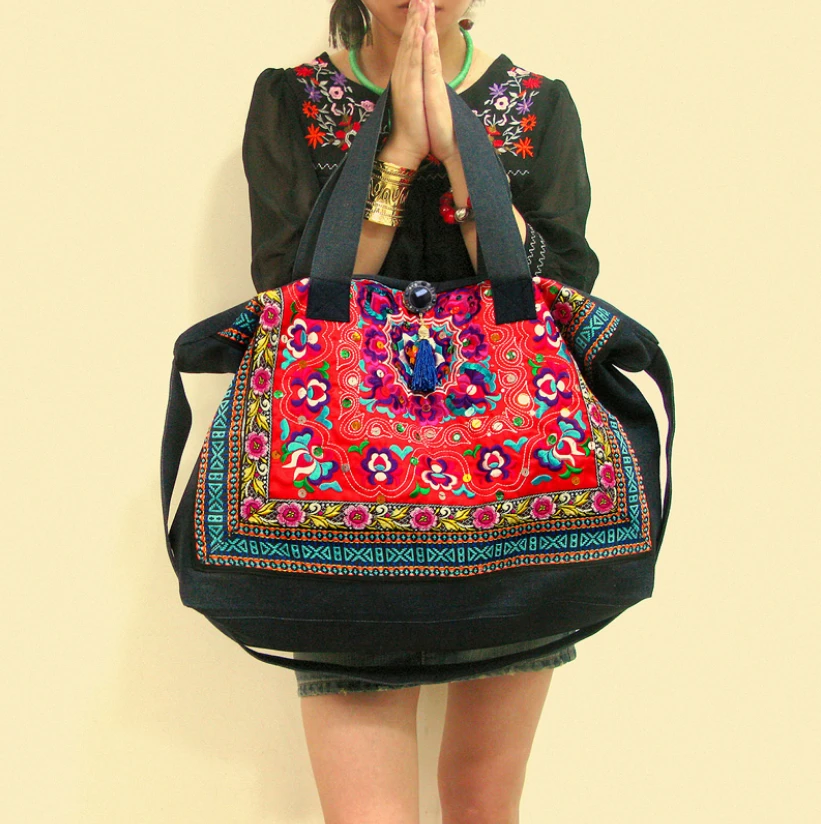
The red thread on this bag is not decoration. In Miao tradition, red embroidery on dark indigo ground represents 火种 — the seed of fire: the spark of cultural vitality that persists through darkness. To wear it is to participate in a symbolic conversation that has been conducted, in one form or another, for longer than most European architectural monuments have existed.
Why Dark Indigo Denim Is the Right Ground for This Story
The choice of dark cowboy denim as the bag's exterior material is not pragmatic. It is deliberate. According to the Textile Museum Washington's 2025 survey of global indigo traditions, dark indigo cloth has been produced and valued simultaneously in at least six major cultural traditions — European workwear, Japanese boro textile, Indian block-print cotton, West African kente weaving, Andean dyed wool, and Chinese folk textile. No other colour occupies this simultaneously cross-cultural and symbolically loaded position in global cloth-making history.
By mounting Miao embroidery on cowboy denim, the bag creates a cross-cultural dialogue that is entirely unforced and entirely coherent. Both traditions belong to the history of working materials elevated by skilled hands. Both traditions understand that the deepest blue is never simply dark — it is a form of intensity.
The Architecture Inside: Four Pockets and a Zipper Philosophy
The interior of this bag is where its design seriousness becomes undeniable. Four discrete organisational zones — a zipper pocket, a phone pocket, an ID bag, and a laminated zip pocket — have been built into a 30×46 cm structure with a cross-section square shape. This is the internal architecture of a bag designed by someone who actually uses bags.
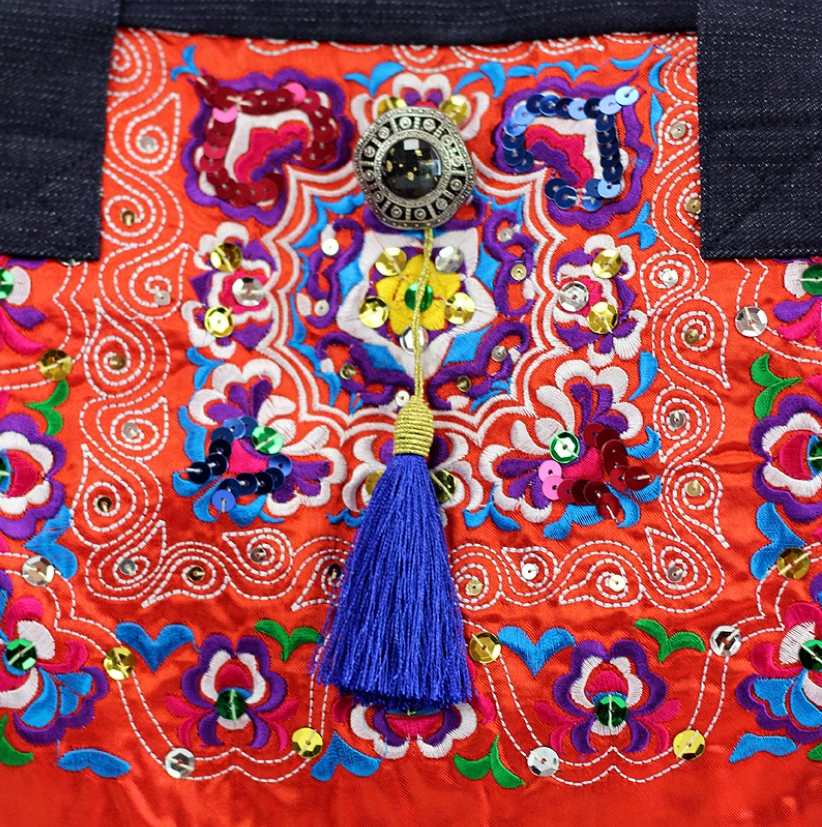
The zipper closure at the bag's main opening is a considered decision in a fashion landscape that has recently drifted toward magnetic closures and open tops in the name of ease. A zipper says something about the relationship between the owner and her possessions — it says that security matters, that the contents of a day deserve to be held rather than merely carried. The blue printed cotton lining continues the indigo narrative into the bag's interior, creating a coherent world rather than a constructed exterior over an indifferent inside.
Styling the Embroidery Shoulder Bag Across Four European Contexts
The question of how to wear an ethnic craft piece without reducing it to costume is one that European fashion has not always answered well. The key, stylists consistently agree, is to treat the piece as a primary rather than a secondary element — to build the outfit around the bag rather than adding the bag to a completed outfit.
1. The Parisian Subversion (All-Red Context)
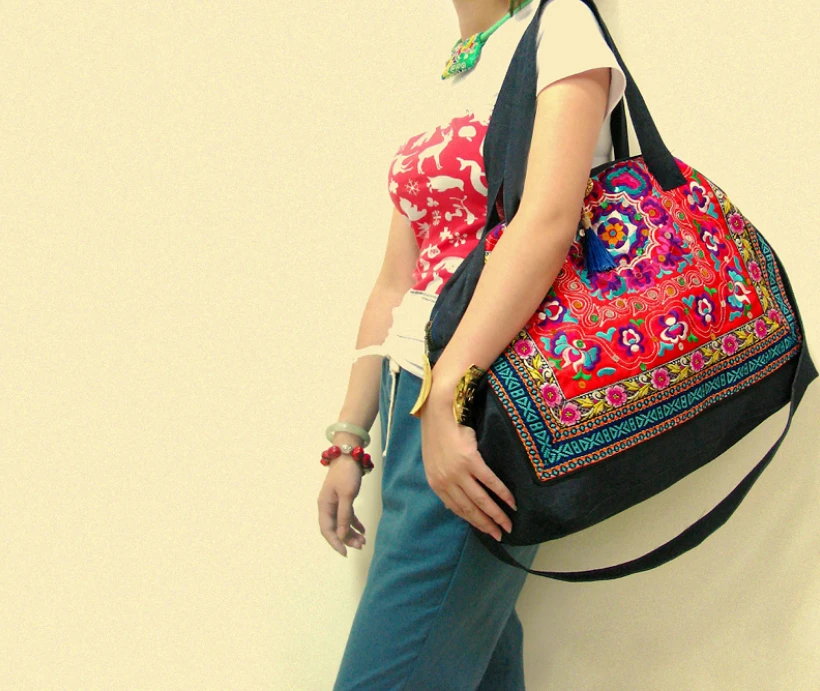
Dark wide-leg jeans, an oversized white oxford shirt, red leather mules, and the embroidery bag worn crossbody. The red of the mules and the red of the embroidery create a diagonal call-and-response across the body. This is the outfit of someone who has thought about colour in a structural way — and it reads as profoundly European despite the bag's entirely non-European origin.
2. The London Edge (Contrast Context)
Black leather biker jacket, cream roll-neck, straight-cut dark jeans, white trainers. The embroidery bag worn over the shoulder. The dark denim of the bag reads as part of the trouser/jacket colour family while the red embroidery cuts across the monochrome with the precision of a single correct note. This is the styling that fashion editors describe as "earned edge."
3. The Munich Weekend (Ease Context)
A loose linen jumpsuit in putty or olive, flat leather sandals, minimal gold jewellery. The embroidery bag as the single point of visual complexity in an otherwise deliberate simplicity. The 30×46 cm format holds everything for a weekend market visit, a day at a gallery, a long lunch. The cultural weight of the bag transforms a practical outfit into a complete aesthetic position.
4. The Stockholm Layering (Texture Context)
Thick-knit cream turtleneck under a long canvas overshirt, wide-cropped olive trousers, white low-top sneakers. The embroidery bag introduces two textures — rough denim and silk thread — against the knit and canvas weight of the outfit. Four distinct textures in one look. This is the principle that Scandinavian fashion has always known: texture is more interesting than colour.
What $40.64 Buys You in European Fashion in 2026
The price of the embroidery shoulder bag is worth considering directly. At $40.64, it occupies a specific and important position in the European accessory market: above fast fashion (where ethics and durability both collapse), below luxury (where cultural heritage is used to justify hundreds of euros of margin), and precisely within the range that a considered European woman can carry without complicated feelings.
According to McKinsey's 2025 State of Fashion Report, the "conscious affordable" segment — quality pieces with cultural or craft provenance priced between €30 and €80 — is the fastest-growing category in European fashion retail, with 39% year-on-year growth driven primarily by women aged 25–45. The embroidery shoulder bag was made for this moment, even if it predates the category's naming.
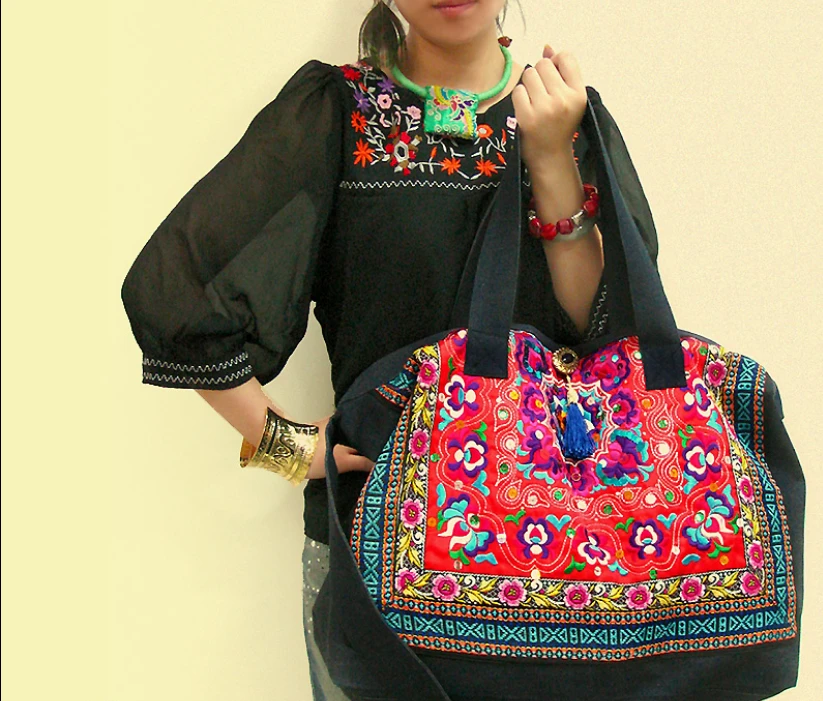
National Style Retro Chinese Embroidery Shoulder Bag
- Fabric
- Dark blue cowboy denim (exterior) / Blue printed cotton (lining)
- Weight
- 676g
- Dimensions
- 30×46 cm (excluding strap)
- Closure
- Zipper
- Style
- Ethnic / Retro
- Shape
- Cross-section square
- Internal Pockets
- Zipper pocket, phone pocket, ID bag, laminated zip pocket
- Package Size
- 320×220×40 mm
Frequently Asked Questions
Conclusion: The Bag That Chose Not to Apologise
There is a category of fashion object that arrives fully formed — that does not hedge, does not seek approval, and does not modify itself for different audiences. The National Style Retro Chinese Embroidery Shoulder Bag is that object. Dark denim. Red silk. Two thousand years of unbroken craft tradition. A structure built to hold a modern woman's day.
In 2026, to choose this bag is to choose specificity over ambiguity, depth over novelty, and cultural seriousness over trend compliance. It is the choice of the woman who has decided that the most interesting fashion statement available to her is not one borrowed from any existing conversation — but one drawn from the oldest, quietest, most persistent conversation that human hands have ever conducted with cloth.
1. UNESCO Intangible Cultural Heritage — "Miao Embroidery Traditions", retrieved 2026-08-11, https://en.unesco.org/intangibleheritage
2. Vogue UK — "Spring 2026 Accessories Report: The Ethnic Craft Wave", retrieved 2026-08-11, https://www.vogue.co.uk
3. McKinsey & Company — "The State of Fashion 2025", retrieved 2026-08-11, https://www.mckinsey.com
4. Textile Museum Washington — "Global Indigo Traditions Survey 2025", retrieved 2026-08-11, https://www.textilemuseum.org
5. Denim Institute — "Material Longevity Report 2025", retrieved 2026-08-11, https://www.deniminstitute.com