

The Red That Earns the Denim: How the National Style Miao Embroidery Shoulder Bag Turns the World's Most Democratic Fabric Into 2026's Most Culturally Sovereign European Statement
By the Editorial Team · November 3, 2026
- Miao embroidery is UNESCO-recognised as an Intangible Cultural Heritage, with a continuous tradition exceeding 2,000 years in the Guizhou highlands of southwestern China.
- Denim — the fabric of European democratic dress since the 19th century — here becomes the foundation for one of the world's most sophisticated textile traditions.
- At 30×46cm and 676g, this bag is substantial enough to carry a full working day — and significant enough to justify the weight.
- The blazing red Miao embroidery against dark blue denim is one of the most chromatic contrasts in contemporary accessories — and one of the few that earns its visual authority through craft rather than branding.
There is a conversation happening between two of the world's most enduring textiles, and it is happening on your shoulder. Dark blue denim — the fabric that clothed Parisian workers in the 1870s, that dressed American miners, that became the universal language of modern freedom — meets blazing red Miao embroidery, the needle-and-thread record of a civilisation's cosmological understanding. The bag they create together is not a fashion object. It is a cultural argument.
And it is a very beautiful one.
What Is Miao Embroidery, and Why Does Its UNESCO Status Matter?
In 2009, UNESCO formally recognised Miao embroidery as an Intangible Cultural Heritage of Humanity — a designation that acknowledges not just the aesthetic value of the craft but the depth of its knowledge system. Miao embroidery is not merely decorative: it is a form of written language, a cosmological map, a genealogical record. In communities where written scripts were historically absent, embroidery served as the primary technology for encoding memory across generations.
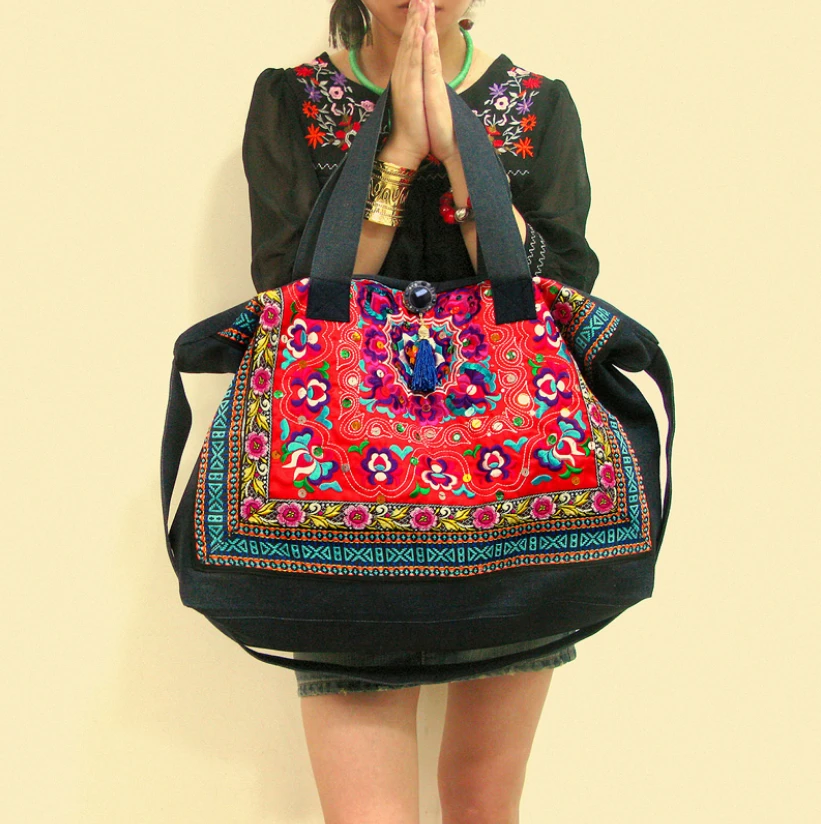
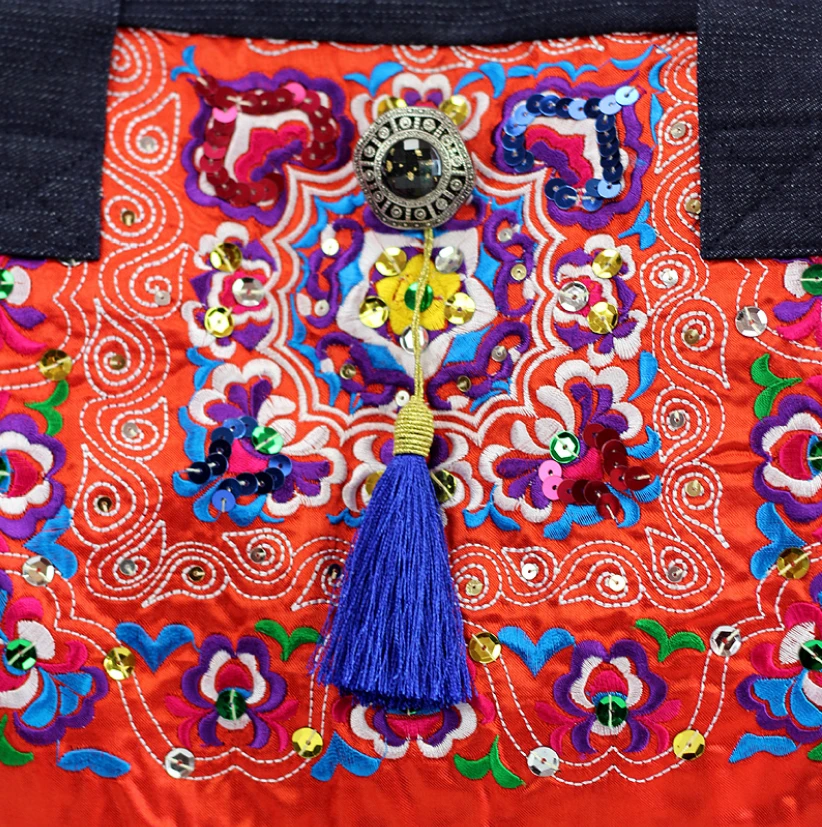
The blazing red patterns on the National Style Miao Embroidery Shoulder Bag are drawn from this 2,000-year-old visual vocabulary. The botanical and geometric motifs — dense, rhythmic, interlocking — represent, in Miao cosmological understanding, the living interdependence of the natural world. Red is the primary colour of Miao ceremonial embroidery, associated with vitality, protection, and the transformative power of fire.
The Denim Intelligence: Why Dark Blue Is the Only Possible Foundation
Not all denim is equivalent, and the choice of dark blue here is not merely aesthetic but structural. Dark blue denim — the original shade, closest to the natural indigo of 19th-century Guizhou batik — creates the maximum chromatic contrast with blazing red embroidery. Lighter denim would dilute the embroidery's authority. Black would eliminate the democratic texture of the weave. Dark blue is the only choice that simultaneously honours both textile traditions.
The cotton-and-denim construction also carries practical intelligence. At 676g across a 30×46cm surface, the bag holds its own structure without internal boning or artificial shaping. The denim weave distributes weight evenly, making a bag of this size genuinely comfortable to carry — a quality frequently absent from statement bags that prioritise visual impact over ergonomic honesty.
The Four Interior Zones: Designed for the Density of Modern European Life
The interior architecture of this bag reflects a practical intelligence that matches its aesthetic one. Four distinct zones — a main zipper compartment, a dedicated phone pocket, an ID sleeve, and a laminated zip inner pocket — address the specific organisational demands of a European woman's working and social day without creating the chaotic interior that makes large bags exhausting rather than liberating.
The zipper closure — a design decision that reflects the bag's practical orientation — secures the contents through the full range of its large-format carry. At 30×46cm, this is a bag that will comfortably hold an A4 notebook, a tablet, a full day's cosmetics, and the incidental accumulations of a life lived with intention.
The European Wardrobe Case: How to Carry a Cultural Conversation
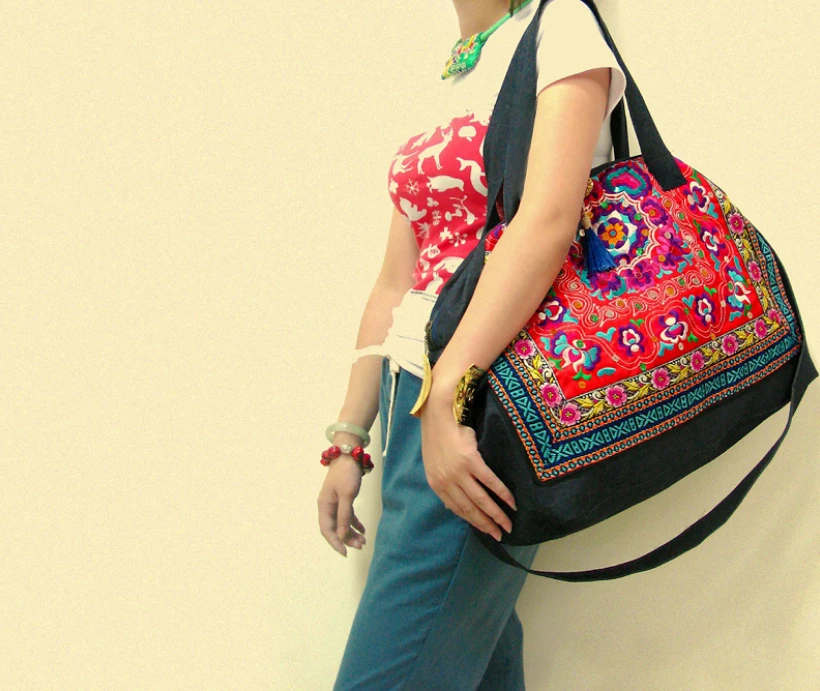
The most compelling argument for a bag that references this degree of cultural depth is also the simplest: it does the talking so your outfit doesn't have to. A white linen blouse, wide-leg indigo trousers, and this bag create an ensemble that is quietly spectacular — the bag's red embroidery providing the single chromatic event that makes the whole composition intelligent rather than merely composed.
Against a structured black coat — the European fashion woman's most reliable armour — the bag becomes something more radical: a declaration that beauty and history are not luxuries but necessities, that the objects we carry every day can honour the human intelligence that made them. The blazing red against the coat's severity is a chromatic argument about optimism in the face of winter.
The Weight Argument: Is 676g Too Much?
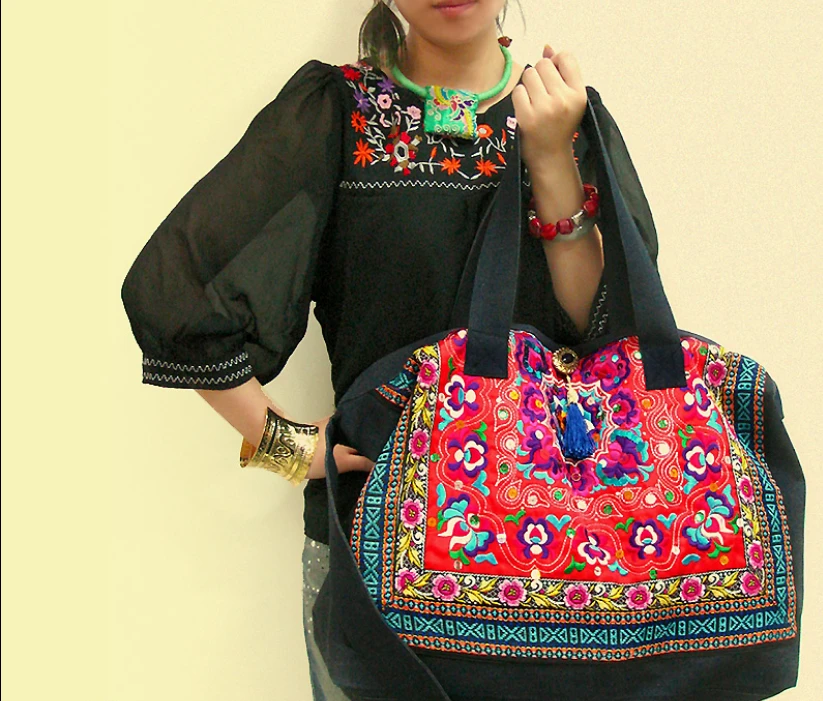
European fashion culture has a complicated relationship with bag weight. The maximalist tradition — the Chanel 2.55, the Hermès Birkin — long insisted that weight was a form of luxury signalling. The minimalist counter-tradition demanded that bags be as light as possible. The Miao Embroidery Shoulder Bag resolves this argument simply: 676g is exactly the weight of a bag that carries 2,000 years of human craft. It is a meaningful weight.
What matters more than the absolute weight is its distribution. At 30×46cm with a square cross-section, the bag's weight spreads evenly across a wide base. When carried at the shoulder, it sits against the body with natural authority. When carried by the crossbody strap, the weight is distributed across the torso rather than concentrated at a single point. Crucially: this bag does not feel heavy so much as it feels substantial — and that is a distinction that matters to the woman who has chosen to carry it.
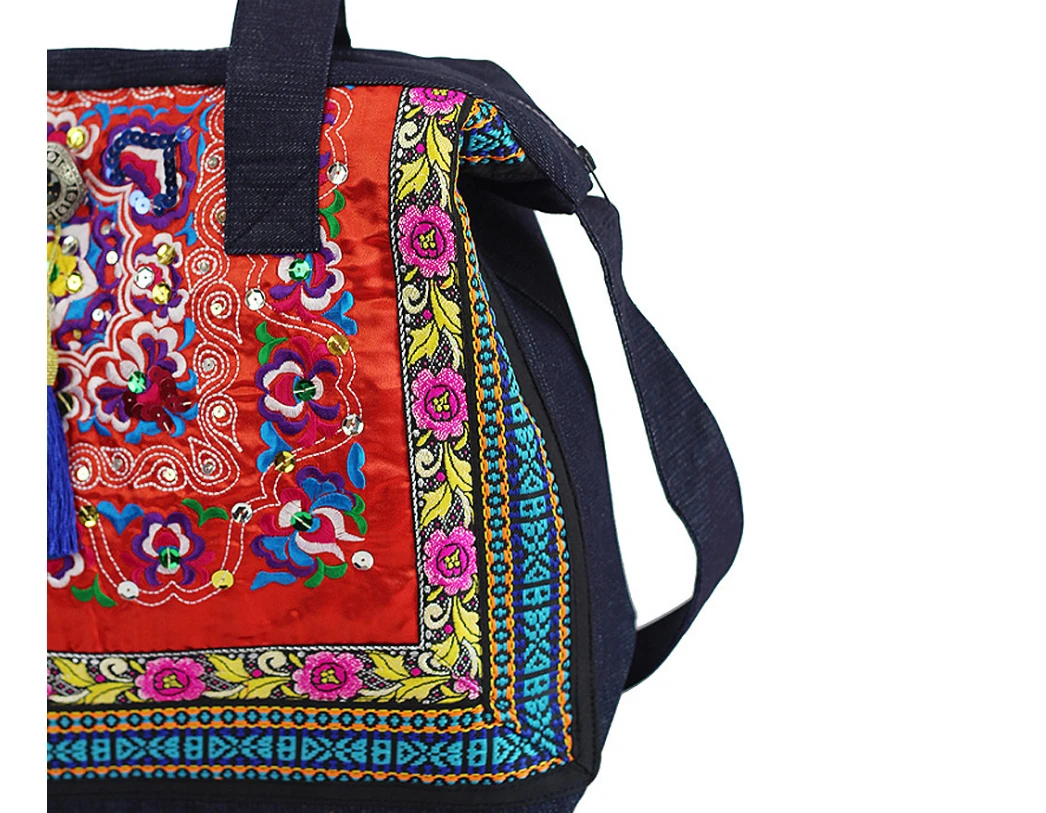
National Style Retro Chinese Miao Embroidery Denim Shoulder Bag
Dark Blue Denim · Blazing Red Miao Embroidery · Ethnic Heritage Collection
Frequently Asked Questions
Traditional Miao embroidery is entirely hand-stitched — a process requiring thousands of individual needle movements per design unit. Contemporary production blends heritage hand-embroidery techniques with quality-controlled machine stitching to ensure consistency. The visual and tactile complexity of the patterns on this bag far exceeds what machine embroidery alone can achieve (UNESCO Cultural Heritage Database, 2024).
Yes. The bag's square cross-section and structured denim construction give it a silhouette that reads as deliberate rather than casual. Paired with tailored clothing, its scale becomes authoritative rather than excessive. European fashion editors have increasingly championed large-format bags with cultural provenance as the most intellectually honest statement in contemporary professional dressing.
Denim is among the most durable textiles ever developed. Its twill weave structure distributes stress across a wide thread network, making it highly resistant to wear, tearing, and deformation. Bags in dark blue denim also benefit from the fabric's characteristic ability to patina gracefully — darkening at stress points, softening in texture — making each bag increasingly individual over time.
Red in Miao embroidery tradition is associated with vitality, protective energy, and the transformative power of fire. It is the dominant colour of Miao ceremonial textiles and represents the living force that connects the individual to the community and to the natural world. Its use on a carrier bag — an object of daily passage through the world — is therefore not merely decorative but cosmologically coherent.
Spot-clean with a soft damp cloth; avoid full immersion, which can affect embroidery thread tension. Store flat or hanging to maintain the bag's structure. If the denim requires deeper cleaning, use cold water and minimal gentle detergent. The embroidery's red threads are colourfast but benefit from being kept away from prolonged friction. These small attentions will ensure this bag ages with increasing beauty.
Conclusion: The Bag That Carries Its Own History
The National Style Miao Embroidery Denim Shoulder Bag is not an easy object to dismiss. At 30×46cm, it occupies space with confidence. At 676g, it has weight — physical and cultural. At $40.64, it asks you to recognise that 2,000 years of human embroidery intelligence is worth more than you might expect to pay.
What it offers in return is remarkable: a bag that will be looked at carefully by everyone who cares about where things come from and how they are made. A bag whose visual argument — red against dark blue, embroidery against denim, heritage against modernity — improves with sustained attention. A bag that carries, in every sense of the word, its own history.
In 2026, that is a rare and genuinely valuable thing.
1. UNESCO — "Intangible Cultural Heritage: Miao Embroidery", retrieved 2026-11-03, https://ich.unesco.org/
2. Business of Fashion — "Cultural Provenance in European Accessories: The 2025 Buying Season Report", retrieved 2026-11-03, https://www.businessoffashion.com/
3. UNESCO Cultural Heritage Database — "Miao Embroidery Production Methods", 2024, retrieved 2026-11-03, https://ich.unesco.org/