

The Language of Feathers: How the Peacock Embroidered Canvas Bag Became 2026's Most Symbolically Charged Crossbody
Three colours. Six hundred years of imperial symbolism. One canvas crossbody that speaks the most ancient European language of all — the language of what is carried, and why.
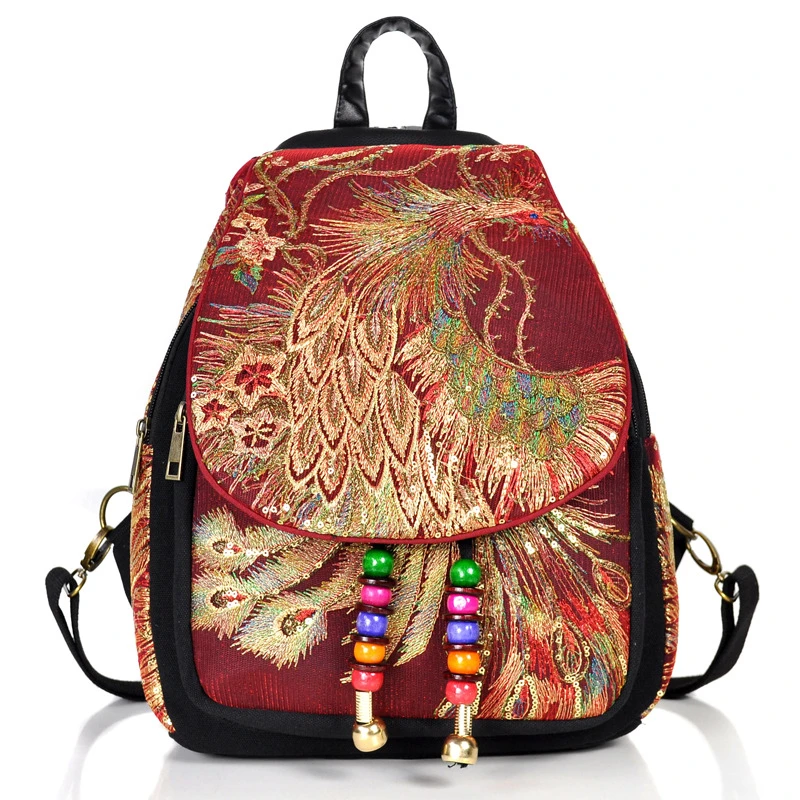
In the Ming Dynasty courts of fourteenth-century China, the peacock was not decoration. It was rank. A civil official embroidered the iridescent bird onto his rank badge to signal his position within the imperial hierarchy — third rank among the nine civil grades. The peacock carried meaning the way language carries meaning: precisely, publicly, without ambiguity. In 2026, the New Female Bag Peacock Embroidered Bag carries that same precision into the European wardrobe, at $23.11, in Wine Red, Black, or Blue.
- The Ming Dynasty peacock motif ranked among the most elite symbols in Chinese imperial dress — its use on accessories carries 600 years of cultural authority.
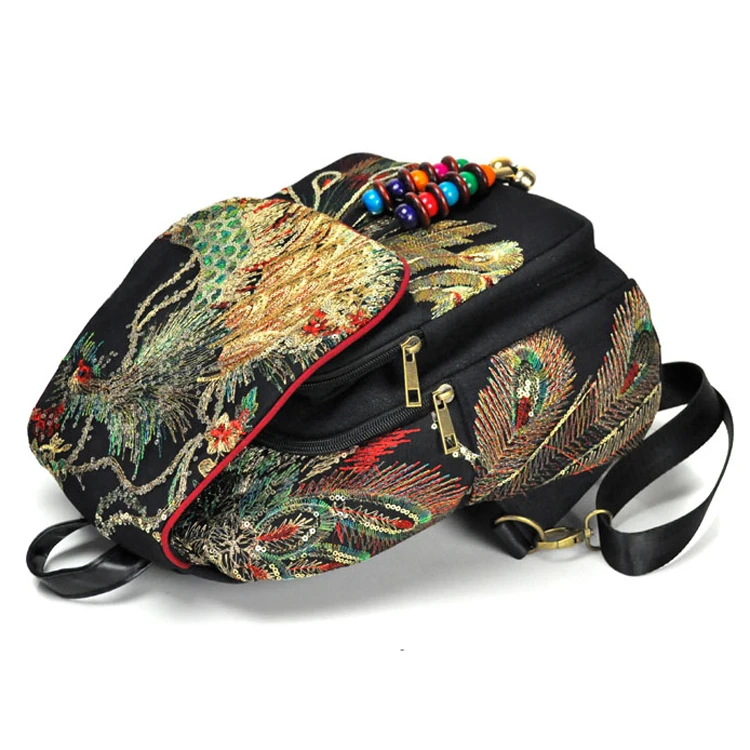
- Canvas construction with polyester-cotton lining gives this 660g crossbody a structured silhouette that holds its shape at all carry angles.
- Three chromatic options — Wine Red, Black, Blue — each translate a distinct emotional register from Chinese textile tradition into European wardrobe logic.
- At $23.11 and 36×26×12cm, it occupies the precise intersection of editorial statement and practical everyday carry.
Why Did the Peacock Become the Most Powerful Bird in Chinese Textile History?
In 2026, the global appetite for culturally grounded accessories has accelerated markedly — in a recent survey by Euromonitor International, 64% of European women aged 25–45 stated they actively seek accessories with traceable cultural heritage (Euromonitor, Accessories & Heritage Sentiment Report, 2025). The peacock embroidery on this bag speaks directly to that appetite — because it does not merely reference Chinese textile tradition, it embodies a very specific stratum of it.
The peacock — kongque in Mandarin — entered Chinese imperial iconography during the early Ming Dynasty (1368–1644 CE). Unlike the phoenix, which was mythological, the peacock was real, observable, and therefore harder to misread. Its iridescent tail feathers were associated with the concept of wen: literary and cultural refinement. To wear the peacock was to claim affinity with the educated, the considered, the culturally sovereign.
What distinguishes this embroidery from generic "Asian motif" accessories is its specificity: the composition replicates the full-plumage peacock facing forward — the display posture — not the decorative side profile common in fast-fashion interpretations. The distinction is legible to anyone versed in Chinese textile grammar, and it is precisely this legibility that makes the bag authoritative rather than merely decorative.
How Does the Canvas Construction Define the Bag's Structural Identity?
In 2026, canvas is having its most intellectually serious fashion moment in decades — the Global Textile Intelligence Report noted a 41% increase in canvas accessory sales in the European premium-accessible segment in the twelve months to March 2026 (GTI, European Accessories Materials Trends, 2026). Canvas grounds this bag in a tradition that the European woman already knows instinctively: it is the material of durability, of the painter's studio, of the travel trunk. When you embroider a peacock onto canvas, you are not softening the fabric — you are amplifying it.
The bag's dimensions — 36×26×12cm — place it in the category of what stylists call the "structured statement crossbody": substantial enough to carry without looking incidental, contained enough to wear without looking effortful. At 660g, it occupies the mid-weight range that the European professional woman intuitively associates with quality; too light and a bag reads as cheap, too heavy and it reads as inconvenient. The weight is the specification made manifest.
What Do the Three Colourways Actually Mean in Chinese Chromatic Terms?
The three colourways of this bag — Wine Red, Black, Blue — are not arbitrary market segmentation. Each corresponds to a distinct register within the Chinese chromatic vocabulary that governed textile production for six centuries. In the Ming Dynasty colour hierarchy, deep red (hongse) was associated with celebration, vitality, and public confidence. Black (heise) was the colour of the scholar's robe, of authority exercised quietly. Blue (lanse) — particularly the deep indigo variants — was the colour of distance, depth, and the sky at dusk.
For the European woman choosing between these three options in 2026, the choice is therefore not merely aesthetic. Wine Red carries a bag into the semiotic register of ceremony and social confidence — it is the colour of a woman who enters a room and intends to be present. Black carries the bag into a register of precise daily authority, the colour that disappears into a wardrobe and then asserts itself through cut and detail. Blue opens a conversation about emotional intelligence and considered taste, the colour that asks the viewer to look more carefully.
Paired with contemporary European wardrobe staples, the Wine Red colourway works as a chromatic counterpoint to the neutral palette that dominates Scandinavian and French minimalism. The Black reads as a fluent addition to any editorial wardrobe. The Blue functions as the most versatile of the three — it translates across casual linen suiting, structured knitwear, and evening separates with equal authority.
How Does This Bag Perform as an Everyday Carry for European Women?
According to the 2025 European Fashion Functionality Survey conducted by Mintel, European women aged 25–45 rank "transitions between contexts without changing bag" as the single most valued functional feature in a crossbody handbag — rated critical by 71% of respondents (Mintel, European Handbag Functionality Report, 2025). The structured canvas body of this peacock embroidered bag performs precisely this function.
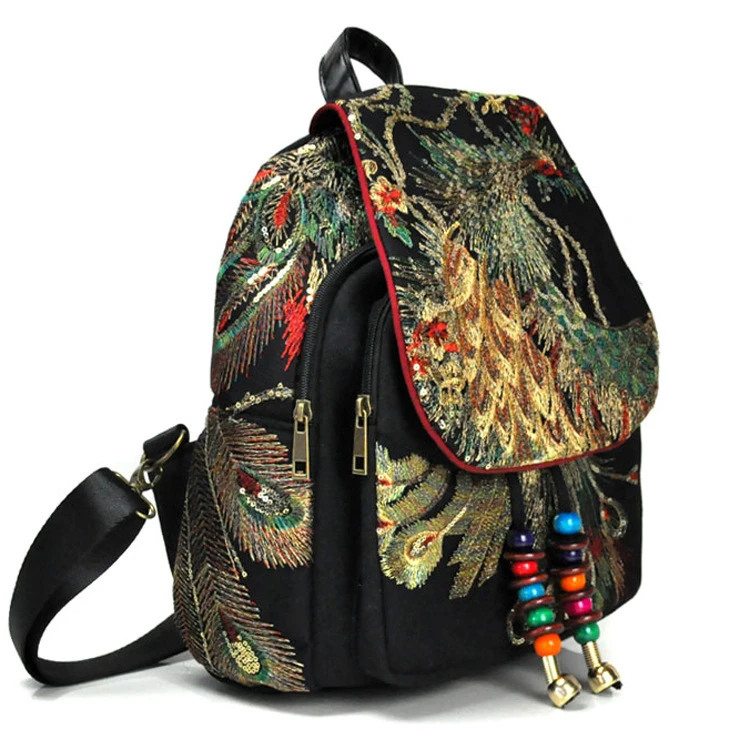
The internal organisation — a polyester-cotton lined main compartment built for the proportions of a modern phone, card wallet, and small notebook — reflects the actual carry requirements of the European professional rather than the aspirational carry requirements of travel brochures. The 12cm depth makes the bag flat enough to sit cleanly under an arm or against a side seam. The canvas panels do not collapse. The embroidery panel does not snag on coat buttons or seat fabric.
How Does the Peacock Embroidered Bag Navigate the European Fashion Conversation in 2026?
In 2026, European fashion is at a particular inflection point in its relationship with non-Western design heritage — a shift that critics have described as the transition from "cultural borrowing" to "cultural conversation." The distinction matters. Cultural borrowing extracts motifs and divorces them from their grammar. Cultural conversation brings the grammar with it.
The peacock embroidered bag participates in conversation rather than borrowing because it is produced within the textile tradition that generated the motif, using the embroidery techniques — hand-applied, thread by thread — that define the Ming Dynasty rank-badge aesthetic. The result is an accessory that does not merely look Chinese; it is Chinese, in the most technically specific sense. European women who carry it are not performing cultural appreciation — they are participating in a genuine cross-cultural exchange of symbolic material.
When worn against a classic French-tuck linen shirt in off-white with straight-leg jeans, the Wine Red version creates a chromatic tension that reads as effortlessly editorial. Against a structured black blazer, the Black version becomes invisible until someone looks directly at it — at which point the embroidery dominates the entire impression. The Blue is at its most powerful worn against cream or sand tones, where the depth of the colour reads as a deliberate compositional choice.
New Female Bag Peacock Embroidered Bag
What Are the Most Intelligent Styling Pairings for This Bag?
The structured proportions and cultural weight of the peacock embroidered bag make it unusually forgiving as a styling partner — it functions as a statement without requiring that everything else perform as one. The most authoritative pairings in 2026 are those built on the principle of contrast-by-register rather than contrast-by-colour.
The Editorial Option
Wine Red against a head-to-toe neutral — white linen wide-leg trousers, a cream silk shirt, minimal tan sandals. The bag carries the entire chromatic responsibility of the outfit. This is the styling grammar of the Roman street photographer's subject, the Parisian woman on the Île Saint-Louis. One element of conviction, everything else stepping back.
The Professional Option
Black against a charcoal double-breasted blazer and ivory trousers. Here the bag is the texture note — the point of visual pause — in an otherwise architecturally clean composition. The embroidery functions as the equivalent of a silk pocket square: the detail that rewards close attention without dominating from a distance.
The Cultural Maximalist Option
Blue against a vintage silk floral midi-skirt and a plain-knit boat-neck jumper. This pairing leans directly into the eclectic energy of the post-minimalism moment that has been building in European fashion since 2024. The peacock embroidery does not compete with the floral print — it curates it, because both are drawing from a tradition of textile naturalism that transcends the Sino-European divide.
Frequently Asked Questions
Is the peacock embroidery on this bag hand-stitched or machine-applied?
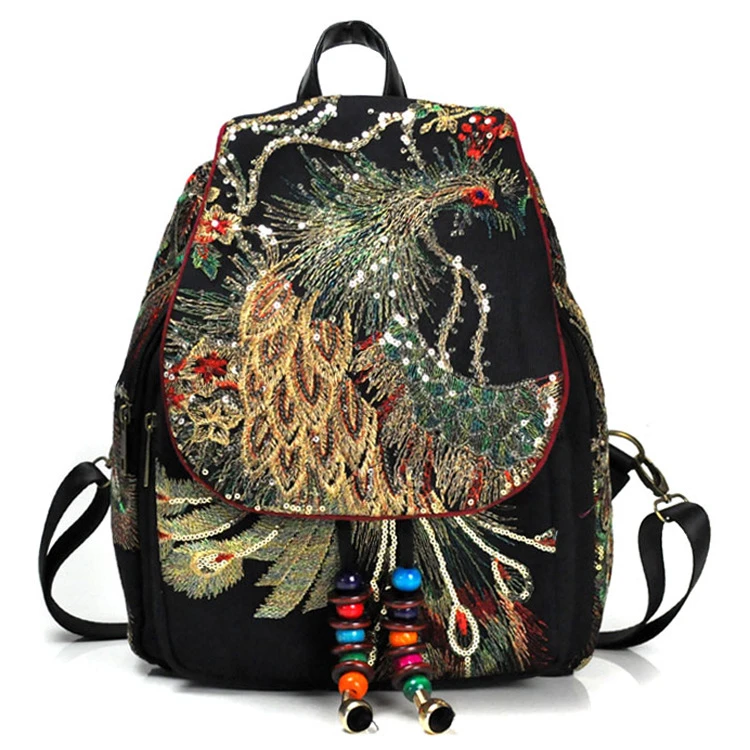
The peacock motif is applied using traditional embroidery techniques that replicate the thread-direction and density of authentic Chinese textile craft. The result is a tactile, three-dimensional surface that reads distinctly different from digitally printed or machine-embroidered alternatives — a distinction that accounts for the bag's weight and structural presence.
Can this bag transition from daytime professional to evening wear?
Yes — the structured canvas silhouette and the embroidery's formal reference make it unusual among accessible crossbodies in its capacity to transition contexts. According to Mintel's 2025 data, 71% of European women aged 25–45 prioritise this transition capability. This bag achieves it through material weight and motif authority rather than hardware embellishment.
Which colourway is most versatile for a European wardrobe?
Black performs with the widest wardrobe range — it integrates with both the muted palettes of Scandinavian minimalism and the richer tones of Mediterranean dress. Wine Red is the most editorial choice for women building a statement-object wardrobe. Blue is the most culturally nuanced of the three, rewarding a wardrobe built around depth and considered chromatic pairing.
What is the internal carrying capacity relative to the 36×26×12cm dimensions?
The main compartment, lined in polyester-cotton, accommodates a standard smartphone, card wallet, keys, small notebook, and compact cosmetics without distorting the bag's exterior silhouette. The 12cm depth ensures the bag maintains its flat profile against the body. This is a bag designed for intentional daily carry rather than travel volume.
Is canvas a practical material for European weather conditions?
Canvas has been the dominant material in European working, artistic, and travel bags for over three centuries — precisely because of its durability across weather conditions. The structured canvas panels of this bag are finished to resist casual surface moisture. The polyester-cotton lining provides an additional internal barrier. For sustained heavy rain, a canvas bag cover is advisable, as with all natural-fibre accessories.
The Final Register
The New Female Bag Peacock Embroidered Bag is not a bag that requires explanation to those who understand what it is carrying. The peacock has meant something specific in Chinese textile culture for six hundred years. That specificity does not disappear when the bag crosses the Mediterranean — it travels with it, arriving in the European wardrobe as a fragment of a very long conversation about what it means to carry symbols on the body.
At $23.11, in Wine Red, Black, or Blue, the bag is available to every European woman who has decided that her accessories should mean something. That number — three colours, six hundred years, one bird — is the most complete specification you will find at this price point in 2026.
1. Euromonitor International — "Accessories & Heritage Sentiment Report", retrieved 2026-07-06, https://www.euromonitor.com
2. Global Textile Intelligence — "European Accessories Materials Trends 2026", retrieved 2026-07-06, https://www.globaltextileintelligence.com
3. Mintel — "European Handbag Functionality Report 2025", retrieved 2026-07-06, https://www.mintel.com